
Question 1965 marksMedium
(a) Show diagrammatically the different types of adsorption isotherms obtained for adsorption of gases on solids.
(b) Discuss the behaviour of Langmuir adsorption isotherm at very low and very high pressure.
Confirming your payment
Sign up now and get 250 free tokens.
Surface Chemistry · Question 196 of 225
(a) Show diagrammatically the different types of adsorption isotherms obtained for adsorption of gases on solids.
(b) Discuss the behaviour of Langmuir adsorption isotherm at very low and very high pressure.
Solution:
Key idea: An adsorption isotherm plots the mass of gas adsorbed per gram of adsorbent, , against the pressure at constant temperature. Langmuir's isotherm is , where and are constants for a given gas, adsorbent and temperature.
Step 1 — Draw the five types of isotherm (part a).
Five types of isotherm are observed for gases on solids. They are sketched below, with the saturation vapour pressure of the gas.
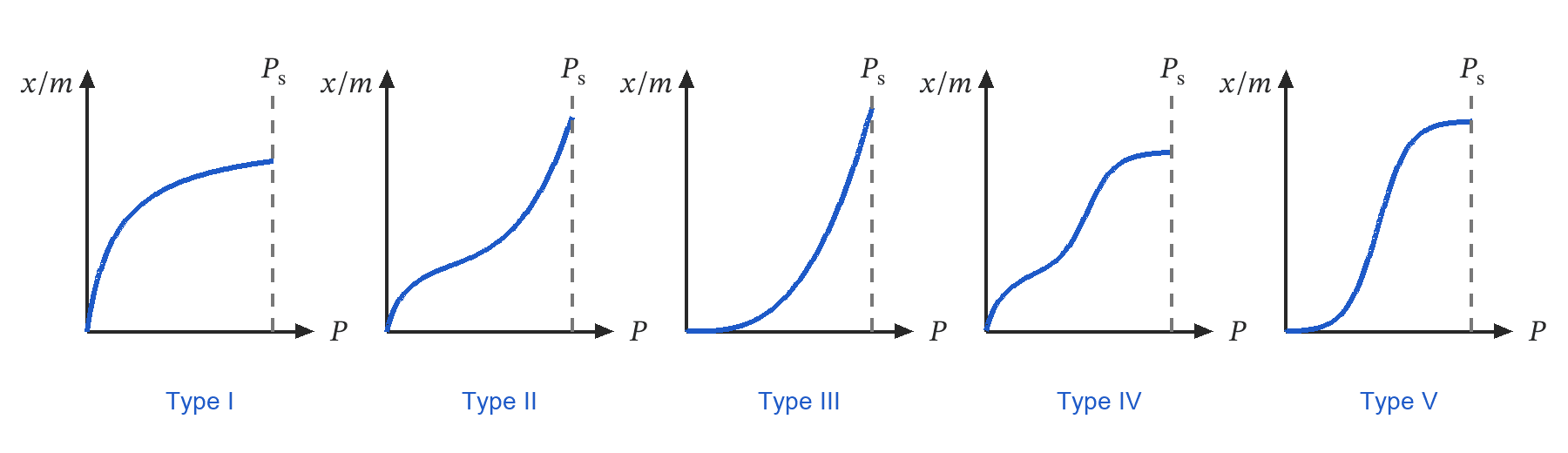
Step 2 — Describe Types I, II and III (part a).
Each shape tells us how the adsorbed layer builds up.
Step 3 — Describe Types IV and V (part a).
Types IV and V are like Types II and III, but they level off near because the gas condenses in the fine pores of the adsorbent (capillary condensation).
Step 4 — Find the behaviour at very low pressure (part b).
At very low pressure , so the denominator is close to 1.
The amount adsorbed is directly proportional to the pressure.
Step 5 — Find the behaviour at very high pressure (part b).
At very high pressure , so the 1 in the denominator can be neglected.
The amount adsorbed becomes constant, independent of pressure, because the surface is fully covered by a monolayer.
Step 6 — Show both limits on a graph (part b).
The graph (a) below shows the straight start and the limiting value ; graph (b) shows the straight-line form .

Therefore, (a) the five isotherm types are I (monolayer, levelling off), II and III (multilayer) and IV and V (multilayer with capillary condensation), and (b) Langmuir's isotherm gives x/m ≈ aP (proportional to pressure) at very low pressure and x/m ≈ a/b (independent of pressure) at very high pressure.