
Opening your dashboard
Class 12 Chemistry Chapter 16: Chemistry in Everyday Life Solutions
88 textbook questions with step-by-step answers, free to read, for ISC 2026-27.
Get talked through Ch 16, not just shown the answer
Reading a finished solution is not the same as being able to do it. The AI tutor takes one question at a time and works it with you, in your own words, until you can.
- Ask it out loud, in your own words
- It gives you the next step, not the answer
- Stuck on part (ii)? Start there
88 questions with solutions
1–5 marks · Mixed difficulty
- 11 mark
Question 1
The correct structure of the drug paracetamol is:
Solve with AIAnswer
(A)
- Correct
(B)
(C)
(D)
Answer: (B)
Key idea: Paracetamol (acetaminophen) is a non-narcotic analgesic and antipyretic. Its chemical name is N-(4-hydroxyphenyl)ethanamide: a benzene ring carrying an –OH group and, at the opposite (para) position, an acetylamino group –NH–CO–CH₃.
Step 1 — Read the name. "4-hydroxyphenyl" tells us the ring has an –OH group. "N-…ethanamide" tells us the ring is joined to the nitrogen of an ethanamide (acetamide) group, so the group is –NH–CO–CH₃ (written –NHCOCH₃).
Step 2 — Put the two groups para to each other. The two groups sit at positions 1 and 4 of the ring, which gives , molecular formula (molar mass 151 g mol⁻¹).
Step 3 — Match with the options. Only option (B) has both the –OH group and the –NHCOCH₃ group.
Why the other options are wrong:
- (A) This is 4-hydroxybenzamide. Here the ring is joined to the carbon of the amide group (–CO–NH₂), not to the nitrogen, and there is no CH₃ group.
- (C) This is 4-chlorobenzamide. It has Cl in place of the –OH group, and the amide is joined through carbon.
- (D) This is 4-chloro-N-methylbenzamide. It has Cl instead of –OH, and the amide is again joined through carbon (–CO–NH–CH₃).
Watch out: In paracetamol the nitrogen is attached to the ring (an anilide, –NH–CO–CH₃). Do not confuse it with a benzamide (–CO–NH₂), where the carbonyl carbon is attached to the ring.
Therefore, the answer is (B).
- 21 mark
Question 2
Which is not true for a detergent molecule?
Solve with AIAnswer
(A) It has a non-polar organic part and a polar group
(B) It is not easily biodegraded
- Correct
(C) It is a sodium salt of fatty acid
(D) It is a surface active agent.
Answer: (C) It is a sodium salt of fatty acid
Key idea: A soap is a sodium (or potassium) salt of a long-chain fatty acid, such as sodium stearate . A synthetic detergent is a different kind of cleansing agent: usually a sodium salt of a long-chain alkyl sulphate or alkylbenzene sulphonate (or a cationic or non-ionic compound). Both kinds clean in the same way.
Step 1 — Check each statement against the structure of a detergent. A detergent such as sodium dodecylbenzene sulphonate has a long hydrocarbon tail (non-polar, oil-loving) and an ionic head (polar, water-loving).
Step 2 — Find the false statement. "Sodium salt of a fatty acid" describes a soap, not a detergent. Detergents are salts of sulphonic acids or alkyl hydrogen sulphates (or ammonium salts, or neutral polyethers). So statement (C) is not true for a detergent.
Why the other options are wrong (they are true statements):
- (A) True. A detergent molecule has a long non-polar hydrocarbon chain and a polar (ionic or hydrogen-bonding) head, which is what lets it hold oil and water together.
- (B) True in the sense the book uses: detergents with a branched hydrocarbon chain are not easily broken down by bacteria, so they stay in rivers and cause foaming. (Detergents with straight, unbranched chains are biodegradable, which is why they are preferred today.)
- (D) True. Detergents lower the surface tension of water, so they are surface-active agents (surfactants).
Therefore, the statement that is not true is (C).
- 31 mark
Question 3
Aspirin is:
Solve with AIAnswer
- Correct
(A) Acetyl salicylic acid
(B) 2-Methoxybenzoic acid
(C) Acetyl oxalic acid
(D) Methylbenzoic acid
Answer: (A) Acetyl salicylic acid
Key idea: Aspirin is made by acetylating salicylic acid (2-hydroxybenzoic acid) with acetic anhydride: the –OH group of salicylic acid becomes an acetoxy group –O–CO–CH₃.
Step 1 — Start from salicylic acid. Salicylic acid is ().
Step 2 — Acetylate the –OH group.
Step 3 — Name the product. The product, , is acetylsalicylic acid (2-acetoxybenzoic acid). This is aspirin.
Why the other options are wrong:
- (B) 2-Methoxybenzoic acid has a methoxy group –OCH₃ (formula ), not an acetoxy group –OCOCH₃, so it is not aspirin.
- (C) Aspirin contains no oxalic acid unit; it is built on a benzene ring (salicylic acid).
- (D) Methylbenzoic acid (toluic acid, ) has only a –CH₃ group on the ring and no acetoxy group.
Therefore, the answer is (A) Acetyl salicylic acid.
- 41 mark
Question 4
2-Acetoxybenzoic acid is used as:
Solve with AIAnswer
(A) antimalarial
(B) antidepressant
(C) antiseptic
- Correct
(D) antipyretic
Answer: (D) antipyretic
Key idea: 2-Acetoxybenzoic acid is the chemical name of aspirin (acetylsalicylic acid). Aspirin is a non-narcotic analgesic that also lowers fever, so it is an antipyretic.
Step 1 — Identify the compound. 2-Acetoxybenzoic acid is with the two groups next to each other (ortho). This is aspirin.
Step 2 — Recall its uses. Aspirin relieves pain (analgesic), reduces fever (antipyretic), and reduces inflammation. It works by stopping the body from making prostaglandins, which cause inflammation, pain and fever. Because it also stops platelets from clumping, it is used in small doses to help prevent heart attacks.
Step 3 — Match with the options. Of the uses listed, only antipyretic applies.
Why the other options are wrong:
- (A) Antimalarials (such as chloroquine or quinine) kill the malaria parasite; aspirin does not.
- (B) Antidepressants (such as phenelzine) are tranquillizers that lift the mood; aspirin has no such action.
- (C) Antiseptics (such as dettol or iodoform) are applied to living tissue to kill microbes; aspirin is not an antimicrobial.
Therefore, the answer is (D) antipyretic.
- 51 mark
Question 5
Which of the following types of drugs reduces fever?
Solve with AIAnswer
(A) analgesic
- Correct
(B) antipyretic
(C) antibiotic
(D) tranquillizer.
Answer: (B) antipyretic
Key idea: Drugs are named by what they do. Pyr means fire or heat, so an anti-pyretic is a drug that lowers body temperature in fever. Paracetamol and aspirin are examples.
Step 1 — Match the action to the name. The question asks for a drug that reduces fever. By definition this is an antipyretic.
Step 2 — Confirm with an example. Paracetamol lowers a high body temperature back towards 37 °C, so it is an antipyretic.
Why the other options are wrong:
- (A) An analgesic relieves pain. Some analgesics (aspirin, paracetamol) also lower fever, but the name "analgesic" means pain-reliever, and narcotic analgesics such as morphine are not used to lower fever.
- (C) An antibiotic kills or stops the growth of bacteria. It may cure the infection that causes a fever, but it does not itself lower body temperature.
- (D) A tranquillizer reduces anxiety, stress or mental tension; it does not lower fever.
Therefore, the answer is (B) antipyretic.
- 61 mark
Question 6
A broad spectrum antibiotic is
Solve with AIAnswer
(A) Paracetamol
(B) Penicillin
(C) Aspirin
- Correct
(D) Chloramphenicol
Answer: (D) Chloramphenicol
Key idea: A broad-spectrum antibiotic kills or stops the growth of a wide range of bacteria, both Gram-positive and Gram-negative. A narrow-spectrum antibiotic works against only one group.
Step 1 — Recall chloramphenicol. Chloramphenicol, first isolated in 1947, acts against a wide range of Gram-positive and Gram-negative bacteria. It is absorbed quickly from the gut, and it is used for typhoid, dysentery, acute fevers and some urinary infections. So it is a broad-spectrum antibiotic.
Step 2 — Check the other options. Paracetamol and aspirin are not antibiotics at all, and penicillin G is narrow-spectrum.
Why the other options are wrong:
- (A) Paracetamol is an analgesic and antipyretic (it relieves pain and lowers fever); it does not kill bacteria.
- (B) Penicillin G acts mainly on Gram-positive bacteria, so it is a narrow-spectrum antibiotic.
- (C) Aspirin is an analgesic and antipyretic; it is not an antibiotic.
Therefore, the answer is (D) Chloramphenicol.
- 71 mark
Question 7
Which one of the following is employed as a tranquillizer?
Solve with AIAnswer
(A) Naproxen
(B) Tetracycline
(C) Chlorpheniramine
- Correct
(D) Equanil
Answer: (D) Equanil
Key idea: Tranquillizers are drugs that act on the central nervous system to reduce anxiety, stress and mental tension. Examples are equanil (meprobamate), barbiturates such as veronal and luminal, chlordiazepoxide, and antidepressants such as iproniazid and phenelzine.
Step 1 — Identify equanil. Equanil is the trade name of meprobamate, a mild tranquillizer used to relieve anxiety and tension.
Step 2 — Check the other drugs. None of the other three acts on the mind in this way.
Why the other options are wrong:
- (A) Naproxen is a non-narcotic analgesic (an anti-inflammatory pain-reliever), not a tranquillizer.
- (B) Tetracycline is a broad-spectrum antibiotic, used against bacterial infections.
- (C) Chlorpheniramine is an antihistamine, used for allergies such as hay fever and itching. It can cause drowsiness as a side effect, but it is not used as a tranquillizer.
Therefore, the answer is (D) Equanil.
- 81 mark
Question 8
The artificial sweetener containing chlorine that has the appearance and taste as that of sugar and is stable at cooking temperature is
Solve with AIAnswer
(A) Aspartame
(B) Saccharin
- Correct
(C) Sucralose
(D) Alitame
Answer: (C) Sucralose
Key idea: Sucralose is made from sucrose by replacing three –OH groups with three chlorine atoms. It is a trichloro derivative of sucrose, looks and tastes like sugar, is about 600 times sweeter, and is stable at cooking temperature.
Step 1 — Find the sweetener with chlorine. Replacing three –OH groups of sucrose () by Cl gives sucralose:
Of the four sweeteners, only sucralose contains chlorine.
Step 2 — Check the other two conditions. Because sucralose is made from sugar itself, it looks and tastes like sugar. It does not break down on heating, so it can be used in baking and cooking. All three conditions fit.
Why the other options are wrong:
- (A) Aspartame (, a methyl ester of a dipeptide) contains no chlorine, and it breaks down at cooking temperature, so it is used only in cold foods and soft drinks.
- (B) Saccharin () contains sulphur and nitrogen but no chlorine; it is stable to heat, but it can leave a bitter aftertaste.
- (D) Alitame contains no chlorine. It is a very high-potency sweetener, more stable than aspartame, but its sweetness in food is hard to control.
Therefore, the answer is (C) Sucralose.
- 91 mark
Question 9
Which of the following is employed as Antihistamine?
Solve with AIAnswer
(A) Chloramphenicol
- Correct
(B) Diphenhydramine
(C) Norethindrone
(D) Omeprazole
Answer: (B) Diphenhydramine
Key idea: Histamine is released in the body during an allergic reaction; it causes sneezing, itching, a runny nose and swelling. Antihistamines compete with histamine for its receptor sites and so block its effect. Examples are diphenhydramine (Benadryl), brompheniramine, chlorpheniramine and terfenadine (Seldane, withdrawn in 1997–98 because of heart-rhythm side effects).
Step 1 — Identify diphenhydramine. Diphenhydramine (sold as Benadryl) is a common antihistamine used for allergies, colds and itching.
Step 2 — Check the others. None of the other drugs blocks histamine at its receptors in this way.
Why the other options are wrong:
- (A) Chloramphenicol is a broad-spectrum antibiotic.
- (C) Norethindrone is a synthetic progesterone derivative used in birth-control pills (an antifertility drug).
- (D) Omeprazole is an antacid of the "proton-pump inhibitor" type: it stops the stomach lining from releasing acid.
Watch out: Cimetidine (and ranitidine, now withdrawn in many countries) also block a histamine receptor, but only the one in the stomach that controls acid release, so they are classed as antacids, not as anti-allergy antihistamines.
Therefore, the answer is (B) Diphenhydramine.
- 101 mark
Question 10
Chloramphenicol is an
Solve with AIAnswer
(A) antifertility drug
(B) antihistaminic
(C) antiseptic and disinfectant
- Correct
(D) antibiotic-broad spectrum
Answer: (D) antibiotic-broad spectrum
Key idea: An antibiotic is a chemical produced by a micro-organism (or made synthetically) that kills or stops the growth of other micro-organisms. A broad-spectrum antibiotic acts on many kinds of bacteria, both Gram-positive and Gram-negative.
Step 1 — Recall chloramphenicol. Chloramphenicol was first obtained from a soil bacterium of the genus Streptomyces. It is taken by mouth, absorbed quickly from the gut, and acts against a very wide range of bacteria, so it is a broad-spectrum antibiotic.
Step 2 — Recall its use. It is used for typhoid, dysentery, acute fevers, some urinary infections, meningitis and pneumonia.
Why the other options are wrong:
- (A) Antifertility drugs are synthetic hormones (such as norethindrone and ethynylestradiol) used for birth control.
- (B) Antihistamines (such as diphenhydramine) block histamine in allergies; chloramphenicol does not.
- (C) Antiseptics and disinfectants (such as dettol, iodine, phenol) are applied to skin or to non-living surfaces; chloramphenicol is taken into the body as a medicine.
Therefore, the answer is (D) antibiotic-broad spectrum.
- 111 mark
Question 11
Penicillin is widely used as
Solve with AIAnswer
(A) Anti hypersensitive
(B) Analgesic
- Correct
(C) Antibiotic
(D) Antiseptic
Answer: (C) Antibiotic
Key idea: Penicillin was the first antibiotic, discovered by Alexander Fleming (in 1928, reported in 1929) from the mould Penicillium notatum. It kills bacteria by stopping them from building their cell walls, so it is a bactericidal antibiotic.
Step 1 — Recall what penicillin does. Penicillin is given to treat bacterial infections such as pneumonia, sore throat, bronchitis and abscesses. That is the use of an antibiotic.
Step 2 — Match. The answer is antibiotic.
Why the other options are wrong:
- (A) Penicillin is not used against high blood pressure or allergic (hypersensitive) reactions; in fact, some people are allergic to penicillin, so a test dose is often given first.
- (B) Penicillin does not relieve pain; analgesics such as aspirin and paracetamol do.
- (D) Antiseptics are applied to the skin or wounds. Penicillin is given by mouth or by injection to act inside the body, so it is classed as an antibiotic.
Therefore, the answer is (C) Antibiotic.
- 121 mark
Question 12
Artificial sweetener which is not stable at cooking temperature is:
Solve with AIAnswer
- Correct
(A) Aspartame
(B) Alitame
(C) Saccharin
(D) Sucralose
Answer: (A) Aspartame
Key idea: Aspartame is the methyl ester of a dipeptide made from aspartic acid and phenylalanine. Heat breaks it down, so it is not stable at cooking temperature, and its use is limited to cold foods and soft drinks.
Step 1 — Recall the stability of aspartame. Aspartame is far sweeter than sugar, so very little is needed. On heating, its ester and peptide bonds break and it loses its sweetness, so it cannot be used in baking or cooking.
Step 2 — Compare with the others. The other three sweeteners keep their sweetness on heating.
Why the other options are wrong:
- (B) Alitame is more stable than aspartame; its drawback is that its very high sweetness is difficult to control in food.
- (C) Saccharin is stable to heat; it passes out of the body unchanged in urine and is safe for diabetic patients.
- (D) Sucralose is stable at cooking temperature, which is one of its main advantages.
Therefore, the answer is (A) Aspartame.
- 131 mark
Question 13
Food preservatives prevent spoilage of food due to microbial growth. The most commonly used preservatives are
Solve with AIAnswer
(A) table salt, sugar
(B) vegetable oils and sodium benzoate
(C)
- Correct
(D) all of the above
Answer: (D) all of the above
Key idea: Food preservatives are chemicals that stop the growth of micro-organisms (bacteria, yeasts, moulds) and so prevent food from spoiling. The most commonly used ones are table salt, sugar, vegetable oils and sodium benzoate ().
Step 1 — Check option (A). Salt and sugar draw water out of microbial cells by osmosis, so microbes cannot grow. This is why pickles and jams keep for a long time. So (A) lists true preservatives.
Step 2 — Check option (B). A layer of vegetable oil keeps air away from food (as in pickles), and sodium benzoate is a chemical preservative used in small amounts in sauces, squashes and jams. So (B) also lists true preservatives.
Step 3 — Check option (C). is the formula of sodium benzoate, so (C) is also a preservative.
Step 4 — Combine. Options (A), (B) and (C) all name common preservatives, so the correct choice is (D) all of the above.
Why the other options are wrong:
- (A) Salt and sugar are preservatives, but this option leaves out vegetable oils and sodium benzoate, so it is not the complete answer.
- (B) Vegetable oils and sodium benzoate are preservatives, but this option leaves out salt and sugar.
- (C) Sodium benzoate is a preservative, but it is only one of the commonly used ones.
Therefore, the answer is (D) all of the above.
- 141 mark
Question 14
Dettol is a mixture of
Solve with AIAnswer
(A) terpineol and bithionol
(B) chloroxylenol and bithionol
- Correct
(C) chloroxylenol and terpineol
(D) phenol and iodine
Answer: (C) chloroxylenol and terpineol
Key idea: Dettol is a common antiseptic. It is a mixture of chloroxylenol (4-chloro-3,5-dimethylphenol, ) and α-terpineol () in a suitable solvent.
Step 1 — Recall the two parts. Chloroxylenol is a chlorinated phenol that kills microbes on the skin; α-terpineol is an alcohol from pine oil that also has antiseptic action and gives dettol its smell.
Step 2 — Match. Option (C) names exactly these two.
Why the other options are wrong:
- (A) Terpineol is present in dettol, but bithionol is not; bithionol is the antiseptic added to medicated soaps.
- (B) Chloroxylenol is present, but again bithionol is not part of dettol.
- (D) Phenol and iodine are separate antiseptics/disinfectants. Iodine is used as tincture of iodine (2–3 % iodine in alcohol–water); phenol is used as a 0.2 % antiseptic or a 1 % disinfectant. Neither is in dettol.
Therefore, the answer is (C) chloroxylenol and terpineol.
- 151 mark
Question 15
Which of the following is not an antacid?
Solve with AIAnswer
- Correct
(A) Phenelzine
(B) Ranitidine
(C) Aluminium hydroxide
(D) Cimetidine
Answer: (A) Phenelzine
Key idea: Antacids reduce the excess acid in the stomach. Some are weak bases that neutralise the acid (magnesium hydroxide, aluminium hydroxide, sodium hydrogencarbonate). Others, such as cimetidine (Tagamet) and ranitidine (Zantac, now withdrawn in many countries), stop the stomach from releasing acid by blocking histamine at its receptors in the stomach wall.
Step 1 — Identify phenelzine. Phenelzine (Nardil) is an antidepressant. It belongs to the tranquillizers: it blocks the enzyme that breaks down noradrenaline, so the level of noradrenaline stays up and the mood lifts.
Step 2 — Conclude. Phenelzine has nothing to do with stomach acid, so it is not an antacid.
Why the other options are wrong (they are antacids):
- (B) Ranitidine (Zantac) is an antacid: it blocks the histamine receptors in the stomach wall, so less acid is released. It was withdrawn in many countries in 2019–20 because some batches contained an impurity (NDMA).
- (C) Aluminium hydroxide is an insoluble weak base that neutralises excess HCl in the stomach:
- (D) Cimetidine (Tagamet) works in the same way as ranitidine and was one of the first drugs of this kind.
Therefore, the drug that is not an antacid is (A) Phenelzine.
- 161 mark
Question 16
Which of the following is not true?
Solve with AIAnswer
(A) Ampicillin is not a natural antibiotic
(B) Vancomycin is a broad spectrum antibiotic
(C) Erythromycin is a bacteriostatic antibiotic
- Correct
(D) Prontosil is not converted into sulphanilamide in the body.
Answer: (D) Prontosil is not converted into sulphanilamide in the body.
Key idea: Prontosil was the first sulpha drug. On its own it does not kill bacteria. In the body it is broken down (reduced) to sulphanilamide, and it is the sulphanilamide that acts against bacteria.
Step 1 — Recall how prontosil works. In 1932 Gerhard Domagk found that the red dye prontosil cures bacterial infections in mice. Later it was found that prontosil is converted in the body into sulphanilamide, the real active compound. This discovery led to the whole family of sulpha drugs.
Step 2 — Judge statement (D). Statement (D) says prontosil is not converted into sulphanilamide. This is the opposite of the truth, so (D) is not true.
Why the other options are wrong:
- (A) True. Ampicillin (like amoxicillin) is made in the laboratory by chemically modifying penicillin, so it is a semi-synthetic, not a natural, antibiotic.
- (B) The book (like NCERT) lists vancomycin as broad-spectrum, but it acts mainly on Gram-positive bacteria, so today it is called narrow-spectrum, and (B) is also untrue by current classification (see the note).
- (C) True. Erythromycin stops bacteria from growing and multiplying (it blocks their protein synthesis) without killing them directly, so it is bacteriostatic; tetracycline and chloramphenicol are other examples.
Note: by current medical classification vancomycin acts mainly on Gram-positive bacteria, so it is better called a narrow-spectrum antibiotic, which would make statement (B) false as well. The printed key (D) is kept because statement (D) is false by any reading, while (B) follows the book's own list.
Therefore, the statement that is not true is (D).
- 171 mark
Question 17
Bithionol is generally added to soaps as an additive to function as an/a
Solve with AIAnswer
(A) buffering agent
- Correct
(B) antiseptic
(C) softener
(D) dryer
Answer: (B) antiseptic
Key idea: Bithionol is an antiseptic. It is added to medicated (toilet) soaps to kill bacteria on the skin.
Step 1 — Recall why skin smells. Bacteria on the skin break down organic matter in sweat, and this produces bad odours.
Step 2 — Recall what bithionol does. Bithionol kills these bacteria, so a soap containing it reduces body odour and helps prevent skin infections. This is the action of an antiseptic.
Why the other options are wrong:
- (A) A buffering agent keeps the pH of a solution steady; bithionol is not added for this.
- (C) Water softeners (such as sodium tripolyphosphate in detergents) remove the hardness of water; bithionol does not.
- (D) Soaps are not given a "drying" additive; bithionol's job is to kill germs.
Therefore, the answer is (B) antiseptic.
- 181 mark
Question 18
The drug Tagamet is
Solve with AIAnswer
(A) analgesic
(B) antidepressant
(C) anesthetic
- Correct
(D) antacid
Answer: (D) antacid
Key idea: Tagamet is the trade name of cimetidine. Cimetidine blocks histamine at its receptors in the stomach wall; histamine there makes the stomach release acid and pepsin, so blocking it means less acid is produced. This makes cimetidine an antacid.
Step 1 — Recall the problem it solves. Too much acid in the stomach causes acidity, irritation and, in severe cases, ulcers.
Step 2 — Recall how Tagamet helps. Earlier antacids such as sodium hydrogencarbonate or magnesium hydroxide only neutralised the acid already present. Cimetidine was a big step forward because it stops the extra acid from being released in the first place.
Why the other options are wrong:
- (A) Analgesics relieve pain (for example aspirin, morphine); Tagamet is not a pain-reliever.
- (B) Antidepressants (for example phenelzine, iproniazid) lift the mood; Tagamet does not act on the mind.
- (C) Anaesthetics cause loss of sensation during surgery; Tagamet is not used for that.
Therefore, the answer is (D) antacid.
- 191 mark
Question 19
Which one of the following is a cationic detergent?
Solve with AIAnswer
(A) Sodium laurylsulphate
- Correct
(B) Cetyltrimethyl ammonium bromide
(C) Sodium dodecylbenzene sulphonate
(D) Glyceryl palmitate
Answer: (B) Cetyltrimethyl ammonium bromide
Key idea: In a cationic detergent the large, surface-active part of the molecule is a positive ion. Such detergents are usually quaternary ammonium salts (acetates, chlorides or bromides) with one long alkyl chain.
Step 1 — Write the formula of cetyltrimethylammonium bromide.
The cetyl group (, from hexadecane) is the long non-polar tail, and the positively charged group is the polar head.
Step 2 — Decide its type. Because the part that does the cleaning is the cation, this is a cationic detergent. It also kills germs and is used in hair conditioners.
Why the other options are wrong:
- (A) Sodium lauryl sulphate, , has a negative surface-active ion, so it is an anionic detergent.
- (C) Sodium dodecylbenzene sulphonate, , is also anionic; it is the common household detergent.
- (D) Glyceryl palmitate is an ester of glycerol and palmitic acid (a fat-like compound). It has no ionic group at all, so it cannot be a cationic detergent.
Therefore, the answer is (B) Cetyltrimethyl ammonium bromide.
- 201 mark
Question 20
A chemical substance which cures the disease, is safe to use, has negligible toxicity and does not cause addiction is called a …… while a chemical substance which cures the disease but is habit forming, causes addiction and has serious side effects is called a …… .
Solve with AIWritten solution
Solution:
Key idea: The words "medicine" and "drug" are often used for the same thing, but the book separates them by safety: a medicine is safe and non-addictive, while a drug (in this narrower sense) may be habit-forming and harmful.
Step 1 — Fill the first blank. A substance that cures disease, is safe, has very low toxicity and does not cause addiction is called a medicine.
Step 2 — Fill the second blank. A substance that also cures disease but is habit-forming, causes addiction and has serious side effects (for example narcotic analgesics such as morphine when misused) is called a drug.
Therefore, the blanks are: medicine; drug.
- 211 mark
Question 21
…… are produced when a drug binds to more than one type of receptor.
Solve with AIWritten solution
Solution:
Key idea: A drug works by binding to a target in the body, such as an enzyme or a receptor. Ideally it binds only to the receptor for which it was designed.
Step 1 — Think about what happens if the drug is not selective. If a drug can also bind to other kinds of receptors, it starts other responses in the body that were not wanted.
Step 2 — Name these unwanted responses. These unwanted effects are called side effects. This is why drug designers try to make a drug that fits one receptor only.
Therefore, the blank is: Side effects.
- 221 mark
Question 22
Omeprazole and lansoprazole are …… .
Solve with AIWritten solution
Solution:
Key idea: Antacids reduce excess acid in the stomach, either by neutralising it or by stopping its release.
Step 1 — Recall how omeprazole works. Omeprazole and lansoprazole block the "proton pump" in the cells of the stomach lining, which is what pumps ions (acid) into the stomach. So they stop acid from being released.
Step 2 — Name the class. Because they lower stomach acid, they are classed as antacids.
Therefore, the blank is: antacids.
- 231 mark
Question 23
Diphenhydramine and terfenadine are …… drugs.
Solve with AIWritten solution
Solution:
Key idea: Histamine causes the symptoms of allergy (sneezing, itching, runny nose). Drugs that compete with histamine for its receptor sites, and so block its effect, are called antihistamines.
Step 1 — Recall these two drugs. Diphenhydramine (Benadryl) is used for hay fever, colds and skin allergies; terfenadine (Seldane) was used the same way until it was withdrawn in 1997–98 because of heart-rhythm side effects.
Step 2 — Name the class. They block histamine, so they are antihistamine drugs.
Note: the book prints "Diphenylhydrazine"; the drug is diphenhydramine.
Therefore, the blank is: antihistamine.
- 241 mark
Question 24
Aspirin inhibits the synthesis of …… which stimulate inflammation in the tissue and cause pain.
Solve with AIWritten solution
Solution:
Key idea: Prostaglandins are chemicals made in the body at a site of injury or infection. They cause inflammation (swelling, redness) and pain, and they also raise body temperature in fever.
Step 1 — Recall how aspirin acts. Aspirin blocks the enzyme the body uses to make prostaglandins.
Step 2 — Connect to its effect. With fewer prostaglandins, there is less inflammation and less pain, and fever comes down. This is why aspirin is an analgesic, an anti-inflammatory and an antipyretic.
Therefore, the blank is: prostaglandins.
- 251 mark
Question 25
Chemicals which lower the body temperature in high fever are called …… .
Solve with AIWritten solution
Solution:
Key idea: Drugs are named by their action. Pyr means heat or fire, so a drug that acts against fever is an antipyretic.
Step 1 — Recall examples. Paracetamol and aspirin lower a high body temperature back towards normal.
Step 2 — Name the class. Such chemicals are called antipyretics.
Therefore, the blank is: antipyretics.
- 261 mark
Question 26
Naproxen is …… analgesic.
Solve with AIWritten solution
Solution:
Key idea: Analgesics are of two types. Narcotic analgesics (morphine, heroin, codeine) relieve severe pain, cause sleep and are habit-forming. Non-narcotic analgesics (aspirin, paracetamol, ibuprofen, naproxen) relieve mild to moderate pain and are not addictive.
Step 1 — Place naproxen. Naproxen relieves pain and inflammation (for example in arthritis) and does not cause sleep or addiction.
Step 2 — Name its type. So naproxen is a non-narcotic analgesic.
Therefore, the blank is: non-narcotic.
- 271 mark
Question 27
Morphine diacetate is called …… .
Solve with AIWritten solution
Solution:
Key idea: Morphine has two –OH groups. When both are acetylated (each –OH becomes –O–CO–CH₃), the product is the diacetate of morphine.
Step 1 — Write the change in formulas. Adding two acetyl groups to morphine () gives diacetylmorphine, .
Step 2 — Name it. Diacetylmorphine is heroin, a narcotic analgesic that is even more strongly habit-forming than morphine.
Therefore, the blank is: heroin.
- 281 mark
Question 28
Chemicals used for reducing pain are called …… .
Solve with AIWritten solution
Solution:
Key idea: Algesia means sense of pain, so an an-algesic is a drug that removes or reduces pain without causing loss of consciousness or other nerve damage.
Step 1 — Recall examples. Aspirin, paracetamol and naproxen (non-narcotic) and morphine and codeine (narcotic) all reduce pain.
Step 2 — Name the class. Such chemicals are called analgesics.
Therefore, the blank is: analgesics.
- 291 mark
Question 29
Morphine or Heroin is a …… analgesic.
Solve with AIWritten solution
Solution:
Key idea: Narcotic analgesics relieve severe pain and also produce sleep (and, in large doses, unconsciousness). They are habit-forming.
Step 1 — Recall morphine and heroin. Both are obtained from opium (heroin by acetylating morphine). They relieve very severe pain, for example after surgery or in terminal cancer, and they cause sleep and addiction.
Step 2 — Name the type. So morphine and heroin are narcotic analgesics.
Therefore, the blank is: narcotic.
- 301 mark
Question 30
The drugs used for the treatment of stress are called …… .
Solve with AIWritten solution
Solution:
Key idea: Drugs that act on the central nervous system to calm the mind and relieve anxiety, stress and mental tension are called tranquillizers.
Step 1 — Recall examples. Equanil (meprobamate), barbiturates such as luminal and seconal, and chlordiazepoxide are used to treat stress and anxiety.
Step 2 — Name the class. These drugs are called tranquillizers.
Therefore, the blank is: tranquillizers.
- 311 mark
Question 31
Penicillin and ofloxacin are …… antibiotics.
Solve with AIWritten solution
Solution:
Key idea: Antibiotics are of two kinds by their effect. Bactericidal antibiotics kill bacteria (penicillin, ofloxacin, aminoglycosides). Bacteriostatic antibiotics only stop bacteria from growing (erythromycin, tetracycline, chloramphenicol).
Step 1 — Recall penicillin. Penicillin stops bacteria from building their cell walls, so the cells burst and die.
Step 2 — Recall ofloxacin. Ofloxacin blocks an enzyme that bacteria need to copy their DNA, so the bacteria die.
Step 3 — Name the type. Since both kill bacteria, they are bactericidal antibiotics.
Therefore, the blank is: bactericidal.
- 321 mark
Question 32
The antiseptic dettol is a mixture of …… and …… in a suitable solvent.
Solve with AIWritten solution
Solution:
Key idea: Dettol is a common antiseptic applied to wounds and skin. It is a mixture of two antiseptic compounds in a suitable solvent.
Step 1 — First component. Chloroxylenol (4-chloro-3,5-dimethylphenol, ), a chlorinated phenol that kills microbes.
Step 2 — Second component. α-Terpineol (), an alcohol from pine oil, which also acts as an antiseptic.
Therefore, the blanks are: chloroxylenol; α-terpineol.
- 331 mark
Question 33
Depending upon concentration, phenol can be used both as an …… as well as a …… .
Solve with AIWritten solution
Solution:
Key idea: Antiseptics kill or stop the growth of microbes and are mild enough to be applied to living tissue (skin, wounds). Disinfectants kill microbes but are too harsh for living tissue, so they are used on non-living things (floors, drains, instruments). The same chemical can be either, depending on its concentration.
Step 1 — Dilute phenol. A 0.2 % solution of phenol is mild enough for skin, so it is an antiseptic.
Step 2 — More concentrated phenol. A 1 % solution of phenol (five times as strong) would harm living tissue, so it is used as a disinfectant.
Therefore, the blanks are: antiseptic; disinfectant.
- 341 mark
Question 34
The artificial sweetening agent sucralose is a …… derivative of sucrose.
Solve with AIWritten solution
Solution:
Key idea: Sucralose is made from sucrose by replacing three –OH groups with three chlorine atoms.
Step 1 — Write the change in formulas.
Three O and three H atoms (three –OH groups) are replaced by three Cl atoms.
Step 2 — Name the derivative. A compound with three Cl atoms put in is a trichloro derivative. Sucralose looks and tastes like sugar, is about 600 times sweeter, and is stable at cooking temperature.
Therefore, the blank is: trichloro.
- 351 mark
Question 35
Tripolyphosphate is added to detergents as …… .
Solve with AIWritten solution
Solution:
Key idea: Hard water contains and ions. These ions use up cleansing agent (and with soap they form scum), so less of it is left to clean.
Step 1 — Recall what tripolyphosphate does. Sodium tripolyphosphate, , binds the and ions into soluble complexes, so they can no longer react with the detergent.
Step 2 — Name its role. Removing the hardness ions in this way softens the water, so tripolyphosphate is added as a water-softener (a "builder").
Watch out: Phosphates that reach lakes and rivers act as plant nutrients and cause excessive growth of algae (eutrophication), so many detergents now use phosphate-free builders.
Therefore, the blank is: water-softener.
- 361 mark
Question 36
Name the chemical responsible for the antiseptic properties of dettol.
or Write the composition of dettol.
Solve with AIWritten solution
Solution:
Key idea: dettol is a common household antiseptic. It is a mixture of two organic compounds dissolved in a suitable solvent.
Step 1 — The two compounds in dettol. Dettol contains chloroxylenol (4-chloro-3,5-dimethylphenol, a chlorinated phenol) and α-terpineol (terpineol, an alcohol).
Step 2 — Which one gives the antiseptic action. Chloroxylenol, like other phenols, damages the cell membranes of bacteria, so it is the main antiseptic ingredient. Terpineol helps it act and gives dettol its smell.
Therefore, dettol is a mixture of chloroxylenol and α-terpineol in a suitable solvent; chloroxylenol is mainly responsible for its antiseptic action.
- 371 mark
Question 37
Why is bithional added to soap?
or What is the role of Bithional in toilet soaps?
Solve with AIWritten solution
Solution:
Key idea: soaps are often made medicated by adding an antiseptic to them.
Step 1 — What bithional is. Bithional is a chlorinated phenol-type compound (two chlorophenol rings joined through sulphur) with antiseptic properties.
Step 2 — Why it is added. Bacteria on the skin break down sweat and other organic matter and produce bad smells. Bithional checks the growth of these bacteria.
Therefore, bithional is added to soap to give it antiseptic properties; it reduces the bad odours caused by bacterial decomposition of organic matter on the skin.
- 381 mark
Question 38
Iodoform has antiseptic properties. Give one reason to support this.
Solve with AIWritten solution
Solution:
Key idea: iodine is a powerful antiseptic. A compound that releases iodine on the skin therefore acts as an antiseptic.
Step 1 — What happens to iodoform on a wound. Iodoform, , is a yellow solid. When it comes in contact with the skin and the organic matter of a wound, it slowly liberates free iodine.
Step 2 — Why this kills germs. The free iodine kills micro-organisms but, being released slowly and in small amounts, it does not harm the living tissue.
Therefore, iodoform is an antiseptic because it slowly liberates iodine, which kills micro-organisms; it was used as an antiseptic wound powder.
- 391 mark
Question 39
Name the substance which can act as both
(i) Analgesic and antipyretic
(ii) Antiseptic and disinfectant.
Solve with AIWritten solution
Solution:
Key idea: an analgesic relieves pain, an antipyretic lowers fever; an antiseptic is safe on living tissue, a disinfectant is used on non-living objects. One substance can do both jobs in each pair.
Step 1 — Part (i). Aspirin (acetylsalicylic acid) both relieves pain and brings down fever. (Paracetamol also does both.)
Step 2 — Part (ii). Phenol acts as both, depending on its concentration: a 0.2 % solution of phenol is an antiseptic, while a 1 % (or stronger) solution is a disinfectant.
Therefore: (i) aspirin (or paracetamol); (ii) phenol.
- 401 mark
Question 40
Which of the following is an antiseptic? 0.2% phenol, 1% phenol
Solve with AIWritten solution
Solution:
Key idea: the same chemical can be an antiseptic in a dilute solution and a disinfectant in a more concentrated one.
Step 1 — Dilute phenol. A 0.2 % solution of phenol kills or stops the growth of micro-organisms but does not harm living tissue, so it can be applied to the skin.
Step 2 — Stronger phenol. A 1 % solution of phenol is strong enough to damage living tissue, so it is used only on floors, drains and instruments (a disinfectant).
Therefore, 0.2 % phenol is the antiseptic (1 % phenol is a disinfectant).
- 411 mark
Question 41
What is the average molecular mass of drugs?
Solve with AIWritten solution
Solution:
Key idea: most drugs are fairly small organic molecules, so that they can travel in the body and fit into the binding sites of their targets (enzymes and receptors).
Step 1 — Typical values. For example, aspirin () has a molecular mass of about 180 u and paracetamol () about 151 u.
Step 2 — General range. Most drugs have molecular masses in the range of about 100 u to 500 u.
Therefore, drugs generally have molecular masses between about 100 u and 500 u.
- 421 mark
Question 42
Write the uses of medicines.
Solve with AIWritten solution
Solution:
Key idea: medicines are chemicals of natural or synthetic origin used for curing diseases and reducing suffering.
Step 1 — Main uses. Medicines are used
- to cure diseases (for example, antibiotics against bacterial infections);
- to relieve pain and suffering (analgesics) and to lower fever (antipyretics);
- to prevent diseases (for example, vaccines and antimalarial drugs taken in advance);
- to control body functions, for example tranquilizers for stress and anxiety, and antifertility drugs for birth control.
Therefore, medicines are used to cure and prevent diseases and to reduce pain and suffering.
- 431 mark
Question 43
What are antiseptics?
Solve with AIWritten solution
Solution:
Key idea: antiseptics and disinfectants both act on micro-organisms; the difference is whether they are safe for living tissue.
Step 1 — Definition. Antiseptics are chemicals that kill or prevent the growth of micro-organisms without harming living tissues.
Step 2 — Where they are used. Because they are safe on the body, they are applied to wounds, cuts, ulcers and diseased skin surfaces.
Therefore, antiseptics are chemicals that kill or stop the growth of micro-organisms and are safe to apply to living tissue; examples are dettol, savlon, tincture of iodine and boric acid.
- 441 mark
Question 44
Which type of drugs come under antimicrobial drugs?
Solve with AIWritten solution
Solution:
Key idea: an antimicrobial is a drug that destroys or stops the growth of micro-organisms (bacteria, viruses, fungi, protozoa) that cause disease.
Step 1 — Groups of antimicrobial drugs. According to the micro-organism they act on, they are
- antibiotics / antibacterials (against bacteria), e.g. penicillin;
- antivirals (against viruses), e.g. acyclovir;
- antifungals (against fungi), e.g. clotrimazole;
- antiprotozoals / antimalarials (against protozoa), e.g. quinine.
Step 2 — Others acting on microbes. Antiseptics and disinfectants also kill micro-organisms, so they are often listed among antimicrobials too.
Therefore, antibiotics, antivirals, antifungals and antiprotozoals (with antiseptics and disinfectants) come under antimicrobial drugs.
- 451 mark
Question 45
Where are receptors located?
Solve with AIWritten solution
Solution:
Key idea: receptors are proteins that pass chemical messages (from hormones and neurotransmitters) into a cell.
Step 1 — Position in the cell. Receptors are embedded in the cell membrane.
Step 2 — Position of the binding site. Their active (binding) site sticks out of the membrane and faces the outside of the cell, so that a chemical messenger can bind to it without entering the cell.
Therefore, receptors are located in the cell membrane, with their binding sites on the outer surface of the cell.
- 461 mark
Question 46
What is the nature of an antacid?
Solve with AIWritten solution
Solution:
Key idea: excess hydrochloric acid in the stomach causes acidity; an antacid removes the extra acid by neutralisation.
Step 1 — Chemical nature. An antacid is a weak base (a mild alkali), for example magnesium hydroxide, aluminium hydroxide or sodium hydrogencarbonate.
Step 2 — What it does. It neutralises the excess acid and raises the pH of the stomach to its proper level, for example
Therefore, an antacid is basic (a weak base) in nature.
- 471 mark
Question 47
What class of drug is ranitidine?
or What is the use of ranitidine?
Solve with AIWritten solution
Solution:
Key idea: histamine stimulates the stomach wall to secrete hydrochloric acid. A drug that blocks histamine at the stomach receptors cuts down this acid.
Step 1 — Class. Ranitidine (Zantac) is an antihistamine of the -receptor-blocker type.
Step 2 — Use. By stopping histamine from binding to the receptors in the stomach wall, it reduces the secretion of acid. So it was used as an antacid to treat acidity, heartburn and stomach ulcers.
Therefore, ranitidine is an antihistamine that was used as an antacid (to reduce acidity).
Note: ranitidine has been withdrawn in many countries since 2020 (an impurity, NDMA, was found); famotidine is a current drug of the same H₂-blocker type.
- 481 mark
Question 48
How do omeprazole and lansoprazole act as antacids?
Solve with AIWritten solution
Solution:
Key idea: acid in the stomach is pumped out by a "proton pump" (an enzyme) in the cells of the stomach wall.
Step 1 — What these drugs do. Omeprazole and lansoprazole block the proton pump, so the stomach wall releases much less acid. They are called proton-pump inhibitors.
Step 2 — Why this relieves acidity. They do not neutralise acid already present; they prevent the formation (secretion) of acid, which treats the cause of excess acidity.
Therefore, omeprazole and lansoprazole reduce acidity by inhibiting the proton pump and so preventing acid secretion in the stomach.
Note: strictly they are acid-reducing drugs rather than antacids (which neutralise acid); the book lists them among antacids because they are used for the same purpose.
- 491 mark
Question 49
Name one estrogen which forms a part of an oral contraceptive.
Solve with AIWritten solution
Solution:
Key idea: birth-control pills are mixtures of a synthetic estrogen and a synthetic progesterone derivative (a progestogen).
Step 1 — The estrogen part. The synthetic estrogen commonly used is ethynylestradiol (sold as novestrol).
Step 2 — The partner. It is combined with a progestogen such as norethindrone.
Therefore, ethynylestradiol (novestrol) is an estrogen used in oral contraceptives.
- 501 mark
Question 50
Which of the following is food preservative?
Equanil, Morphine, Sodium benzoate
Solve with AIWritten solution
Solution:
Key idea: a food preservative stops the spoilage of food by micro-organisms.
Step 1 — Check each substance. Equanil (meprobamate) is a tranquilizer, and morphine is a narcotic analgesic, so both are medicines.
Step 2 — The preservative. Sodium benzoate checks the growth of micro-organisms in food and is used in soft drinks and acidic foods.
Therefore, sodium benzoate is the food preservative.
- 511 mark
Question 51
What is aspartame and what is its use?
Solve with AIWritten solution
Solution:
Key idea: artificial sweeteners are synthetic substances much sweeter than sugar that add little or no energy.
Step 1 — What it is. Aspartame is the methyl ester of the dipeptide formed from aspartic acid and phenylalanine. It is about 200 times sweeter than cane sugar (sucrose).
Step 2 — Its use. It is used as an artificial sweetener. It breaks down at cooking temperatures, so it is used only in cold foods and soft drinks.
Therefore, aspartame is an artificial sweetening agent (a dipeptide methyl ester) used in cold drinks and cold foods.
- 521 mark
Question 52
What is salvarsan? To which class of drugs does it belong and for what disease is it used?
Solve with AIWritten solution
Solution:
Key idea: salvarsan was one of the first synthetic chemotherapy drugs, discovered by Paul Ehrlich.
Step 1 — What it is. Salvarsan is arsphenamine, an organic compound of arsenic.
Step 2 — Class. It is an antimicrobial (antibacterial) drug: it kills the bacterium that causes the disease.
Step 3 — Use. It was used to treat syphilis.
Therefore, salvarsan (arsphenamine) is an arsenic-containing antimicrobial drug used for the treatment of syphilis.
- 531 mark
Question 53
Name one broad spectrum antibiotic.
Solve with AIWritten solution
Solution:
Key idea: a broad (wide) spectrum antibiotic acts on a wide range of bacteria (Gram-positive and Gram-negative).
Step 1 — Example. Chloramphenicol acts on many kinds of bacteria. It is used, for example, in typhoid.
Step 2 — Other examples. Tetracycline, ampicillin and ofloxacin are also broad spectrum antibiotics.
Therefore, chloramphenicol is a broad spectrum antibiotic.
- 541 mark
Question 54
Give one example of a (i) bactericidal antibiotic (ii) bacteriostatic antibiotic.
Solve with AIWritten solution
Solution:
Key idea: a bactericidal antibiotic kills bacteria; a bacteriostatic antibiotic only stops their growth, so the body's defences can remove them.
Step 1 — Part (i). Bactericidal antibiotic: penicillin (ofloxacin and aminoglycosides are also bactericidal).
Step 2 — Part (ii). Bacteriostatic antibiotic: erythromycin (tetracycline and chloramphenicol are also bacteriostatic).
Therefore: (i) penicillin; (ii) erythromycin.
- 551 mark
Question 55
What is an antipyretic? Give an example.
Solve with AIWritten solution
Solution:
Key idea: "pyretic" refers to fever, so an anti-pyretic is something that acts against fever.
Step 1 — Definition. An antipyretic is a drug that lowers the body temperature in fever, bringing it back to normal.
Step 2 — Example. Paracetamol is a common antipyretic. Aspirin also acts as an antipyretic.
Therefore, an antipyretic is a fever-reducing drug, e.g. paracetamol.
- 561 mark
Question 56
How does aspirin act as an analgesic?
Solve with AIWritten solution
Solution:
Key idea: prostaglandins are chemicals made in the body that cause inflammation in tissues and the feeling of pain.
Step 1 — Action of aspirin. Aspirin inhibits the synthesis of prostaglandins (it blocks the enzyme that makes them).
Step 2 — Result. With fewer prostaglandins, there is less inflammation and the pain signals are reduced.
Therefore, aspirin relieves pain by inhibiting the synthesis of prostaglandins, which stimulate inflammation and cause pain.
- 572 marks
Question 57
What is the harmful effect of hyperacidity?
Solve with AIWritten solution
Solution:
Key idea: the stomach normally secretes hydrochloric acid to help digestion. Hyperacidity means too much acid is produced.
Step 1 — Irritation and pain. The excess acid irritates the inner lining of the stomach and food pipe, causing a burning feeling (heartburn), discomfort and pain.
Step 2 — Ulcers. If hyperacidity continues for a long time, the acid eats into the stomach lining and causes ulcers (peptic ulcers) in the stomach; in severe cases they can bleed.
Therefore, hyperacidity irritates the stomach and causes pain and, in severe cases, ulcers in the stomach.
- 582 marks
Question 58
Which site of an enzyme is called allosteric site?
Solve with AIWritten solution
Solution:
Key idea: an enzyme holds its substrate at a special pocket called the active site. Drugs can block an enzyme either at this site or at a different one.
Step 1 — Definition. The allosteric site is a binding site on the enzyme other than the active site.
Step 2 — What happens when a drug binds there. A drug (inhibitor) that binds at the allosteric site changes the shape of the active site. The natural substrate can no longer recognise and fit into it, so the enzyme stops working. Such drugs are non-competitive inhibitors.
Therefore, the allosteric site is a site on an enzyme, different from the active site, where an inhibitor binds and changes the shape of the active site.
- 592 marks
Question 59
What type of forces are involved in binding of substrate to the active site of enzyme?
Solve with AIWritten solution
Solution:
Key idea: the substrate must be held at the active site firmly enough for the reaction, but loosely enough to be released afterwards, so only weak forces are involved.
Step 1 — The forces. The substrate is held to the active site by
- ionic bonding (attraction between charged groups);
- hydrogen bonding;
- van der Waals forces;
- dipole–dipole interactions.
Step 2 — Why these. These interactions are weaker than covalent bonds, so the product can leave the active site after the reaction and the enzyme can be used again.
Therefore, ionic bonding, hydrogen bonding, van der Waals forces and dipole–dipole interactions hold the substrate at the active site.
- 602 marks
Question 60
What is the commonality between the antibiotic arsphenamine and azo dye?
Solve with AIWritten solution
Solution:
Key idea: Paul Ehrlich noticed a structural likeness between arsphenamine and azo dyes, which led to the discovery of sulpha drugs.
Step 1 — Arsphenamine (salvarsan). It contains an arsenic–arsenic double bond, .
Step 2 — Azo dyes. They contain the azo group, a nitrogen–nitrogen double bond, .
Step 3 — The common feature. Arsenic and nitrogen are both in group 15, so the two linkages are alike.
Therefore, both contain a similar double-bonded linkage: in arsphenamine and in azo dyes.
- 612 marks
Question 61
Which class of drugs is used in sleeping pills?
Solve with AIWritten solution
Solution:
Key idea: tranquilizers act on the central nervous system and reduce anxiety and stress.
Step 1 — The class. Sleeping pills contain tranquilizers of the hypnotic (sedative) type. A hypnotic induces sleep, and a sedative calms a person.
Step 2 — Examples. Derivatives of barbituric acid (barbiturates) such as luminal and seconal, and valium (diazepam), are used in sleeping pills.
Therefore, tranquilizers (hypnotics such as the barbiturates) are used in sleeping pills.
- 622 marks
Question 62
Aspirin is pain relieving antipyretic drug but can be used to prevent heart attack. Explain.
Solve with AIWritten solution
Solution:
Key idea: a heart attack is often caused by a blood clot that blocks a blood vessel carrying blood to the heart muscle.
Step 1 — Anti-clotting action. Aspirin prevents the platelets in blood from sticking together. It does this by blocking the formation of prostaglandin-like substances that trigger platelet clumping.
Step 2 — Result. With less clumping, clots do not form easily in the blood vessels of the heart.
Step 3 — Use. So, in small regular doses, aspirin is given to people at risk to prevent heart attacks.
Therefore, aspirin has anti-blood-clotting action; by preventing clots in the blood vessels of the heart, it helps to prevent heart attacks.
- 632 marks
Question 63
Give one example for each of the following:
(i) An artificial sweetener whose use is limited to cold drinks
(ii) A non-ionic detergent
(iii) A pain reliever for relief from severe post-operative pain or pain due to terminal cancer.
Solve with AIWritten solution
Solution:
Key idea: pick the example that fits the special condition given in each part.
Step 1 — Part (i). Aspartame. It breaks down at cooking temperatures, so its use is limited to cold foods and cold drinks.
Step 2 — Part (ii). Polyethylene glycol stearate, . It has no ions; the many oxygen atoms of the polyether chain make it water-attracting.
Step 3 — Part (iii). Morphine. It is a narcotic analgesic, given for severe pain, such as after operations or in terminal cancer.
Therefore: (i) aspartame; (ii) polyethylene glycol stearate; (iii) morphine.
- 642 marks
Question 64
Give one example of an artificial sweetener used by diabetic patients.
Solve with AIWritten solution
Solution:
Key idea: a diabetic patient must limit sugar. An artificial sweetener gives sweetness without adding sugar (or calories) to the blood.
Step 1 — Example. Saccharin is about 550 times sweeter than cane sugar.
Step 2 — Why it suits diabetics. It is not used by the body for energy and is excreted unchanged in the urine. So it gives sweetness without raising blood sugar.
Therefore, saccharin is used by diabetic patients (aspartame and sucralose are also used).
- 652 marks
Question 65
Name the antioxidant used in wine and beers.
Solve with AIWritten solution
Solution:
Key idea: an antioxidant is added to food and drinks to stop them from being spoiled by oxidation.
Step 1 — The antioxidant. Sulphur dioxide (and sulphites) is used as an antioxidant in wine and beer.
Step 2 — How it works. It reacts with oxygen and oxidising agents more readily than the drink does, so the drink's flavour and colour are protected. It also checks unwanted micro-organisms.
Therefore, sulphur dioxide (or a sulphite) is the antioxidant used in wine and beer.
- 662 marks
Question 66
What is the nature of an antacid?
Solve with AIWritten solution
Solution:
Key idea: antacids are used when the stomach produces too much hydrochloric acid.
Step 1 — Chemical nature. An antacid is a weak base. Examples are magnesium hydroxide, aluminium hydroxide, magnesium carbonate and sodium hydrogencarbonate.
Step 2 — How it acts. It neutralises the excess acid in the stomach and raises the pH to the proper level, for example
Therefore, an antacid is basic (a weak base) in nature and neutralises excess stomach acid.
- 672 marks
Question 67
What class of drug is ranitidine?
or What is the use of ranitidine?
Solve with AIWritten solution
Solution:
Key idea: histamine stimulates the release of hydrochloric acid and pepsin in the stomach by binding to receptors in the stomach wall.
Step 1 — Class. Ranitidine is an antihistamine that blocks these stomach (H₂) receptors.
Step 2 — How it acts. Histamine can no longer bind to the receptors, so less acid is secreted.
Step 3 — Use. Ranitidine was therefore used as an antacid, to treat acidity, heartburn and stomach ulcers.
Therefore, ranitidine is an antihistamine that was used as an antacid.
Note: ranitidine has been withdrawn in many countries since 2020 (an impurity, NDMA, was found); famotidine is a current drug of the same H₂-blocker type.
- 682 marks
Question 68
Give one important use of each of the following in Pharmacy?
(i) Equanil
(ii) Morphine.
Solve with AIWritten solution
Solution:
Key idea: name the class of each drug first; its use follows from the class.
Step 1 — Part (i). Equanil (meprobamate) is a tranquilizer. It is used to relieve anxiety and nervous tension, and in the treatment of depression and hypertension.
Step 2 — Part (ii). Morphine is a narcotic analgesic. It is used to relieve severe pain, for example after surgery, in heart pain and in terminal cancer.
Therefore: (i) Equanil is used as a tranquilizer; (ii) morphine is used as a pain killer for severe pain.
- 692 marks
Question 69
Write the side effect of aspirin?
Solve with AIWritten solution
Solution:
Key idea: aspirin is acetylsalicylic acid. In the body it hydrolyses to salicylic acid, so it is acidic.
Step 1 — Effect on the stomach. Being acidic, aspirin irritates the stomach lining. It can cause stomach ulcers and bleeding in the stomach.
Step 2 — Effect on blood. Its anti-clotting action also makes bleeding more likely.
Therefore, the main side effect of aspirin is irritation of the stomach wall, which can lead to ulcers and bleeding.
- 702 marks
Question 70
What are antimalarials. Give examples.
Solve with AIWritten solution
Solution:
Key idea: malaria is caused by a protozoan parasite, Plasmodium. It enters the body through the bite of the female Anopheles mosquito.
Step 1 — Definition. Antimalarials are drugs that kill the malarial parasite (or stop it from multiplying) and so cure malaria, bringing down the malarial fever. They belong to the antiprotozoal drugs.
Step 2 — Examples. Quinine, chloroquine, primaquine and artemisinin derivatives (e.g. artesunate). P. falciparum is now resistant to chloroquine in most regions, so it is treated with artemisinin-based combination therapy; chloroquine is still used for P. vivax. A doctor chooses the drug after a blood test.
Therefore, antimalarials are drugs used to treat malaria; examples are quinine, chloroquine, primaquine and artemisinin derivatives.
- 712 marks
Question 71
Classify the following into antihistamine, antacid, tranquiliser, antibiotic drug: penicillin, meprobamate, terfenadine, ranitidine.
Solve with AIWritten solution
Solution:
Key idea: classify each drug by the job it does in the body (its pharmacological action).
Step 1 — Penicillin. It kills bacteria, so it is an antibiotic.
Step 2 — Meprobamate (Equanil). It relieves anxiety and tension, so it is a tranquiliser.
Step 3 — Terfenadine (Seldane). It blocks the action of histamine in allergies, so it is an antihistamine. (It was withdrawn in the late 1990s because of heart-rhythm side effects; fexofenadine replaced it.)
Step 4 — Ranitidine. It cuts down acid secretion in the stomach, so it was used as an antacid.
Therefore: penicillin – antibiotic; meprobamate – tranquiliser; terfenadine – antihistamine; ranitidine – antacid.
Note: ranitidine has been withdrawn in many countries since 2020 (an impurity, NDMA, was found); famotidine is a current drug of the same H₂-blocker type.
- 722 marks
Question 72
Give an example of sulpha drugs.
Solve with AIWritten solution
Solution:
Key idea: sulpha drugs are synthetic antibacterial drugs. They are derivatives of sulphanilamide, (p-aminobenzenesulphonamide).
Step 1 — Example. Sulphanilamide itself is the simplest sulpha drug.
Step 2 — Other examples. Sulphadiazine and sulphaguanidine are also sulpha drugs.
Therefore, sulphanilamide (or sulphadiazine) is an example of a sulpha drug.
- 732 marks
Question 73
Define antiseptics?
Solve with AIWritten solution
Solution:
Key idea: antiseptics are compared with disinfectants; both act on micro-organisms, but only antiseptics are safe for living tissue.
Step 1 — Definition. Antiseptics are chemicals that kill or prevent the growth of micro-organisms and do not harm living tissues.
Step 2 — Use. They are applied to wounds, cuts, ulcers and diseased skin surfaces.
Step 3 — Examples. Dettol, tincture of iodine, boric acid (weak solution) and 0.2 % phenol.
Therefore, antiseptics are chemicals that kill or stop the growth of micro-organisms without harming living tissue, e.g. dettol.
- 742 marks
Question 74
What structural unit makes detergents non-biodegradable?
Solve with AIWritten solution
Solution:
Key idea: a detergent is biodegradable if bacteria can break down its hydrocarbon chain.
Step 1 — Straight chains. Bacteria easily attack and break down a straight (unbranched) hydrocarbon chain, so such detergents are biodegradable.
Step 2 — Branched chains. The bacteria cannot easily break down a highly branched hydrocarbon chain. An example is the chain from the propylene tetramer in ABS detergents.
Therefore, a highly branched hydrocarbon (alkyl) chain makes a detergent non-biodegradable.
- 752 marks
Question 75
What are the consequences of using non-biodegradable detergents?
Solve with AIWritten solution
Solution:
Key idea: a non-biodegradable detergent is not broken down by bacteria, so it stays in the water that leaves our homes.
Step 1 — Accumulation. These detergents stay in the water even after sewage treatment, and they collect in rivers, ponds and lakes.
Step 2 — Foaming. They cause foam on rivers, streams and ponds.
Step 3 — Harm to aquatic life. The foam layer cuts down the oxygen that dissolves in the water, and the chemicals harm fish and other aquatic life. In this way the water becomes polluted.
Therefore, non-biodegradable detergents accumulate in water bodies, cause foaming and water pollution, and harm aquatic life.
- 762 marks
Question 76
Why are detergents preferred over soaps?
Solve with AIWritten solution
Solution:
Key idea: soaps are sodium salts of fatty acids, while synthetic detergents are mostly sodium alkyl sulphates or alkylbenzenesulphonates. Their calcium and magnesium salts behave differently.
Step 1 — Hard water. Detergents can be used in hard water. Their calcium and magnesium salts are soluble, so they form no scum. Soap forms insoluble scum, and part of it is wasted.
Step 2 — Acidic water. Detergents work in acidic solutions. Soaps are precipitated as insoluble free fatty acids.
Step 3 — Better cleaning. Detergents are more soluble, lather more easily (even in cold water) and lower the surface tension of water more. So they clean better.
Therefore, detergents are preferred because they work in hard and acidic water and have a stronger cleansing action.
- 775 marks
Question 77
Why do drugs cause side effects?
Solve with AIWritten solution
Solution:
Key idea: a drug acts by binding to a target in the body, such as an enzyme or a receptor. It is useful only when it binds to the right target.
Step 1 — Receptors are alike. The body has many receptors. Their binding sites differ only slightly, even for the same chemical messenger.
Step 2 — Drugs are not perfectly selective. So a drug made for one receptor may also bind to other receptors (or other enzymes) whose binding sites are similar.
Step 3 — Unwanted effects. Binding to these other targets starts or blocks body processes that were not meant to be changed. These unwanted effects are the side effects.
Step 4 — Other reasons. A drug taken in a dose larger than needed can act on other targets too. The body can also break down a drug into products that harm some tissues.
Step 5 — Example. Aspirin is taken for pain, but it also acts on the stomach and on blood platelets. So it can cause stomach bleeding.
Therefore, drugs cause side effects mainly because they bind to more than one type of receptor or enzyme, and change body processes other than the intended one.
- 785 marks
Question 78
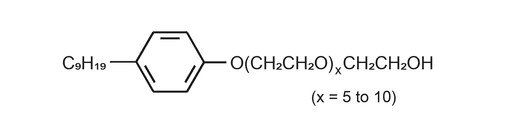
Following type of non-ionic detergents are present in liquid detergents, emulsifying agents and wetting agents. Label the hydrophilic and hydrophobic parts in the molecule. Identify the functional group(s) present in the molecule.
 Solve with AI
Written solution
Solution:
Key idea: a detergent molecule has two ends. The hydrophobic ("water-hating") part is a hydrocarbon portion that dissolves in grease. The hydrophilic ("water-loving") part is polar and attracts water.
Step 1 — Write the molecule in parts. The molecule is
Step 2 — The hydrophobic part. The nonyl group, , together with the benzene ring, , is pure hydrocarbon. It is non-polar, so it dissolves in oil and grease. This is the hydrophobic tail.
Step 3 — The hydrophilic part. The chain has many oxygen atoms and an –OH at the end. These form hydrogen bonds with water, so this polyether chain is the hydrophilic head. It is water-soluble even though it carries no charge, which is why the detergent is non-ionic.
Step 4 — The functional groups.
- Ether linkages, –O–: the aryl ether and the many links in the polyether chain;
- a primary alcohol group, , at the end of the chain;
- an aromatic (benzene) ring, carrying the two groups at para positions.
Therefore, the part is hydrophobic, the part is hydrophilic, and the functional groups are ether (–O–) linkages and a primary alcoholic –OH group (on a benzene ring skeleton).
- 795 marks
Question 79
What is the basic difference between antiseptics and disinfectants?
Solve with AIWritten solution
Solution:
Key idea: both antiseptics and disinfectants act against micro-organisms. The basic difference is their effect on living tissue, and so where they can be used.
Step 1 — Antiseptics. Antiseptics kill or prevent the growth of micro-organisms but do not harm living tissues. So they are applied to wounds, cuts, ulcers and diseased skin. Examples: dettol, tincture of iodine, boric acid, 0.2 % phenol.
Step 2 — Disinfectants. Disinfectants kill micro-organisms but are harmful to living tissues. So they are applied only to non-living objects such as floors, toilets, drains and instruments. Examples: 1 % phenol, chlorine (0.2 to 0.4 ppm in drinking water), sulphur dioxide.
Step 3 — Same substance, different concentration. A substance can be both. A 0.2 % solution of phenol is an antiseptic, and a 1 % solution is a disinfectant.
Therefore, antiseptics are safe on living tissue and are applied to the body, while disinfectants are harmful to living tissue and are used only on inanimate objects.
- 805 marks
Question 80
Between sodium hydrogen carbonate and magnesium hydroxide which is a better antacid and why?
Solve with AIWritten solution
Solution:
Key idea: a good antacid should neutralise the extra acid without making the stomach alkaline, and without side effects.
Step 1 — Sodium hydrogencarbonate. It neutralises acid as
It is soluble in water. An excess dissolves and makes the stomach alkaline. The stomach then responds by producing even more acid. The carbon dioxide given off also causes gas and bloating.
Step 2 — Magnesium hydroxide. It neutralises acid as
It is insoluble in water. Only as much of it dissolves as there is acid to neutralise, so an excess does not raise the pH above neutral. It gives off no gas.
Step 3 — Compare. Magnesium hydroxide removes the extra acid but does not over-neutralise. Sodium hydrogencarbonate can overshoot and cause more acid to be made.
Therefore, magnesium hydroxide is the better antacid, because it is insoluble and does not make the stomach alkaline (and gives no CO₂).
- 815 marks
Question 81
Which analgesics are called opiates?
Solve with AIWritten solution
Solution:
Key idea: analgesics are of two types: non-narcotic (for example aspirin, paracetamol) and narcotic. Narcotic analgesics produce sleep and, in large doses, unconsciousness.
Step 1 — Source. Some narcotic analgesics are obtained from opium, the dried juice of the unripe seed capsules of the opium poppy.
Step 2 — Name. Because they come from opium, these analgesics (and their derivatives) are called opiates.
Step 3 — Examples. Morphine, codeine and heroin (diacetylmorphine, made from morphine).
Step 4 — Use and caution. They relieve severe pain. However, they are habit-forming and addictive, so they are used only under medical supervision.
Therefore, the narcotic analgesics obtained from opium, such as morphine, codeine and heroin, are called opiates.
- 825 marks
Question 82
What is the medicinal use of narcotic drugs?
Solve with AIWritten solution
Solution:
Key idea: narcotic drugs are analgesics that relieve pain and produce sleep. Examples are morphine and codeine.
Step 1 — Relief from severe pain. Narcotic analgesics are used mainly to relieve severe pain. This includes post-operative pain, cardiac (heart) pain, the pain of terminal cancer, and pain in childbirth.
Step 2 — Other uses. In small doses, codeine is used in cough syrups to suppress cough. Narcotics also produce sleep.
Step 3 — Why their use is controlled. They are habit-forming and cause addiction. In larger doses they cause unconsciousness and can be fatal. So they are given only under a doctor's control.
Therefore, narcotic drugs are used mainly for the relief of severe pain, such as post-operative pain, cardiac pain, pain of terminal cancer and childbirth.
- 835 marks
Question 83
What are antagonistic drugs?
Solve with AIWritten solution
Solution:
Key idea: a receptor passes a message into the cell when the body's chemical messenger (a hormone or neurotransmitter) binds to it. Drugs that act on receptors are of two kinds: agonists and antagonists.
Step 1 — Definition. Antagonists are drugs that bind to the receptor site but do not start the cell's response. By occupying the site, they block the natural messenger from binding. So they inhibit the receptor's natural function.
Step 2 — When they are useful. They are useful when a message must be blocked, for example when too much of a messenger is acting.
Step 3 — Example. Antihistamines such as cimetidine and famotidine block the receptors at which histamine acts. This reduces the acid secretion that histamine would cause.
Step 4 — Contrast with agonists. Agonists mimic the natural messenger and switch on the receptor. They are useful when there is a lack of the messenger.
Therefore, antagonistic drugs (antagonists) are drugs that bind to receptors and block the natural chemical messenger, so the message is not passed into the cell.
- 845 marks
Question 84
What is the mode of action of antimicrobial drugs?
Solve with AIWritten solution
Solution:
Key idea: an antimicrobial drug must harm the micro-organism but not the human (host) cells. It does this by attacking a process or structure that is vital to the microbe.
Step 1 — Two broad effects. An antimicrobial may kill the microbes (a cidal effect, e.g. bactericidal). It may instead stop their growth (a static effect, e.g. bacteriostatic), so that the body's defences remove them.
Step 2 — Blocking cell-wall formation. Penicillin stops bacteria from building their cell walls, so the bacterial cells burst. Human cells have no cell wall, so they are not affected.
Step 3 — Blocking protein synthesis. Chloramphenicol, tetracycline and erythromycin bind to the bacterial ribosomes and stop protein synthesis. The bacteria then cannot grow and multiply.
Step 4 — Blocking a metabolic pathway. Sulpha drugs resemble p-aminobenzoic acid, which bacteria need to make folic acid. The drug takes its place on the bacterial enzyme, so folic acid is not made. Humans get folic acid from food, so they are not harmed.
Step 5 — Damaging membranes or nucleic acids. Some antifungals (e.g. amphotericin) damage the microbe's cell membrane. Antivirals (e.g. acyclovir) stop the virus from copying its nucleic acid.
Therefore, antimicrobial drugs kill or stop the growth of microbes by interfering with processes vital to them: cell-wall synthesis, protein synthesis, metabolism (folic acid), cell membranes or nucleic acid replication.
- 855 marks
Question 85
What is the side product of soap industry? Give reactions showing soap formation.
Solve with AIWritten solution
Solution:
Key idea: soap is made by saponification: a fat or oil (a glyceryl ester of fatty acids) is heated with aqueous sodium hydroxide. The ester is hydrolysed into the sodium salt of the fatty acid (soap) and glycerol.
Step 1 — Reaction with tristearin. Tristearin (glyceryl tristearate) is a fat. Heating it with sodium hydroxide gives sodium stearate (soap) and glycerol:
Step 2 — Separating the soap. The soap forms as a colloid. It is precipitated by adding common salt (salting out) and skimmed off.
Step 3 — The side product. The liquid left behind (the lye) contains glycerol (propane-1,2,3-triol, ). Glycerol is recovered from the lye by distillation.
Step 4 — Potassium soap. With potassium hydroxide, a potassium soap (softer to the skin) is formed in the same way:
Therefore, the side product of the soap industry is glycerol (glycerine).
- 865 marks
Question 86
How are transparent soaps manufactured?
Solve with AIWritten solution
Solution:
Key idea: ordinary soap is opaque because it contains tiny crystals of soap that scatter light. If these crystals are prevented from forming, the soap looks transparent.
Step 1 — Dissolving. Soap is first made by the usual saponification. It is then dissolved in ethanol (alcohol).
Step 2 — Evaporating. The excess solvent (ethanol) is then evaporated off.
Step 3 — Result. When the solution sets, the soap is left in a clear, non-crystalline form, so a transparent bar is obtained. Glycerol is often added as well.
Therefore, transparent soaps are made by dissolving soap in ethanol and then evaporating the excess solvent.
- 875 marks
Question 87
What is the advantage of using antihistamines over antacids in the treatment of acidity?
Solve with AIWritten solution
Solution:
Key idea: histamine stimulates the stomach wall to secrete hydrochloric acid. An antacid removes the acid, while an antihistamine stops it from being secreted.
Step 1 — How antacids work. Antacids are weak bases, such as and . They only neutralise the acid already produced. They treat the symptom, not the cause.
Step 2 — Problems with antacids. An excess of an antacid can make the stomach alkaline, and the stomach then makes even more acid. In severe cases, ulcers become life-threatening.
Step 3 — How antihistamines work. Antihistamines such as cimetidine and famotidine stop histamine from binding to its receptors in the stomach wall. Less acid is then secreted. So they control the cause of acidity.
Step 4 — Advantage. Antihistamines reduce acid at its source and give long-lasting relief. They are effective in treating ulcers, without the overshoot caused by excess antacid.
Therefore, antihistamines are better because they prevent the secretion of excess acid (they treat the cause), while antacids only neutralise acid already formed (they treat the symptom).
- 885 marks
Question 88
What are the functions performed by histamine in the body?
Solve with AIWritten solution
Solution:
Key idea: histamine is a chemical messenger in the body. It is released, for example, in response to allergens and injury.
Step 1 — In the stomach. It stimulates the secretion of hydrochloric acid and pepsin in the stomach.
Step 2 — Smooth muscles. It contracts the smooth muscles of the bronchi (air passages) and the gut.
Step 3 — Blood vessels. It relaxes the muscles in the walls of fine blood vessels, so they widen. They also become more permeable, which leads to swelling and redness.
Step 4 — In allergies. It is responsible for nasal congestion, sneezing, itching and skin rashes in allergic reactions such as hay fever.
Step 5 — In the nervous system. It also acts as a neurotransmitter.
Therefore, histamine stimulates acid secretion in the stomach, contracts smooth muscles of the bronchi and gut, relaxes and widens fine blood vessels, and causes the symptoms of allergy.
What Class 12 Chemistry Ch 16 covers
The sections of the chapter, in the order the book takes them. Every question above comes from one of these.
- 01Drugs and Their Classification
- 02Drug–Target Interaction
- 03Therapeutic Action of Drugs: Antacids, Antihistamines and Tranquilizers
- 04Analgesics
- 05Antimicrobials, Antibiotics, Antiseptics and Disinfectants
- 06Antifertility Drugs
More ways to study this chapter
The same chapter asked three other ways. Practise it, revise it, and see what the board has set on Ch 16 before.
- Competency-Based Questions (CBQ)Case study questions: a situation, and the part of the chapter that answers it.40questionsOpen
- Previous Year QuestionsQuestions that have actually appeared in board papers, each tagged with its year.4questionsOpen
- Practice QuestionsExtra questions per chapter, for when one attempt at a method is not enough.88questionsOpen
Ch 16 in past ISC papers
The same chapter as the board has actually asked it. These are worded differently from the textbook exercise, which is the point of reading them.
- 12 marks
Board paper question 1
How do antiseptics differ from disinfectants?
Solve with AIWritten solution
Solution:
Key idea: Antiseptics and disinfectants both act against microorganisms. They differ in what they are applied to: antiseptics to living tissue, disinfectants to non-living objects.
Step 1 — Say what the two groups have in common.
Both antiseptics and disinfectants are antimicrobials. Each one either kills microorganisms (bacteria, fungi, viruses) or stops them from growing.
Step 2 — Describe antiseptics.
Antiseptics are applied to living tissue, such as wounds, cuts, ulcers and diseased skin surfaces. At the strength used they do not harm the living tissue. Examples are Dettol (a mixture of chloroxylenol and terpineol), tincture of iodine and a 0.2 % solution of phenol.
Step 3 — Describe disinfectants.
Disinfectants are applied to non-living objects, such as floors, drains, toilets and instruments. At the strength used they would damage living tissue, so they are never put on the body. Examples are a 1 % solution of phenol and bleaching powder used for drains and toilets.
Step 4 — Note that strength decides the use.
The same substance can be an antiseptic in a dilute solution and a disinfectant in a stronger one. Phenol is the usual example: a 0.2 % solution is an antiseptic, while a 1 % solution is a disinfectant.
Therefore, antiseptics kill or stop the growth of microorganisms on living tissue without harming it (e.g. Dettol, 0.2 % phenol), while disinfectants do the same job on non-living objects such as floors and drains and would harm living tissue (e.g. 1 % phenol).
- 22 marks
Board paper question 2
State the role of the following chemicals in the food industry:
(i) Sodium benzoate
(ii) Aspartame
Solve with AIWritten solution
Solution:
Key idea: Chemicals are added to food for definite jobs: preservatives stop spoilage by microorganisms, and artificial sweeteners give a sweet taste with little or no food energy.
Step 1 — (i) State the role of sodium benzoate.
Sodium benzoate is a food preservative. It stops the growth of moulds, yeasts and bacteria, so foods such as jams, squashes, pickles and soft drinks keep for longer without spoiling. It works best in acidic foods, where it is present largely as benzoic acid. The body changes benzoic acid into hippuric acid, which is passed out in the urine.
Step 2 — (ii) State the role of aspartame.
Aspartame is an artificial sweetener. It is the methyl ester of a dipeptide made from aspartic acid and phenylalanine, and it is roughly 200 times as sweet as cane sugar (sucrose). Because so little is needed, it adds almost no calories, so it is used in low-calorie soft drinks and in foods for people who must limit sugar, such as diabetics.
Step 3 — Note one limit of aspartame.
Aspartame breaks down at cooking temperatures, so it is used only in cold foods and drinks. Labels warn people with phenylketonuria to avoid it, because it releases phenylalanine.
Therefore, sodium benzoate is a preservative that prevents spoilage of food by microorganisms, and aspartame is a low-calorie artificial sweetener used in cold foods and soft drinks.
- 32 marks
Board paper question 3
I) Name the type of drug which lowers the body temperature in high fever condition.
II) What are tranquilizers? Give one example of a tranquilizer.
Solve with AIWritten solution
Solution:
Key idea: Drugs are grouped by their effect on the body. Antipyretics bring down a raised body temperature, and tranquilizers act on the central nervous system to relieve stress and anxiety.
Step 1 — (I) Name the drug that lowers the temperature in fever.
A drug that brings the body temperature down to normal in fever is called an antipyretic. It acts on the temperature-control centre in the brain (the hypothalamus), which then lets the body lose the extra heat. Paracetamol is a common antipyretic; aspirin also has this action.
Step 2 — (II) Define tranquilizers.
Tranquilizers are chemical compounds used to treat stress and mild or even severe mental illness. They act on the central nervous system and relieve anxiety, tension, irritability and excitement, giving a sense of calm. Many of them are also used in sleeping pills.
Step 3 — (II) Give an example.
Diazepam (sold as Valium) is a widely used tranquilizer.
Note: Older books also list equanil (meprobamate). It has since been withdrawn in many countries because of safety concerns, so diazepam is the better example today.
Therefore, (I) the drug is an antipyretic, such as paracetamol; (II) tranquilizers are drugs that relieve stress, anxiety and mental tension, for example diazepam (Valium).
- 42 marks
Board paper question 4
(i) How do antiseptics differ from disinfectants?
(ii) Name a substance that can be used as an antiseptic as well as a disinfectant.
Solve with AIWritten solution
Solution:
Key idea: Antiseptics and disinfectants both act against microorganisms. They differ in what they are applied to: antiseptics to living tissue, disinfectants to non-living objects. The strength of the solution often decides which use a substance has.
Step 1 — (i) Say what the two groups have in common.
Both antiseptics and disinfectants are antimicrobials. Each one either kills microorganisms (bacteria, fungi, viruses) or stops them from growing.
Step 2 — (i) Describe antiseptics.
Antiseptics are applied to living tissue, such as wounds, cuts, ulcers and diseased skin surfaces. At the strength used they do not harm the living tissue. Examples are Dettol (a mixture of chloroxylenol and terpineol), tincture of iodine and a 0.2 % solution of phenol.
Step 3 — (i) Describe disinfectants.
Disinfectants are applied to non-living objects, such as floors, drains, toilets and instruments. At the strength used they would damage living tissue, so they are never put on the body. Examples are a 1 % solution of phenol and bleaching powder used for drains and toilets.
Step 4 — (ii) Name a substance that can do both jobs.
The same substance can be an antiseptic in a dilute solution and a disinfectant in a stronger one. Phenol is the usual example: a 0.2 % solution is an antiseptic, while a 1 % solution is a disinfectant.
Therefore, (i) antiseptics are used on living tissue without harming it, while disinfectants are used on non-living objects and would harm living tissue; (ii) phenol is an antiseptic as a 0.2 % solution and a disinfectant as a 1 % solution.
Class 12 Chemistry Ch 16 questions students ask
How many questions are there in Class 12 Chemistry Ch 16?
88 questions. Every one is solved step by step on this page.
Are these Class 12 Chemistry solutions free?
Yes. Every question and its full working is free to read, with no account needed.
Can I download the Class 12 Chemistry Ch 16 solutions as a PDF?
There is no PDF to download. Every solution is on this page instead, which means it is searchable, always the current syllabus, and readable on a phone. Use your browser's print option if you want it on paper.