
Opening your dashboard
Class 12 Chemistry Chapter 16 Chemistry in Everyday Life: Practice Questions
88 questions on Chapter 16, each worked through on its own page with the AI tutor. Class 12 Chemistry, ICSE 2026-27.
88 questions
1–4 marks · Mixed difficulty
- 11 mark
Question 1
Drugs can be classified in four ways. Which classification is the most useful to medicinal chemists who design new drugs?
- 22 marks
Question 2
Famotidine and omeprazole are both used to reduce the amount of acid in the stomach. Yet, if drugs are classified on the basis of their molecular targets, the two would be placed in different groups. Explain why.
- 32 marks
Question 3
A student says, "A medicine is always safe; the more you take, the faster you recover." Give two reasons, based on how drugs act in the body, why the statement is wrong.
- 41 mark
Question 4
Which pair of drugs would be placed in the same class when drugs are classified on the basis of their chemical structure?
- 53 marks
Question 5
Classify each of the following drugs on the basis of its pharmacological effect, and state one use of each.
(i) Chlordiazepoxide
(ii) Acyclovir
(iii) Ofloxacin
- 61 mark
Question 6
Proteins in the body that act as biological catalysts, proteins that are crucial to the body's communication system, and proteins that carry polar molecules across cell membranes are called, respectively:
- 73 marks
Question 7
Chemical messengers such as hormones pass a message into a cell without entering the cell. Explain, in steps, how a receptor makes this possible.
- 81 mark
Question 8
In a certain disorder, the body produces too little of a natural chemical messenger, so the message it carries is not passed on to the cells. Which type of drug would be most useful?
- 91 mark
Question 9
A drug molecule has the right shape to fit into the active site of an enzyme, but the enzyme cannot carry out any reaction on it. What is the most likely effect of the drug?
- 104 marks
Question 10
A drug Z inhibits an enzyme E. When the concentration of the natural substrate is raised ten times, the enzyme is still inhibited to the same extent. (Hypothetical observation.)
(a) What type of inhibitor is Z, and where on the enzyme does it bind?
(b) How does Z stop the enzyme from working even though it does not occupy the active site?
(c) Why does raising the substrate concentration not remove the inhibition?
(d) How would the result have differed if Z were the other type of inhibitor?
- 114 marks
Question 11
An antacid tablet contains 0.290 g of magnesium hydroxide and 0.312 g of aluminium hydroxide. (Hypothetical data.)
(a) Write balanced equations for the reaction of each hydroxide with the hydrochloric acid in the stomach.
(b) Calculate the total number of moles of HCl that one tablet can neutralise.
(c) What volume of gastric acid, taken as 0.10 mol L⁻¹ HCl, can one tablet neutralise?
(Atomic masses: Mg = 24, Al = 27, O = 16, H = 1.)
- 121 mark
Question 12
Histamine causes the sneezing and itching of an allergy and also stimulates the release of acid in the stomach. A patient taking chlorpheniramine for hay fever finds that it does not reduce his stomach acidity. The best explanation is that:
- 133 marks
Question 13
Noradrenaline is one of the neurotransmitters that plays a role in mood changes.
(a) Why can a low level of noradrenaline make a person depressed?
(b) Phenelzine is used as an antidepressant. Explain how it raises the noradrenaline level.
(c) To which group of tranquillisers does such a drug belong?
- 141 mark
Question 14
A patient needs relief from anxiety and nervous tension during the day, but the drug must not put him to sleep. According to the classes of tranquillisers in this chapter, which type of drug is needed?
- 152 marks
Question 15
Sodium hydroxide neutralises hydrochloric acid very effectively, yet it is never used as an antacid, while magnesium hydroxide is widely used. Give two reasons.
- 163 marks
Question 16
In a school laboratory, aspirin is made by heating 2.76 g of salicylic acid () with excess acetic anhydride. The dry product weighs 2.70 g. (Hypothetical data.)
(a) Write the balanced equation for the reaction.
(b) Calculate the mass of aspirin expected if the reaction were complete.
(c) Calculate the percentage yield.
(Atomic masses: C = 12, H = 1, O = 16.)
- 171 mark
Question 17
Which property is shared by morphine and codeine but not by ibuprofen?
- 183 marks
Question 18
Ibuprofen, a common pain reliever, has the structure .
(a) Name the functional group responsible for its acidic nature, and state whether it is a narcotic or a non-narcotic analgesic.
(b) Find its molecular formula and molar mass.
(c) How many moles of ibuprofen are present in one 400 mg tablet?
(Atomic masses: C = 12, H = 1, O = 16.)
- 191 mark
Question 19
An old bottle of aspirin tablets, kept in a damp place, smells of vinegar. This is because the aspirin has:
- 203 marks
Question 20
When aspirin is added to aqueous sodium hydrogencarbonate, it dissolves with effervescence. Paracetamol (-acetamidophenol, ) gives no effervescence.
(a) Which group in aspirin reacts? Write the equation.
(b) Why does paracetamol not react, even though it also has an acidic group?
- 213 marks
Question 21
A housing society treats the 50 000 L of water in its overhead tank with chlorine so that the water contains 0.30 ppm (by mass) of chlorine. (Hypothetical data.)
(a) Calculate the mass of chlorine needed. (Take the mass of 1 L of water as 1 kg.)
(b) Is chlorine acting here as an antiseptic or a disinfectant? Give a reason.
- 221 mark
Question 22
The antiseptic "tincture of iodine" is:
- 233 marks
Question 23
A person with a common cold asks a chemist for an antibiotic. Another person, given a five-day course of an antibiotic for a bacterial throat infection, stops taking it on the third day because he feels better.
(a) Why is an antibiotic of no use against the common cold?
(b) Why is it harmful to stop an antibiotic course early?
- 241 mark
Question 24
A student has athlete's foot, an itchy infection of the skin between the toes. Which drug is suitable for treating it?
- 253 marks
Question 25
Two antibiotics, P and Q, are tested on a bacterial culture. With P, the bacteria stop multiplying, but they start growing again as soon as P is washed away. With Q, the bacteria die, and none grow even after Q is washed away. (Hypothetical observation.)
(a) Classify P and Q as bactericidal or bacteriostatic.
(b) Explain the difference between the two types.
(c) For a patient whose immune system is very weak, which type of antibiotic is preferred, and why?
- 261 mark
Question 26
A combined oral contraceptive pill contains a synthetic progesterone derivative and a synthetic estrogen derivative. How does such a pill mainly prevent pregnancy?
- 272 marks
Question 27
Birth-control pills contain synthetic progesterone derivatives such as norethindrone rather than natural progesterone itself. Give the reason for using a synthetic derivative, and state how the pill uses it to control fertility.
- 281 mark
Question 28
Mifepristone and norethindrone are both synthetic steroids used in controlling fertility. Which statement correctly describes how mifepristone differs from norethindrone?
- 293 marks
Question 29
A low-dose birth-control tablet contains 30 µg of ethynylestradiol, . (C = 12, H = 1, O = 16; = 6.022 × 10²³ mol⁻¹.)
(a) Calculate the amount (in mol) of ethynylestradiol in one tablet.
(b) Calculate the number of ethynylestradiol molecules in one tablet.
(c) A pack has 21 such hormone tablets. What total mass of ethynylestradiol, in mg, does the pack contain?
- 301 mark
Question 30
Norethindrone and ethynylestradiol are both used in birth-control pills. Which structural feature do the two molecules have in common?
- 313 marks
Question 31
Potassium metabisulphite, , is added to fruit squashes and jams.
(a) Write the equations that show how it produces the substance that actually preserves the food.
(b) Explain how this substance protects the food.
(c) Name the class of food additive to which potassium metabisulphite belongs.
- 323 marks
Question 32
Raw mango pieces are stored in a concentrated salt solution (brine) to make pickle.
(a) What mass of common salt must be dissolved in 500 g of water to make a brine that is 20 % salt by mass?
(b) Explain why micro-organisms cannot grow in such a brine.
- 331 mark
Question 33
A bakery wants to stop mould from growing on its bread and cakes. Which additive is commonly used for this purpose?
- 343 marks
Question 34
Potato chips fried in sunflower oil (rich in unsaturated fats) go rancid sooner than chips fried in a saturated fat. Explain why, and explain how adding butylated hydroxyanisole (BHA) to the packet slows this change.
- 351 mark
Question 35
Fresh fruits, green leafy vegetables, nuts and germinated whole grains are natural sources of antioxidants. Which pair of compounds gives them this antioxidant action?
- 363 marks
Question 36
A cake recipe uses 300 g of sugar (sucrose). A baker making it for diabetic customers replaces the sugar with sucralose, which is about 600 times as sweet as sucrose (mass for mass) and provides no calories. Sucrose provides about 4 kcal per gram.
(a) What mass of sucralose gives the same sweetness?
(b) By how much is the energy content of the cake reduced?
(c) Why is sucralose, and not aspartame, suitable for this use?
- 371 mark
Question 37
Sachets of a certain artificial sweetener carry the printed warning "Phenylketonurics: contains phenylalanine". Which sweetener is it?
- 382 marks
Question 38
Saccharin is only slightly soluble in water, so it is sold as its sodium salt. Explain why saccharin is able to form a sodium salt, and write the equation for its reaction with sodium hydroxide. (Take the molecular formula of saccharin as .)
- 394 marks
Question 39
Palm oil contains glyceryl tripalmitate, . 403 g of pure glyceryl tripalmitate is boiled with excess sodium hydroxide solution. (C = 12, H = 1, O = 16, Na = 23.)
(a) Write the balanced equation for the reaction.
(b) Calculate the mass of sodium hydroxide used up.
(c) Calculate the mass of soap formed.
(d) Calculate the mass of glycerol formed.
- 401 mark
Question 40
In the manufacture of soap, common salt is added to the mixture after the fat has been boiled with sodium hydroxide. What is the purpose of adding the salt?
- 412 marks
Question 41
A student tries to wash a greasy cloth using soap dissolved in water to which some dilute hydrochloric acid has been added. The soap does not clean the cloth. Explain why, and write the equation for the reaction, taking sodium stearate as the soap.
- 423 marks
Question 42
A sample of hard water contains 0.111 g of calcium chloride per litre. Sodium stearate soap is used for washing in it. (C = 12, H = 1, O = 16, Na = 23, Cl = 35.5, Ca = 40.)
(a) Write the equation for the reaction of the soap with the calcium chloride.
(b) Calculate the mass of soap wasted for every litre of this water before any lather forms.
(c) Calculate the mass of scum formed per litre.
- 431 mark
Question 43
Shaving creams and liquid hand-wash soaps are usually potassium soaps rather than sodium soaps. Which statement about potassium soaps is correct?
- 443 marks
Question 44
Different substances are added to soaps to make them suitable for particular uses. State the purpose of adding each of the following:
(a) glycerol to shaving soap
(b) rosin to shaving soap
(c) sodium silicate and sodium carbonate to laundry soap
- 453 marks
Question 45
Sodium lauryl sulphate is used in shampoos and toothpastes. Starting from lauryl alcohol, :
(a) write the equations for its preparation in two steps;
(b) state why this detergent can be used for washing in hard water.
- 461 mark
Question 46
After shampooing, the surface of hair carries a slight negative charge. A hair conditioner contains a surfactant whose head is attracted to this surface, so it stays on the hair and makes it smooth. Which surfactant is most suitable?
- 472 marks
Question 47
A non-ionic detergent such as polyethylene glycol stearate carries no electric charge, yet it dissolves in water and cleans well even in very hard water. Explain both facts.
- 481 mark
Question 48
A sodium alkyl sulphate detergent keeps working in slightly acidic water, whereas soap stops working. What is the best reason?
- 491 mark
Question 49
A white cleaning powder X gives a good lather in hard water without forming any curdy scum. When dilute hydrochloric acid is added to a solution of X, no solid separates. X is most likely:
- 502 marks
Question 50
How do antiseptics differ from disinfectants?
- 513 marks
Question 51
State the role of the following in food industry:
(a) Sodium benzoate
(b) Aspartame
- 522 marks
Question 52
Name the type of drug which lowers body temperature in high fever condition.
- 532 marks
Question 53
What are tranquilizers? Give one example.
- 542 marks
Question 54
Name a substance that can be used as an antiseptic as well as a disinfectant.
- 551 mark
Question 55
Which one of the following compounds is an antifertility drug?
- 561 mark
Question 56
Which of the following statements about aspirin is not true?
- 571 mark
Question 57
Which one of the following is used as antihistamine?
- 581 mark
Question 58
Which of the following compounds is not an antacid?
- 591 mark
Question 59
Which of the following is an anionic detergent?
- 601 mark
Question 60
The reason for "drug induced poisoning" is
- 611 mark
Question 61
The predominant form of histamine present in human blood is (, Histidine - 6.0)

- 621 mark
Question 62
If a person is suffering from the deficiency of noradrenaline, what kind of drug can be suggested?
- 631 mark
Question 63
The following molecule acts as an:
(Brompheniramine; = 2-pyridyl ring, = 4-bromophenyl ring)
- 641 mark
Question 64
The mechanism of action of "Terfenadine" (Seldane) is;
- 651 mark
Question 65
The antifertility drug "Novestrol" can react with:
- 661 mark
Question 66
Noradrenaline is a/an:
- 671 mark
Question 67
Which one of the following chemicals is responsible for the production of HCl in the stomach leading to irritation and pain?

- 681 mark
Question 68
Given below are two statements:
Statement I: Penicillin is a bacteriostatic type antibiotic.
Statement II: The general structure of Penicillin is:
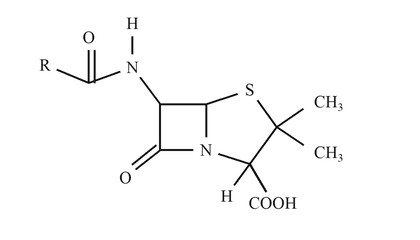
Choose the correct option:
- 691 mark
Question 69
Sodium stearate is an anionic surfactant which forms micelles in oil.
Choose the correct statement for it from the following.
- 701 mark
Question 70
Which one of the following chemical agent is not being used for dry-clothes?
- 711 mark
Question 71
Which of the following compounds is an example of hypnotic drug?
- 721 mark
Question 72
The number of chlorine atoms in bithionol is ............ .
- 731 mark
Question 73
Statements about Enzyme Inhibitor Drugs are given below:
(A) There are competitive and non-competitive inhibitor drugs.
(B) These can bind at the active sites and allosteric sites.
(C) Competitive drugs are allosteric site blocking drugs.
(D) Non-competitive drugs are active site blocking drugs.
Choose the correct answer from the options given below;
- 741 mark
Question 74
Two statements in respect of drug-enzyme interaction are given below:
Statement I: Action of an enzyme can be blocked only when an inhibitor blocks the active site of the enzyme.
Statement II: An inhibitor can form a strong covalent bond with the enzyme.
In the light of the above statements, choose the correct answer from the options given below:
- 751 mark
Question 75
Which one of the following is employed as a tranquilizer drug?
- 761 mark
Question 76
Which one of the following is employed as Antihistamine?
- 771 mark
Question 77
Chloramphenicol is an:
- 781 mark
Question 78
Dettol is the mixture of
- 791 mark
Question 79
Antiseptics and disinfectants either kill or prevent growth of microorganisms. Identify which of the following statements is not true:
- 801 mark
Question 80
Artificial sweetener which is stable under cold conditions only is:
- 811 mark
Question 81
Bithionol is generally added to the soaps as an additive to function as a/an:
- 821 mark
Question 82
Which of the following is an analgesic?
- 831 mark
Question 83
Mixture of chloroxylenol and terpineol acts as:
- 841 mark
Question 84
The artificial sweetener stable at cooking temperature and does not provide calories is
- 851 mark
Question 85
Among the following, the narrow spectrum antibiotic is:
- 861 mark
Question 86
Which of the following is a cationic detergent?
- 871 mark
Question 87
Given below are two statements:
Statement I: Aspirin and Paracetamol belong to the class of narcotic analgesics.
Statement II: Morphine and Heroin are non-narcotic analgesics.
In the light of the above statements, choose the correct answer from the options given below.
- 881 mark
Question 88
Match List-I with List-II.
List-I (Drug class) List-II (Drug molecule) (A) Antacids (i) Salvarsan (B) Antihistamines (ii) Morphine (C) Analgesics (iii) Cimetidine (D) Antimicrobials (iv) Seldane Choose the correct answer from the options given below: