
Question 715 marksMedium
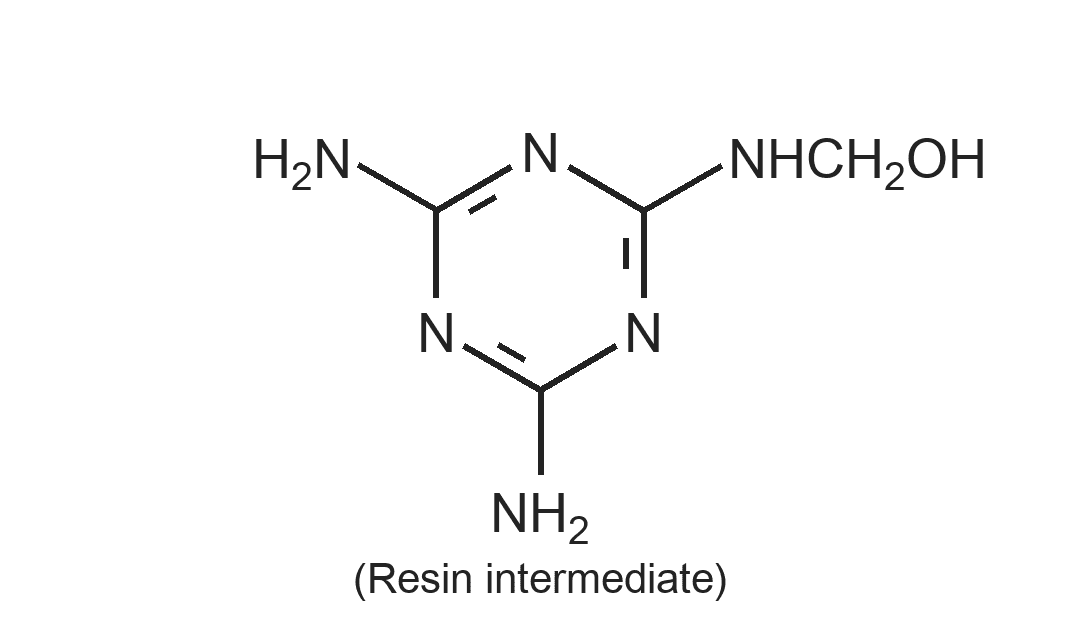
How is the following resin intermediate prepared and which polymer is formed by this monomer unit?
Confirming your payment
Sign up now and get 250 free tokens.
Polymers · Question 71 of 77
How is the following resin intermediate prepared and which polymer is formed by this monomer unit?
Solution:
Concept: formaldehyde reacts with –NH₂ groups to give –NH–CH₂OH (methylol) groups. These methylol groups then condense with –NH₂ groups of other molecules, losing water, to form –NH–CH₂–NH– bridges. This is how the formaldehyde resins are made.
Step 1 — Identify the intermediate. The molecule is a 1,3,5-triazine ring carrying two –NH₂ groups and one –NHCH₂OH group. The parent compound with three –NH₂ groups is melamine (2,4,6-triamino-1,3,5-triazine), . So the intermediate is methylol melamine (melamine in which one –NH₂ has become –NHCH₂OH).
Step 2 — Preparation. Melamine is heated with formaldehyde; one –NH₂ group adds to the C=O of formaldehyde:
Step 3 — Polymerisation. On further heating, the –NHCH₂OH group of one molecule reacts with an –NH₂ group of another, water is lost, and a methylene bridge –NH–CH₂–NH– joins the rings:
Because each ring has several –NH₂ groups, bridges form in all directions and a hard, cross-linked (thermosetting) network results.
Step 4 — The polymer. The polymer formed is melamine–formaldehyde resin (Melmac), used for unbreakable crockery (dinnerware) and decorative articles.