
Opening your dashboard
Class 12 Chemistry Chapter 15: Polymers Solutions
77 textbook questions with step-by-step answers, free to read, for ISC 2026-27.
Get talked through Ch 15, not just shown the answer
Reading a finished solution is not the same as being able to do it. The AI tutor takes one question at a time and works it with you, in your own words, until you can.
- Ask it out loud, in your own words
- It gives you the next step, not the answer
- Stuck on part (ii)? Start there
77 questions with solutions
1–5 marks · Mixed difficulty
- 11 mark
Question 1
Soft drinks and baby feeding bottles are generally made up of
Solve with AIAnswer
- Correct
(A) Polyester
(B) Polyurethane
(C) Polyurea
(D) Polystyrene
Answer: (A) Polyester
Concept: A bottle for drinks must be light, tough, unbreakable, transparent and safe for food. The polymer chosen for such bottles is a polyester.
Step 1 — Identify the polymer of soft-drink bottles. Soft-drink (PET) bottles are made of polyethylene terephthalate, which is the same polymer as terylene (Dacron). It is made from ethylene glycol and terephthalic acid, joined by ester links, so it is a polyester.
Step 2 — Identify the polymer of baby feeding bottles. Hard, clear baby bottles have been made of polycarbonate (Lexan), which is a polyester of carbonic acid; many are now made of polypropylene. Polystyrene is not used.
Step 3 — Match with the options. Of the four options, only polyester is a bottle polymer.
Note: the printed key (d) polystyrene is incorrect. Polystyrene is brittle and is used for household articles, toys and hot-drink cups (as this chapter itself says), not for drink bottles; soft-drink bottles are PET, a polyester.
Why the other options are wrong:
- (B) Polyurethanes are used mainly as foams (cushions, mattresses), elastic fibres and coatings, not for drink bottles.
- (C) Polyureas are used as tough coatings and linings, not for food bottles.
- (D) Polystyrene is brittle and cracks easily, so it is used for cups, toys and packaging foam (thermocole), not for drink bottles.
Therefore, the answer is (A) Polyester.
- 21 mark
Question 2
Polymer used in bullet proof glass is
Solve with AIAnswer
(A) PMMA
- Correct
(B) Lexan
(C) Nomex
(D) Kevlar
Answer: (B) Lexan
Concept: Bullet-proof "glass" must be transparent and also extremely tough, so that it absorbs the energy of a bullet without shattering.
Step 1 — Recall what Lexan is. Lexan is a polycarbonate: a polyester of carbonic acid made from bisphenol A. It is clear like glass but about 250 times stronger in impact.
Step 2 — Use it. Layers of polycarbonate (often with glass) are used to make bullet-resistant windows, so the answer is Lexan.
Why the other options are wrong:
- (A) PMMA (perspex, plexiglass) is transparent but is not as impact-resistant as polycarbonate; it is used for lenses, aircraft windows and sign boards.
- (C) Nomex is an aromatic polyamide used for fire-resistant clothing; it is not transparent.
- (D) Kevlar is an aromatic polyamide used in bullet-proof vests and body armour, but it is an opaque fibre, so it cannot be used as glass.
Therefore, the answer is (B) Lexan.
- 31 mark
Question 3
is a monomer of:
Solve with AIAnswer
(A) Buna-S
- Correct
(B) Teflon
(C) Glyptal
(D) Nylon-6
Answer: (B) Teflon
Concept: In addition polymerisation, the C=C double bond of the monomer opens and the monomer units join end to end.
Step 1 — Name the monomer. is tetrafluoroethene (tetrafluoroethylene).
Step 2 — Polymerise it. On heating with a peroxide catalyst under pressure, its double bonds open and give polytetrafluoroethene (PTFE):
Step 3 — Give the trade name. PTFE is sold as Teflon.
Why the other options are wrong:
- (A) Buna-S is a copolymer of 1,3-butadiene and styrene.
- (C) Glyptal is a polyester of ethylene glycol and phthalic acid.
- (D) Nylon-6 is made from caprolactam.
Therefore, the answer is (B) Teflon.
- 41 mark
Question 4
Nylon-6 is made from:
Solve with AIAnswer
(A) Butadiene
(B) Chloroprene
(C) Adipic acid
- Correct
(D) Caprolactam
Answer: (D) Caprolactam
Concept: The number in the name of a nylon gives the number of carbon atoms in its monomer(s). Nylon-6 has one number, so it comes from one monomer with 6 carbon atoms.
Step 1 — Find a six-carbon monomer containing both N and C=O. Caprolactam is a seven-membered ring with six carbon atoms and an amide group (–CO–NH–) in the ring.
Step 2 — Polymerise it. Heating caprolactam with a little water at about 533–543 K opens the ring, and the units join:
This polymer is nylon-6.
Why the other options are wrong:
- (A) Butadiene is the monomer of polybutadiene and is used with styrene for Buna-S.
- (B) Chloroprene is the monomer of neoprene, a synthetic rubber.
- (C) Adipic acid (6 C) is used with hexamethylenediamine (6 C) to make nylon-6,6, which has two numbers because it has two monomers.
Therefore, the answer is (D) Caprolactam.
- 51 mark
Question 5
Natural rubber is polymer of:
Solve with AIAnswer
- Correct
(A) Isoprene
(B) Styrene
(C) Ethyl acrylate
(D) Butadiene
Answer: (A) Isoprene
Concept: Natural rubber comes from the latex of rubber trees. Chemically it is a linear 1,4-addition polymer.
Step 1 — Name the monomer. The monomer is isoprene, 2-methyl-1,3-butadiene, .
Step 2 — See how it joins. Each isoprene unit adds through its 1 and 4 carbons, leaving one double bond in every unit:
In natural rubber all the double bonds have the cis arrangement, so natural rubber is cis-polyisoprene.
Why the other options are wrong:
- (B) Styrene gives polystyrene, a hard plastic, and is a co-monomer in Buna-S.
- (C) Ethyl acrylate gives polyethyl acrylate, a tough rubber-like synthetic product, not natural rubber.
- (D) Butadiene (without the methyl group) is used for synthetic rubbers such as Buna-S and Buna-N.
Therefore, the answer is (A) Isoprene.
- 61 mark
Question 6
Which of the following is a natural fibre?
Solve with AIAnswer
(A) Starch
- Correct
(B) Cellulose
(C) Nylon-6
(D) Teflon
Answer: (B) Cellulose
Concept: A fibre is a polymer whose long chains are held side by side by strong forces (such as hydrogen bonds), so it can be drawn into thread-like strands of high tensile strength. A natural polymer is one found in plants or animals.
Step 1 — Look for a natural polymer. Starch and cellulose are natural; nylon-6 and Teflon are synthetic.
Step 2 — Look for a fibre. Cellulose has straight chains of β-glucose units held together by many hydrogen bonds. Cotton, jute and linen are almost pure cellulose, so cellulose is a natural fibre.
Why the other options are wrong:
- (A) Starch is a natural polymer, but its chains are coiled and branched (amylose and amylopectin); it is a food store, not a fibre.
- (C) Nylon-6 is a fibre, but it is synthetic.
- (D) Teflon is a synthetic plastic, not a natural fibre.
Therefore, the answer is (B) Cellulose.
- 71 mark
Question 7
Bakelite is prepared by the reaction between:
Solve with AIAnswer
- Correct
(A) phenol and formaldehyde
(B) ethylene glycol and dimethyl terephthlate
(C) urea and formaldehyde
(D) tetramethylene glycol and hexamethylene diisocyanate
Answer: (A) phenol and formaldehyde
Concept: Bakelite is a phenol–formaldehyde resin, a thermosetting condensation polymer.
Step 1 — First stage. Phenol and formaldehyde react (acid or base catalyst) to give o- and p-hydroxymethylphenol. These condense, losing water, to give a linear polymer called novolac, in which phenol rings are joined by –– bridges.
Step 2 — Second stage. On heating with more formaldehyde, more –– bridges form between the chains. This gives a hard, three-dimensional cross-linked network, which is Bakelite.
Why the other options are wrong:
- (B) Ethylene glycol and dimethyl terephthalate give terylene (Dacron), a polyester.
- (C) Urea and formaldehyde give urea–formaldehyde resin, another thermosetting resin, but not Bakelite.
- (D) A glycol and a diisocyanate give a polyurethane.
Therefore, the answer is (A) phenol and formaldehyde.
- 81 mark
Question 8
A condensation polymer among the following is :
Solve with AIAnswer
(A) Polystyrene
(B) Teflon
- Correct
(C) Dacron
(D) PVC
Answer: (C) Dacron
Concept: A condensation polymer is formed when two monomers with two functional groups each join with the loss of a small molecule such as water or methanol. An addition polymer is formed by opening C=C bonds, with nothing lost.
Step 1 — Check Dacron. Dacron (terylene) is formed from ethylene glycol and terephthalic acid; each ester link formed releases a molecule of water:
So Dacron is a condensation polymer (a polyester).
Why the other options are wrong:
- (A) Polystyrene is made by opening the C=C bond of styrene: an addition polymer.
- (B) Teflon is made by opening the C=C bond of tetrafluoroethene: an addition polymer.
- (D) PVC is made by opening the C=C bond of vinyl chloride: an addition polymer.
Therefore, the answer is (C) Dacron.
- 91 mark
Question 9
Which of the following is not a polymer?
Solve with AIAnswer
(A)
(B) Teflon
(C) Neoprene
- Correct
(D) Isoprene
Answer: (D) Isoprene
Concept: A polymer is a very large molecule made by joining a large number of small repeating units. A monomer is the small molecule from which the polymer is made.
Step 1 — Look at isoprene. Isoprene, , is a small molecule (, molar mass 68 g mol⁻¹). It is the monomer of natural rubber, not a polymer.
Step 2 — Check the others. Each of the other three is a giant structure made of repeating units, as shown below.
Why the other options are wrong:
- (A) Silica, , is a giant three-dimensional network of tetrahedra joined through shared O atoms, so it is an inorganic polymer-like network.
- (B) Teflon is polytetrafluoroethene, , a polymer.
- (C) Neoprene is polychloroprene, a polymer (a synthetic rubber).
Therefore, the answer is (D) Isoprene.
- 101 mark
Question 10
Ziegler-Natta catalyst is
Solve with AIAnswer
- Correct
(A) a mixture of titanium (III) chloride and triethyl aluminium
(B) a mixture of zirconium (III) chloride and triethyl aluminium
(C) a mixture of zirconium (III) chloride and dimethyl aluminium
(D) a mixture of titanium (III) chloride and dimethyl aluminium
Answer: (A) a mixture of titanium (III) chloride and triethyl aluminium
Concept: The Ziegler–Natta catalyst is used for coordination polymerisation of alkenes at low pressure, for example to make high density polythene and polypropylene.
Step 1 — The two parts of the catalyst. It is a combination of a titanium halide ( or ) and an organoaluminium compound, triethylaluminium .
Step 2 — Match with the options. Only option (A) has both titanium(III) chloride and triethylaluminium.
Why the other options are wrong:
- (B) The transition-metal part of the classic Ziegler–Natta catalyst is titanium, not zirconium.
- (C) Both parts are wrong: the metal is titanium, and the aluminium compound is triethylaluminium; "dimethyl aluminium" is not even a complete compound (Al needs three groups).
- (D) The titanium part is right, but the aluminium compound is triethylaluminium, , not "dimethyl aluminium".
Therefore, the answer is (A).
- 111 mark
Question 11
Which of the following is a polyamide molecule ?
Solve with AIAnswer
(A) Terylene
(B) Rayon
- Correct
(C) Nylon-6
(D) Polystyrene
Answer: (C) Nylon-6
Concept: A polyamide is a polymer whose repeating units are joined by amide links, –CO–NH–.
Step 1 — Write the repeat unit of nylon-6.
Each unit is joined to the next by a –CO–NH– (amide) link, so nylon-6 is a polyamide.
Why the other options are wrong:
- (A) Terylene has ester links, –CO–O–, so it is a polyester.
- (B) Rayon is regenerated cellulose; its glucose units are joined by glycosidic (C–O–C) links.
- (D) Polystyrene has only C–C bonds in its chain; it is an addition polymer with no amide links.
Therefore, the answer is (C) Nylon-6.
- 121 mark
Question 12
Caprolactam is a monomer of:
Solve with AIAnswer
(A) glyptal
- Correct
(B) nylon-6
(C) melamine
(D) PTFE
Answer: (B) nylon-6
Concept: Caprolactam is a cyclic amide (a lactam) with six carbon atoms in its seven-membered ring.
Step 1 — Open the ring. On heating with a trace of water, the ring opens and the units link through amide bonds:
Step 2 — Name the product. The repeat unit has six carbon atoms and comes from one monomer, so the polymer is nylon-6.
Why the other options are wrong:
- (A) Glyptal is made from ethylene glycol and phthalic acid.
- (C) Melamine resin is made from melamine and formaldehyde.
- (D) PTFE (Teflon) is made from tetrafluoroethene.
Therefore, the answer is (B) nylon-6.
- 131 mark
Question 13
Which one of the following is not correctly matched?
Solve with AIAnswer
(A) Neoprene
(B) Nylon-6,6
- Correct
(C) Terylene
(D) PMMA
Answer: (C) Terylene
Concept: To check a polymer structure, write the monomers and see how they join. Every link formed in a condensation polymer keeps the atoms of both functional groups except the small molecule lost.
Step 1 — Write terylene correctly. Terylene is made from ethylene glycol, , and terephthalic acid, . Both O atoms of the glycol stay in the chain, so the correct repeat unit is:
Step 2 — Compare with the printed unit. The printed unit is –O–––CO––CO–. The second oxygen (between and C=O) is missing, so there is no ester link on that side. The formula of the printed unit is instead of . So (C) is not correctly matched.
Why the other options are wrong (they are correctly matched):
- (A) Neoprene is polychloroprene; chloroprene, , adds 1,4 to give ––CCl=CH––, exactly as shown.
- (B) Nylon-6,6 has –NH––NH– from hexamethylenediamine and –CO––CO– from adipic acid, exactly as shown.
- (D) PMMA is poly(methyl methacrylate); each unit is ––C()()–, exactly as shown.
Therefore, the answer is (C) Terylene.
- 141 mark
Question 14
Monomer of is
Solve with AIAnswer
- Correct
(A) 2-methyl propene
(B) styrene
(C) propylene
(D) ethene
Answer: (A) 2-methyl propene
Concept: In an addition polymer, the repeat unit has the same atoms as the monomer; the C=C double bond of the monomer becomes a C–C single bond in the chain.
Step 1 — Read the repeat unit. The unit is –C()––: one carbon carries two methyl groups and the next carbon is a . Its formula is .
Step 2 — Put the double bond back. Joining the two chain carbons by a double bond gives , which is 2-methylpropene (isobutylene). Its polymer is polyisobutylene.
Why the other options are wrong:
- (B) Styrene, , would give ––CH()– units.
- (C) Propylene, , would give ––CH()– units with only one methyl group.
- (D) Ethene would give ––– units with no methyl groups.
Therefore, the answer is (A) 2-methyl propene.
- 151 mark
Question 15
Nylon threads are made of
Solve with AIAnswer
(A) Polyethylene polymer
(B) Polyvinyl polymer
(C) Polyester polymer
- Correct
(D) Polyamide polymer
Answer: (D) Polyamide polymer
Concept: Nylons are the synthetic polyamides: their units are joined by amide links, –CO–NH–.
Step 1 — Example. Nylon-6,6 is formed from hexamethylenediamine and adipic acid; each – group reacts with a –COOH group, water is lost and an amide link –CO–NH– forms.
Step 2 — Why threads. Hydrogen bonds between the N–H and C=O groups of neighbouring chains hold the chains side by side, giving strong fibres used for threads, ropes and fabrics.
Why the other options are wrong:
- (A) Polyethylene has only C–C and C–H bonds and no amide links; it is a plastic for bags and films.
- (B) "Polyvinyl" polymers such as PVC are addition polymers of vinyl compounds, not nylon.
- (C) Polyesters (such as terylene) have ester links, –CO–O–, not amide links.
Therefore, the answer is (D) Polyamide polymer.
- 161 mark
Question 16
Which of the following is a chain growth polymer ?
Solve with AIAnswer
(A) Starch
(B) Nucleic acid
- Correct
(C) Polystyrene
(D) Proteins
Answer: (C) Polystyrene
Concept: Chain-growth (addition) polymerisation goes through reactive intermediates (free radicals, cations or anions): a monomer with a C=C bond adds to the growing end of the chain one unit at a time. Step-growth (condensation) polymerisation joins molecules with loss of a small molecule such as water.
Step 1 — Check polystyrene. Styrene, , polymerises with a peroxide initiator by a free-radical chain mechanism, adding unit by unit to the growing chain:
So polystyrene is a chain-growth polymer.
Why the other options are wrong:
- (A) Starch is formed from glucose units joined by glycosidic links with loss of water: a condensation polymer.
- (B) Nucleic acids are formed from nucleotides joined by phosphodiester links with loss of water: condensation polymers.
- (D) Proteins are formed from amino acids joined by peptide links with loss of water: condensation polymers.
Therefore, the answer is (C) Polystyrene.
- 171 mark
Question 17
The monomer of the polymer is
Solve with AIAnswer
(A)
(B)
(C)
- Correct
(D)
Answer: (D)
Concept: The structure shows a growing chain with a positive carbon at its end (a carbocation), so this is cationic addition polymerisation. Every unit in the chain is a copy of the monomer.
Step 1 — Read one repeat unit. The chain is ––C()––(). The pattern that repeats is ––C()–, which is .
Step 2 — Put back the double bond. The monomer is , 2-methylpropene (isobutylene).
Step 3 — Check the cation. When (or another cation) adds to the end of the monomer, the positive charge sits on the carbon carrying two methyl groups. This tertiary carbocation is stable, which is why the chain end in the figure is ––.
Why the other options are wrong:
- (A) But-2-ene is also , but its units would be –CH()–CH()–, with one methyl on each carbon, not two methyls on one carbon.
- (B) Propene would give ––CH()– units with only one methyl group per unit.
- (C) 2,3-Dimethylbut-2-ene would give units with four methyl groups and no group in the chain.
Therefore, the answer is (D).
- 181 mark
Question 18
is a :
Solve with AIAnswer
- Correct
(A) co-polymer
(B) addition polymer
(C) thermosetting polymer
(D) homopolymer
Answer: (A) co-polymer
Concept: A homopolymer is made from one kind of monomer; a copolymer is made from two (or more) different monomers.
Step 1 — Split the repeat unit into its two parts. The unit has an –NH–(…)–NH– part, which comes from a diamine, and a –CO––CO– part, which comes from adipic acid (a dicarboxylic acid).
Step 2 — Decide. Two different monomers are joined alternately by amide links with loss of water, so the polymer is a copolymer (it is the nylon-6,6 type of polyamide).
Note: the book prints "" without a subscript; for nylon-6,6 it is . Either way the unit comes from two different monomers, so the answer is the same.
Why the other options are wrong:
- (B) It is formed by condensation (water is lost when each amide link forms), not by addition across C=C bonds.
- (C) Nylons are linear chains that soften on heating and can be remoulded: they are thermoplastics, not thermosetting polymers.
- (D) It is not made from a single monomer, so it is not a homopolymer.
Therefore, the answer is (A) co-polymer.
- 191 mark
Question 19
In the reaction sequence
(X) is
Solve with AIAnswer
(A) cyclohexanone
- Correct
(B) caprolactam
(C)
(D) hexamethylene diisocyanate
Answer: (B) caprolactam
Concept: The starting compound, (printed in the book as a cyclohexane ring carrying =NOH), is cyclohexanone oxime. With concentrated an oxime undergoes the Beckmann rearrangement, which changes it into an amide.
Step 1 — Apply the Beckmann rearrangement. One ring carbon moves from carbon to nitrogen, so the N atom enters the ring. The six-membered ring becomes a seven-membered ring containing –CO–NH–, which is caprolactam. The molecular formula does not change ( for both), because it is a rearrangement.
Step 2 — Check the next step. Heating caprolactam at about 540 K (with a trace of water) opens the ring and gives nylon-6, . This matches the sequence.
Why the other options are wrong:
- (A) Cyclohexanone is the compound from which the oxime is made (with ); it comes before the oxime, not after it.
- (C) 6-Aminohexan-1-ol, , has no C=O group, so it cannot form the amide links of nylon-6, and it is not formed from the oxime.
- (D) Hexamethylene diisocyanate is used with glycols to make polyurethanes, not nylon-6.
Therefore, (X) is (B) caprolactam.
- 201 mark
Question 20
Bakelite is a
Solve with AIAnswer
(A) natural polymer
(B) addition polymer
- Correct
(C) condensation polymer
(D) homopolymer
Answer: (C) condensation polymer
Concept: Bakelite is formed from phenol and formaldehyde. Each new bridge between two phenol rings forms with the loss of a water molecule.
Step 1 — Identify the type of reaction. Since a small molecule (water) is eliminated at every link, Bakelite is a condensation polymer. It is also thermosetting, because the chains become cross-linked into a three-dimensional network.
Why the other options are wrong:
- (A) Bakelite is made in factories from phenol and formaldehyde; it does not occur in nature.
- (B) In addition polymerisation nothing is lost; in Bakelite formation water is lost, so it is not an addition polymer.
- (D) It is made from two different monomers (phenol and formaldehyde), so it is a copolymer, not a homopolymer.
Therefore, the answer is (C) condensation polymer.
- 211 mark
Question 21
Which of the following monomers, gives synthetic rubber on polymerisation?
(a)
(b)
(c)
(d)
Solve with AIWritten solution
Solution:
Concept: A rubber (elastomer) is a polymer with weak forces between coiled chains, so it can be stretched and returns to its shape. Rubbers are made from dienes (monomers with two C=C bonds), because 1,4-addition leaves one double bond in every unit, which keeps the chain flexible and allows vulcanisation.
Step 1 — Look for dienes. Only (c) and (d) have two C=C bonds; (a) and (b) have one each.
Step 2 — Option (d). is chloroprene. Its polymer, polychloroprene, is neoprene, a synthetic rubber. This is the book's answer.
Step 3 — Option (c). is isoprene. Isoprene is the monomer of natural rubber, but polymerising it in a factory (for example with a Ziegler–Natta catalyst) gives synthetic polyisoprene, which is also a synthetic rubber; this chapter itself describes isoprene being polymerised to a synthetic rubber.
Step 4 — Options (a) and (b). (vinyl chloride) gives PVC, a plastic, not a rubber. (tetrachloroethene) is used as a solvent and is not used to make a rubber.
Answer: (d) chloroprene (giving neoprene) is the book's answer; (c) isoprene also gives a synthetic rubber (synthetic polyisoprene).
Note: the book keys only (d). Because (c) is also correct, this item has two correct options, so both are given.
- 221 mark
Question 22
Of the following which one is classified as polyester polymer?
Solve with AIAnswer
(A) Bakelite
(B) Melamine
(C) Nylon-66
- Correct
(D) Terylene
Answer: (D) Terylene
Concept: A polyester is a condensation polymer whose units are joined by ester links, –CO–O–, formed from a diol and a dicarboxylic acid.
Step 1 — Check terylene. Terylene is made from ethylene glycol (a diol) and terephthalic acid (a dicarboxylic acid). The repeat unit is:
It contains ester links, so terylene is a polyester.
Why the other options are wrong:
- (A) Bakelite has phenol rings joined by –– bridges; it is a phenol–formaldehyde resin with no ester links.
- (B) Melamine–formaldehyde resin has –NH––NH– links, not ester links.
- (C) Nylon-6,6 has amide links, –CO–NH–, so it is a polyamide.
Therefore, the answer is (D) Terylene.
- 231 mark
Question 23
Which one of the following is not a condensation polymer?
Solve with AIAnswer
(A) Melamine
(B) Glyptal
(C) Dacron
- Correct
(D) Neoprene
Answer: (D) Neoprene
Concept: Condensation polymers form with loss of a small molecule (usually water); addition polymers form by opening C=C bonds with nothing lost.
Step 1 — Check neoprene. Neoprene is made from chloroprene, , by 1,4-addition. No small molecule is lost:
So neoprene is not a condensation polymer.
Why the other options are wrong (they are condensation polymers):
- (A) Melamine–formaldehyde resin forms from melamine and formaldehyde with loss of water.
- (B) Glyptal forms from ethylene glycol and phthalic acid with loss of water (a polyester).
- (C) Dacron forms from ethylene glycol and terephthalic acid with loss of water (a polyester).
Therefore, the answer is (D) Neoprene.
- 241 mark
Question 24
Nylon is an example of
Solve with AIAnswer
- Correct
(A) polyamide
(B) polythene
(C) polyester
(D) polysaccharide
Answer: (A) polyamide
Concept: Nylons are synthetic polymers whose units are joined by amide links, –CO–NH–.
Step 1 — Look at the link. In nylon-6,6 each – group of hexamethylenediamine reacts with a –COOH group of adipic acid, water is lost, and an amide link forms. So nylon is a polyamide.
Why the other options are wrong:
- (B) Polythene is an addition polymer of ethene with only C–C and C–H bonds.
- (C) Polyesters (like terylene) have ester links –CO–O–, not amide links.
- (D) Polysaccharides (starch, cellulose) are natural polymers of sugar units joined by glycosidic links.
Therefore, the answer is (A) polyamide.
- 251 mark
Question 25
Polythene is a …… homopolymer while bakelite is a …… copolymer.
Solve with AIWritten solution
Solution:
Concept: A thermoplastic softens on heating and hardens on cooling again and again (linear or slightly branched chains). A thermosetting polymer sets permanently on heating because its chains become cross-linked.
Step 1 — Polythene. Polythene has long linear (or branched) chains with only weak forces between them, so it softens on heating and can be remoulded: it is a thermoplastic homopolymer (one monomer, ethene).
Step 2 — Bakelite. Bakelite forms a three-dimensional cross-linked network on heating and cannot be softened again: it is a thermosetting copolymer (two monomers, phenol and formaldehyde).
Answer: thermoplastic; thermosetting.
- 261 mark
Question 26
Ziegler-Natta catalyst is a mixture of …… and …… and is used for preparation of …… .
Solve with AIWritten solution
Solution:
Concept: The Ziegler–Natta catalyst lets alkenes polymerise at low pressure and low temperature by coordination polymerisation, giving linear, closely packed chains.
Step 1 — The two parts. It is a mixture of triethylaluminium, , and titanium trichloride, (or titanium tetrachloride, ).
Step 2 — Its use. Ethene heated with this catalyst at about 333–343 K and 6–7 atm gives high density polythene (HDPE), which has linear chains. It is also used to make isotactic polypropylene.
Answer: triethylaluminium ; titanium trichloride (or ); high density polythene.
Note: the book prints three blanks but answers only the first two; the third blank is answered here as high density polythene.
- 271 mark
Question 27
When ethene is heated at 350–370 K under a pressure of 1000-2000 atm in presence of trace of oxygen or peroxide, …… is obtained.
Solve with AIWritten solution
Solution:
Concept: Ethene can be polymerised in two ways. At high pressure with a trace of oxygen or peroxide, it polymerises by a free-radical mechanism; at low pressure with a Ziegler–Natta catalyst it gives a linear polymer.
Step 1 — Identify the conditions. High pressure (1000–2000 atm) with oxygen or peroxide as the initiator means free-radical polymerisation.
Step 2 — Name the product. Free radicals also attack the chain itself, so branches form. Branched chains cannot pack closely, so the polymer has a low density: low density polythene (LDPE). It is soft and flexible, used for squeeze bottles, carry bags and films.
Answer: low density polythene (LDPE).
- 281 mark
Question 28
The monomer of PAN is …… .
Solve with AIWritten solution
Solution:
Concept: PAN stands for polyacrylonitrile, an addition polymer used to make acrilan and orlon fibres.
Step 1 — Name the monomer. The monomer is acrylonitrile (vinyl cyanide), .
Step 2 — How it polymerises. With a peroxide initiator, the C=C bonds open:
Answer: acrylonitrile.
- 291 mark
Question 29
…… is obtained by polymerization of …… and is used for making non-stick utensils.
Solve with AIWritten solution
Solution:
Concept: Non-stick coatings must resist heat and chemicals and must not let food stick. The polymer with these properties is a fully fluorinated addition polymer.
Step 1 — Name the polymer. The polymer is Teflon (polytetrafluoroethene, PTFE). The very strong C–F bonds make it chemically inert and heat resistant, and its surface is very slippery.
Step 2 — Name the monomer. Teflon is made by heating tetrafluoroethene, , with a peroxide catalyst under high pressure:
Answer: Teflon; tetrafluoroethene.
- 301 mark
Question 30
Nylon 6 is obtained by polymerization of …… .
Solve with AIWritten solution
Solution:
Concept: Nylon-6 has only one number in its name, so it is made from one monomer with six carbon atoms.
Step 1 — Name the monomer. The monomer is caprolactam, a cyclic amide with six C atoms.
Step 2 — How it polymerises. Heating caprolactam with a little water at about 533–543 K opens the ring, and the units join through amide links:
Answer: caprolactam.
- 311 mark
Question 31
Nylon 6, 10 is obtained by condensation polymerization of …… with …… .
Solve with AIWritten solution
Solution:
Concept: In "nylon-x,y", the first number is the number of C atoms in the diamine and the second is the number of C atoms in the dicarboxylic acid.
Step 1 — Read the numbers. Nylon-6,10 needs a 6-carbon diamine and a 10-carbon diacid.
Step 2 — Name the monomers. The 6-carbon diamine is hexamethylenediamine, . The 10-carbon diacid is sebacic acid (decanedioic acid), .
Step 3 — The reaction. Each amine group reacts with an acid group, water is lost and an amide link forms:
Answer: sebacic acid with hexamethylenediamine.
- 321 mark
Question 32
The monomers of terylene are …… and …… .
Solve with AIWritten solution
Solution:
Concept: Terylene (Dacron) is a polyester, made from a diol and a dicarboxylic acid with loss of water.
Step 1 — The diol. The diol is ethylene glycol (ethane-1,2-diol), .
Step 2 — The acid. The acid is terephthalic acid (benzene-1,4-dicarboxylic acid), , or its methyl ester, dimethyl terephthalate (then methanol is lost instead of water).
Step 3 — The product.
Answer: terephthalic acid (or its methyl ester) and ethylene glycol.
- 331 mark
Question 33
…… is used for making magnetic recording tapes.
Solve with AIWritten solution
Solution:
Concept: Recording tape needs a thin, strong film that does not stretch, as a base on which the magnetic coating is spread.
Step 1 — Name the polymer. Polyethylene terephthalate, sold as Dacron or terylene (as a film it is called Mylar), forms very strong, thin films that keep their size. So it is used as the base of magnetic recording tapes.
Answer: Dacron (terylene).
- 341 mark
Question 34
Bakelite is the condensation polymer of formaldehyde and …… .
Solve with AIWritten solution
Solution:
Concept: Bakelite is a phenol–formaldehyde resin.
Step 1 — Name the second monomer. Formaldehyde condenses with phenol to give o- and p-hydroxymethylphenol, which condense further, losing water, to give –– bridges between phenol rings.
Step 2 — Cross-linking. On further heating the chains are joined into a three-dimensional network, giving hard, thermosetting Bakelite.
Answer: phenol.
- 351 mark
Question 35
Natural rubber is a polymer of …… .
Solve with AIWritten solution
Solution:
Concept: Natural rubber comes from latex and is a linear 1,4-addition polymer of a diene.
Step 1 — Name the monomer. The monomer is isoprene, 2-methyl-1,3-butadiene, .
Step 2 — Its structure. The units join 1,4 and every unit keeps one C=C bond with the cis arrangement, so natural rubber is cis-polyisoprene.
Answer: isoprene (2-methyl-1,3-butadiene).
- 361 mark
Question 36
The process of vulcanization was introduced by …… .
Solve with AIWritten solution
Solution:
Concept: Vulcanisation is heating raw rubber with sulphur (at about 373–415 K) so that sulphur cross-links form between the chains, making rubber harder, stronger and less sticky.
Step 1 — Name the discoverer. The process was discovered by Charles Goodyear in 1839.
Answer: Charles Goodyear.
- 371 mark
Question 37
In vulcanized rubber …… are in form of cross links.
Solve with AIWritten solution
Solution:
Concept: Raw natural rubber is soft and sticky because its chains can slide past each other.
Step 1 — What vulcanisation does. When rubber is heated with sulphur, sulphur atoms form bridges (–S–S– cross-links) between neighbouring chains at the reactive positions next to the double bonds.
Step 2 — Effect. These sulphur bridges stop the chains from slipping, so the rubber becomes harder and tougher, and returns to its shape after stretching.
Answer: sulphur atoms (sulphur bridges).
- 381 mark
Question 38
Buna-S is obtained by copolymerization of …… with …… .
Solve with AIWritten solution
Solution:
Concept: Buna-S is a synthetic rubber made from two different monomers, so it is a copolymer. In the name, "Bu" = butadiene, "na" = sodium (natrium, the catalyst) and "S" = styrene.
Step 1 — Name the monomers. The first monomer is 1,3-butadiene, .
The second monomer is styrene, .
Step 2 — The polymer. They are copolymerised in the presence of sodium to give styrene–butadiene rubber (SBR), used for tyres.
Answer: styrene with 1,3-butadiene.
- 391 mark
Question 39
In Buna-S, S stands for …… .
Solve with AIWritten solution
Solution:
Concept: The name Buna-S is made from its starting materials.
Step 1 — Break up the name. "Bu" stands for butadiene, "na" for sodium (natrium, the catalyst), and "S" for styrene, the co-monomer.
Answer: styrene.
- 401 mark
Question 40
Neoprene is a polymer of …… .
Solve with AIWritten solution
Solution:
Concept: Neoprene is a synthetic rubber made by addition polymerisation of a chlorine-containing diene.
Step 1 — Name the monomer. The monomer is chloroprene, 2-chloro-1,3-butadiene, .
Step 2 — The polymer. It adds 1,4 to give polychloroprene:
Answer: chloroprene (2-chloro-1,3-butadiene).
- 411 mark
Question 41
PHBV is a biodegradable polymer and is obtained by copolymerization of …… with …… .
Solve with AIWritten solution
Solution:
Concept: PHBV is poly-β-hydroxybutyrate-co-β-hydroxyvalerate, a biodegradable copolyester that bacteria in the soil can break down.
Step 1 — Name the two hydroxy acids. It is made from 3-hydroxybutanoic acid, , and 3-hydroxypentanoic acid, .
Step 2 — How they join. The –OH group of one acid reacts with the –COOH group of the next, water is lost and ester links form, so PHBV is a polyester. It is used for packaging, orthopaedic devices and controlled release of drugs.
Answer: 3-hydroxybutanoic acid with 3-hydroxypentanoic acid.
- 421 mark
Question 42
The polymer obtained by step-growth polymerization of 2-aminoethanoic acid and 6-aminohexanoic acid is called …… .
Solve with AIWritten solution
Solution:
Concept: Each amino acid has an – group and a –COOH group, so they join by amide (peptide) links with loss of water: step-growth (condensation) polymerisation.
Step 1 — Count the carbons. 2-Aminoethanoic acid (glycine, ) has 2 C atoms, and 6-aminohexanoic acid () has 6 C atoms.
Step 2 — Name the polymer. The alternating copolymer of these two is named after the carbon counts: nylon-2-nylon-6. It is a biodegradable polyamide.
Answer: nylon-2-nylon-6.
- 431 mark
Question 43
The starting material for the manufacture of PVC is obtained by reacting HCl with …… .
Solve with AIWritten solution
Solution:
Concept: PVC is made by addition polymerisation of vinyl chloride, .
Step 1 — Make vinyl chloride. Vinyl chloride is obtained by adding HCl to acetylene (ethyne), , with as catalyst:
Step 2 — Polymerise it. Vinyl chloride is then polymerised with an organic peroxide to give PVC, .
Answer: acetylene (ethyne).
- 441 mark
Question 44
The polymer PMMA is used for making …… and its monomer is …… .
Solve with AIWritten solution
Solution:
Concept: PMMA is poly(methyl methacrylate), sold as perspex, lucite or plexiglass. It is a hard, transparent addition polymer with very good optical clarity.
Step 1 — Its use. Because it is clear and tough, it is used for lenses (such as eye lenses), sky domes, aircraft windows, light shades and sign boards.
Step 2 — Its monomer. The monomer is methyl methacrylate, .
Answer: lenses (eye lenses) or sky domes; methyl methacrylate.
- 451 mark
Question 45
Identify the type of polymer.
Solve with AIWritten solution
Solution:
Concept: a homopolymer is built from one kind of monomer only (A–A–A–A…), while a copolymer is built from two (or more) different monomers.
Step 1 — Look at the units in the chain. The chain contains two different repeating units, A and B.
Step 2 — Look at how they are arranged. A and B do not follow any fixed pattern (A–B–B–A–A–A–B–A): they are joined in a random order.
Therefore, it is a copolymer — more exactly a random copolymer of the monomers A and B.
- 461 mark
Question 46
Out of chain growth polymerisation and step growth polymerisation, in which type will you place the following:
Solve with AIWritten solution
Solution:
Concept: in chain growth polymerisation one monomer molecule at a time adds to a growing chain. In step growth polymerisation any two molecules present — monomers, dimers or longer chains — join with each other.
Step 1 — Read the reaction. Two chains that have already grown, one with units and one with units, join together to give a bigger chain of units.
Step 2 — Decide the type. Chains joining chains (not single monomers adding one by one) is the mark of step growth.
Therefore, the reaction is step growth polymerisation.
- 471 mark
Question 47
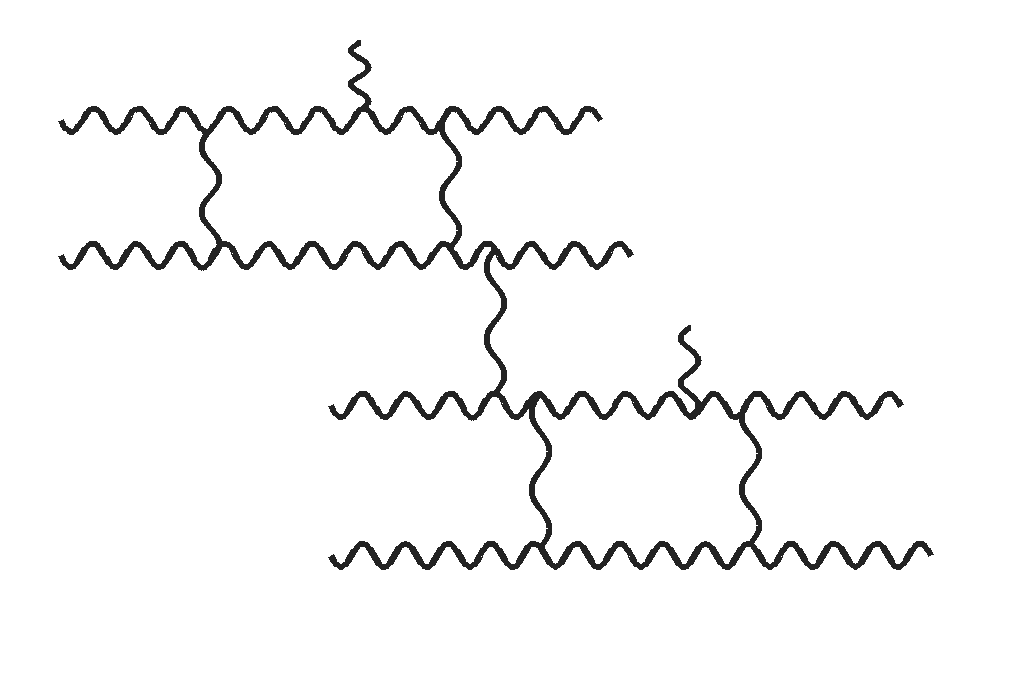
Identify the type of polymer given in the following figure.
 Solve with AI
Written solution
Solution:
Concept: on the basis of structure, polymers are linear, branched or cross-linked (network).
Step 1 — Look at the figure. Each wavy line is a polymer chain, and the chains are joined to one another by many short bridges (cross-links) running between them.
Step 2 — Name the structure. Chains bonded to each other at many points form a three-dimensional network.
Therefore, it is a cross-linked (network) polymer, like bakelite or melamine–formaldehyde resin.
- 481 mark
Question 48
Identify the polymer given below:
 Solve with AI
Written solution
Solution:
Concept: natural rubber is a 1,4-addition polymer of isoprene (2-methylbuta-1,3-diene), , with every double bond in the cis form.
Step 1 — Find the repeating unit. Each unit in the drawing has five carbons, : a C=C carrying a methyl group with a on either side. This is the isoprene unit.
Step 2 — Look at each double bond. At every C=C the two chain bonds leave on the same side of the double bond, so the configuration is cis.
Therefore, the polymer is cis-polyisoprene, i.e. natural rubber.
- 491 mark
Question 49
Why are rubbers called elastomers?
Solve with AIWritten solution
Solution:
Concept: an elastomer is a polymer that can be stretched and returns to its original shape when the force is removed.
Step 1 — Forces in rubber. In rubber the chains are held together only by the weakest intermolecular forces (van der Waals forces), and the chains are coiled.
Step 2 — Result. A small force stretches the coiled chains; a few cross-links between them pull the chains back when the force is removed.
Therefore, rubbers are called elastomers because they are elastic: they stretch easily and regain their shape.
- 501 mark
Question 50
Can enzyme be called a polymer?
Solve with AIWritten solution
Solution:
Concept: a polymer is a big molecule made by joining a large number of small units (monomers).
Step 1 — What an enzyme is. Enzymes are proteins.
Step 2 — What a protein is. A protein is made of a large number of α-amino acid units joined by peptide (amide) links, .
Therefore, yes — an enzyme is a natural polymer (a polyamide / polypeptide of α-amino acids).
- 511 mark
Question 51
To have practical application why are cross links in rubber?
Solve with AIWritten solution
Solution:
Concept: raw natural rubber is soft and sticky, becomes softer when hot and brittle when cold, and its chains slip past one another when stretched.
Step 1 — What the cross-links do. Sulphur cross-links (made by vulcanisation) tie neighbouring chains together, so the chains cannot slide past each other.
Step 2 — Effect on properties. The rubber becomes harder and stronger, is no longer sticky, keeps its elasticity over a wider range of temperature, and resists solvents and oxidising agents better.
Therefore, cross-links are needed to make rubber strong, non-sticky and truly elastic, so that it can be used for tyres, tubes and other goods.
- 521 mark
Question 52
What is a plasticizer?
Solve with AIWritten solution
Solution:
Concept: thermoplastics such as PVC are hard; their workability must be improved before moulding.
Step 1 — Definition. A plasticizer is an organic compound added to a polymer during processing to make it softer and more flexible at lower temperatures.
Step 2 — How it works. Its molecules get in between the polymer chains and weaken the forces between them, so the chains can move more easily.
Example: dialkyl phthalates such as di-n-butyl phthalate (dibutyl phthalate), added to PVC.
- 531 mark
Question 53
Give the name of the polymer which is used for making non-stick utensils.
Solve with AIWritten solution
Solution:
Concept: a non-stick coating must resist heat and must not react with food.
Step 1 — Choose the polymer. Polytetrafluoroethylene is chemically inert and stable to heat because of its very strong C–F bonds.
Therefore, the polymer is Teflon (polytetrafluoroethylene, PTFE).
- 541 mark
Question 54
Write equation for the preparation of teflon.
Solve with AIWritten solution
Solution:
Concept: Teflon is an addition polymer: tetrafluoroethylene molecules add to one another by a free-radical chain reaction, with no small molecule lost.
Step 1 — Monomer. Tetrafluoroethylene, .
Step 2 — Equation. It is heated under high pressure with a free-radical catalyst (a peroxide such as acetyl peroxide, or ammonium persulphate):
The product is Teflon (polytetrafluoroethylene).
- 551 mark
Question 55
Write equation for the preparation of polyacrylonitrile.
Solve with AIWritten solution
Solution:
Concept: polyacrylonitrile (PAN, Orlon, Acrilan) is an addition polymer of acrylonitrile (vinyl cyanide).
Step 1 — Monomer. Acrylonitrile, .
Step 2 — Equation. It polymerises in the presence of a peroxide catalyst:
The product is polyacrylonitrile (PAN).
- 561 mark
Question 56
What is the primary structural feature necessary for a molecule to make it useful in a condensation polymerization reaction?
Solve with AIWritten solution
Solution:
Concept: in condensation polymerisation two molecules join by reacting their functional groups, losing a small molecule such as water.
Step 1 — Why one group is not enough. A molecule with only one reactive group can react once and the chain stops there.
Step 2 — The needed feature. To keep the chain growing at both ends, each monomer must carry at least two reactive functional groups, e.g. or .
Therefore, the monomer must be bifunctional (or polyfunctional).
- 571 mark
Question 57
Name a synthetic polymer which is an amide.
Solve with AIWritten solution
Solution:
Concept: polyamides have amide links, , in the main chain.
Step 1 — Example. Nylon-6,6 is made from adipic acid and hexamethylenediamine, joined by amide links.
Therefore, nylon-6,6 (or nylon-6) is a synthetic polyamide.
- 581 mark
Question 58
Write the structure of monomeric unit of nylon-6.
Solve with AIWritten solution
Solution:
Concept: nylon-6 is made from caprolactam, a cyclic amide with six carbon atoms; the ring opens and the units join by amide links.
Step 1 — Monomer. Caprolactam, (a seven-membered ring).
Step 2 — Repeating (monomeric) unit in the polymer.
The monomeric unit of nylon-6 is , derived from caprolactam.
- 592 marks
Question 59
Write the structures of the monomers of the following polymers:
(a)
(b)
Solve with AIWritten solution
Solution:
Concept: to find the monomers, break the link that was formed in polymerisation and give back the small molecule (here water) that was lost.
(a)
Step 1 — Find the link. The chain is made of groups joined through oxygen, : an ether link.
Step 2 — Give back the water. Such a link forms when two –OH groups join with loss of water, so each part comes from one molecule of
Monomer: ethylene glycol (ethane-1,2-diol). (The same chain can also be made from ethylene oxide by ring opening.)
(b)
Step 1 — Find the link. The chain contains (imine) links.
Step 2 — Give back the water. An imine link forms when a –CHO group reacts with an –NH₂ group and water is lost. Breaking each link back into + gives two monomers:
Monomers: hexane-1,6-dial (adipaldehyde) and hexane-1,6-diamine (hexamethylenediamine). (The printed unit ends in ; its double bond closes on the CH of the next unit.)
- 602 marks
Question 60
What is the repeating unit in the condensation polymer obtained by combining (succinic acid) and (ethylenediamine).
Solve with AIWritten solution
Solution:
Concept: a –COOH group and an –NH₂ group condense to form an amide link, , with loss of water. With two groups on each monomer, the chain grows at both ends (like nylon-6,6).
Step 1 — Join the monomers. Each –COOH of succinic acid reacts with an –NH₂ of ethylenediamine; two water molecules are lost per repeating unit.
Step 2 — Write the repeating unit.
The polymer is a polyamide (nylon-2,4); its repeating unit is .
- 612 marks
Question 61
Draw the repeating structural units of the step growth polymer you would expect to obtain from the following reactions.
(a)
(b)
Solve with AIWritten solution
Solution:
Concept: In step growth polymerisation each bifunctional monomer reacts at both ends, and a small molecule is lost at every new link.
(a) Dibromide + diol with a base → polyether.
Step 1 — Find the link formed. The base removes from –OH, and the alkoxide ion replaces Br (as in Williamson's ether synthesis), so C–O–C (ether) links form and HBr is eliminated (taken up by the base).
Step 2 — Write the polymer.
We join monomer units, losing one small molecule at every new link:
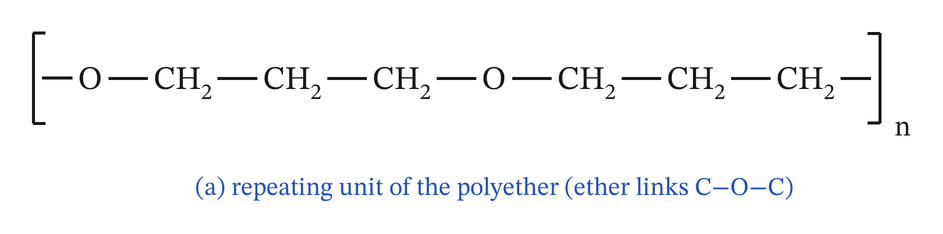
Repeating unit: (a polyether).
(b) Diol + dicarboxylic acid with acid catalyst → polyester.
Step 1 — Find the link formed. Each –OH of ethylene glycol and –COOH of the acid form an ester link, , with loss of water.
Step 2 — Write the polymer.
We join monomer units, losing one small molecule at every new link:

Repeating unit: (a polyester).
- 622 marks
Question 62
Which factor imparts crystalline nature to a polymer like nylon?
Solve with AIWritten solution
Solution:
Concept: a polymer is crystalline when its chains can line up side by side in a regular, closely packed way. This needs strong forces between the chains.
Step 1 — Structure of nylon. Nylon chains are linear and contain many amide groups: the of one chain lies near the of the next.
Step 2 — Force between chains. Strong intermolecular hydrogen bonds, , hold the chains together and keep them closely packed and parallel.
Therefore, the strong hydrogen bonding between the linear chains gives nylon its crystalline nature (and its high tensile strength, as a fibre).
- 632 marks
Question 63
Name the polymers used in laminated sheets and give the name of monomeric units involved in its formation.
Solve with AIWritten solution
Solution:
Concept: laminated sheets need a hard, heat-setting (thermosetting) resin that binds the layers; the formaldehyde resins are used for this.
Step 1 — Polymer. Urea–formaldehyde resin is used for laminated sheets (and unbreakable cups).
Step 2 — Monomers. It is a condensation polymer of
- urea, , and
- formaldehyde, ,
joined by links with loss of water.
(Melamine–formaldehyde resin, from melamine and formaldehyde, is also used for decorative laminates.)
- 642 marks
Question 64
Which type of biomolecule have some structural similarity with synthetic polyamides? What is this similarity?
Solve with AIWritten solution
Solution:
Concept: a polyamide is a polymer whose units are joined by amide links, .
Step 1 — The biomolecule. Proteins resemble synthetic polyamides such as nylons.
Step 2 — The similarity. In proteins the α-amino acid units are joined by peptide links, — the same amide link that joins the units of nylon. Both are formed by condensation with loss of water.
Therefore, proteins are natural polyamides: both contain the amide (peptide) linkage.
- 652 marks
Question 65
Why should the monomers used in addition polymerisation through free radical pathway be very pure?
Solve with AIWritten solution
Solution:
Concept: free-radical polymerisation is a chain reaction. Each chain grows as long as its radical end keeps adding monomer molecules.
Step 1 — What impurities do. Impurities react with the growing radical.
- Some (e.g. ) act as chain transfer agents: they stop the growing chain and start new short chains, so the average molecular mass falls.
- Others (phenols, amines, quinones) act as inhibitors: they form very stable radicals that stop the chain altogether.
Step 2 — Result. With impurities present we get short chains or no polymer.
Therefore, the monomers must be very pure so that long chains of the required molecular mass are formed.
- 662 marks
Question 66
Arrange the following in the increasing order of their tensile strength. Nylon-6, Buna-S and polythene.
Solve with AIWritten solution
Solution:
Concept: tensile strength rises with the strength of the forces between the chains: elastomers (weakest) < thermoplastics (intermediate) < fibres (strongest).
Step 1 — Classify each polymer.
- Buna-S – an elastomer (weak van der Waals forces).
- Polythene – a thermoplastic (intermediate forces).
- Nylon-6 – a fibre (strong hydrogen bonds between chains).
Step 2 — Arrange.
Increasing tensile strength: Buna-S < Polythene < Nylon-6.
- 672 marks
Question 67
What are the monomers of SBR or Buna-S?
Solve with AIWritten solution
Solution:
Concept: Buna-S (styrene–butadiene rubber, SBR) is a copolymer. In the name, Bu = butadiene, Na = sodium (the initiator) and S = styrene.
Step 1 — Monomer 1. Buta-1,3-diene, .
Step 2 — Monomer 2. Styrene (vinylbenzene), .
The monomers of Buna-S are 1,3-butadiene and styrene.
- 682 marks
Question 68
What is the main constituent of bubble gum?
Solve with AIWritten solution
Solution:
Concept: bubble gum must stretch into a thin film without breaking, so its base is a rubber-like (elastomeric) synthetic polymer.
Step 1 — Main constituent. The gum base of bubble gum is mainly styrene–butadiene rubber (SBR, Buna-S), a copolymer of styrene and 1,3-butadiene.
Step 2 — Why it works. Like other elastomers, SBR stretches easily and regains its shape, so a thin film can be blown into a bubble.
(Other gum bases also contain polyvinyl acetate or polyisobutylene.)
- 692 marks
Question 69
What is the name and structure of the monomer of natural rubber?
Solve with AIWritten solution
Solution:
Concept: natural rubber is cis-polyisoprene, a 1,4-addition polymer of one monomer.
Step 1 — Name. Isoprene, i.e. 2-methylbuta-1,3-diene (2-methyl-1,3-butadiene).
Step 2 — Structure.
The monomer of natural rubber is isoprene, .
- 705 marks
Question 70
Can nucleic acids, proteins and starch be considered as step growth polymers?
Solve with AIWritten solution
Solution:
Concept: in step growth (condensation) polymerisation, molecules with two (or more) functional groups join step by step, and a small molecule such as water is lost each time a link forms. Any two species (monomers, dimers, longer chains) can join.
Step 1 — Proteins. Proteins are formed from α-amino acids. The –COOH of one amino acid and the –NH₂ of the next form a peptide link, , and water is lost:
Each amino acid has two reacting groups, so the chain keeps growing step by step.
Step 2 — Starch. Starch is formed from α-D-glucose. The –OH groups of neighbouring glucose units join to form glycosidic (C–O–C) links, and one water molecule is lost for each link:
Step 3 — Nucleic acids. DNA and RNA are formed from nucleotides. The phosphate group of one nucleotide joins the sugar –OH of the next to form a phosphodiester link, again with loss of water.
Step 4 — Conclusion. In all three, bifunctional units join stepwise through condensation with loss of water.
Therefore, yes — nucleic acids, proteins and starch can all be regarded as natural step growth (condensation) polymers.
- 715 marks
Question 71
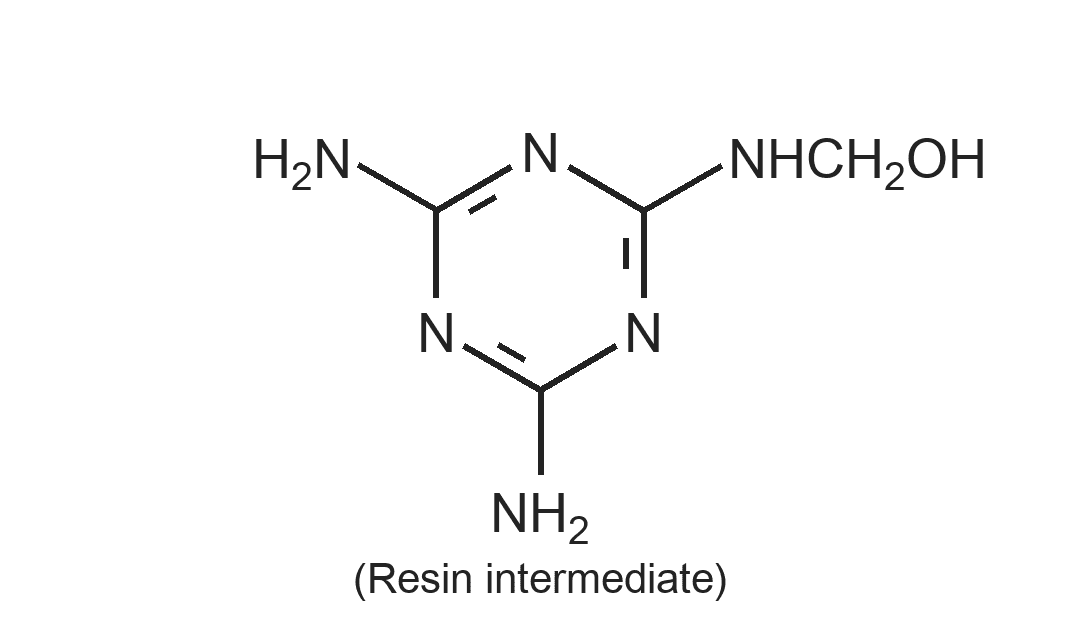
How is the following resin intermediate prepared and which polymer is formed by this monomer unit?
 Solve with AI
Written solution
Solution:
Concept: formaldehyde reacts with –NH₂ groups to give –NH–CH₂OH (methylol) groups. These methylol groups then condense with –NH₂ groups of other molecules, losing water, to form –NH–CH₂–NH– bridges. This is how the formaldehyde resins are made.
Step 1 — Identify the intermediate. The molecule is a 1,3,5-triazine ring carrying two –NH₂ groups and one –NHCH₂OH group. The parent compound with three –NH₂ groups is melamine (2,4,6-triamino-1,3,5-triazine), . So the intermediate is methylol melamine (melamine in which one –NH₂ has become –NHCH₂OH).
Step 2 — Preparation. Melamine is heated with formaldehyde; one –NH₂ group adds to the C=O of formaldehyde:
Step 3 — Polymerisation. On further heating, the –NHCH₂OH group of one molecule reacts with an –NH₂ group of another, water is lost, and a methylene bridge –NH–CH₂–NH– joins the rings:
Because each ring has several –NH₂ groups, bridges form in all directions and a hard, cross-linked (thermosetting) network results.
Step 4 — The polymer. The polymer formed is melamine–formaldehyde resin (Melmac), used for unbreakable crockery (dinnerware) and decorative articles.
- 725 marks
Question 72
Why does cis-polyisoprene possess elastic property?
Solve with AIWritten solution
Solution:
Concept: a polymer is elastic when its chains are held by weak forces and are coiled, so that they straighten when pulled and coil back when released.
Step 1 — Structure. Natural rubber is cis-polyisoprene, , with every double bond in the cis form.
Step 2 — Effect of the cis double bonds. At each cis double bond the chain bends. The chains therefore cannot lie straight and close to each other; they take a coiled shape.
Step 3 — Forces between chains. Since the chains cannot come close, only weak van der Waals forces act between them.
Step 4 — Stretching and recovery. When pulled, the coils open out and the chains become partly aligned, like a spring being stretched. When the force is removed, the chains return to their coiled state and the rubber regains its shape.
Therefore, the cis configuration (coiled chains, weak intermolecular forces) makes cis-polyisoprene elastic.
Watch out: trans-polyisoprene (gutta-percha) has regular zig-zag chains that pack closely, so it is hard and non-elastic.
- 735 marks
Question 73
What is the structural difference between HDP and LDP? How does the structure account for different behaviour and nature, hence the use of a polymer?
Solve with AIWritten solution
Solution:
Concept: for the same monomer (ethene), the way the chains are built — linear or branched — decides how closely they pack, and packing decides density, strength and use.
Step 1 — Low density polythene (LDP). It is made by free-radical polymerisation of ethene at high pressure (1000–2000 atm) and high temperature, with a trace of oxygen or a peroxide as initiator. The radicals attack the chain at random places, so the chains are highly branched.
Step 2 — High density polythene (HDP). It is made at low pressure (about 6–7 atm) and about 333–343 K with a Ziegler–Natta catalyst (triethylaluminium + titanium tetrachloride). The chains are linear, with almost no branches.
Step 3 — How the structure controls behaviour.
Property LDP (branched) HDP (linear) Packing of chains loose (branches keep chains apart) close Density low (about 0.92 g cm⁻³) high (about 0.97 g cm⁻³) Intermolecular forces weaker stronger Nature soft, flexible, tough hard, rigid, higher tensile strength Melting point lower higher Both are chemically inert and poor conductors of electricity.
Step 4 — Hence the uses.
- LDP (flexible): squeeze bottles, flexible pipes, toys, packaging films and carry bags, insulation of electric wires.
- HDP (rigid, strong): buckets, dustbins, bottles, pipes and containers.
Therefore, LDP is branched and loosely packed (soft and flexible), while HDP is linear and closely packed (dense, hard and strong), and each is used where these properties are needed.
- 745 marks
Question 74
What is the role of benzoyl peroxide in addition polymerisation of alkenes? Explain its mode of action with the help of an example.
Solve with AIWritten solution
Solution:
Concept: free-radical addition polymerisation needs an initiator — a substance that easily breaks into free radicals to start the chain. Benzoyl peroxide is such an initiator.
Step 1 — Role. Benzoyl peroxide acts as the free-radical initiator. Its weak O–O bond breaks on heating, giving radicals that start the chain.
Step 2 — Formation of radicals (initiation, part 1). On heating, the O–O bond breaks homolytically; the benzoyloxy radical then loses to give a phenyl radical:
Example: polymerisation of ethene to polythene.
Step 3 — Chain initiation (part 2). The phenyl radical adds to an ethene molecule, giving a new, larger radical:
Step 4 — Chain propagation. The new radical adds another ethene molecule, and this repeats again and again, so the chain grows:
Step 5 — Chain termination. Finally two growing radicals combine, and the chain stops:
Therefore, benzoyl peroxide starts the chain by supplying free radicals; the monomer then adds on step by step (propagation) until two radicals meet (termination), giving polythene.
- 755 marks
Question 75
What is the function of sulphur in vulcanization of rubber? or what is vulcanization of rubber?
Solve with AIWritten solution
Solution:
Concept: raw natural rubber is soft and sticky, becomes softer at high temperatures and brittle at low temperatures, has low tensile strength, absorbs much water and is attacked by organic solvents and oxidising agents.
Step 1 — What vulcanisation is. Vulcanisation is the process of heating raw rubber with sulphur (and an accelerator such as zinc oxide) at about 373–415 K. It was discovered by Charles Goodyear.
Step 2 — Function of sulphur. Sulphur forms sulphur bridges (cross-links), such as , between neighbouring polymer chains. They form at the reactive allylic positions (next to the C=C) or at the double bonds.
Step 3 — Why the cross-links help. The chains are now locked together:
- when stretched, the chains straighten but cannot slip past each other;
- when released, the cross-links pull them back to the original shape.
Step 4 — Improved properties. Vulcanised rubber is harder, stronger and non-sticky, has excellent elasticity over a wider temperature range, low water absorption, and resists organic solvents and oxidising agents.
Step 5 — Amount of sulphur. The hardness depends on the amount of sulphur: about 5% for tyre rubber, and about 30% for hard ebonite (battery cases).
Therefore, sulphur cross-links the rubber chains, turning soft, sticky raw rubber into strong, elastic vulcanised rubber.
- 765 marks
Question 76
(a) Write the name and structure of the monomer of neoprene rubber.
(b) Name the polymer used for making contact lenses?
(c) Write the name of the polymer which is also known as orlon or Acrilon.
(d) What is the monomer of PVC?
(e) Write equation for the preparation of polyvinyl chloride.
Solve with AIWritten solution
Solution:
Key idea: each commercial polymer is named from its monomer; write the monomer and keep the repeating unit the same as the monomer for addition polymers.
(a) Monomer of neoprene. Neoprene is an addition polymer of chloroprene (2-chlorobuta-1,3-diene):
(b) Contact lenses. Lenses are made of polymethyl methacrylate (PMMA, Perspex), a hard, transparent polymer of methyl methacrylate, . (Soft contact lenses use a related polymer, poly(2-hydroxyethyl methacrylate).)
(c) Orlon / Acrilan. It is polyacrylonitrile (PAN), , the addition polymer of acrylonitrile, .
(d) Monomer of PVC. Vinyl chloride (chloroethene), .
(e) Preparation of PVC.
Step 1 — Making the monomer. Vinyl chloride is obtained by adding HCl to acetylene in the presence of as catalyst:
Step 2 — Polymerisation. Vinyl chloride is heated under pressure with an organic peroxide (free-radical initiator):
The product is polyvinyl chloride (PVC).
- 775 marks
Question 77
(a) Write the monomer units of bakelite.
(b) Write the name and structure of monomer units of nylon 6, 6.
Solve with AIWritten solution
Solution:
Key idea: both bakelite and nylon-6,6 are condensation polymers made from two different monomers, with loss of water.
(a) Bakelite.
Step 1 — Name the monomers. Bakelite is a phenol–formaldehyde resin. Its monomer units are
- phenol, , and
- formaldehyde (methanal), .
Step 2 — How they join. Phenol and formaldehyde first give o- and p-hydroxymethylphenol; these condense with more phenol, losing water, so the rings are joined by bridges. With more formaldehyde and heat, the chains cross-link to give hard bakelite.
(b) Nylon-6,6.
Step 1 — Name and structure of the monomers. The name "6,6" means each monomer has six carbon atoms. The monomers are
Hexamethylenediamine (hexane-1,6-diamine):
Adipic acid (hexanedioic acid):
Step 2 — How they join. They condense, with loss of water, to give amide links:
Monomers of nylon-6,6: hexamethylenediamine and adipic acid.
What Class 12 Chemistry Ch 15 covers
The sections of the chapter, in the order the book takes them. Every question above comes from one of these.
- 01Monomers and Polymerisation
- 02Classification of Polymers
- 03Addition (Chain-Growth) Polymerisation
- 04Condensation (Step-Growth) Polymerisation
- 05Copolymerisation
- 06Natural and Synthetic Rubber
More ways to study this chapter
The same chapter asked three other ways. Practise it, revise it, and see what the board has set on Ch 15 before.
- Competency-Based Questions (CBQ)Case study questions: a situation, and the part of the chapter that answers it.40questionsOpen
- Previous Year QuestionsQuestions that have actually appeared in board papers, each tagged with its year.7questionsOpen
- Practice QuestionsExtra questions per chapter, for when one attempt at a method is not enough.97questionsOpen
Ch 15 in past ISC papers
The same chapter as the board has actually asked it. These are worded differently from the textbook exercise, which is the point of reading them.
- 12 marks
Board paper question 1
Name the monomers and the type of polymerization in each of the following polymers:
(a) Polyester
(b) Bakelite
Solve with AIWritten solution
Solution:
Key idea: In addition polymerisation, monomers with a double bond join without losing any atoms. In condensation polymerisation, monomers with two reactive groups each join with the loss of a small molecule, usually water, at every link.
Step 1 — (a) Choose the polyester to describe.
A polyester is a polymer whose units are joined by ester links . The best-known polyester is Terylene, so we describe it.
Step 2 — (a) Name its monomers and the type of polymerisation.
Terylene (also called Dacron) is a polyester. Its monomers are ethylene glycol (ethane-1,2-diol, ) and terephthalic acid (benzene-1,4-dicarboxylic acid, ). The group of the glycol reacts with the group of the acid to form an ester link, and a molecule of water is lost at every link, so this is condensation (step-growth) polymerisation.
Another polyester in the syllabus, glyptal, is made in the same way from ethylene glycol and phthalic acid.
Step 3 — (b) Name the monomers of Bakelite and the type of polymerisation.
Bakelite is made from phenol () and formaldehyde (methanal, ). Formaldehyde first adds at the ortho and para positions of phenol to give hydroxymethylphenols. These units then join through bridges between the rings, losing a molecule of water at each new link, first into a linear polymer (novolac) and then, on heating with more formaldehyde, into a hard cross-linked network. Water is lost at every step, so this is condensation polymerisation.
Therefore, (a) polyester (Terylene) is made from ethylene glycol and terephthalic acid by condensation polymerisation; (b) Bakelite is made from phenol and formaldehyde by condensation polymerisation.
- 24 marks
Board paper question 2
Answer the following:
(i) What do you observe when glucose solution is heated with Tollen's reagent?
(ii) Name the monomers and the type of polymerisation in each of the following polymers:
(1) Terylene
(2) Polyvinyl chloride
Solve with AIWritten solution
Solution:
Key idea: Tollens' reagent (ammoniacal silver nitrate, which contains ) is a mild oxidising agent that is reduced to metallic silver by aldehydes. Polymers are made either by addition of monomers with a double bond or by condensation of monomers with two reactive groups.
Step 1 — (i) Recognise the reacting group in glucose.
Glucose is an aldohexose: its open-chain form carries an aldehyde group , so it behaves as a reducing sugar.
Step 2 — (i) State what is seen and why.
On warming, a shining silver mirror forms on the inner wall of the test tube (or a grey-black deposit of silver if the glass is not clean). The aldehyde group of glucose reduces the silver ions to metallic silver and is itself oxidised to a carboxylate group, giving gluconic acid (present as gluconate ion in the alkaline solution).
Step 3 — (ii)(1) Name the monomers of Terylene and the type of polymerisation.
Terylene (also called Dacron) is a polyester. Its monomers are ethylene glycol (ethane-1,2-diol, ) and terephthalic acid (benzene-1,4-dicarboxylic acid, ). The group of the glycol reacts with the group of the acid to form an ester link, and a molecule of water is lost at every link, so this is condensation (step-growth) polymerisation.
Step 4 — (ii)(2) Name the monomer of polyvinyl chloride and the type of polymerisation.
Polyvinyl chloride (PVC) is made from a single monomer, vinyl chloride (chloroethene, ). Heated with a peroxide initiator, its double bonds open and the molecules join end to end without losing any atoms, so this is addition (chain-growth, free-radical) polymerisation.
Therefore, (i) a silver mirror forms because glucose reduces Tollens' reagent to silver and is oxidised to gluconic acid; (ii)(1) Terylene comes from ethylene glycol and terephthalic acid by condensation polymerisation; (ii)(2) PVC comes from vinyl chloride by addition polymerisation.
- 31 mark
Board paper question 3
Complete the following statements by selecting the correct alternative from the choices given:
The polymer formed by the condensation of hexamethylenediamine and adipic acid is:
Solve with AIAnswer
(A) Teflon
(B) Bakelite
(C) Dacron
- Correct
(D) Nylon-66
Answer: (D) Nylon-66
Key idea: A diamine and a dicarboxylic acid condense to form a polyamide, with an amide link and loss of water at each step.
Step 1 — Count the carbon atoms in each monomer.
Hexamethylenediamine, , has 6 carbon atoms. Adipic acid, , also has 6 carbon atoms.
Step 2 — Name the polyamide.
A nylon made from a diamine and a diacid is named by the carbon counts of the two monomers, diamine first. Both monomers have 6 carbon atoms, so the polymer is nylon-6,6 (nylon-66).
Why the others are wrong:
- (A) Teflon is an addition polymer of tetrafluoroethene, ; it contains no nitrogen at all.
- (B) Bakelite is a condensation polymer of phenol and formaldehyde, joined by bridges between benzene rings.
- (C) Dacron (Terylene) is a polyester made from ethylene glycol and terephthalic acid, not a polyamide.
Therefore, hexamethylenediamine and adipic acid condense to give nylon-66, option (D).
- 42 marks
Board paper question 4
Write the names of the monomers for each of the following polymers:
(a) Bakelite
(b) Nylon-2-nylon-6
Solve with AIWritten solution
Solution:
Key idea: The monomers of a condensation polymer are the molecules that join, with loss of water, to build its repeating unit.
Step 1 — (a) Name the monomers of Bakelite.
Bakelite is made from phenol () and formaldehyde (methanal, ). Formaldehyde first adds at the ortho and para positions of phenol to give hydroxymethylphenols. These units then join through bridges between the rings, losing a molecule of water at each new link, first into a linear polymer (novolac) and then, on heating with more formaldehyde, into a hard cross-linked network. Water is lost at every step, so this is condensation polymerisation.
Step 2 — (b) Name the monomers of nylon-2–nylon-6.
Nylon-2–nylon-6 is a copolymer: it is built from two different amino acids. Its monomers are glycine (aminoethanoic acid, , which has 2 carbon atoms) and 6-aminohexanoic acid (also called aminocaproic acid, , which has 6 carbon atoms). They join through amide links with loss of water, giving an alternating polyamide.
Nylon-2–nylon-6 is a biodegradable polyamide.
Therefore, (a) the monomers of Bakelite are phenol and formaldehyde; (b) the monomers of nylon-2–nylon-6 are glycine and 6-aminohexanoic acid (aminocaproic acid).
- 51 mark
Board paper question 5
Select the correct alternative from the choice given:
Which, among the following polymers, is polyester?
Solve with AIAnswer
(A) Melamine
(B) Bakelite
- Correct
(C) Terylene
(D) Polythene
Answer: (C) Terylene
Key idea: A polyester is a polymer whose repeating units are joined by ester links, , formed when a diol condenses with a dicarboxylic acid.
Step 1 — Find the polymer with ester links.
Terylene is made from ethylene glycol (a diol) and terephthalic acid (a dicarboxylic acid). Each group reacts with a group to give an ester link, so Terylene is a polyester.
Step 2 — Check the other polymers for ester links.
None of the other three polymers contains an ester link, as the bullets below show, so Terylene is the only polyester in the list.
Why the others are wrong:
- (A) Melamine is the monomer of melamine–formaldehyde resin, a condensation polymer whose units are joined mainly by links; it has no ester links.
- (B) Bakelite is a phenol–formaldehyde polymer; its benzene rings are joined mainly by bridges; it has no ester links.
- (D) Polythene is an addition polymer of ethene; it contains only C–C and C–H bonds.
Therefore, the polyester among the given polymers is Terylene, option (C).
- 62 marks
Board paper question 6
I) Name the monomer and the type of polymerization that takes place when PTFE is formed.
II) Name the monomers of nylon-6, 6.
Solve with AIWritten solution
Solution:
Key idea: PTFE (Teflon) is made from one monomer with a C=C double bond, so it forms by addition. Nylon-6,6 is made from two monomers, each with two reactive groups, so it forms by condensation.
Step 1 — (I) Name the monomer of PTFE.
PTFE stands for polytetrafluoroethene. Its monomer is tetrafluoroethene, .
Step 2 — (I) State the type of polymerisation.
When tetrafluoroethene is heated under high pressure with a free-radical initiator (such as a persulphate), the double bonds open and the molecules join end to end. No atoms are lost, so this is addition (chain-growth, free-radical) polymerisation.
Step 3 — (II) Name the monomers of nylon-6,6.
The monomers of nylon-6,6 are hexamethylenediamine (hexane-1,6-diamine, ) and adipic acid (hexanedioic acid, ). The amine group of one reacts with the acid group of the other to form an amide link , and water is lost at each link.
Therefore, (I) PTFE is formed from tetrafluoroethene by addition polymerisation; (II) the monomers of nylon-6,6 are hexamethylenediamine and adipic acid.
All 7 board paper questions for this chapter, solved the same way.
Class 12 Chemistry Ch 15 questions students ask
How many questions are there in Class 12 Chemistry Ch 15?
77 questions. Every one is solved step by step on this page.
Are these Class 12 Chemistry solutions free?
Yes. Every question and its full working is free to read, with no account needed.
Can I download the Class 12 Chemistry Ch 15 solutions as a PDF?
There is no PDF to download. Every solution is on this page instead, which means it is searchable, always the current syllabus, and readable on a phone. Use your browser's print option if you want it on paper.