
Question 21 markMCQMedium

Major product 'X' is
Confirming your payment
Sign up now and get 250 free tokens.
Aldehydes, Ketones and Carboxylic Acids · Question 2 of 80
Major product 'X' is
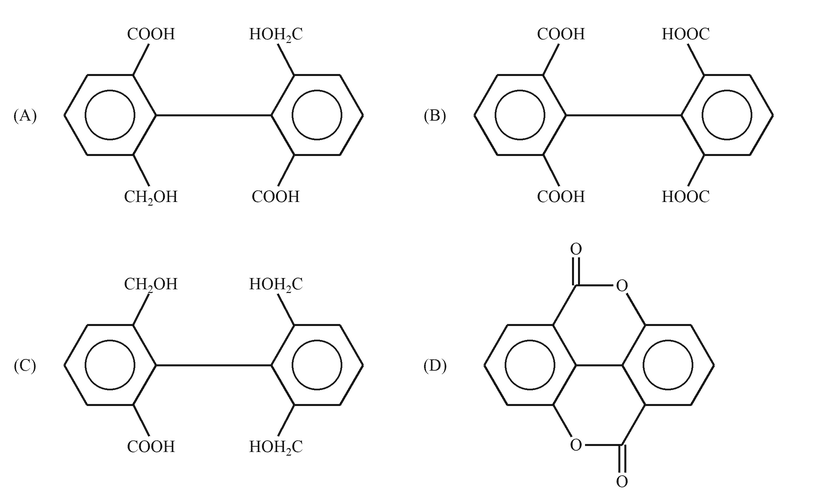
(A) Structure (A)
(B) Structure (B)
(C) Structure (C)
(D) Structure (D)
Answer: (A) the product with one –COOH group and one –CH₂OH group on each ring
Key idea: An aldehyde with no α-hydrogen, heated with concentrated alkali, undergoes the Cannizzaro reaction: one –CHO group is oxidised to –COO⁻ and another is reduced to –CH₂OH, by transfer of a hydride ion between them. When two such –CHO groups are held close together in one molecule, the reaction takes place inside the molecule (intramolecular Cannizzaro reaction).
Step 1 — Check the –CHO groups for α-hydrogens.
Each of the four –CHO groups is joined directly to a carbon of a benzene ring, and that ring carbon carries no hydrogen. So no –CHO group has an α-hydrogen, aldol condensation is impossible, and hot NaOH (100 °C) brings about the Cannizzaro reaction.
Step 2 — Find which –CHO groups react together.
The two rings are joined through C-1 and C-1′. So the –CHO group at C-2 of the left ring lies next to the –CHO group at C-2′ of the right ring (the top pair), and the –CHO groups at C-6 and C-6′ form the bottom pair. Each facing pair reacts like two molecules of benzaldehyde: a hydride ion passes from one –CHO group to the other.
Step 3 — Write what the alkali step gives.
In each pair one –CHO group becomes –COO⁻ and the other becomes –CH₂OH. Overall two groups are oxidised and two are reduced, and every carbon atom is kept.
Step 4 — Acidify the product.
Dilute acid () turns each –COO⁻ group into –COOH, and the –CH₂OH groups are unchanged.
So the top pair now carries one –COOH group and one –CH₂OH group, and so does the bottom pair. This is structure (A).
Why the other options are wrong:
Therefore, X is the compound with one –COOH group and one –CH₂OH group on each ring, structure (A): option (A).