
Opening your dashboard
Class 12 Chemistry Chapter 12: Aldehydes, Ketones and Carboxylic Acids Solutions
80 textbook questions with step-by-step answers, free to read, for ISC 2026-27.
Get talked through Ch 12, not just shown the answer
Reading a finished solution is not the same as being able to do it. The AI tutor takes one question at a time and works it with you, in your own words, until you can.
- Ask it out loud, in your own words
- It gives you the next step, not the answer
- Stuck on part (ii)? Start there
80 questions with solutions
1–5 marks · Mixed difficulty
The first 48 solutions are on this page. This chapter is a long one, so the rest open on their own page to keep this one quick to load.
- 11 mark
Question 1
Treatment of cyclopentanone with methyllithium gives which of the following species?
Solve with AIAnswer
(A) Cyclopentanonyl radical
(B) Cyclopentanonyl biradical
- Correct
(C) Cyclopentanonyl anion
(D) Cyclopentanonyl cation
Answer: (C) Cyclopentanonyl anion
Key idea: Methyllithium, , has a very polar C–Li bond, so it reacts as a source of the methyl carbanion, . A carbanion is both a strong base and a strong nucleophile. It reacts with a ketone by ionic (polar) steps, in which electrons move in pairs, so the organic species formed is negatively charged; no radicals or cations are formed.
Step 1 — See what the name in option (C) means.
"Cyclopentanonyl" is cyclopentanone with one hydrogen atom removed. So the cyclopentanonyl anion is the anion left when an α-hydrogen (a hydrogen on a carbon next to C=O) is taken off cyclopentanone as a proton. Its negative charge is shared between the α-carbon and the oxygen, so it is an enolate ion.
Step 2 — Show how methyllithium forms this anion.
Acting as a strong base, the methyl carbanion removes an α-hydrogen as a proton. Methane is given off, and the enolate is held as its lithium salt.
Step 3 — Compare with the addition path.
Methyllithium is also a strong nucleophile, and with an unhindered ketone such as cyclopentanone it usually adds to the carbonyl carbon. This gives the lithium salt of 1-methylcyclopentan-1-olate, which water converts into 1-methylcyclopentan-1-ol. This alkoxide is also an anion, so whichever path is followed, the species formed carries a negative charge.
Why the other options are wrong:
- (A) is wrong: A radical has one unpaired electron and forms when a bond breaks evenly; the C–Li bond reacts by giving its whole electron pair to carbon, so no radical is formed.
- (B) is wrong: A biradical has two unpaired electrons; in these ionic steps electrons move only in pairs, so no unpaired electrons appear.
- (D) is wrong: The methyl group brings an electron pair to the ketone (as a base or as a nucleophile), so the organic species gains negative charge; a cation would need electrons to be removed.
Therefore, methyllithium converts cyclopentanone into a negatively charged species, the cyclopentanonyl anion: option (C).
- 21 mark
Question 2

Major product 'X' is
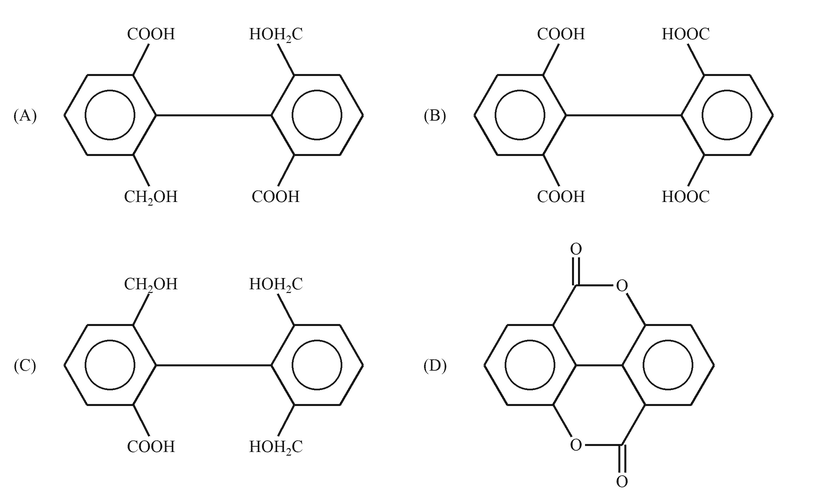 Solve with AI
Answer
- Correct
(A) Structure (A)
(B) Structure (B)
(C) Structure (C)
(D) Structure (D)
Answer: (A) the product with one –COOH group and one –CH₂OH group on each ring
Key idea: An aldehyde with no α-hydrogen, heated with concentrated alkali, undergoes the Cannizzaro reaction: one –CHO group is oxidised to –COO⁻ and another is reduced to –CH₂OH, by transfer of a hydride ion between them. When two such –CHO groups are held close together in one molecule, the reaction takes place inside the molecule (intramolecular Cannizzaro reaction).
Step 1 — Check the –CHO groups for α-hydrogens.
Each of the four –CHO groups is joined directly to a carbon of a benzene ring, and that ring carbon carries no hydrogen. So no –CHO group has an α-hydrogen, aldol condensation is impossible, and hot NaOH (100 °C) brings about the Cannizzaro reaction.
Step 2 — Find which –CHO groups react together.
The two rings are joined through C-1 and C-1′. So the –CHO group at C-2 of the left ring lies next to the –CHO group at C-2′ of the right ring (the top pair), and the –CHO groups at C-6 and C-6′ form the bottom pair. Each facing pair reacts like two molecules of benzaldehyde: a hydride ion passes from one –CHO group to the other.
Step 3 — Write what the alkali step gives.
In each pair one –CHO group becomes –COO⁻ and the other becomes –CH₂OH. Overall two groups are oxidised and two are reduced, and every carbon atom is kept.
Step 4 — Acidify the product.
Dilute acid () turns each –COO⁻ group into –COOH, and the –CH₂OH groups are unchanged.
So the top pair now carries one –COOH group and one –CH₂OH group, and so does the bottom pair. This is structure (A).
Why the other options are wrong:
- (B) is wrong: Four –COOH groups would mean all four –CHO groups are oxidised and none reduced; in the Cannizzaro reaction the hydride ion lost by each oxidised group must be taken up by another –CHO group, so one group is reduced for each one oxidised.
- (C) is wrong: Three –CH₂OH groups and one –COOH group would mean three reductions for one oxidation; each reduction needs a hydride ion that only an oxidised –CHO group can supply, so the two numbers must be equal (two and two).
- (D) is wrong: This dilactone has only two C=O carbons, so it contains 14 carbon atoms, while the starting compound has 16; the Cannizzaro reaction keeps every carbon atom, and it never joins an oxygen atom directly to a ring carbon as this structure does.
Therefore, X is the compound with one –COOH group and one –CH₂OH group on each ring, structure (A): option (A).
- 31 mark
Question 3
did not give a silver mirror with Tollens reagent, but gave an oxime with hydroxylamine. It can give positive
Solve with AIAnswer
- Correct
(A) iodoform test
(B) Fehling's test
(C) Schiff's test
(D) Carbylamine test
Answer: (A) iodoform test
Key idea: A compound that forms an oxime with hydroxylamine has a C=O group, so it is an aldehyde or a ketone. Tollens' reagent gives a silver mirror with aldehydes but not with simple ketones. Ketones that contain a group give the iodoform test.
Step 1 — List the carbonyl compounds with this formula.
The formula fits two carbonyl compounds: propanal, (an aldehyde), and propanone (acetone), (a ketone).
Step 2 — Use the two test results.
The compound forms an oxime, so it has a C=O group. It gives no silver mirror, so it is not the aldehyde. It must therefore be propanone.
Step 3 — Apply the iodoform test.
Propanone has a group, so warming it with iodine and sodium hydroxide gives a yellow precipitate of iodoform, .
Why the other options are wrong:
- (B) is wrong: Fehling's solution is reduced by aliphatic aldehydes; a ketone such as propanone does not reduce it.
- (C) is wrong: Schiff's reagent turns pink with aldehydes; propanone, a ketone, does not give the pink colour in the normal test.
- (D) is wrong: The carbylamine test (chloroform and alcoholic KOH) is given by primary amines, which contain nitrogen; has no nitrogen at all.
Therefore, the compound is propanone, which gives a positive iodoform test: option (A).
- 41 mark
Question 4
Reactions by which benzaldehyde cannot be prepared is:
Solve with AIAnswer
(A) Benzene + CO + HCl in presence of anhyd.
- Correct
(B) Benzoic acid () + Zn/Hg and conc. HCl
(C) Toluene () + in followed by
(D) Benzoyl chloride () + in presence of Pd-
Answer: (B) Benzoic acid + Zn/Hg and conc. HCl
Key idea: Benzaldehyde can be made by adding a –CHO group to benzene, by partly oxidising a group on the ring, or by partly reducing a –COCl group. Zinc amalgam with concentrated HCl (the Clemmensen reagent) does none of these: it reduces the C=O group of aldehydes and ketones all the way to .
Step 1 — Look at what zinc amalgam and HCl do.
The Clemmensen reagent turns a ketone C=O group into , for example acetophenone into ethylbenzene. It does not reduce a –COOH group, and even if an aldehyde formed it could not stop there, because it reduces aldehydes further. So benzoic acid with Zn/Hg and conc. HCl gives no benzaldehyde.
Step 2 — Check the other three methods.
Each of the other three reactions is a standard named preparation of benzaldehyde, as the bullets below show.
Why the other options are wrong:
- (A) is wrong: This is the Gattermann–Koch reaction, which does give benzaldehyde: benzene with carbon monoxide and HCl over anhydrous (with a little CuCl), .
- (C) is wrong: This is the Etard reaction, which does give benzaldehyde: chromyl chloride oxidises the methyl group of toluene to a chromium complex, which water hydrolyses to benzaldehyde.
- (D) is wrong: This is the Rosenmund reduction, which does give benzaldehyde: hydrogen over palladium on barium sulphate (a partly poisoned catalyst) reduces benzoyl chloride only as far as the aldehyde, .
Watch out: Carbon monoxide is very poisonous, and chromyl chloride is a chromium(VI) compound, which is toxic and causes cancer; both are used only with full safety controls in a fume cupboard.
Therefore, benzaldehyde cannot be prepared from benzoic acid with Zn/Hg and conc. HCl: option (B).
- 51 mark
Question 5
Which of the following does not give Cannizzaro's reaction
Solve with AIAnswer
(A) p-––CHO
(B)
(C) HCHO
- Correct
(D)
Answer: (D)
Key idea: The Cannizzaro reaction (one aldehyde molecule reduced and another oxidised by concentrated alkali) is given only by aldehydes with no α-hydrogen, meaning no hydrogen on the carbon next to the –CHO group. An aldehyde with α-hydrogens undergoes aldol condensation with alkali instead.
Step 1 — Count the α-hydrogens in acetaldehyde.
In the carbon next to the –CHO group is the carbon, which carries three α-hydrogens.
Step 2 — Decide what acetaldehyde does with alkali.
Because it has α-hydrogens, the alkali removes one of them to form a carbanion (enolate), and acetaldehyde undergoes aldol condensation rather than the Cannizzaro reaction.
Why the other options are wrong:
- (A) is wrong: In p-nitrobenzaldehyde the –CHO group is joined to a ring carbon that carries no hydrogen, so there is no α-hydrogen and the compound does give the Cannizzaro reaction.
- (B) is wrong: Benzaldehyde has no α-hydrogen for the same reason, and with concentrated NaOH it gives benzyl alcohol and sodium benzoate.
- (C) is wrong: Formaldehyde has no α-carbon at all, and with concentrated NaOH it gives methanol and sodium formate.
Therefore, acetaldehyde, which has α-hydrogens, does not give the Cannizzaro reaction: option (D).
- 61 mark
Question 6
HCHO was treated with a reagent X. The product forms upon hydrolysis in the presence of an acid gave . The reagent X is
Solve with AIAnswer
(A) aqueous KOH
(B) alcoholic KOH
(C) alcoholic KCN
- Correct
(D)
Answer: (D)
Key idea: A Grignard reagent, RMgX, adds its alkyl group to the carbon of a C=O group, and acid hydrolysis of the adduct gives an alcohol. With formaldehyde the product is a primary alcohol with one carbon atom more than the alkyl group of the Grignard reagent.
Step 1 — Count the carbon atoms needed.
Formaldehyde has one carbon atom and ethanol has two, so reagent X must supply one carbon atom that becomes joined to the carbonyl carbon by a new C–C bond.
Step 2 — Add methylmagnesium iodide to formaldehyde.
The methyl group of adds to the carbonyl carbon, and the oxygen takes the MgI group.
Step 3 — Hydrolyse the adduct.
Dilute acid replaces the MgI group by hydrogen, giving ethanol.
Why the other options are wrong:
- (A) is wrong: Concentrated aqueous KOH brings about the Cannizzaro reaction of formaldehyde, giving methanol and potassium formate; no carbon is added, so no ethanol forms.
- (B) is wrong: No carbon atom that could bond to the carbonyl carbon is supplied by alcoholic KOH, so a two-carbon alcohol cannot form from formaldehyde.
- (C) is wrong: Cyanide does add one carbon, but as a group: the cyanohydrin forms, and its acid hydrolysis gives glycolic acid, , not ethanol.
Therefore, reagent X is methylmagnesium iodide: option (D).
- 71 mark
Question 7
Which of the following is/are formed on reaction of benzaldehyde with aqueous NaOH followed by acidification with dilute hydrochloric acid?
Solve with AIAnswer
(A) Benzoic acid
(B) Benzyl alcohol
- Correct
(C) Benzoic acid and benzyl alcohol
(D) p-hydroxybenzaldehyde
Answer: (C) Benzoic acid and benzyl alcohol
Key idea: Benzaldehyde has no α-hydrogen, because its –CHO group is joined to a ring carbon that carries no hydrogen. With sodium hydroxide it therefore undergoes the Cannizzaro reaction: one molecule is reduced to benzyl alcohol and another is oxidised to the benzoate ion.
Step 1 — Write the Cannizzaro reaction.
Two molecules of benzaldehyde react with one hydroxide ion, and a hydride ion passes from one aldehyde molecule to the other.
Step 2 — Acidify the mixture.
Dilute hydrochloric acid, a stronger acid than benzoic acid, converts sodium benzoate into benzoic acid, while benzyl alcohol is unchanged.
Step 3 — List the organic products.
After acidification the mixture contains both benzoic acid and benzyl alcohol, and option (C) is the only option that names both of them.
Why the other options are wrong:
- (A) is wrong: Only one of the two products is named: benzoic acid is formed, but benzyl alcohol forms in the same reaction, one molecule for each molecule of benzoic acid.
- (B) is wrong: Only one of the two products is named: benzyl alcohol is formed, but the benzoate formed alongside it gives benzoic acid on acidification.
- (D) is wrong: Sodium hydroxide does not put an –OH group on the benzene ring, so no p-hydroxybenzaldehyde is formed.
Note: The book's answer key gives benzoic acid alone. Benzoic acid is indeed formed, but the Cannizzaro equation shows that benzyl alcohol forms with it, so the answer that lists every product is benzoic acid and benzyl alcohol.
Therefore, benzaldehyde with aqueous NaOH, followed by dilute HCl, gives benzoic acid and benzyl alcohol: option (C).
- 81 mark
Question 8
The major product of the addition of water molecule to propyne in the presence of mercuric sulphate and dilute sulphuric acid is
Solve with AIAnswer
(A) ethanal
(B) ethyne
(C) 2-propanol
- Correct
(D) propanone
Answer: (D) propanone
Key idea: Alkynes add water in the presence of mercury(II) sulphate and dilute sulphuric acid. The –OH group adds to the carbon that has fewer hydrogen atoms (Markovnikov's rule), and the enol formed changes at once into the more stable carbonyl compound (keto–enol tautomerism).
Step 1 — Add water to propyne by Markovnikov's rule.
In propyne, , the middle carbon carries no hydrogen, so the –OH group goes there and the H atom goes to the end carbon. This gives the enol prop-1-en-2-ol.
Step 2 — Let the enol tautomerise.
An enol, with –OH on a C=C carbon, is unstable. A hydrogen atom moves from oxygen to carbon and a C=O group forms, giving the ketone propanone.
Step 3 — Check the formula.
Propyne, , plus water, , gives , which is the formula of propanone.
Why the other options are wrong:
- (A) is wrong: A two-carbon product cannot come from a three-carbon alkyne: ethanal, , is the hydration product of ethyne, while the product from propyne keeps all three carbons.
- (B) is wrong: Adding water can neither remove a carbon atom nor leave out the oxygen, and ethyne, , has one carbon fewer than propyne and no oxygen.
- (C) is wrong: A product with two extra hydrogen atoms would need a reduction: 2-propanol, , has two hydrogen atoms more than propyne plus water; it is the hydration product of propene, whereas propyne gives an enol that becomes a ketone.
Therefore, the hydration of propyne gives propanone: option (D).
- 91 mark
Question 9
Trichloroacetaldehyde, reacts with chlorobenzene in presence of sulphuric acid and produces.
Solve with AIAnswer
(A)
(B)
(C)
- Correct
(D)
Answer: (D)
Key idea: In concentrated sulphuric acid the carbonyl carbon of chloral, , becomes strongly electrophilic and attacks the para position of chlorobenzene (Cl is an ortho/para-directing group). Two rings join to the former carbonyl carbon, which keeps its H atom and its group, and the carbonyl oxygen leaves as water. The product is DDT, p,p′-dichlorodiphenyltrichloroethane.
Step 1 — Write the condensation.
One molecule of chloral condenses with two molecules of chlorobenzene, and one molecule of water is removed.
Step 2 — Check the equation.
Each side has 14 C, 11 H, 5 Cl and 1 O atoms, so the equation is balanced, and the product keeps the whole group of chloral.
Why the other options are wrong:
- (A) is wrong: Its side chain carries only two chlorine atoms, on two different carbons (); the group of chloral stays whole, with all three chlorine atoms on one carbon.
- (B) is wrong: It has three p-chlorophenyl groups and no group; the carbonyl carbon loses only its oxygen, so it joins just two rings and keeps its group.
- (C) is wrong: It has lost the group and still carries an –OH group; in the condensation the carbonyl oxygen leaves as water and the group stays.
Note: DDT was once a major insecticide, but it persists in the environment and builds up in food chains. Its use in farming is now banned under the Stockholm Convention (in force since 2004), and it is allowed only in limited amounts for controlling malaria mosquitoes.
Therefore, chloral and chlorobenzene in sulphuric acid give DDT, : option (D).
- 101 mark
Question 10
Which one of the following compounds will not undergo aldol condensation?
Solve with AIAnswer
(A) Acetaldehyde
- Correct
(B) Formaldehyde
(C) Propionaldehyde
(D) Acetone
Answer: (B) Formaldehyde
Key idea: In aldol condensation a base removes an α-hydrogen (a hydrogen on the carbon next to C=O) to form a carbanion (enolate), which then adds to the C=O group of a second molecule. A compound with no α-hydrogen cannot form this carbanion, so it cannot undergo aldol condensation.
Step 1 — Look for α-hydrogens in formaldehyde.
Formaldehyde, HCHO, has only two hydrogen atoms, and both are on the carbonyl carbon itself. It has no α-carbon, so it has no α-hydrogen.
Step 2 — Decide what formaldehyde does with alkali.
Without an α-hydrogen, formaldehyde cannot undergo aldol condensation; with concentrated alkali it gives the Cannizzaro reaction instead (methanol and formate).
Why the other options are wrong:
- (A) is wrong: Three α-hydrogens on its group let acetaldehyde form a carbanion, so it gives the aldol .
- (C) is wrong: Two α-hydrogens on the group of propionaldehyde, , let it form a carbanion, so it undergoes aldol condensation.
- (D) is wrong: Six α-hydrogens (three on each group) let acetone form a carbanion, so it gives diacetone alcohol with a base such as .
Therefore, formaldehyde, which has no α-hydrogen, does not undergo aldol condensation: option (B).
- 111 mark
Question 11
In Cannizzaro reaction given below:
The slowest step is
Solve with AIAnswer
(A) the attack of : at the carboxyl group
- Correct
(B) the transfer of hydride to the carbonyl group
(C) the abstraction of proton from the carboxylic group
(D) the deprotonation of
Answer: (B) the transfer of hydride to the carbonyl group
Key idea: In the Cannizzaro reaction one aldehyde molecule is oxidised and another is reduced. The electrons pass from one to the other as a hydride ion, , moving between two carbon atoms. The slowest (rate-determining) step is the step with the highest energy barrier.
Step 1 — Hydroxide adds to one benzaldehyde molecule.
The ion attacks the carbonyl carbon of one benzaldehyde molecule and gives a tetrahedral alkoxide ion, . This nucleophilic addition is fast and reversible.
Step 2 — The hydride ion is transferred.
The alkoxide ion pushes a hydride ion from its carbon onto the carbonyl carbon of a second benzaldehyde molecule. Moving a hydride ion from one carbon atom to another has a high energy barrier, so this is the slow, rate-determining step. It gives benzoic acid and the benzyl alkoxide ion, .
Step 3 — Fast proton exchange gives the products.
A proton passes from benzoic acid to the benzyl alkoxide ion, giving the benzoate ion and benzyl alcohol. Proton transfers between oxygen atoms are very fast.
Step 4 — Check the slow step against the rate law.
The rate law found by experiment is . Two aldehyde molecules and one hydroxide ion appear in it, which are exactly the species that come together in the hydride-transfer step (the alkoxide ion formed from one aldehyde molecule and , plus a second aldehyde molecule).
Why the other options are wrong:
- (A) is wrong: There is no carboxyl group at the start; the ion attacks the carbonyl carbon of the aldehyde, and this addition is the fast first step.
- (C) is wrong: Removing a proton from the carboxylic acid formed is an acid–base step between oxygen atoms, which is very fast.
- (D) is wrong: Benzyl alcohol is not deprotonated in the reaction; it is a final product, formed when the benzyl alkoxide ion takes a proton.
Therefore, the slowest step of the Cannizzaro reaction is the transfer of a hydride ion to the carbonyl group: option (B).
- 121 mark
Question 12
Which of the following on heating with aqueous KOH, produces acetaldehyde?
Solve with AIAnswer
(A)
(B)
(C)
- Correct
(D)
Answer: (D)
Key idea: Aqueous KOH replaces each chlorine atom of an alkyl chloride by an –OH group. When two –OH groups end up on the same carbon (a gem-diol), the compound loses water at once and a C=O group forms.
Step 1 — Identify the gem-dihalide.
In 1,1-dichloroethane, , both chlorine atoms are on the same carbon, so it is a gem-dihalide.
Step 2 — Hydrolyse it.
Aqueous KOH replaces both chlorine atoms by –OH groups.
Step 3 — Let the gem-diol lose water.
The gem-diol is unstable and loses a molecule of water, giving acetaldehyde.
Why the other options are wrong:
- (A) is wrong: Acetyl chloride is an acyl chloride, which aqueous KOH hydrolyses to the salt of the acid, , not to an aldehyde.
- (B) is wrong: Ethyl chloride has only one chlorine atom, so aqueous KOH replaces it by one –OH group and gives ethanol, not a carbonyl compound.
- (C) is wrong: In 1,2-dichloroethane the two chlorine atoms are on different carbons (a vicinal dihalide), so hydrolysis gives ethane-1,2-diol (glycol), with no gem-diol to lose water.
Note: In the original printing option (C) appears as "CH₃ClCH₂Cl", which is not a possible formula (that carbon would have five bonds); it is a misprint for .
Therefore, 1,1-dichloroethane gives acetaldehyde on heating with aqueous KOH: option (D).
- 131 mark
Question 13
Which of the following, is an example of aldol condensation?
Solve with AIAnswer
- Correct
(A)
(B)
(C)
(D) None of the above.
Answer: (A) the conversion of two acetone molecules into diacetone alcohol
Key idea: In aldol condensation a base removes an α-hydrogen from one carbonyl molecule to give a carbanion (enolate). The carbanion adds to the C=O carbon of a second molecule, and the product, called an aldol, is a β-hydroxy aldehyde or a β-hydroxy ketone. Only compounds with α-hydrogens can react in this way.
Step 1 — Look for α-hydrogens in each reactant.
Acetone, , has six α-hydrogens. Formaldehyde and benzaldehyde have none.
Step 2 — Follow the aldol reaction of acetone.
The hydroxide ion removes an α-hydrogen from one acetone molecule, and the carbanion adds to the carbonyl carbon of a second acetone molecule; the oxygen then takes a proton from water. The product is diacetone alcohol, 4-hydroxy-4-methylpentan-2-one, a β-hydroxy ketone.
Step 3 — Match this with the options.
Reaction (A) is exactly this aldol reaction, so (A) is an example of aldol condensation.
Why the other options are wrong:
- (B) is wrong: Formaldehyde has no α-hydrogen; its conversion into methanol (with formate) is the Cannizzaro reaction, a redox reaction, not an aldol condensation.
- (C) is wrong: Neither benzaldehyde nor formaldehyde has an α-hydrogen; benzyl alcohol forms by the crossed Cannizzaro reaction, in which formaldehyde is oxidised to formate and benzaldehyde is reduced.
- (D) is wrong: Reaction (A) is an aldol condensation, so "none of the above" cannot be right.
Note: In the original printing the product in option (A) is a straight-chain formula, "CH₃ COHCH₂CH₂COCH₃", which two acetone molecules cannot give; the product of the acetone aldol is diacetone alcohol, , as shown in option (A) here.
Therefore, the reaction of acetone with dilute NaOH to give diacetone alcohol is an example of aldol condensation: option (A).
- 141 mark
Question 14
Bakelite is obtained from phenol by reacting with
Solve with AIAnswer
(A)
(B)
(C)
- Correct
(D) HCHO
Answer: (D) HCHO
Key idea: Bakelite is a phenol–formaldehyde resin. Formaldehyde provides the (methylene) bridges that join phenol rings at their ortho and para positions. Because each ring can be joined at up to three places, a hard, cross-linked thermosetting polymer forms.
Step 1 — Follow the first reaction.
With an acid or a base as catalyst, formaldehyde reacts at the ortho and para positions of phenol to give hydroxymethylphenols, such as .
Step 2 — Follow the build-up of the polymer.
The groups condense with further phenol rings and water is lost. The bridges link the rings first into chains (novolac) and then, on heating, into a three-dimensional network, which is Bakelite.
Why the other options are wrong:
- (A) is wrong: Ethylene glycol, , is a diol; it is used with terephthalic acid to make the polyester terylene (Dacron), not Bakelite.
- (B) is wrong: Acetaldehyde would give links, not the bridges of Bakelite, and it is not used to make Bakelite.
- (C) is wrong: Phenol and acetone give bisphenol A, a monomer for polycarbonates and epoxy resins, not Bakelite.
Therefore, Bakelite is obtained from phenol by reacting it with formaldehyde, HCHO: option (D).
- 151 mark
Question 15
The product formed in aldol condensation is :
Solve with AIAnswer
(A) a beta-hydroxy acid
- Correct
(B) a beta-hydroxy aldehyde or a beta-hydroxy ketone
(C) an alpha-hydroxy aldehyde or ketone
(D) an alpha, beta unsaturated ester
Answer: (B) a beta-hydroxy aldehyde or a beta-hydroxy ketone
Key idea: In aldol condensation the carbanion formed at the α-carbon of one molecule adds to the carbonyl carbon of a second molecule. That former carbonyl carbon now carries an –OH group, and it sits at the β position, two carbons along from the C=O group that remains.
Step 1 — Follow the reaction of acetaldehyde.
The carbanion adds to the C=O carbon of a second acetaldehyde molecule, and the oxygen then takes a proton.
Step 2 — Locate the –OH group.
In 3-hydroxybutanal, , the carbon next to the –CHO group is the α-carbon (the group), and the carbon after it, which carries the –OH group, is the β-carbon. So the aldol is a β-hydroxy aldehyde. Ketones such as acetone give β-hydroxy ketones in the same way.
Why the other options are wrong:
- (A) is wrong: No –COOH group is formed; the aldehyde or ketone group of the product stays as it is, so the product is not an acid.
- (C) is wrong: The –OH group is on the β-carbon, two carbons from the C=O carbon, not on the α-carbon next to it.
- (D) is wrong: No ester forms; when the aldol is heated it loses water to give an α,β-unsaturated aldehyde or ketone, not an ester.
Therefore, the product formed in aldol condensation is a β-hydroxy aldehyde or a β-hydroxy ketone: option (B).
- 161 mark
Question 16
Acetophenone when reacted with a base, , yields
Solve with AIAnswer
- Correct
(A)
(B)
(C)
(D)
Answer: (A)
Key idea: A ketone with α-hydrogens undergoes aldol condensation with a strong base. The aldol (a β-hydroxy ketone) then loses water to give an α,β-unsaturated ketone, especially when the new C=C bond is conjugated with a benzene ring and with the C=O group.
Step 1 — Form the carbanion.
Acetophenone, , has three α-hydrogens on its group. Sodium ethoxide removes one of them and gives the carbanion .
Step 2 — Add the carbanion to a second molecule.
The carbanion adds to the carbonyl carbon of a second acetophenone molecule, giving the β-hydroxy ketone .
Step 3 — Remove water.
The β-hydroxy ketone loses a molecule of water, and the new C=C bond is conjugated with both the benzene ring and the C=O group. The product is dypnone, 1,3-diphenylbut-2-en-1-one.
Why the other options are wrong:
- (B) is wrong: This saturated ketone has two hydrogen atoms more than dypnone, so forming it would need a reducing agent; sodium ethoxide acts only as a base here.
- (C) is wrong: This 1,2-diol is a pinacol, formed by reductive coupling of acetophenone (for example with magnesium amalgam), which again needs a reducing agent.
- (D) is wrong: This diol (hydrobenzoin) has no methyl groups; it comes from benzaldehyde by reductive coupling, not from acetophenone.
Therefore, acetophenone with sodium ethoxide gives dypnone, : option (A).
- 171 mark
Question 17
HBr reacts with under anhydrous conditions at room temperature to give
Solve with AIAnswer
(A) and
(B) and
(C)
- Correct
(D)
Answer: (D)
Key idea: Under anhydrous conditions HBr adds across a C=C bond. The proton goes to the carbon that gives the more stable carbocation, and the bromide ion then joins that carbocation (Markovnikov addition). In a vinyl ether, a carbocation next to the oxygen is strongly stabilised, because the oxygen lone pair is shared with the positive carbon (an oxocarbenium ion).
Step 1 — Add the proton.
The proton adds to the terminal carbon of methyl vinyl ether, so the positive charge lands on the carbon joined to oxygen.
Step 2 — Explain why this carbocation forms.
The lone pair on the oxygen is shared with the positive carbon, as in . This spreads the charge and makes the ion far more stable than the primary carbocation .
Step 3 — Add the bromide ion.
Bromide is the only nucleophile present (there is no water), so it joins the positive carbon and gives 1-bromo-1-methoxyethane.
Why the other options are wrong:
- (A) is wrong: Acetaldehyde forms only if water attacks the oxocarbenium ion (hydrolysis, which gives acetaldehyde and methanol); under anhydrous conditions bromide adds instead and no C–O bond is broken.
- (B) is wrong: These two products together contain four carbon atoms and two oxygen atoms, while has only three carbon atoms and one oxygen atom, so they cannot come from one molecule of the ether and HBr.
- (C) is wrong: Bromine on the terminal carbon is the anti-Markovnikov product; it would need the much less stable primary carbocation (or a radical path started by peroxides, which are absent).
Note: In the original printing option (C) ends in "OCH₂", a misprint for .
Therefore, HBr adds to methyl vinyl ether under anhydrous conditions to give : option (D).
- 181 mark
Question 18
The increasing order of the rate of HCN addition to compounds, A–D is
(A) HCHO
(B)
(C)
(D)
Solve with AIAnswer
(A) A < B < C < D
(B) D < B < C < A
- Correct
(C) D < C < B < A
(D) C < D < B < A
Answer: (C) D < C < B < A
Key idea: HCN adds to a carbonyl group by nucleophilic attack of the cyanide ion, , on the carbonyl carbon. The addition is faster when the carbonyl carbon is more positive (fewer electron-releasing groups) and less crowded (smaller groups).
Step 1 — Compare the groups on each carbonyl carbon.
Compound A, HCHO, has two H atoms, which release no electrons and cause no crowding. Compound B, acetone, has two methyl groups, which release electrons (+I effect) and crowd the carbon. Compound C, acetophenone, has one methyl group and one phenyl group; the phenyl group is bulky and also lowers the positive charge by resonance with the C=O group. Compound D, benzophenone, has two phenyl groups, the largest effect of all.
Step 2 — Put the compounds in order of rate.
The more the carbonyl carbon is crowded and supplied with electrons, the slower the attack, so the rate falls from A to B to C to D. In increasing order:
Why the other options are wrong:
- (A) is wrong: It reverses the true order and makes formaldehyde the slowest, yet formaldehyde has no electron-releasing or bulky groups on its carbonyl carbon.
- (B) is wrong: It makes acetone (compound B) slower than acetophenone (compound C), but the phenyl group of acetophenone lowers reactivity more than a methyl group does.
- (D) is wrong: It makes benzophenone (compound D) faster than acetophenone (compound C), but two phenyl groups crowd and deactivate the C=O group more than one does.
Note: In the original printing both of the last two compounds carry the label (D); the first of them, , is compound C.
Watch out: HCN is an extremely poisonous gas, so these additions are carried out with sodium or potassium cyanide and acid, only under strict safety control.
Therefore, the increasing order of the rate of HCN addition is D < C < B < A: option (C).
- 191 mark
Question 19
The best reagent to convert pent-3-en-2-ol into pent-3-en-2-one is
Solve with AIAnswer
(A) Acidic
(B) Alkaline
(C) Chromic anhydride in glacial acetic acid
- Correct
(D) Pyridinium chlorochromate.
Answer: (D) Pyridinium chlorochromate
Key idea: Pent-3-en-2-ol, , is a secondary alcohol that also contains a C=C bond. The reagent must oxidise only the –CH(OH)– group to C=O and leave the C=C bond untouched, so a mild, selective oxidising agent that works in a non-aqueous solvent is needed.
Step 1 — Choose the reagent.
Pyridinium chlorochromate (PCC), , used in dichloromethane, is a mild oxidant. It turns a secondary alcohol into a ketone and does not attack C=C bonds.
Step 2 — Write the reaction.
The –CH(OH)– group becomes a C=O group, and the double bond stays in place, giving pent-3-en-2-one.
Why the other options are wrong:
- (A) is wrong: Acidic potassium permanganate is a strong oxidant that also attacks the C=C bond and can cleave it, so the product would not keep the double bond.
- (B) is wrong: In alkaline solution dichromate changes into chromate, which is a poor oxidant for alcohols; dichromate oxidises alcohols well only in acid solution.
- (C) is wrong: A strong, acidic oxidising medium such as chromic anhydride () in acetic acid can also attack C=C bonds, so it is less selective than PCC.
Watch out: PCC, dichromate and chromic anhydride all contain chromium(VI), which is toxic and causes cancer; they are handled only with gloves in a fume cupboard, and many laboratories now use chromium-free oxidants instead.
Therefore, the best reagent to convert pent-3-en-2-ol into pent-3-en-2-one is pyridinium chlorochromate: option (D).
- 201 mark
Question 20
Propanal is …… than propanone towards nucleophiles.
Solve with AIWritten solution
Solution:
Key idea: Nucleophiles attack the carbonyl carbon, which carries a partial positive charge. The more positive and the less crowded this carbon is, the faster the attack.
Step 1 — Compare the groups on the carbonyl carbon.
Propanal, , has one ethyl group and one hydrogen atom on its carbonyl carbon. Propanone, , has two methyl groups.
Step 2 — Apply the electronic and steric effects.
Alkyl groups release electrons (+I effect), which makes the carbonyl carbon less positive, and they also crowd it. Propanone has two alkyl groups and propanal only one, so the carbonyl carbon of propanal is more positive and easier for a nucleophile to reach.
Therefore, propanal is more reactive than propanone towards nucleophiles.
- 211 mark
Question 21
The reaction of acetophenone with in presence of anhydrous gives …… but with in presence of ether at 273 K gives …… .
Solve with AIWritten solution
Solution:
Key idea: Bromine can attack acetophenone in two places: the benzene ring (electrophilic substitution, which needs a Lewis acid) or the group next to the C=O group (α-substitution, through the enol form). The conditions decide which one happens.
Step 1 — Brominate with anhydrous aluminium chloride.
With aluminium chloride in excess (more than one mole per mole of ketone), bromine substitutes in the ring. The –COCH₃ group withdraws electrons from the ring and is meta-directing, so m-bromoacetophenone is formed.
Step 2 — Brominate in ether at 273 K.
Without a Lewis acid in excess, bromine does not attack the deactivated ring. Instead it replaces an α-hydrogen of the methyl group, through the enol form, giving phenacyl bromide (2-bromo-1-phenylethan-1-one).
Note: The excess of aluminium chloride matters. It binds to the C=O oxygen and stops the enol from forming, so the ring is attacked instead; a mere trace of aluminium chloride in ether actually speeds up the side-chain bromination to phenacyl bromide.
Watch out: Phenacyl bromide is a strong lachrymator (it makes the eyes stream), so it is handled only in a fume cupboard.
Therefore, acetophenone gives m-bromoacetophenone with and anhydrous , but phenacyl bromide, , with in ether at 273 K.
- 221 mark
Question 22
2-Pentanone can be differentiated from 3-pentanone by …… .
Solve with AIWritten solution
Solution:
Key idea: The iodoform test (iodine and sodium hydroxide, warmed) gives a yellow precipitate of iodoform, , with compounds that contain a group (methyl ketones and acetaldehyde) or a group.
Step 1 — Write the two structures.
2-Pentanone is , with its C=O group on carbon 2, next to a methyl group. 3-Pentanone is , with its C=O group on carbon 3, between two ethyl groups.
Step 2 — Apply the iodoform test.
2-Pentanone has a group, so it gives a yellow precipitate of iodoform.
3-Pentanone has no group, so it gives no precipitate.
Therefore, 2-pentanone can be differentiated from 3-pentanone by the iodoform test.
- 231 mark
Question 23
Formaldehyde on treatment with …… gives an …… and salt of a carboxylic and this reaction is called …… .
Solve with AIWritten solution
Solution:
Key idea: An aldehyde with no α-hydrogen, warmed with concentrated alkali, undergoes the Cannizzaro reaction: one molecule is reduced to an alcohol and another is oxidised to the salt of a carboxylic acid.
Step 1 — Check formaldehyde for α-hydrogens.
Formaldehyde, HCHO, has no α-carbon, so it has no α-hydrogen and cannot undergo aldol condensation. With concentrated NaOH (or KOH) it gives the Cannizzaro reaction instead.
Step 2 — Write the reaction.
One molecule of formaldehyde is reduced to methanol (an alcohol), and another is oxidised to sodium formate (the salt of methanoic acid).
Watch out: Formaldehyde is toxic and is classed as a cause of cancer in humans, so its solutions are used only in a fume cupboard.
Therefore, formaldehyde on treatment with concentrated NaOH (or KOH) gives an alcohol (methanol) and the salt of a carboxylic acid (sodium formate), and this reaction is called the Cannizzaro reaction.
- 241 mark
Question 24
Acetone on reduction with magnesium amalgam and water gives …… .
Solve with AIWritten solution
Solution:
Key idea: Magnesium amalgam gives electrons to the C=O groups of a ketone. Two ketone molecules then join through their carbonyl carbons (reductive coupling), and water converts the magnesium salt into a 1,2-diol called a pinacol.
Step 1 — Join two acetone molecules.
Each acetone molecule takes one electron from magnesium. The two radical ions formed bond to each other through their carbonyl carbons, giving the magnesium salt of the diol.
Step 2 — Add water.
Water replaces the magnesium by hydrogen, giving pinacol, 2,3-dimethylbutane-2,3-diol, and magnesium hydroxide.
Each side has 6 C, 16 H, 4 O and 1 Mg atoms, so the equation is balanced.
Therefore, acetone on reduction with magnesium amalgam and water gives pinacol, 2,3-dimethylbutane-2,3-diol.
- 251 mark
Question 25
Fehling solution 'A' consists of an aqueous solution of copper sulphate while Fehling solution 'B' consists of an alkaline solution of …… .
Solve with AIWritten solution
Solution:
Key idea: Fehling's solution is made just before use by mixing equal volumes of two stock solutions. Solution A is aqueous copper(II) sulphate. Solution B must make the mixture alkaline and must also keep the ions in solution.
Step 1 — Name what solution B contains.
Solution B is an alkaline (sodium hydroxide) solution of Rochelle salt, sodium potassium tartrate, .
Step 2 — Explain the role of the tartrate.
Without the tartrate, the alkali would precipitate the copper as copper(II) hydroxide. The tartrate ions hold the ions as a deep blue soluble complex. An aliphatic aldehyde then reduces this complex and gives a red precipitate of copper(I) oxide, .
Therefore, Fehling's solution B is an alkaline solution of Rochelle salt (sodium potassium tartrate).
- 261 mark
Question 26
and of an acid are connected by the relation …… .
Solve with AIWritten solution
Solution:
Key idea: The acid dissociation constant, , measures how far an acid ionises in water: the larger it is, the stronger the acid. Because values are usually very small numbers, chemists use their negative logarithm, called .
Step 1 — Write the relation.
The of an acid is the negative logarithm (to base 10) of its .
Step 2 — Use the relation for ethanoic acid.
Ethanoic acid has , so we take the negative logarithm of this value.
A larger gives a smaller , so the stronger of two acids has the smaller .
Therefore, and of an acid are connected by the relation .
- 271 mark
Question 27
Characteristic group of aldehyde is …… .
Solve with AIWritten solution
Solution:
Key idea: A characteristic (functional) group is the group of atoms that every member of a class of compounds contains and that gives the class its typical reactions.
Step 1 — Look at the structure of an aldehyde.
In an aldehyde the carbonyl carbon is joined to at least one hydrogen atom, so every aldehyde, (and HCHO itself), contains the group –CHO.
Step 2 — Name the group.
The –CHO group is called the aldehyde (formyl) group. It is the group that Tollens' reagent oxidises and that adds nucleophiles at its carbonyl carbon.
Note: The book's answer list gives "ethanal" here; ethanal, , is one aldehyde, while the group that marks every aldehyde is –CHO.
Therefore, the characteristic group of an aldehyde is the –CHO (aldehyde or formyl) group.
- 281 mark
Question 28
In presence of , two molecules of acetone condense together to form …… .
Solve with AIWritten solution
Solution:
Key idea: Acetone has α-hydrogens, so a base such as barium hydroxide makes it undergo aldol condensation: the carbanion from one molecule adds to the C=O group of another, giving a β-hydroxy ketone.
Step 1 — Form the carbanion.
Barium hydroxide removes an α-hydrogen from one acetone molecule, giving the carbanion .
Step 2 — Add it to a second acetone molecule.
The carbanion adds to the carbonyl carbon of a second acetone molecule, and the oxygen takes a proton from water. The product is diacetone alcohol, 4-hydroxy-4-methylpentan-2-one.
Note: The equilibrium lies mostly on the acetone side, so in practice acetone is boiled over solid barium hydroxide in an apparatus that keeps carrying the product away from the base (a Soxhlet extractor).
Therefore, in the presence of , two molecules of acetone condense to form diacetone alcohol, 4-hydroxy-4-methylpentan-2-one.
- 291 mark
Question 29
Acetophenone hydrazone when heated with KOH in ethylene glycol at 453 K gives …… . This is known as …… .
Solve with AIWritten solution
Solution:
Key idea: A hydrazone, , heated with a strong base in a high-boiling solvent, loses nitrogen gas, and its carbon becomes a group. The C=O group of the original ketone is thus turned into ; this is the Wolff–Kishner reduction.
Step 1 — Write the hydrazone of acetophenone.
Acetophenone, , reacts with hydrazine to give its hydrazone and water.
Step 2 — Heat the hydrazone with KOH in ethylene glycol.
At 453 K the base removes protons from nitrogen, nitrogen gas is lost, and the carbon gains two hydrogen atoms, giving ethylbenzene.
Note: The book's answer list gives only the first blank. Using a high-boiling glycol as the solvent, so that the reaction runs at about 450 to 470 K at ordinary pressure, is the basis of the Huang-Minlon form of the Wolff–Kishner reduction.
Therefore, acetophenone hydrazone heated with KOH in ethylene glycol at 453 K gives ethylbenzene, and this is known as the Wolff–Kishner reduction.
- 301 mark
Question 30
Ethanoic acid is a weaker acid than methanoic acid due to …… of the methyl group.
Solve with AIWritten solution
Solution:
Key idea: A carboxylic acid is stronger when its anion (the carboxylate ion) is more stable. Groups that push electrons towards the –COO⁻ group (+I effect) concentrate its negative charge and make the anion less stable, so they weaken the acid.
Step 1 — Compare the two anions.
In the ethanoate ion, , the methyl group releases electrons towards the –COO⁻ group (+I effect). This concentrates the negative charge and makes the ion less stable. In the methanoate ion, , a hydrogen atom takes the place of the methyl group and does not push electrons in this way, so this anion is more stable.
Step 2 — Compare the acid strengths.
A less stable anion means less ionisation, so ethanoic acid is the weaker acid. The measured values agree: methanoic acid has 3.75 (), while ethanoic acid has 4.76 (), about ten times smaller.
Note: The +I effect is the textbook explanation; differences in how strongly water solvates the two anions also contribute to the gap.
Therefore, ethanoic acid is a weaker acid than methanoic acid due to the +I (electron-releasing inductive) effect of the methyl group.
- 311 mark
Question 31
Between acetophenone and anisole, iodoform test is given by …… .
Solve with AIWritten solution
Solution:
Key idea: The iodoform test (iodine and sodium hydroxide) gives a yellow precipitate of iodoform, , only with compounds that contain a group or a group.
Step 1 — Look at the two structures.
Acetophenone, , is a methyl ketone and has a group. Anisole, , is an ether: its methyl group is joined to an oxygen atom, not to a C=O group.
Step 2 — Apply the test.
Acetophenone gives yellow iodoform and sodium benzoate.
Anisole has no group, so it gives no precipitate.
Therefore, between acetophenone and anisole, the iodoform test is given by acetophenone.
- 321 mark
Question 32
Benzoic acid does not undergo Friedel-Crafts reaction due to …… of the benzene ring by the …… effect of the –COOH group.
Solve with AIWritten solution
Solution:
Key idea: In Friedel–Crafts alkylation and acylation, an electrophile made with the Lewis acid attacks the benzene ring. The reaction fails when the ring is strongly deactivated by an electron-withdrawing group.
Step 1 — See how the –COOH group affects the ring.
The –COOH group withdraws electrons from the ring by its –I and –R effects. The ring becomes poorer in electrons, so it is strongly deactivated towards electrophiles; this is also why –COOH is a meta-directing group.
Step 2 — See how the –COOH group affects the catalyst.
The oxygen atoms of the –COOH group also bind to the Lewis acid . This uses up the catalyst, and the complex formed withdraws electrons from the ring even more strongly.
Therefore, benzoic acid does not undergo the Friedel–Crafts reaction due to deactivation of the benzene ring by the electron-withdrawing effect of the –COOH group.
- 331 mark
Question 33
Chloroacetic acid is a stronger acid than acetic acid due to …… of the chlorine atom.
Solve with AIWritten solution
Solution:
Key idea: An electron-withdrawing atom near the –COOH group pulls electron density away from the carboxylate ion (–I effect). This spreads out the negative charge, stabilises the anion and so strengthens the acid.
Step 1 — Compare the two anions.
In the chloroacetate ion, , the highly electronegative chlorine atom pulls electrons through the group away from the –COO⁻ group. The negative charge is spread out and the ion is stabilised. The acetate ion has no such atom.
Step 2 — Compare the measured strengths.
Chloroacetic acid has 2.86 and acetic acid has 4.76. We find the ratio of their values from the difference in .
So chloroacetic acid ionises far more: its is about 80 times that of acetic acid.
Therefore, chloroacetic acid is a stronger acid than acetic acid due to the –I (electron-withdrawing inductive) effect of the chlorine atom.
- 341 mark
Question 34
Fehling's solution reduces …… aldehydes but not …… aldehydes.
Solve with AIWritten solution
Solution:
Key idea: Fehling's solution contains ions held as a tartrate complex in alkali. Aliphatic aldehydes are oxidised by it to carboxylate ions, and the is reduced to a red precipitate of copper(I) oxide, .
Step 1 — Test an aliphatic aldehyde.
Acetaldehyde, an aliphatic aldehyde, is oxidised by Fehling's solution, and a red precipitate of forms.
Step 2 — Test an aromatic aldehyde.
Benzaldehyde, an aromatic aldehyde, does not reduce Fehling's solution under the usual test conditions, so no red precipitate forms.
Note: Strictly, it is the aldehyde that reduces Fehling's solution (the is reduced to ); the blanks are filled as the statement is worded.
Therefore, the blanks are "aliphatic" and "aromatic": Fehling's solution reacts with aliphatic aldehydes but not with aromatic aldehydes.
- 351 mark
Question 35
Trimer of acetaldehyde is called …… and its structure is …… .
Solve with AIWritten solution
Solution:
Key idea: With a few drops of concentrated sulphuric acid at room temperature, three acetaldehyde molecules join through their C=O groups into a six-membered ring. The ring has three oxygen atoms and three carbon atoms, alternating, and this cyclic trimer is called paraldehyde.
Step 1 — Write the trimerisation.
Three molecules of acetaldehyde give one molecule of the trimer.
Step 2 — Draw the ring.
Each carbonyl carbon becomes a ring carbon that carries one H atom and one group and is joined to two ring oxygen atoms. The structure is 2,4,6-trimethyl-1,3,5-trioxane:
Therefore, the trimer of acetaldehyde is called paraldehyde, and its structure is a six-membered ring of three O atoms alternating with three groups (2,4,6-trimethyl-1,3,5-trioxane).
- 361 mark
Question 36
Esters on treatment with excess of Grignard reagents followed by acid hydrolysis gives …… .
Solve with AIWritten solution
Solution:
Key idea: A Grignard reagent, , adds to the C=O group of an ester, . The –OR′ group is then lost, giving a ketone, which is more reactive than the ester and at once adds a second molecule of the Grignard reagent. Acid hydrolysis then gives an alcohol whose carbon carries two R″ groups.
Step 1 — Follow the first addition.
Take ethyl acetate with methylmagnesium bromide as an example: the first molecule of Grignard reagent adds and the ethoxide group leaves, giving acetone.
Step 2 — Follow the second addition.
The acetone formed adds a second molecule of the Grignard reagent at its carbonyl carbon.
Step 3 — Hydrolyse with dilute acid.
Water (with acid) replaces the MgBr group by hydrogen and gives the tertiary alcohol 2-methylpropan-2-ol.
Step 4 — State the general result.
Most esters, , give tertiary alcohols, . Formate esters, , give an aldehyde after the first addition, and so they give secondary alcohols, .
Therefore, esters on treatment with excess Grignard reagent followed by acid hydrolysis give tertiary alcohols (secondary alcohols from formate esters).
- 371 mark
Question 37
Vinegar is a dilute solution of …… .
Solve with AIWritten solution
Solution:
Key idea: Vinegar is made when acetic acid bacteria (Acetobacter) oxidise dilute ethanol, from fermented fruit juice or another alcoholic liquid, in air.
Step 1 — Write the reaction.
The bacteria use oxygen from the air to oxidise ethanol to ethanoic (acetic) acid.
Step 2 — State the strength of vinegar.
The liquid formed contains only about 4–8 % acetic acid (commonly about 5 %), with water and small amounts of flavouring substances, so vinegar is a dilute solution of acetic acid.
Therefore, vinegar is a dilute solution of acetic (ethanoic) acid.
- 381 mark
Question 38
Hell-Volhard Zelinsky reaction involves the replacement of an …… atom from the alkyl group of a monocarboxylic acid by a …… atom.
Solve with AIWritten solution
Solution:
Key idea: In the Hell–Volhard–Zelinsky (HVZ) reaction, a carboxylic acid that has an α-hydrogen is treated with chlorine or bromine in the presence of a little red phosphorus. The α-hydrogen (on the carbon next to the –COOH group) is replaced by a halogen atom.
Step 1 — See why phosphorus is needed.
Red phosphorus and the halogen form a phosphorus trihalide, which turns some of the acid into its acyl halide. The acyl halide forms an enol much more easily than the acid itself, and the enol reacts with the halogen at the α-carbon.
Step 2 — Write the reaction for ethanoic acid.
With chlorine, one α-hydrogen of ethanoic acid is replaced, giving chloroacetic acid and hydrogen chloride.
Therefore, the Hell–Volhard–Zelinsky reaction involves the replacement of an α-hydrogen atom from the alkyl group of a monocarboxylic acid by a chlorine (or bromine) atom.
- 391 mark
Question 39
Higher the …… or lower the …… of an acid, stronger is the acid.
Solve with AIWritten solution
Solution:
Key idea: The strength of an acid in water is measured by its acid dissociation constant , the equilibrium constant for its ionisation. Chemists often use its negative logarithm, , instead.
Step 1 — Link to the strength of the acid.
A stronger acid ionises to a greater extent in water, so at equilibrium there are more ions and less un-ionised acid. This makes the dissociation constant larger.
Step 2 — Link to the strength of the acid.
The is defined as the negative logarithm of , so a larger gives a smaller .
For example, chloroacetic acid ( 2.86) is a stronger acid than acetic acid ( 4.76).
Therefore, higher the (acid dissociation constant) or lower the of an acid, stronger is the acid.
- 401 mark
Question 40
When ethyl acetate is treated with …… acetoacetic ester is formed.
Solve with AIWritten solution
Solution:
Key idea: In the Claisen condensation, a strong base removes an α-hydrogen from an ester and forms a carbanion (an enolate ion). This carbanion attacks the C=O carbon of a second ester molecule, and an alkoxide ion is pushed out, so a β-keto ester is formed.
Step 1 — Name the base and say why it is chosen.
The base used is sodium ethoxide, , in dry ethanol. Its ethoxide ion removes an α-hydrogen from the group next to the ester C=O. Ethoxide is chosen because it is the same alkoxide group as in ethyl acetate, so any exchange of alkoxy groups gives back ethyl acetate and no mixture of esters forms.
Step 2 — Write the overall reaction.
Two molecules of ethyl acetate join, and one molecule of ethanol is lost. The product is ethyl acetoacetate (ethyl 3-oxobutanoate), which is called acetoacetic ester.
Note: The group between the two C=O groups of the product is fairly acidic, so the ester is first obtained as its sodium salt. Dilute acid is added at the end to give the free acetoacetic ester. Sodium ethoxide is corrosive and reacts with water, so it is handled dry and with gloves.
Therefore, when ethyl acetate is treated with sodium ethoxide, acetoacetic ester is formed (Claisen condensation).
- 411 mark
Question 41
Nitration of benzoic acid gives …… .
Solve with AIWritten solution
Solution:
Key idea: The –COOH group withdraws electrons from the benzene ring by its –I and –R effects. It makes the ring less reactive (deactivates it) and directs an incoming electrophile to the meta position.
Step 1 — Form the electrophile.
Nitration uses a mixture of concentrated nitric acid and concentrated sulphuric acid. Sulphuric acid protonates nitric acid, which then loses water and forms the nitronium ion, , the electrophile.
Step 2 — Decide where the electrophile attacks.
The resonance structures of benzoic acid put a positive charge on the ortho and para ring carbons, because the C=O of –COOH pulls π-electrons out of the ring. The meta carbons are left less electron-poor, so the ion attacks a meta carbon.
Step 3 — Write the reaction.
The –NO₂ group enters at position 3, and the product is m-nitrobenzoic acid (3-nitrobenzoic acid).
Watch out: Concentrated nitric and sulphuric acids are very corrosive, and mixing them gives out heat. The mixture is made slowly with cooling, in a fume cupboard.
Therefore, nitration of benzoic acid gives m-nitrobenzoic acid (3-nitrobenzoic acid).
- 421 mark
Question 42
In cannizzaro reaction, HCHO reacts in presence of …… .
Solve with AIWritten solution
Solution:
Key idea: An aldehyde with no α-hydrogen, such as HCHO, or , cannot form an enolate ion, so it cannot undergo aldol condensation. With concentrated alkali it undergoes self oxidation–reduction (disproportionation) instead: this is the Cannizzaro reaction.
Step 1 — Name the reagent and say what it does.
Formaldehyde is warmed with concentrated (about 50 %) sodium hydroxide or potassium hydroxide solution. A hydroxide ion adds to the C=O carbon of one HCHO molecule, and this adduct then transfers a hydride ion () to the C=O carbon of a second HCHO molecule.
Step 2 — Write the reaction.
The molecule that receives the hydride ion is reduced to methanol. The molecule that gives it is oxidised to formic acid, which is present as sodium formate in the alkali.
Watch out: Concentrated NaOH is very corrosive, and formaldehyde is toxic and a known cancer-causing substance, so this is done with gloves and eye protection in a fume cupboard.
Therefore, in Cannizzaro reaction, HCHO reacts in presence of concentrated NaOH (or concentrated KOH).
- 431 mark
Question 43
m-Methoxybenzoic acid is a …… acid than p-methoxybenzoic acid due to …… of group at m-position.
Solve with AIWritten solution
Solution:
Key idea: A group that withdraws electrons stabilises the carboxylate ion and makes a benzoic acid stronger; a group that releases electrons does the opposite. The –OCH₃ group does both: its electronegative oxygen withdraws electrons through the σ-bonds (–I effect), and a lone pair on that oxygen releases electrons into the ring by resonance (+R effect).
Step 1 — Look at the para isomer.
From the para position, the +R effect of –OCH₃ pushes electron density onto the ring carbon that carries –COOH. The +R effect is stronger than the –I effect here, so the carboxylate ion is destabilised. That is why p-methoxybenzoic acid ( 4.47) is weaker than benzoic acid ( 4.20).
Step 2 — Look at the meta isomer.
Resonance from –OCH₃ places extra electron density only at the positions ortho and para to itself. From the meta position, this never reaches the ring carbon that carries –COOH, so only the –I effect acts. The –I effect stabilises the carboxylate ion, so m-methoxybenzoic acid ( 4.09) is a little stronger than benzoic acid.
Step 3 — Compare the two acids.
The meta acid has the lower (4.09 against 4.47), so it is the stronger acid. The difference of 0.38 in means its is about 2.4 times larger.
Therefore, m-methoxybenzoic acid is a stronger acid than p-methoxybenzoic acid due to the –I effect (electron-withdrawing inductive effect) of the –OCH₃ group at the m-position.
- 441 mark
Question 44
Formic acid reduces …… but acetic acid does not.
Solve with AIWritten solution
Solution:
Key idea: Formic acid, HCOOH, is the only simple carboxylic acid with a hydrogen atom on the carboxyl carbon. That H–C=O part behaves like an aldehyde group, so formic acid is easily oxidised to carbon dioxide and acts as a reducing agent.
Step 1 — Find the aldehyde-like group in formic acid.
Formic acid can be written as . Its carbon carries a hydrogen atom as well as the –OH group, so the molecule contains an aldehyde (–CHO) group and a carboxyl (–COOH) group on the same carbon.
Step 2 — Show how it reduces Tollens' reagent.
When formic acid is warmed with Tollens' reagent (ammoniacal silver nitrate), it reduces the silver(I) ions to metallic silver, which forms a silver mirror, and it is itself oxidised to carbon dioxide. Writing the reagent in its simple form as :
Step 3 — Explain why acetic acid does not react.
In acetic acid, , the carboxyl carbon carries a group in place of that hydrogen. There is no aldehyde-like C–H on the carboxyl carbon, so mild oxidising agents such as Tollens' reagent and Fehling's solution cannot oxidise it.
Note: Formic acid also reduces Fehling's solution (red forms) and decolourises acidified potassium permanganate.
Therefore, formic acid reduces Tollens' reagent (and also Fehling's solution) but acetic acid does not.
- 451 mark
Question 45
Show the arrowhead steps for the preparation of acetic acid by using the following substances in the correct order: dry , , Mg, red P, , , dilute HCl.
Solve with AIWritten solution
Solution:
Key idea: A Grignard reagent, RMgX, adds to carbon dioxide, and the product gives a carboxylic acid, RCOOH, on hydrolysis with dilute acid. The acid has one carbon more than R, so acetic acid (2 C) is made from , which comes from methanol (1 C).
Step 1 — Convert methanol into iodomethane.
Red phosphorus and iodine react in the flask itself (in situ) to form phosphorus triiodide. Phosphorus triiodide replaces the –OH group of methanol by an iodine atom.
Step 2 — Make the Grignard reagent.
Iodomethane is added to magnesium turnings in dry diethyl ether, . The ether must be dry, because water would destroy the Grignard reagent and give methane.
Step 3 — Add carbon dioxide.
The carbon of the group in the Grignard reagent carries a partial negative charge, so it attacks the carbon atom of . This gives the magnesium salt of acetic acid.
Step 4 — Hydrolyse with dilute HCl.
Dilute hydrochloric acid supplies to the carboxylate group and frees acetic acid; the magnesium goes into solution as a salt.
Watch out: Diethyl ether is extremely flammable, so no flame may be used near it.
Therefore, the substances are used in this order: red P and on to make ; Mg in dry to make ; then ; and finally dilute HCl to obtain .
- 461 mark
Question 46
Give the IUPAC names of the following compounds.
(i) (a benzene ring carrying the –CH=CH–CHO chain)
(ii) (a cyclohexane ring carrying –CHO)
(iii)
(iv)
Solve with AIWritten solution
Solution:
Key idea: In an aldehyde chain, the –CHO carbon is C-1 and the suffix is -al. When –CHO is joined directly to a ring, the ring is the parent and the suffix -carbaldehyde is used (the –CHO carbon is not counted in the ring). When a ketone C=O is also present, –CHO is the principal group and the ketone oxygen is named by the prefix oxo-.
Step 1 — Name compound (i).
The chain that contains –CHO has 3 carbons: C-1 is the –CHO carbon, the double bond lies between C-2 and C-3, and the phenyl group is on C-3. The parent is prop-2-enal, so the name is 3-phenylprop-2-enal (common name cinnamaldehyde).
Step 2 — Name compound (ii).
The –CHO group is joined directly to a cyclohexane ring, so the ring is the parent and the suffix -carbaldehyde is added. The name is cyclohexanecarbaldehyde.
Step 3 — Name compound (iii).
The chain has 5 carbons. Numbering starts at the –CHO carbon (C-1), so the ketone carbon is C-3 and is named 3-oxo. The name is 3-oxopentanal.
Step 4 — Name compound (iv).
The chain has 4 carbons, with C-1 as the –CHO carbon and the double bond between C-2 and C-3. The name is but-2-enal (common name crotonaldehyde).
Therefore, the IUPAC names are (i) 3-phenylprop-2-enal, (ii) cyclohexanecarbaldehyde, (iii) 3-oxopentanal and (iv) but-2-enal.
- 471 mark
Question 47
Write IUPAC names of the following structures.
(i)
(ii) (two –CHO groups on opposite carbons of a benzene ring)
(iii) (–CHO and –Br on a benzene ring, with one ring carbon between them)
Solve with AIWritten solution
Solution:
Key idea: Two –CHO groups on a chain give the suffix -dial; two –CHO groups on a ring give -dicarbaldehyde. Benzaldehyde is a retained IUPAC name, and in its derivatives the ring carbon that carries –CHO takes locant 1.
Step 1 — Name compound (i).
Compound (i), , is a two-carbon chain, and both carbons are –CHO groups. The parent is ethane with the suffix -dial, so the name is ethanedial (common name glyoxal).
Step 2 — Name compound (ii).
Two –CHO groups are joined to opposite carbons (positions 1 and 4) of a benzene ring. The ring is the parent, so the name is benzene-1,4-dicarbaldehyde (common name terephthalaldehyde).
Step 3 — Name compound (iii).
The –CHO group is on C-1 of the ring. With one ring carbon between them, the bromine atom is on C-3 (the meta position). The name is 3-bromobenzaldehyde, also written 3-bromobenzenecarbaldehyde (common name m-bromobenzaldehyde).
Therefore, the IUPAC names are (i) ethanedial, (ii) benzene-1,4-dicarbaldehyde and (iii) 3-bromobenzaldehyde.
- 481 mark
Question 48
Name the electrophile produced in the reaction of benzene with benzoyl chloride in the presence of anhydrous . Name the reaction also.
Solve with AIWritten solution
Solution:
Key idea: In Friedel–Crafts acylation, anhydrous (a Lewis acid) takes a chloride ion from an acid chloride. This leaves a positively charged acylium ion, the electrophile that attacks the benzene ring.
Step 1 — Form the electrophile.
Aluminium chloride accepts a chloride ion from benzoyl chloride. The benzoylium (acylium) ion that remains is stabilised by resonance, because a lone pair on the oxygen can form a third bond to carbon and share the positive charge.
The two resonance forms of the ion are and .
Step 2 — Describe the attack on benzene.
The acylium ion attacks the π-electrons of benzene and forms a positively charged intermediate (a σ-complex). The ion then removes from this intermediate, which restores the aromatic ring and gives back and HCl.
Step 3 — Write the overall reaction and name it.
A benzoyl group replaces a hydrogen atom of benzene, so the product is benzophenone (diphenylmethanone). The reaction is Friedel–Crafts acylation, here called benzoylation.
Note: The must be anhydrous, because water decomposes it. Benzoyl chloride is corrosive and irritates the eyes, and benzene is a cancer-causing liquid, so the reaction is done in a fume cupboard.
Therefore, the electrophile is the benzoylium (acylium) ion, , and the reaction is Friedel–Crafts acylation (benzoylation), which gives benzophenone.
- 491 mark
Question 49
Identify the compounds A, B and C in the following reaction.
- 501 mark
Question 50
What is the product of the reaction of ethanoyl chloride with diethylcadmium followed by acid hydrolysis?
- 511 mark
Question 51
Give the IUPAC names of:
(i) Diacetone alcohol
(ii) Crotonaldehyde.
- 521 mark
Question 52
How will you convert an acid into an ester without using an alcohol?
- 531 mark
Question 53
Write the structural formulae of the following compounds:
(i) 3-Bromo-4-phenylpent-3-enoic acid.
(ii) Hex-2-en-4-ynoic acid.
- 541 mark
Question 54
Suggest a scheme to convert a primary alcohol into an acid with one more carbon atom.
- 551 mark
Question 55
How is converted into (in one step)?
- 561 mark
Question 56
What is meant by acidity constant ()? How is it expressed?
- 572 marks
Question 57
Although aldehydes are easily oxidisable yet propanal can conveniently be prepared by the oxidation of propanol by acidic potassium dichromate.
- 582 marks
Question 58
Give names of the reagents to bring about the following transformations.
(i) Hexan-1-ol to hexanal,
(ii) Cyclohexanol to cyclohexanone
(iii) p-Fluorotoluene to p-fluorobenzaldehyde,
(iv) Ethanenitrile to ethanal,
(v) Allyl alcohol to propenal, and
(vi) But-2-ene to ethanal.
- 592 marks
Question 59
What happens when calcium ethanoate is dry distilled?
- 602 marks
Question 60
Give the structure of the following compounds.
(i) 4-Nitropropiophenone
(ii) 2-Hydroxycyclopentanecarbaldehyde
(iii) Phenylacetaldehyde
- 612 marks
Question 61
Benzaldehyde can be obtained from benzal chloride. Write reactions for obtaining benzal chloride and then benzaldehyde from it.
- 622 marks
Question 62
Name the reaction and the reagent used for the conversion of acid chlorides to the corresponding aldehydes.
- 632 marks
Question 63
Draw the structures of the following:
(i) 3-Methylbutanal
(ii) 4-Chloropentan-2-one
- 642 marks
Question 64
Why is the ester hydrolysis slow in the beginning and becomes faster after some time?
- 652 marks
Question 65
Write method of preparation of urotropine and give its use.
- 662 marks
Question 66
Write two important uses of formalin.
- 672 marks
Question 67
Write the intermediate steps for the following reaction.
- 682 marks
Question 68
How will you prepare methanol from formaldehyde without using a reducing agent?
- 695 marks
Question 69
Identify A to E in the following reactions:
- 705 marks
Question 70
Complete the following reaction sequence.
- 715 marks
Question 71
Identify A to E in the following series of reactions:
- 725 marks
Question 72
Write the structural formula of
(i) 3-Oxopentanal
(ii) 1-Phenylpentan-1-one
(iii) p-Methylbenzaldehyde
(iv) 2-Methylcyclohexanone
- 735 marks
Question 73
Give the IUPAC names of the following compounds:
(i)
(ii)
(iii) (–CH₂CHO and –Br on neighbouring carbons of a benzene ring)
(iv)
(v)
(vi)
(vii)
(viii)
(ix)
(x)
(xi) (–NO₂ para to the side chain)
(xii)
- 745 marks
Question 74
Arrange the following in increasing order of acid strength: , , , ,
- 755 marks
Question 75
of chloroacetic acid is lower than of acetic acid. Explain.
- 765 marks
Question 76
Why is benzoic acid less soluble in water than acetic acid?
- 775 marks
Question 77
Arrange the following in decreasing order of the boiling points: , , .
- 785 marks
Question 78
Suggest appropriate structures for the missing compounds. (The number of carbon atoms remains the same throughout the reaction).
(1,2-Dimethylcyclopentene is a cyclopentene ring with a group on each carbon of the C=C bond.)
- 795 marks
Question 79
What is the function of Rochelle salt in Fehling's solution?
- 805 marks
Question 80
Out of acetophenone and benzophenone, which gives iodoform test? Write the reaction involved.
What Class 12 Chemistry Ch 12 covers
The sections of the chapter, in the order the book takes them. Every question above comes from one of these.
- 01Nomenclature and Structure of the Carbonyl Group
- 02Preparation of Aldehydes
- 03Preparation of Ketones
- 04Physical Properties of Aldehydes and Ketones
- 05Nucleophilic Addition Reactions
- 06Oxidation, Reduction and Tests for Aldehydes and Ketones
More ways to study this chapter
The same chapter asked three other ways. Practise it, revise it, and see what the board has set on Ch 12 before.
- Competency-Based Questions (CBQ)Case study questions: a situation, and the part of the chapter that answers it.40questionsOpen
- Previous Year QuestionsQuestions that have actually appeared in board papers, each tagged with its year.40questionsOpen
- Practice QuestionsExtra questions per chapter, for when one attempt at a method is not enough.140questionsOpen
Ch 12 in past ISC papers
The same chapter as the board has actually asked it. These are worded differently from the textbook exercise, which is the point of reading them.
- 11 mark
Board paper question 1
Fill in the blanks by choosing the appropriate word/words from those given in the brackets:
(increases, decreases, positive, efficient, 68, non-efficient, no -hydrogen, -hydrogen, negative, Rosenmund's, greater, Cannizzaro, 74, common-ion effect, lesser, buffer action, diamagnetic, paramagnetic)
Benzaldehyde undergoes ______ reaction on treatment with concentrated sodium hydroxide because it has ______ atom.
Solve with AIWritten solution
Solution:
Key idea: An aldehyde with no hydrogen atom on the carbon next to the –CHO group (no α-hydrogen) cannot form an enolate ion, so it cannot undergo aldol condensation. With concentrated alkali it undergoes the Cannizzaro reaction instead.
Step 1 — Look for α-hydrogen in benzaldehyde.
In benzaldehyde, , the carbon next to the –CHO group is a ring carbon that carries no hydrogen atom. So benzaldehyde has no α-hydrogen atom.
Step 2 — Name the reaction with concentrated NaOH.
Since it has no α-hydrogen, two molecules of benzaldehyde react with concentrated sodium hydroxide: one is oxidised to sodium benzoate and the other is reduced to benzyl alcohol. This is the Cannizzaro reaction.
Therefore, benzaldehyde undergoes Cannizzaro reaction on treatment with concentrated sodium hydroxide because it has no α-hydrogen atom.
- 21 mark
Board paper question 2
Complete the following statements by selecting the correct alternative from the choices given:
When acetaldehyde is treated with Grignard reagent, followed by hydrolysis the product formed is:
Solve with AIAnswer
(A) Primary alcohol
- Correct
(B) Secondary alcohol
(C) Carboxylic acid
(D) Tertiary alcohol
Answer: (B) Secondary alcohol
Key idea: A Grignard reagent, R–MgX, adds to the C=O group of an aldehyde or ketone. The R group becomes attached to the carbonyl carbon, and hydrolysis then gives an alcohol. Formaldehyde gives a primary alcohol, other aldehydes give secondary alcohols and ketones give tertiary alcohols.
Step 1 — Add the Grignard reagent to acetaldehyde.
Take methylmagnesium bromide as the Grignard reagent. Its methyl group attaches to the carbonyl carbon of acetaldehyde, and the oxygen becomes bonded to MgBr (dry ether is the solvent).
Step 2 — Hydrolyse the addition product.
Dilute acid (or water) replaces the MgBr group by hydrogen and gives propan-2-ol.
Step 3 — Classify the alcohol.
In propan-2-ol, the carbon carrying the –OH group is joined to two other carbon atoms, so it is a secondary alcohol. Any Grignard reagent gives a secondary alcohol, R–CH(OH)–CH₃, with acetaldehyde.
Why the others are wrong:
- (A) Among aldehydes and ketones, only formaldehyde, HCHO, gives a primary alcohol with a Grignard reagent, because its carbonyl carbon carries two hydrogen atoms (an epoxide such as ethylene oxide also gives one). Acetaldehyde already has a methyl group on that carbon, so the carbon carrying –OH ends up joined to two carbon atoms.
- (C) This kind of product forms when a Grignard reagent reacts with carbon dioxide (dry ice) and the product is hydrolysed, not with an aldehyde.
- (D) This kind of alcohol forms from a ketone, whose carbonyl carbon already carries two alkyl groups; acetaldehyde has only one.
Therefore, acetaldehyde with a Grignard reagent followed by hydrolysis gives a secondary alcohol, option (B).
- 31 mark
Board paper question 3
How can the following conversions be brought about:
Glycerol to formic acid
Solve with AIWritten solution
Solution:
Key idea: Formic acid is prepared in the laboratory by heating oxalic acid with glycerol at about 383 K (110 °C). Glycerol forms an ester with formic acid (glycerol monoformate), which is then hydrolysed to give formic acid; glycerol is set free again.
Step 1 — Heat glycerol with oxalic acid.
Glycerol is heated with crystals of oxalic acid at about 383 K. Oxalic acid forms glycerol monooxalate, which loses carbon dioxide to give glycerol monoformate.
Step 2 — Hydrolyse the monoformate.
More oxalic acid (which contains water of crystallisation) is added and the mixture is heated. The monoformate is hydrolysed, formic acid distils over and glycerol is regenerated.
Adding the two steps, glycerol cancels out, so the overall change is the breakdown of oxalic acid:
Therefore, glycerol is converted to formic acid by heating it with oxalic acid at about 383 K, forming glycerol monoformate, which is hydrolysed to formic acid.
- 43 marks
Board paper question 4
Give balanced equations for the following name reactions:
(i) Reimer-Tiemann reaction.
(ii) Rosenmund reaction
(iii) Hoffmann's degradation reaction
Solve with AIWritten solution
Solution:
Key idea: A name reaction is shown by a balanced equation with its reagents and conditions. The Reimer–Tiemann and Rosenmund reactions give aldehydes; the Hofmann degradation (Hofmann bromamide reaction) turns an amide into an amine with one carbon atom fewer.
Step 1 — (i) Reimer–Tiemann reaction.
Phenol is heated with chloroform and aqueous sodium hydroxide at about 340 K. A –CHO group enters the ring at the position ortho to the –OH group, giving the sodium salt of salicylaldehyde.
Acidifying this salt gives salicylaldehyde (2-hydroxybenzaldehyde).
Step 2 — (ii) Rosenmund reaction.
An acid chloride is reduced with hydrogen over palladium supported on barium sulphate. The barium sulphate (often with a little sulphur or quinoline) poisons the catalyst, so the aldehyde formed is not reduced further to an alcohol.
Step 3 — (iii) Hofmann's degradation reaction.
An amide is warmed with bromine and aqueous sodium hydroxide. The carbonyl carbon leaves as sodium carbonate, so the amine formed has one carbon atom fewer than the amide.
Note: Chloroform is toxic, acetyl chloride reacts vigorously with water and moist air giving off corrosive HCl fumes, and bromine is toxic and corrosive, so these reactions are carried out in a fume cupboard with gloves and goggles.
Therefore, (i) phenol with chloroform and NaOH gives salicylaldehyde (Reimer–Tiemann), (ii) acetyl chloride with H₂ over Pd/BaSO₄ gives acetaldehyde (Rosenmund), and (iii) acetamide with Br₂ and NaOH gives methylamine (Hofmann degradation).
- 53 marks
Board paper question 5
An organic compound A with molecular formula on reaction with nitrous acid gives a compound B. B on controlled oxidation gives compound C. C reduces Tollen's reagent to give silver mirror and D. B reacts with D in the presence of concentrated sulphuric acid to give sweet smelling compound E. Identify A, B, C, D and E. Give the reaction of C with ammonia.
Solve with AIWritten solution
Solution:
Key idea: Work along the chain one clue at a time. A primary amine gives an alcohol with nitrous acid; a primary alcohol is oxidised first to an aldehyde, which reduces Tollens' reagent and becomes a carboxylic acid; an alcohol and an acid form a sweet-smelling ester.
Step 1 — Identify A from its formula and its reaction with nitrous acid.
The formula fits ethylamine, , or dimethylamine, . Only a primary amine gives an alcohol (with nitrogen gas) with nitrous acid, and the alcohol is needed for the later steps. So A is ethylamine and B is ethanol.
This is the simplified equation used at this level; in practice primary aliphatic amines also give some alkene and other products with nitrous acid.
Step 2 — Identify C from the controlled oxidation of B.
Mild (controlled) oxidation of ethanol with acidified potassium dichromate stops at the aldehyde, so C is acetaldehyde (ethanal).
Step 3 — Identify D from the Tollens' test.
Acetaldehyde reduces Tollens' reagent (ammoniacal silver nitrate) to metallic silver, which forms a mirror on the glass. The aldehyde is oxidised to the acetate ion, which on acidification gives acetic acid. So D is acetic acid (ethanoic acid).
Step 4 — Identify E from the reaction of B with D.
Ethanol and acetic acid, warmed with a little concentrated sulphuric acid, form the ester ethyl acetate, which has a sweet, fruity smell. So E is ethyl acetate (ethyl ethanoate).
Step 5 — Write the reaction of C with ammonia.
Ammonia adds across the C=O group of acetaldehyde (nucleophilic addition) to give acetaldehyde ammonia (1-aminoethanol).
Watch out: Dimethylamine also has the formula , but with nitrous acid it gives a yellow N-nitrosoamine, not an alcohol, so it cannot be A.
Note: Potassium dichromate is a chromium(VI) compound, which is toxic and carcinogenic, and concentrated sulphuric acid is highly corrosive, so both are handled only with gloves and goggles in a fume cupboard.
Therefore, A is ethylamine (C₂H₅NH₂), B is ethanol (C₂H₅OH), C is acetaldehyde (CH₃CHO), D is acetic acid (CH₃COOH) and E is ethyl acetate (CH₃COOC₂H₅); acetaldehyde adds ammonia to give acetaldehyde ammonia, CH₃CH(OH)NH₂.
- 63 marks
Board paper question 6
Give balanced equations for the following reactions:
(i) Aniline is treated with nitrous acid and at low temperature.
(ii) Acetyl chloride is treated with ethyl alcohol.
(iii) Formaldehyde is treated with ammonia
Solve with AIWritten solution
Solution:
Key idea: Each part is a standard reaction: (i) diazotisation of a primary aromatic amine, (ii) acylation (ester formation) of an alcohol by an acid chloride, and (iii) the addition–condensation of formaldehyde with ammonia that gives urotropine.
Step 1 — (i) Aniline with nitrous acid and HCl at low temperature.
At 273–278 K, nitrous acid (made in the mixture from sodium nitrite and hydrochloric acid) converts aniline into benzenediazonium chloride. The low temperature is needed because the diazonium salt decomposes when warm.
Step 2 — (ii) Acetyl chloride with ethyl alcohol.
The –OH hydrogen of ethanol is replaced by the acetyl group, giving ethyl acetate and hydrogen chloride. A base such as pyridine is usually added to remove the HCl.
Step 3 — (iii) Formaldehyde with ammonia.
Six molecules of formaldehyde react with four molecules of ammonia to give hexamethylenetetramine (urotropine), a cage compound, and water.
Note: Acetyl chloride reacts vigorously with water and moist air, giving off corrosive HCl fumes, and formaldehyde is toxic and a known human carcinogen, so both are handled in a fume cupboard. Benzenediazonium chloride is kept in cold solution and never dried, because the dry salt can explode.
Therefore, (i) aniline gives benzenediazonium chloride, (ii) acetyl chloride and ethanol give ethyl acetate and HCl, and (iii) formaldehyde and ammonia give urotropine, (CH₂)₆N₄.
All 40 board paper questions for this chapter, solved the same way.
Class 12 Chemistry Ch 12 questions students ask
How many questions are there in Class 12 Chemistry Ch 12?
80 questions. Every one is solved step by step on this page.
Are these Class 12 Chemistry solutions free?
Yes. Every question and its full working is free to read, with no account needed.
Can I download the Class 12 Chemistry Ch 12 solutions as a PDF?
There is no PDF to download. Every solution is on this page instead, which means it is searchable, always the current syllabus, and readable on a phone. Use your browser's print option if you want it on paper.