
Opening your dashboard
Class 12 Chemistry Chapter 10: Haloalkanes and Haloarenes Solutions
89 textbook questions with step-by-step answers, free to read, for ISC 2026-27.
Get talked through Ch 10, not just shown the answer
Reading a finished solution is not the same as being able to do it. The AI tutor takes one question at a time and works it with you, in your own words, until you can.
- Ask it out loud, in your own words
- It gives you the next step, not the answer
- Stuck on part (ii)? Start there
89 questions with solutions
1–5 marks · Mixed difficulty
The first 52 solutions are on this page. This chapter is a long one, so the rest open on their own page to keep this one quick to load.
- 11 mark
Question 1
Which nomenclature is not according to IUPAC system?
Solve with AIAnswer
- Correct
(A) , 1-Bromoprop-2-ene
(B) , 4-Bromo-2,4-dimethylhexane
(C) , 2-Methyl-3-phenylpentane
(D) , 5-Oxohexanoic acid
Answer: (A) 1-Bromoprop-2-ene
Concept: In IUPAC naming a C=C double bond is part of the parent name (the ending -ene), so the chain is numbered to give the double bond the lowest possible locant. A halogen is only a prefix (substituent) and is numbered after that.
Step 1 — Number the chain in option (A). In , numbering from the end puts the double bond at C1 and Br at C3. The correct name is therefore 3-bromoprop-1-ene; the printed name 1-bromoprop-2-ene gives the double bond the higher locant 2, which breaks the rule.
Step 2 — Check option (B). The parent chain has six carbons. Numbering from the right gives the substituent locants 2, 4, 4, while numbering from the left gives 3, 3, 5; the first point of difference (2 against 3) favours the right end, so 4-bromo-2,4-dimethylhexane is correct.
Step 3 — Check option (C). The longest chain has five carbons. Numbering from the left gives methyl at C2 and phenyl at C3, the set {2, 3}, lower than {3, 4} from the right, so 2-methyl-3-phenylpentane is correct.
Step 4 — Check option (D). The –COOH carbon is C1 of a six-carbon chain and the keto group is on C5, so 5-oxohexanoic acid is correct.
Note: The book's printed answer marks 5-oxohexanoic acid as the incorrect name, but that name follows the IUPAC rules; by the lowest-locant rule for the double bond, the name that is not according to IUPAC is 1-bromoprop-2-ene.
Therefore, the name that is not according to the IUPAC system is 1-bromoprop-2-ene (correct name 3-bromoprop-1-ene), option (A).
- 21 mark
Question 2
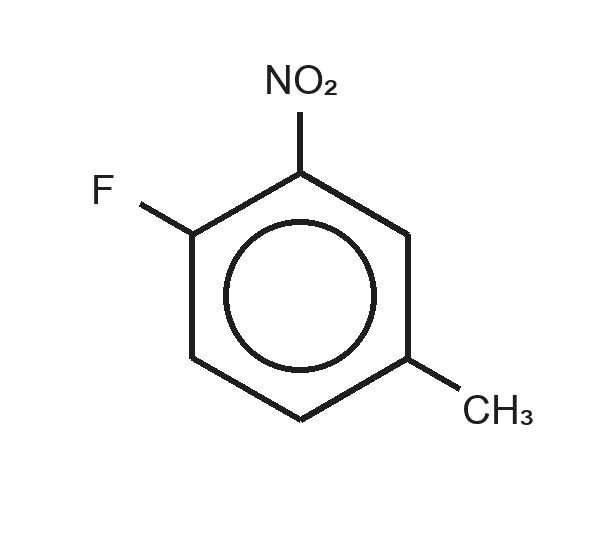
The IUPAC name of the compound is
 Solve with AI
Answer
- Correct
(A) 1-fluoro-4-methyl-2-nitrobenzene
(B) 4-fluoro-1-methyl-3-nitrobenzene
(C) 4-methyl-1-fluoro-2-nitrobenzene
(D) 2-fluoro-5-methyl-1-nitrobenzene
Answer: (A) 1-fluoro-4-methyl-2-nitrobenzene
Concept: For a benzene ring with several substituents, the ring is numbered to give the lowest set of locants; only if there is still a choice does the substituent first in alphabetical order get C1. The prefixes are then written in alphabetical order.
Step 1 — Read the structure. In the figure F and are on neighbouring carbons, and is on the carbon opposite (para to) F, which is meta to .
Step 2 — Find the lowest set of locants. We try each possible start and direction. Starting at F and moving towards gives F = 1, = 2, = 4, the set {1, 2, 4}. Starting at gives at best {1, 2, 5}, and starting at gives at best {1, 3, 4}, so {1, 2, 4} is the lowest.
Step 3 — Write the name. The prefixes in alphabetical order are fluoro, methyl, nitro, which gives 1-fluoro-4-methyl-2-nitrobenzene.
Step 4 — Check the other options. Each of the other options fails for a definite reason:
- (B) Its locant set {1, 3, 4} is higher than {1, 2, 4} at the second number.
- (C) The locants are right, but the prefixes are not in alphabetical order (fluoro must come before methyl).
- (D) Its locant set {1, 2, 5} is higher than {1, 2, 4} at the third number.
Therefore, the IUPAC name is 1-fluoro-4-methyl-2-nitrobenzene, option (A).
- 31 mark
Question 3
A B C, C is
Solve with AIAnswer
(A)
(B)
(C)
- Correct
(D)
Answer: (D) (fluorobenzene)
Concept: This sequence is the Balz–Schiemann reaction. Aniline is diazotised at 0–5 °C, the diazonium salt is changed into the diazonium fluoroborate, and this salt gives the aryl fluoride on heating.
Step 1 — Identify compound A. Nitrous acid (made from and HCl) converts aniline at 0–5 °C into benzenediazonium chloride:
Step 2 — Identify compound B. Fluoroboric acid () precipitates the diazonium fluoroborate:
Step 3 — Identify compound C. On heating, the fluoroborate loses nitrogen and boron trifluoride, leaving fluorine on the ring:
Step 4 — Check the other options. Each of the other options fails for a definite reason:
- (A) Benzenediazonium fluoroborate is compound B, the salt that is heated; it is not the final product C.
- (B) 4-Fluorobiphenyl would need two benzene rings to join; heating the diazonium salt only replaces the group by F on the same ring.
- (C) 4,4′-Difluorobiphenyl also needs two rings to couple, which does not happen in this sequence.
Therefore, C is fluorobenzene, Ph–F, option (D).
- 41 mark
Question 4
In the following reaction, methylcyclopentane the major product obtained is
Solve with AIAnswer
(A) (bromomethyl)cyclopentane
(B) 1-bromo-2-methylcyclopentane
- Correct
(C) 1-bromo-1-methylcyclopentane
(D) 1-bromo-3-methylcyclopentane
Answer: (C) 1-bromo-1-methylcyclopentane
Concept: Bromination in light goes by free radicals. Bromine is very selective: it removes the hydrogen whose loss gives the most stable radical, and radical stability is 3° > 2° > 1°.
Step 1 — Find the hydrogen that gives the most stable radical. The ring carbon carrying the group has one hydrogen, and removing it gives a tertiary radical. All other ring hydrogens give secondary radicals, and the hydrogens give a primary radical.
Step 2 — Form the product. The tertiary radical picks up a bromine atom from , so Br ends up on the same carbon as :
Step 3 — Check the other options. Each of the other options fails for a definite reason:
- (A) Attack on the hydrogens gives a primary radical, the least stable, so this is a very minor product.
- (B) Attack at C2 of the ring gives a secondary radical, which is less stable than the tertiary one.
- (D) Attack at C3 of the ring also gives a secondary radical, so this product is minor too.
Note: The book prints these four products as structures; their IUPAC names are used here.
Therefore, the major product is 1-bromo-1-methylcyclopentane, option (C).
- 51 mark
Question 5
Predict the product C obtained in the following reaction of butyne-1
Solve with AIAnswer
- Correct
(A)
(B)
(C)
(D)
Answer: (A)
Concept: Both additions follow Markovnikov's rule: the H of HX goes to the carbon of the multiple bond that already has more hydrogens, because this gives the more stable carbocation.
Step 1 — Find B. In but-1-yne the triple bond is between C1 (≡CH) and C2. The H of HCl goes to C1 and Cl goes to C2, giving 2-chlorobut-1-ene:
Step 2 — Find C. The H of HI again goes to the end. The carbocation then forms on the carbon that already carries Cl, because a lone pair of Cl stabilises it, so I adds to that carbon:
Step 3 — Check the other options. Each of the other options fails for a definite reason:
- (B) It places a halogen on C3 or C4, which were not part of the triple bond; addition can put atoms only on C1 and C2, the two carbons of the triple bond.
- (C) Putting both Cl and I on the terminal carbon would need anti-Markovnikov addition twice.
- (D) I on C2 and Cl on C1 would need anti-Markovnikov addition of HCl in the first step.
Therefore, C is 2-chloro-2-iodobutane, , option (A).
- 61 mark
Question 6
A (predominantly) is
Solve with AIAnswer
(A)
(B)
(C)
- Correct
(D)
Answer: (D) (2-bromo-2-methylbutane)
Concept: Addition of HBr to an alkene goes through a carbocation, and a carbocation can rearrange (by a 1,2-hydride or 1,2-methyl shift) to a more stable one before bromide adds.
Step 1 — Protonate the alkene. The alkene is 3-methylbut-1-ene. adds to the terminal (Markovnikov), giving a secondary carbocation on C2:
Step 2 — Let the carbocation rearrange. The H atom on the neighbouring carbon moves over with its electron pair (a 1,2-hydride shift), giving the more stable tertiary carbocation:
Step 3 — Add bromide. attacks the tertiary carbon, which gives 2-bromo-2-methylbutane as the main product.
Step 4 — Check the other options. Each of the other options fails for a definite reason:
- (A) This is 2-bromo-3-methylbutane, the product with no rearrangement; it forms only in a small amount.
- (B) This is the same compound as (A), 2-bromo-3-methylbutane, written from the other end of the chain; it is the minor, unrearranged product.
- (C) 1-Bromo-3-methylbutane is the anti-Markovnikov product, formed only in the presence of a peroxide.
Note: Options (A) and (B) are printed as two different-looking formulas, but they are the same compound; they are kept as printed.
Therefore, A is mainly 2-bromo-2-methylbutane, formed after a hydride shift, option (D).
- 71 mark
Question 7
Which of the following is the correct method of preparation of methyl fluoride?
Solve with AIAnswer
(A)
(B)
(C)
- Correct
(D)
Answer: (D)
Concept: Alkyl fluorides are made by the Swarts reaction: an alkyl bromide or chloride is heated with a metallic fluoride such as AgF, , or .
Step 1 — Write the Swarts reaction. Fluoride from silver fluoride replaces bromine, and insoluble silver bromide is formed:
Step 2 — Check the other options. Each of the other options fails for a definite reason:
- (A) HF does not react with an alkane: there is no multiple bond to add to and no group to replace.
- (B) HF is the weakest halogen acid (strong H–F bond), so it does not convert alcohols into alkyl fluorides in good yield.
- (C) Fluorine reacts with methane explosively, breaking C–H and C–C bonds; the reaction cannot be controlled to give .
Therefore, methyl fluoride is correctly prepared by heating methyl bromide with silver fluoride (Swarts reaction), option (D).
- 81 mark
Question 8
Benzene reacts with in presence of which of the following to give iodobenzene?
Solve with AIAnswer
- Correct
(A)
(B) HF
(C)
(D)
Answer: (A)
Concept: Iodination of benzene is reversible, because the HI formed reduces iodobenzene back to benzene. An oxidising agent such as or removes the HI and so drives the reaction forward.
Step 1 — Write the reversible reaction. Benzene and iodine give iodobenzene and HI, but the reaction reaches equilibrium with little product:
Step 2 — Remove the HI. Nitric acid oxidises the HI back to iodine, so the equilibrium shifts towards iodobenzene:
Step 3 — Check the other options. Each of the other options fails for a definite reason:
- (B) HF is not an oxidising agent, so it cannot remove HI.
- (C) is a reducing agent; it would not oxidise HI.
- (D) Water neither oxidises HI nor catalyses the substitution.
Therefore, benzene gives iodobenzene with in the presence of the oxidising agent , option (A).
- 91 mark
Question 9
The reaction of toluene with in presence of gives predominantly
Solve with AIAnswer
(A) m-chlorotoluene
(B) benzoyl chloride
(C) benzyl chloride
- Correct
(D) o- and p-chlorotoluene
Answer: (D) o- and p-chlorotoluene
Concept: With a Lewis acid such as (in the dark), chlorine substitutes on the ring by electrophilic substitution. The group activates the ring and is ortho, para-directing.
Step 1 — Write the reaction. Chlorine replaces a ring hydrogen ortho or para to the group:
Step 2 — Check the other options. Each of the other options fails for a definite reason:
- (A) activates the ortho and para positions, not meta, so m-chlorotoluene is formed only in traces.
- (B) Benzoyl chloride, , contains oxygen; it cannot form from toluene and chlorine alone.
- (C) Benzyl chloride forms when the side chain is chlorinated, with chlorine in sunlight or on heating, without .
Therefore, toluene with and gives mainly o- and p-chlorotoluene, option (D).
- 101 mark
Question 10
The reaction of toluene with in presence of gives X and reaction in presence of light gives Y. Thus, X and Y are
Solve with AIAnswer
(A) X = benzyl chloride, Y = m-chlorotoluene
(B) X = benzal chloride, Y = o-chlorotoluene
(C) X = m-chlorotoluene, Y = p-chlorotoluene
- Correct
(D) X = o- and p-chlorotoluene, Y = trichloromethylbenzene
Answer: (D) X = o- and p-chlorotoluene, Y = trichloromethylbenzene
Concept: The conditions decide where chlorine goes. A Lewis acid () gives ring substitution ortho and para to ; light gives free-radical substitution of the side-chain hydrogens, one after another.
Step 1 — Find X. With the ring is chlorinated, and the group directs Cl to the ortho and para positions, so X is a mixture of o- and p-chlorotoluene.
Step 2 — Find Y. In light the three side-chain hydrogens are replaced one after another (benzyl chloride, then benzal chloride, then benzotrichloride); with excess chlorine the final product is trichloromethylbenzene:
Step 3 — Check the other options. Each of the other options fails for a definite reason:
- (A) Benzyl chloride is a light (side-chain) product, not a product, and chlorination in light does not give the ring isomer m-chlorotoluene.
- (B) Benzal chloride () is a side-chain product formed in light, not with , and o-chlorotoluene is a ring product, not formed in light.
- (C) Both are ring products, and m-chlorotoluene is not the main ring product.
Therefore, X is o- and p-chlorotoluene and Y is trichloromethylbenzene, option (D).
- 111 mark
Question 11
Which of the following reactions is an example of nucleophilic substitution reaction?
Solve with AIAnswer
(A) 2 RX + Na ⟶ R—R + 2 NaX
(B)
(C)
- Correct
(D)
Answer: (D)
Concept: In a nucleophilic substitution, a nucleophile (an electron-pair donor) replaces an atom or group on carbon; in a haloalkane the halogen leaves as the halide ion, .
Step 1 — Identify the substitution. In option (D) the ion from aqueous KOH is the nucleophile; it attacks the carbon of the C–X bond and the halide ion leaves:
Step 2 — Check the other options. Each of the other options fails for a definite reason:
- (A) This is the Wurtz reaction: two alkyl groups join through a reaction with sodium metal; no nucleophile replaces X.
- (B) This is reduction (hydrogenolysis) of the C–X bond by hydrogen, not attack by a nucleophile.
- (C) This is the formation of a Grignard reagent: magnesium inserts into the C–X bond and nothing is replaced.
Therefore, the nucleophilic substitution is the reaction of RX with aqueous KOH to give ROH, option (D).
- 121 mark
Question 12
For the following (a) (b) (c) the increasing order of nucleophilicity would be
Solve with AIAnswer
(A)
(B)
- Correct
(C)
(D)
Answer: (C)
Concept: In a protic solvent such as water or alcohol, the nucleophilicity of the halide ions rises down the group. A large ion is weakly solvated and its electron cloud is easily polarised, so it attacks carbon more readily.
Step 1 — Compare the three ions. The large ion is the least solvated and the most polarisable, so it is the best nucleophile. The small ion is held tightly by solvent molecules, so it is the poorest; lies between them.
Step 2 — Write the increasing order. Placing the weakest nucleophile first gives:
Step 3 — Check the other options. Each of the other options fails for a definite reason:
- (A) It puts below , but bromide is the larger, less solvated, more polarisable ion, so it is the better nucleophile.
- (B) This is the increasing order of basicity ( is the strongest base of the three), not of nucleophilicity in protic solvents.
- (D) It makes the weakest, though it is the strongest nucleophile of the three in protic solvents.
Therefore, the increasing order of nucleophilicity is , option (C).
- 131 mark
Question 13
Which one is most reactive towards reaction?
Solve with AIAnswer
(A)
(B)
(C)
- Correct
(D)
Answer: (D)
Concept: The slow step of an reaction is ionisation to a carbocation, so the more stable the carbocation, the faster the reaction.
Step 1 — Write the carbocation from each bromide. Losing gives from (A), from (B), from (C) and from (D).
Step 2 — Find the most stable carbocation. The cation from (D) is tertiary, its positive charge is spread over two benzene rings by resonance, and the group helps further by its +I effect, so it is the most stable of the four.
Step 3 — Check the other options. Each of the other options fails for a definite reason:
- (A) is a primary benzylic cation, stabilised by only one ring.
- (B) has two rings but is secondary; it lacks the extra group of the cation from (D).
- (C) is a secondary benzylic cation with only one ring.
Therefore, the bromide most reactive towards is , option (D).
- 141 mark
Question 14
Consider the following bromides :
A: B: C:
The correct order of reactivity is
Solve with AIAnswer
(A) C > B > A
(B) A > B > C
- Correct
(C) B > C > A
(D) B > A > C
Answer: (C) B > C > A
Concept: The rate of an reaction follows the stability of the carbocation formed in the slow step.
Step 1 — Look at bromide B. Bromide B (3-bromobut-1-ene) gives an allylic secondary cation, which is stabilised by resonance with the C=C bond, so it is the most stable of the three:
Step 2 — Look at bromides C and A. Bromide C (2-bromobutane) gives an ordinary secondary cation. Bromide A (1-bromobutane) would give a primary cation, the least stable, so A reacts slowest.
Step 3 — Check the other options. Each of the other options fails for a definite reason:
- (A) It puts C above B, ignoring the resonance stabilisation of the allylic cation from B.
- (B) It is the reverse order; a primary bromide is the slowest in .
- (D) It puts primary A above secondary C, but a primary cation is less stable than a secondary one.
Therefore, the order of reactivity is B > C > A, option (C).
- 151 mark
Question 15
Which of the following is correct order of decreasing reactivity?
Solve with AIAnswer
(A)
(B)
- Correct
(C)
(D) (X = halogen)
Answer: (C)
Concept: In an reaction the nucleophile attacks the carbon from the side opposite to X. Every extra alkyl group on that carbon crowds this path (steric hindrance), so the rate falls in the order 1° > 2° > 3°.
Step 1 — Rank the halides. The primary halide, , has one alkyl group on the carbon and is attacked fastest; the secondary halide has two and is slower; the tertiary halide has three and is the slowest.
Step 2 — Check the other options. Each of the other options fails for a definite reason:
- (A) It makes the 1° halide the slowest, though it is the least hindered.
- (B) It puts the most hindered 3° halide above the 2° halide.
- (D) This is the order for (carbocation stability), not for .
Therefore, the decreasing order of reactivity is , option (C).
- 161 mark
Question 16
The organic chloro compound, which shows complete stereochemical inversion during a reaction, is
Solve with AIAnswer
- Correct
(A)
(B)
(C)
(D)
Answer: (A)
Concept: An reaction always inverts the carbon it attacks (Walden inversion, like an umbrella turning inside out in the wind). A substrate that reacts only by , with no competing path, therefore reacts with complete inversion.
Step 1 — Find the substrate that reacts only by S_N2. Methyl chloride is the least hindered halide, and the methyl cation is far too unstable to form, so reacts purely by back-side attack.
Step 2 — Check the other options. Each of the other options fails for a definite reason:
- (B) 3-Chloropentane is secondary: it is more hindered and can also react partly by , which does not give clean inversion.
- (C) tert-Butyl chloride is too hindered for back-side attack; it reacts by .
- (D) 2-Chloropropane is secondary, so its reaction is slower and an path can compete.
Watch out: Methyl chloride, , is not chiral, so its inversion cannot be seen as a change in optical rotation; it is shown with isotopically labelled methyl compounds. The question asks which substrate reacts purely by .
Therefore, the chloro compound that shows complete inversion in an reaction is , option (A).
- 171 mark
Question 17
The order of rate of hydrolysis of alkyl halides 1°, 2°, 3° and by the pathway is
Solve with AIAnswer
(A) 1° < 2° < 3° >
(B) > 3° > 2° > 1°
- Correct
(C) > 1° > 2° > 3°
(D) 3° > 2° > 1° >
Answer: (C) > 1° > 2° > 3°
Concept: The rate depends on how easily the nucleophile reaches the back of the carbon bonded to X; every alkyl group on that carbon gets in the way.
Step 1 — Rank the halides. has only H atoms around the carbon, so it is fastest. Each alkyl group added slows the attack, so 1° is faster than 2°, and 3° is the slowest.
Step 2 — Check the other options. Each of the other options fails for a definite reason:
- (A) This order rises from 1° to 3°, the trend of carbocation stability (), not of .
- (B) It puts the most hindered 3° halide second; a 3° halide is the slowest in .
- (D) This is the order, the exact reverse of the order.
Therefore, the order of the rate of hydrolysis is > 1° > 2° > 3°, option (C).
- 181 mark
Question 18
In a substitution reaction of the type which one of the following has the highest relative rate?
Solve with AIAnswer
(A)
- Correct
(B)
(C)
(D)
Answer: (B)
Concept: All four are primary bromides, so the deciding factor is crowding by groups on the next carbon (β-branching). The fewer and smaller these groups, the faster the back-side attack in an reaction.
Step 1 — Find the least hindered bromide. In the carbon next to carries only H atoms, so the path of the nucleophile is the least crowded and this bromide reacts fastest.
Step 2 — Check the other options. Each of the other options fails for a definite reason:
- (A) Neopentyl bromide has three groups on the β-carbon; it is so hindered that its reaction is extremely slow.
- (C) 1-Bromopropane has one group on the β-carbon, which slows it a little compared with bromoethane.
- (D) 1-Bromo-2-methylpropane has two groups on the β-carbon, so it is slower still.
Therefore, bromoethane, , has the highest relative rate, option (B).
- 191 mark
Question 19
Alkyl halides undergoing nucleophilic bimolecular substitution involve
Solve with AIAnswer
(A) formation of carbocation
(B) racemic mixture
- Correct
(C) inversion of configuration
(D) retention of configuration
Answer: (C) inversion of configuration
Concept: In a bimolecular nucleophilic substitution (), bond-making and bond-breaking occur in one step through a single transition state.
Step 1 — Describe the attack. The nucleophile enters from the side opposite the leaving halide, so as the halide leaves, the other three groups on the carbon flip over to the other side. This is Walden inversion.
Step 2 — Check the other options. Each of the other options fails for a definite reason:
- (A) A carbocation intermediate is a feature of ; has only a transition state.
- (B) A racemic mixture (or partial racemisation) comes from , where the planar carbocation can be attacked from either face.
- (D) Back-side attack cannot keep the original arrangement; the configuration is inverted.
Therefore, substitution of alkyl halides involves inversion of configuration, option (C).
- 201 mark
Question 20
The increasing order of hydrolysis of the following compounds is
I: bromobenzene, II: bromocyclohexane, III: 3-bromocyclohexene IV:
Solve with AIAnswer
(A) I < IV < II < III
(B) I < II < III < IV
- Correct
(C) I < II < IV < III
(D) IV < III < II < I
Answer: (C) I < II < IV < III
Concept: Hydrolysis of these bromides goes by , so the rate follows the stability of the carbocation formed; an aryl halide hardly reacts at all.
Step 1 — Place bromobenzene (I). The C–Br bond of bromobenzene has partial double-bond character by resonance, and the phenyl cation is very unstable, so I is the slowest.
Step 2 — Place bromocyclohexane (II) and tert-butyl bromide (IV). Compound II gives a plain secondary carbocation, while IV gives a tertiary carbocation stabilised by three groups, so IV reacts faster than II.
Step 3 — Place 3-bromocyclohexene (III). In III the Br is on an allylic carbon, so the cation is shared over two carbons by resonance with the C=C bond. This resonance stabilises it more than the three methyl groups stabilise the cation from IV, so III is the fastest.
Step 4 — Check the other options. Each of the other options fails for a definite reason:
- (A) It puts IV below the secondary II, but a tertiary cation forms faster than a secondary one.
- (B) It puts the allylic III below IV; resonance makes the allylic cation the most stable here.
- (D) This is the reverse order; it makes the unreactive aryl halide the fastest.
Note: The book draws I to III as ring structures; their names are used here.
Therefore, the increasing order of hydrolysis is I < II < IV < III, option (C).
- 211 mark
Question 21
Arrange the following: (I), (II), (III) and (IV) in order of decreasing tendency towards reactions
Solve with AIAnswer
- Correct
(A) I > III > II > IV
(B) III > IV > II > I
(C) II > I > III > IV
(D) IV > III > II > I
Answer: (A) I > III > II > IV
Concept: An reaction is fastest at the least crowded carbon, so 1° > 2° > 3°. Between two primary halides, a branch on the next (β) carbon slows the attack.
Step 1 — Classify each chloride. I (1-chloropropane) is primary and unbranched; III (1-chloro-2-methylpropane) is primary with a branch on the β-carbon; II (2-chlorobutane) is secondary; IV (2-chloro-2-methylpropane) is tertiary.
Step 2 — Arrange them. The unbranched primary I is fastest, the β-branched primary III is a little slower, the secondary II is slower still, and the tertiary IV is the slowest.
Step 3 — Check the other options. Each of the other options fails for a definite reason:
- (B) It puts the tertiary IV second and the unbranched primary I last, the reverse of the steric trend.
- (C) It puts the secondary II above both primary halides.
- (D) This order, with the tertiary halide first, is the trend, not the trend.
Therefore, the decreasing order of tendency towards is I > III > II > IV, option (A).
- 221 mark
Question 22
Among the following, the optically active compound is
Solve with AIAnswer
(A)
(B)
- Correct
(C)
(D)
Answer: (C)
Concept: A compound is optically active (chiral) when it has a carbon atom joined to four different groups and so cannot be superimposed on its mirror image.
Step 1 — Test option (C). In the carbon bearing OH carries H, D (deuterium), OH and . H and D are isotopes but count as different groups, so this carbon has four different groups and the molecule is chiral.
Step 2 — Check the other options. Each of the other options fails for a definite reason:
- (A) In ethanol the OH carbon carries two H atoms, so it is not a stereocentre.
- (B) But-2-ene shows geometrical (cis–trans) isomerism, but it has no stereocentre and is not optically active.
- (D) Butan-2-one has no carbon with four different groups (the C=O carbon has only three groups).
Therefore, the optically active compound is , option (C).
- 231 mark
Question 23
Out of the following, the alkene that exhibits optical isomerism is
Solve with AIAnswer
- Correct
(A) 3-methyl-1-pentene
(B) 2-methyl-2-pentene
(C) 3-methyl-2-pentene
(D) 4-methyl-1-pentene
Answer: (A) 3-methyl-1-pentene
Concept: An alkene shows optical isomerism only if it has a carbon atom joined to four different groups.
Step 1 — Test option (A). 3-Methyl-1-pentene is . Its C3 carries H, , and , four different groups, so the molecule is chiral.
Step 2 — Check the other options. Each of the other options fails for a definite reason:
- (B) 2-Methyl-2-pentene, , has no carbon with four different groups.
- (C) 3-Methyl-2-pentene, , shows geometrical isomerism, but none of its carbons carries four different groups.
- (D) In 4-methyl-1-pentene, , C4 carries two identical groups, so it is not a stereocentre.
Therefore, the alkene that shows optical isomerism is 3-methyl-1-pentene, option (A).
- 241 mark
Question 24
Which of the following compounds is chiral
Solve with AIAnswer
(A) 3-Pentanol
(B) 1-Pentanol
(C) 3-Methyl-1-butanol
- Correct
(D) 3-Methyl-2-butanol
Answer: (D) 3-Methyl-2-butanol
Concept: A chiral molecule has a carbon atom joined to four different groups.
Step 1 — Test option (D). 3-Methyl-2-butanol is . Its C2 carries H, OH, and , which are all different, so it is chiral.
Step 2 — Check the other options. Each of the other options fails for a definite reason:
- (A) In 3-pentanol, , C3 carries two identical ethyl groups.
- (B) 1-Pentanol, , has no carbon with four different groups.
- (C) In 3-methyl-1-butanol, , C3 carries two identical groups.
Therefore, the chiral compound is 3-methyl-2-butanol, option (D).
- 251 mark
Question 25
How many chiral compounds are possible on monochlorination of 2-methylbutane?
Solve with AIAnswer
- Correct
(A) 2
(B) 4
(C) 6
(D) 8
Answer: (A) 2
Concept: Replace each different kind of hydrogen in 2-methylbutane, , by Cl, then test each product for a carbon atom joined to four different groups.
Step 1 — List the monochloro products. 2-Methylbutane has four kinds of hydrogen, so it gives four structurally different monochloro products:
Product Chiral? 1-chloro-2-methylbutane, yes: C2 has H, , , 2-chloro-2-methylbutane, no: two groups on C2 2-chloro-3-methylbutane, yes: C2 has H, Cl, , 1-chloro-3-methylbutane, no: no carbon with four different groups Step 2 — Count the chiral products. Two of the four structural products are chiral. Each of them exists as a pair of enantiomers, so there are 4 optically active stereoisomers in all.
Step 3 — Check the other options. Each of the other options fails for a definite reason:
- (B) 4 counts each enantiomer as a separate compound (two pairs of enantiomers); this is the other defensible reading, but the printed key counts the structurally different chiral compounds.
- (C) 6 is the total of all isomers when each chiral compound is counted as two enantiomers and the two achiral products are added (4 + 2); the question asks only for chiral compounds.
- (D) 8 would count every one of the four products twice, but only the two chiral products have enantiomers.
Note: Enantiomers are, strictly, different compounds, so 4 is also a defensible answer; the printed key (2) counts structural isomers only.
Therefore, by the printed key, monochlorination of 2-methylbutane gives 2 structurally different chiral compounds (4 if each enantiomer is counted separately), option (A).
- 261 mark
Question 26
How many stereoisomers does this molecule have?
Solve with AIAnswer
(A) 8
(B) 2
- Correct
(C) 4
(D) 6
Answer: (C) 4
Concept: Count the independent sources of stereoisomerism. Each C=C with two different groups on each end gives 2 forms (cis/trans), and each stereocentre gives 2 forms (R/S); with n such units and no internal symmetry there are stereoisomers.
Step 1 — Look at the double bond. In 5-bromohex-2-ene, , C2 carries H and , and C3 carries H and , so cis and trans forms are possible.
Step 2 — Look for a stereocentre. C5, the CHBr carbon, carries H, Br, and , four different groups, so it is one stereocentre.
Step 3 — Multiply. There are two independent stereogenic units, each giving two forms:
These are cis-R, cis-S, trans-R and trans-S.
Step 4 — Check the other options. Each of the other options fails for a definite reason:
- (A) 8 = would need three stereogenic units; the molecule has only two.
- (B) 2 counts only one unit, either the double bond or the stereocentre, and misses the other.
- (D) 6 is not a power of 2; with no internal symmetry, two independent units give isomers.
Therefore, the molecule has 4 stereoisomers, option (C).
- 271 mark
Question 27
The case of dehydrohalogenation of alkyl halides with alcoholic KOH is
Solve with AIAnswer
(A) 3° < 2° < 1°
- Correct
(B) 3° > 2° > 1°
(C) 3° < 2° > 1°
(D) 3° > 2° < 1°
Answer: (B) 3° > 2° > 1°
Concept: Alcoholic KOH removes HX from an alkyl halide to give an alkene (dehydrohalogenation, an elimination reaction).
Step 1 — Compare the three classes. A tertiary halide eliminates most easily: it gives the more substituted, more stable alkene, and its crowded carbon favours elimination over substitution. A secondary halide comes next, and a primary halide eliminates least easily.
Step 2 — Check the other options. Each of the other options fails for a definite reason:
- (A) It is the reverse order; a primary halide eliminates least easily.
- (C) It makes 2° faster than 3°, but a 3° halide eliminates most easily.
- (D) It makes 1° faster than 2°, but a 1° halide eliminates least easily.
Note: The word “case” in the question is read as “ease”.
Therefore, the ease of dehydrohalogenation with alcoholic KOH is 3° > 2° > 1°, option (B).
- 281 mark
Question 28
An alkyl halide with molecular formula, on dehydrohalogenation gave two isomeric alkenes X and Y with molecular formula . On reductive ozonolysis, X and Y gave four compounds , , and . The alkyl halide is
Solve with AIAnswer
(A) 2-bromohexane
(B) 2,2-dimethyl-1-bromobutane
(C) 4-bromo-2-methylpentane
- Correct
(D) 3-bromo-2-methylpentane
Answer: (D) 3-bromo-2-methylpentane
Concept: Ozonolysis cuts a C=C bond into two C=O compounds. Joining the carbonyl pieces back in pairs gives each alkene, and the halide is the one that can lose HBr in both directions to give these two alkenes.
Step 1 — Rebuild the two alkenes. The carbonyl pieces must pair up so that each alkene has six carbons:
- and come from X = (2-methylpent-2-ene).
- and come from Y = (4-methylpent-2-ene).
Step 2 — Find the halide. Both alkenes have the carbon skeleton of 2-methylpentane, and in both the C=C involves C3, so Br must be on C3: . Losing H from C2 gives X, and losing H from C4 gives Y.
Step 3 — Check the other options. Each of the other options fails for a definite reason:
- (A) 2-Bromohexane has an unbranched chain; its alkenes give only straight-chain pieces, never acetone or .
- (B) has no H on the carbon next to , so it cannot give an alkene by simple dehydrohalogenation.
- (C) 4-Bromo-2-methylpentane can lose HBr to give Y or 4-methylpent-1-ene. The second alkene gives 3-methylbutanal and methanal on ozonolysis. Neither alkene is X, so acetone and propanal are never formed.
Therefore, the alkyl halide is 3-bromo-2-methylpentane, option (D).
- 291 mark
Question 29
In the following reaction, X, the product 'X' is
Solve with AIAnswer
(A)
(B)
- Correct
(C)
(D)
Answer: (C) (toluene)
Concept: Magnesium in dry ether turns an alkyl halide into a Grignard reagent. The carbon attached to Mg is strongly basic, so water or dilute acid simply puts H in place of MgBr.
Step 1 — Form the Grignard reagent. Benzyl bromide reacts with magnesium in dry ether:
Step 2 — Hydrolyse it. Dilute acid supplies a proton to the benzyl carbon, giving toluene:
Step 3 — Check the other options. Each of the other options fails for a definite reason:
- (A) Dibenzyl ether would need an alkoxide reacting with benzyl bromide (Williamson synthesis), not a Grignard reagent and water.
- (B) Benzyl alcohol forms when benzyl bromide itself is heated with aqueous KOH; hydrolysis of the Grignard reagent puts H, not OH, on the carbon.
- (D) 1,2-Diphenylethane is a coupling (Wurtz-type) product, a side product of Grignard formation, not the product of the hydrolysis step.
Therefore, X is toluene, , option (C).
- 301 mark
Question 30
Which of the following compounds undergo nucleophilic substitution reaction most easily?
Solve with AIAnswer
- Correct
(A) 1-chloro-4-nitrobenzene,
(B) 1-chloro-4-methylbenzene,
(C) 1-chloro-4-methoxybenzene,
(D) chlorobenzene,
Answer: (A) 1-chloro-4-nitrobenzene,
Concept: A haloarene is attacked by nucleophiles easily only when an electron-withdrawing group sits ortho or para to the halogen, because such a group stabilises the negatively charged intermediate.
Step 1 — Look at the nitro compound. The group para to Cl pulls electron density from the ring, and the negative charge of the intermediate can move onto its oxygen atoms by resonance, so 1-chloro-4-nitrobenzene reacts most easily.
Step 2 — Check the other options. Each of the other options fails for a definite reason:
- (B) is electron-releasing (+I); it makes the ring richer in electrons and slows nucleophilic attack.
- (C) The group releases electrons by resonance (+R), so it also slows nucleophilic attack.
- (D) Plain chlorobenzene has no activating group; it reacts only under severe conditions (about 623 K and 300 atm with NaOH).
Note: The book draws these compounds as ring structures; their names are used here.
Therefore, 1-chloro-4-nitrobenzene undergoes nucleophilic substitution most easily, option (A).
- 311 mark
Question 31
Chlorobenzene reacts with ______ in presence of conc. to form DDT.
Solve with AIWritten solution
Solution:
Key idea: DDT is made by condensing two molecules of chlorobenzene with one molecule of chloral, using concentrated sulphuric acid as the condensing (dehydrating) agent.
Step 1 — Identify the missing reagent. The part of DDT comes from chloral, trichloroethanal, ; its carbonyl carbon joins the para positions of two chlorobenzene rings.
Step 2 — Write the equation. The oxygen of chloral leaves with two ring hydrogens as water, which concentrated removes:
Note: DDT is now banned for farm use in India and most other countries, because it persists in the environment and builds up along food chains; only limited public-health use is allowed.
Therefore, chlorobenzene reacts with chloral, , in the presence of conc. to form DDT.
- 321 mark
Question 32
With potassium cyanide, alkyl halides give ______ while with silver cyanide ______ are the major product.
Solve with AIWritten solution
Solution:
Key idea: The cyanide ion is an ambident nucleophile: it can attack carbon through its C atom or through its N atom, and the reagent decides which.
Step 1 — Look at KCN. KCN is ionic, so the free ion attacks through carbon, which forms the stronger C–C bond. The product is an alkyl cyanide (nitrile), R–C≡N.
Step 2 — Look at AgCN. AgCN is mainly covalent (Ag–C bond), so the carbon end is not free; only the nitrogen lone pair can attack. The product is an alkyl isocyanide (isonitrile), R–N≡C.
Therefore, with KCN alkyl halides give alkyl cyanides (nitriles), while with AgCN alkyl isocyanides (isonitriles) are the major product.
- 331 mark
Question 33
DDT stands for ______ .
Solve with AIWritten solution
Solution:
Key idea: The letters of DDT come from the chemical name of the compound, which describes its structure.
Step 1 — Read the structure. DDT is : two p-chlorophenyl groups and a group on the same ethane skeleton.
Step 2 — Expand the letters. The two chlorines on the phenyl rings give dichloro-diphenyl, and the three chlorines on the other carbon give trichloroethane, so DDT stands for p,p′-dichlorodiphenyltrichloroethane.
Note: DDT is now banned for farm use in India and most other countries, because it persists in the environment and builds up along food chains; only limited public-health use is allowed.
Therefore, DDT stands for p,p′-dichlorodiphenyltrichloroethane.
- 341 mark
Question 34
Toluene reacts with chlorine in presence of catalyst to form ______ .
Solve with AIWritten solution
Solution:
Key idea: With a Lewis acid catalyst such as , chlorine substitutes on the benzene ring (electrophilic substitution), and the group directs it to the ortho and para positions.
Step 1 — Decide where chlorine enters. The group releases electrons and activates the ortho and para positions, so Cl replaces a ring hydrogen there and not on the side chain.
Step 2 — Write the equation. One ring hydrogen is replaced and HCl is given off:
Therefore, toluene reacts with chlorine in the presence of to form a mixture of o- and p-chlorotoluene.
- 351 mark
Question 35
The well-known refrigerant freon has the structure ______
Solve with AIWritten solution
Solution:
Key idea: Freons are chlorofluorocarbons (CFCs); the best-known refrigerant of this type is freon-12, dichlorodifluoromethane.
Step 1 — Give the structure. Freon-12 has one carbon atom bonded to two chlorine and two fluorine atoms, .
Step 2 — Show how it is made. It is made from carbon tetrachloride by the Swarts reaction with antimony trifluoride and a little as catalyst:
Note: CFCs such as freon-12 damage the ozone layer, so their production was phased out worldwide by 2010 under the Montreal Protocol; modern refrigerators use other refrigerants.
Therefore, the refrigerant freon (freon-12) is , dichlorodifluoromethane.
- 361 mark
Question 36
Preparation of chlorobenzene from benzenediazonium chloride with cuprous chloride and aq. HCl is known as ______ reaction.
Solve with AIWritten solution
Solution:
Key idea: Replacing the diazonium group of an arenediazonium salt by Cl or Br with the copper(I) halide dissolved in the halogen acid is called the Sandmeyer reaction.
Step 1 — Write the reaction. Benzenediazonium chloride is warmed with cuprous chloride (, that is CuCl) in aqueous HCl, and nitrogen gas is given off:
Step 2 — Tell it apart from the Gattermann reaction. If copper powder and HCl were used instead of cuprous chloride, the reaction would be the Gattermann reaction.
Therefore, the reaction is known as the Sandmeyer reaction.
- 371 mark
Question 37
Small quantity of alcohol is added to chloroform to remove ______ formed as a result of exposure to air and light.
Solve with AIWritten solution
Solution:
Key idea: In air and light, chloroform is slowly oxidised to phosgene, carbonyl chloride, a very poisonous gas.
Step 1 — Write the oxidation. Oxygen of the air oxidises chloroform in light:
Step 2 — Explain the role of the alcohol. About 1% ethanol is added; it reacts with any phosgene formed and converts it into diethyl carbonate, which is far less harmful:
Chloroform is also stored in dark coloured, completely filled bottles to keep out light and air.
Therefore, the alcohol is added to remove phosgene, .
- 381 mark
Question 38
Butanenitrile can be prepared by heating ______ with alcoholic KCN.
Solve with AIWritten solution
Solution:
Key idea: Heating a haloalkane with alcoholic KCN replaces the halogen by –CN, so the nitrile has one carbon atom more than the haloalkane.
Step 1 — Count the carbons. Butanenitrile, , has four carbon atoms, one of which is the –CN carbon, so the haloalkane must have a straight chain of three carbons with the halogen on the end carbon.
Step 2 — Write the equation. 1-Bromopropane reacts with KCN:
Therefore, butanenitrile is prepared by heating n-propyl bromide (1-bromopropane), , with alcoholic KCN.
- 391 mark
Question 39
With aqueous KOH, alkyl halides undergo ______ reaction but with hot alcoholic KOH, they undergo ______ reaction.
Solve with AIWritten solution
Solution:
Key idea: The solvent decides how behaves: in water it acts mainly as a nucleophile, while in hot alcohol it (together with the ethoxide ion) acts mainly as a base.
Step 1 — Aqueous KOH. In water, attacks the carbon of the C–X bond and replaces X, so the haloalkane gives an alcohol (R–X to R–OH). This is a substitution reaction.
Step 2 — Hot alcoholic KOH. In hot alcohol the base removes a β-hydrogen along with X, which gives an alkene. This is an elimination reaction (dehydrohalogenation).
Therefore, with aqueous KOH alkyl halides undergo substitution, but with hot alcoholic KOH they undergo elimination.
- 401 mark
Question 40
Alkyl halides are insoluble in water because they do not form ______ with water.
Solve with AIWritten solution
Solution:
Key idea: A substance dissolves in water readily only if its attractions to water are about as strong as the hydrogen bonds between water molecules.
Step 1 — Look at what dissolving needs. To dissolve, a haloalkane must break hydrogen bonds between water molecules.
Step 2 — Compare the new attractions. A haloalkane forms at most very weak hydrogen bonds with water, so the new dipole–dipole and dispersion attractions it forms are weaker than the hydrogen bonds broken, and only a very little dissolves.
Therefore, alkyl halides are insoluble in water because they do not form hydrogen bonds with water.
- 411 mark
Question 41
(i)
(ii)
Solve with AIWritten solution
Solution:
Key idea: A cyanide ion replaces the halogen to give a nitrile, and the –CN group can then be partly hydrolysed to an amide or reduced to a primary amine.
Step 1 — Part (i), first step. Iodoethane reacts with NaCN, and replaces to give propanenitrile:
Step 2 — Part (i), second step. Partial hydrolysis with alkali adds one molecule of water to the –C≡N group and stops at the amide, propanamide:
Step 3 — Part (ii), first step. Bromoethane reacts with KCN in the same way to give propanenitrile:
Step 4 — Part (ii), second step. reduces the –C≡N group to , giving propan-1-amine:
Therefore, in (i) the products are propanenitrile, , and then propanamide, ; in (ii) they are propanenitrile and then propan-1-amine, .
- 421 mark
Question 42
Iodobenzene on heating with copper powder forms diphenyl. The reaction is called ______ .
Solve with AIWritten solution
Solution:
Key idea: Joining two aryl groups by heating an aryl iodide with copper powder is the Ullmann reaction.
Step 1 — Write the reaction. Two molecules of iodobenzene lose their iodine atoms to copper, and the two phenyl groups join:
Step 2 — Tell it apart from the Fittig reaction. If sodium in dry ether were used instead of copper, the reaction would be the Fittig reaction.
Therefore, the reaction is called the Ullmann reaction.
- 431 mark
Question 43
The boiling points of alkyl halides are higher than those of corresponding alkanes because of ______ .
Solve with AIWritten solution
Solution:
Key idea: The boiling point depends on how strongly molecules attract one another; stronger attractions need more energy to separate the molecules.
Step 1 — Look at the C–X bond. The C–X bond is polar, so alkyl halide molecules attract one another by dipole–dipole interactions, which alkanes do not have.
Step 2 — Look at the molar mass. An alkyl halide is also heavier than the corresponding alkane, so its van der Waals forces are stronger too; both effects raise the boiling point.
Therefore, alkyl halides boil higher than the corresponding alkanes because of dipole–dipole interactions (helped by stronger van der Waals forces).
- 441 mark
Question 44
Nitroalkanes are formed when alkyl halides react with ______ while alkyl nitrites are formed when alkyl halides are treated with ______ .
Solve with AIWritten solution
Solution:
Key idea: The nitrite ion is ambident: it can attack carbon through an oxygen atom or through the nitrogen atom, and the reagent decides which.
Step 1 — Look at silver nitrite. is covalent (Ag–O bond), so the nitrogen lone pair is the free end that attacks; the product is a nitroalkane, .
Step 2 — Look at potassium nitrite. is ionic, so the negatively charged oxygen of the free nitrite ion attacks; the product is an alkyl nitrite, R–O–N=O.
Therefore, nitroalkanes are formed with silver nitrite, , while alkyl nitrites are formed with potassium nitrite, .
- 451 mark
Question 45
Vinyl chloride on reaction with dimethylcopper gives ______
Solve with AIWritten solution
Solution:
Key idea: An organocopper reagent replaces the halogen of a haloalkene by its alkyl group, joining two carbon groups (Corey–House reaction).
Step 1 — Write the reaction. The methyl group of lithium dimethylcuprate replaces Cl on the vinyl carbon:
Step 2 — Name the product. The product, , has three carbons and a double bond at C1, so it is propene.
Note: The reagent used in this reaction is lithium dimethylcuprate, ; the book calls it “dimethylcopper”.
Therefore, vinyl chloride gives propene, .
- 461 mark
Question 46
Alkyl halides are ______ reactive than haloarenes but ______ reactive than ______ towards nucleophilic substitution reactions.
Solve with AIWritten solution
Solution:
Key idea: Reactivity towards nucleophilic substitution depends on how easily the C–X bond breaks and how well the carbocation or transition state is stabilised.
Step 1 — Compare with haloarenes. In haloarenes the C–X bond gains partial double-bond character by resonance and the carbon is , so the bond is hard to break. Alkyl halides are therefore more reactive than haloarenes.
Step 2 — Compare with allyl and benzyl halides. Allyl and benzyl halides react faster than alkyl halides, because their carbocations (and transition states) are stabilised by resonance with the C=C bond or the benzene ring. Alkyl halides are therefore less reactive than these.
Therefore, alkyl halides are more reactive than haloarenes but less reactive than allyl and benzyl halides towards nucleophilic substitution.
- 471 mark
Question 47
The reaction of p-nitrochlorobenzene with sodium methoxide to form p-nitroanisole occurs by ______ reaction.
Solve with AIWritten solution
Solution:
Concept: A halogen on a benzene ring is normally very hard to replace. When a strong electron-withdrawing group such as sits ortho or para to it, a nucleophile can add to the ring first and the halide ion leaves afterwards. This two-step path is called nucleophilic aromatic substitution, (addition–elimination).
Step 1 — Identify the nucleophile and the reacting carbon. Sodium methoxide supplies the methoxide ion, , a strong nucleophile. It attacks the ring carbon that carries the chlorine atom.
Step 2 — Follow the addition step. The methoxide ion adds to that carbon and forms a negatively charged intermediate (a Meisenheimer complex). The negative charge spreads round the ring and onto the oxygen atoms of the para group, which stabilises the intermediate. Because both the halide and the nucleophile take part in this rate-deciding step, the reaction is bimolecular.
Step 3 — Follow the elimination step. The ring regains its aromatic character by pushing out the chloride ion, so p-nitroanisole is formed:
Therefore, the reaction occurs by bimolecular aromatic nucleophilic substitution (, addition–elimination).
- 481 mark
Question 48
Chlorobenzene and sodium react in dry ether medium to form ______ .
Solve with AIWritten solution
Solution:
Concept: When an aryl halide is heated with sodium in dry ether, sodium removes the halogen atoms and two aryl groups join together. This is the Fittig reaction.
Step 1 — Name the reaction. Chlorobenzene and sodium in dry ether undergo the Fittig reaction. Sodium takes the chlorine atoms as sodium chloride, and the two phenyl groups bond to each other.
Step 2 — Write the equation. Two molecules of chlorobenzene react with two atoms of sodium:
Therefore, chlorobenzene and sodium in dry ether form biphenyl (diphenyl), (Fittig reaction).
- 491 mark
Question 49
What are enantiomers? Draw the structures of the possible enantiomers of 3-methylpent-1-ene.
Solve with AIWritten solution
Solution:
Concept: Enantiomers are a pair of stereoisomers that are non-superimposable mirror images of each other. A molecule has enantiomers when it contains a chiral (asymmetric) carbon, a carbon joined to four different groups.
Step 1 — Write the structure. 3-Methylpent-1-ene has a five-carbon chain with a double bond between C-1 and C-2 and a methyl group on C-3:
Step 2 — Find the chiral carbon. C-3 carries four different groups: H, , and . So C-3 is chiral, and the molecule exists as two enantiomers.
Step 3 — Draw the two enantiomers. They are shown below as Fischer projections, with a mirror between them. Swapping H and turns one into its mirror image:
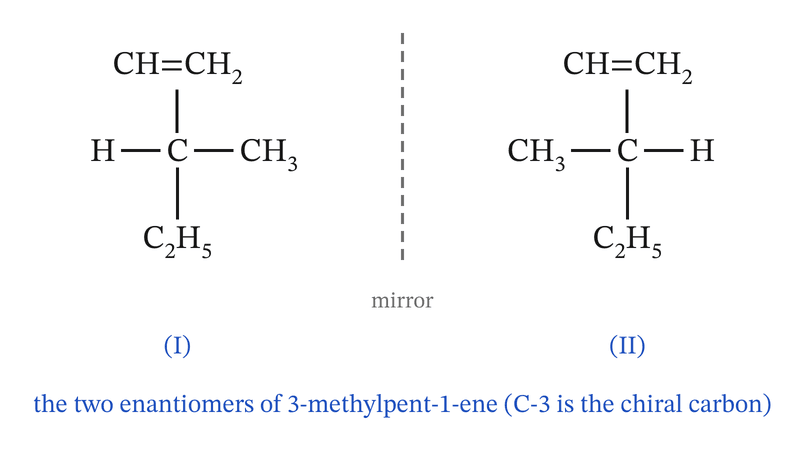
Therefore, enantiomers are non-superimposable mirror-image stereoisomers, and 3-methylpent-1-ene, with one chiral carbon (C-3), has the two enantiomers drawn above.
- 501 mark
Question 50
Write the names of the following compounds.
(a)
(b)
(c)
(d)
Solve with AIWritten solution
Solution:
Concept: A haloalkane is named by giving the halogen as a prefix (fluoro, chloro, bromo, iodo; "halo" when X is general) with the number of the carbon it is on. Common names use the alkyl group followed by "halide".
Step 1 — Name compound (a). is a three-carbon chain with X on the middle carbon. It is 2-halopropane (isopropyl halide), a secondary alkyl halide.
Step 2 — Name compound (b). is a three-carbon chain with a C=C bond. Numbering from the end gives the double bond the lowest number (C-1), which puts X on C-3. It is 3-halopropene (allyl halide).
Step 3 — Name compound (c). is a halogen joined directly to a benzene ring. It is halobenzene (an aryl halide; chlorobenzene when X = Cl).
Step 4 — Name compound (d). is a halogen on a carbon of a C=C bond. It is haloethene (vinyl halide).
Therefore, (a) 2-halopropane (isopropyl halide), (b) 3-halopropene (allyl halide), (c) halobenzene (aryl halide) and (d) haloethene (vinyl halide).
- 511 mark
Question 51
How many monochloro derivative are possible when 3-methylheptane is subjected to free radical chlorination?
Solve with AIWritten solution
Solution:
Concept: Free-radical chlorination can replace any hydrogen atom of an alkane. The number of different monochloro products equals the number of different kinds (non-equivalent sets) of hydrogen atoms in the molecule.
Step 1 — Write the structure. 3-Methylheptane is:
It has eight carbon atoms: C-1 to C-7 of the chain and the methyl carbon on C-3.
Step 2 — Look for symmetry. C-3 joins three different groups (ethyl, methyl and butyl), so no two carbons are equivalent. The methyl group on C-3 is not the same as C-1 (the end of the ethyl group), and C-7 is not the same as either.
Step 3 — Count the products. Each of the eight carbons carries hydrogen and is different, so replacing an H on each one gives a different compound. Every carbon gives one product, so there are 8 structural isomers.
Note: Every one of these products is chiral, so if stereoisomers are also counted the total is larger (24).
Therefore, 8 monochloro derivatives (structural isomers) are possible.
- 521 mark
Question 52
How many chiral stereoisomers are possible for 2-bromo-3-chlorobutane?
Solve with AIWritten solution
Solution:
Concept: A molecule with chiral carbons can have at most stereoisomers. The number is smaller only when a meso form exists, which needs the two chiral centres to carry the same set of groups.
Step 1 — Find the chiral carbons. In 2-bromo-3-chlorobutane both C-2 and C-3 carry four different groups:
So .
Step 2 — Check for a meso form. One chiral carbon carries Br and the other carries Cl, so the two halves of the molecule are different. No internal mirror plane is possible, so there is no meso form.
Step 3 — Count the stereoisomers. All stereoisomers exist:
They form two pairs of enantiomers.
Therefore, 2-bromo-3-chlorobutane has 4 chiral stereoisomers (two pairs of enantiomers).
- 531 mark
Question 53
Total number of compound among the following having zero dipole moment is/are , o-, m- and p-dichlorobenzene, benzyl chloride, benzal dichloride, benzotrichloride.
- 541 mark
Question 54
The total number of isomers including stereoisomers that could be obtained by replacing two hydrogen atoms of propane by two chlorine atoms are.
- 551 mark
Question 55
Arrange the alkyl halides (1°, 2°, 3°) in the decreasing order of their ease of dehydration with alcoholic KOH.
- 561 mark
Question 56
Give an example of ambident nucleophile.
- 571 mark
Question 57
Give the correct method for the preparation of .
- 581 mark
Question 58
Give an example of Sandmeyer reaction.
- 591 mark
Question 59
Out of o- and p-dibromobenzene which one has higher melting point and why?
- 601 mark
Question 60
Why is the solubility of haloalkanes in water very low?
- 611 mark
Question 61
Why is it necessary to avoid even traces of moisture during the use of a Grignard reagent?
- 621 mark
Question 62
Write the structure of 2-chloro-3-methylpentane.
- 632 marks
Question 63
Complete the following reaction.
- 642 marks
Question 64
Arrange the following halides in order of increasing reactivity: .
- 652 marks
Question 65
An alkyl halide (A), on reaction with magnesium in dry ether followed by treatment with ethanol gave 2-methylbutane. Write all the possible structures of A.
- 662 marks
Question 66
Why iodoform has appreciable antiseptic property?
- 672 marks
Question 67
Write down the structure and IUPAC name for neopentyl bromide.
- 682 marks
Question 68
Write the structural formula of 4-chloro-2-pentene.
- 692 marks
Question 69
Draw other resonance structures related to the following structure and find out whether the functional group present in the molecule is ortho, para directing or meta directing.

- 702 marks
Question 70
Name the alkene which will yield 1-chloro-1-methyl cyclohexane by its reaction with HCl. Write the reactions involved.
- 712 marks
Question 71
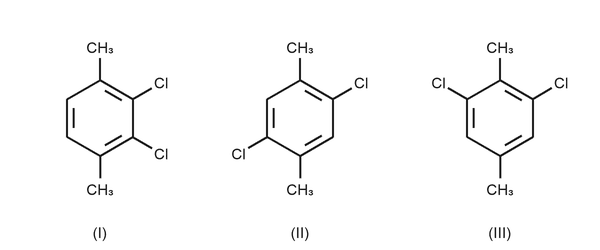
Which of the following compounds will have the highest melting point and why?
- 722 marks
Question 72
How do polar solvents help in the first step in mechanism?
- 732 marks
Question 73
Arrange the following in order of their increasing reactivity in nucleophilic substitution reactions: .
- 742 marks
Question 74
What happens when is treated with KCN?
- 752 marks
Question 75
What happens when ethyl chloride is treated with aqueous KOH?
- 762 marks
Question 76
Which alkyl halide has the highest density and why?
- 772 marks
Question 77
Which one undergoes substitution reaction faster and why?
or
- 785 marks
Question 78
Draw the structures of all eight structural isomers that have the molecular formula . Name each isomer according to IUPAC system and classify them as primary, secondary or tertiary bromide.
- 795 marks
Question 79
Write the structures of the following compounds:
(i) 2-Chloro-3-methylpentane
(ii) 1-Chloro-4-ethylcyclohexane
(iii) 4-tert-Butyl-3-iodoheptane
(iv) 1,4-Dibromobut-2-ene
(v) 1-Bromo-4-sec-butyl-2-methylbenzene.
- 805 marks
Question 80
is less acidic than . Explain.
- 815 marks
Question 81
Complete the following reactions.
- 825 marks
Question 82
Write down the structure of the product of the following reaction.
- 835 marks
Question 83
An alkyl halide (A), on reaction with magnesium in dry ether followed by treatment with ethanol gave 2-methylbutane. Write all the possible structures of A.
- 845 marks
Question 84
Distinguish between enantiomers and diastereomers.
- 855 marks
Question 85
Write the products of the following reactions:
(i)
(ii)
(iii)
- 865 marks
Question 86
Out of chlorobenzene and chloromethane which is more reactive towards nucleophilic substitution reactions.
- 875 marks
Question 87
Write a chemical reaction in which the iodide ion replaces the diazonium group in a diazonium salt.
- 885 marks
Question 88
What effect should the following resonance of vinyl chloride have on its dipole moment?
- 895 marks
Question 89
Why is vinyl chloride less reactive than ethyl chloride?
What Class 12 Chemistry Ch 10 covers
The sections of the chapter, in the order the book takes them. Every question above comes from one of these.
- 01Classification and Nomenclature of Halogen Derivatives
- 02Nature of C–X Bond and Methods of Preparation of Haloalkanes
- 03Physical Properties of Haloalkanes
- 04Nucleophilic Substitution Reactions: SN1 and SN2
- 05Optical Isomerism and Stereochemistry of Substitution
- 06Elimination Reactions and Reactions with Metals
More ways to study this chapter
The same chapter asked three other ways. Practise it, revise it, and see what the board has set on Ch 10 before.
- Competency-Based Questions (CBQ)Case study questions: a situation, and the part of the chapter that answers it.40questionsOpen
- Previous Year QuestionsQuestions that have actually appeared in board papers, each tagged with its year.16questionsOpen
- Practice QuestionsExtra questions per chapter, for when one attempt at a method is not enough.99questionsOpen
Ch 10 in past ISC papers
The same chapter as the board has actually asked it. These are worded differently from the textbook exercise, which is the point of reading them.
- 11 mark
Board paper question 1
How is iodoform prepared from ethanol? Give balanced equation.
Solve with AIWritten solution
Solution:
Key idea: Ethanol gives the iodoform (haloform) reaction because iodine in alkali first oxidises it to ethanal, , which carries the group needed for the reaction.
Step 1 — Choose the reagents.
Ethanol is warmed with iodine and sodium hydroxide solution (or sodium carbonate solution). A yellow solid with a typical smell, iodoform (, triiodomethane), separates out.
Step 2 — Follow what happens to ethanol.
The alkaline iodine first oxidises ethanol to ethanal. The three hydrogen atoms of the group of ethanal are then replaced by iodine, and the alkali splits the product into iodoform and sodium formate.
Step 3 — Write the overall balanced equation.
Adding the steps gives one overall equation, which uses four molecules of iodine (one for the oxidation and three for the substitution):
Counting atoms: each side has 2 C, 12 H, 7 O, 8 I and 6 Na, so the equation is balanced.
Therefore, iodoform is prepared by warming ethanol with iodine and sodium hydroxide: .
- 21 mark
Board paper question 2
What will be the product formed when chlorobenzene is heated with sodium metal in the presence of dry ether?
Solve with AIWritten solution
Solution:
Key idea: When an aryl halide is heated with sodium in dry ether, two aryl groups join together. This is the Fittig reaction.
Step 1 — Name the reaction.
Chlorobenzene and sodium in dry ether undergo the Fittig reaction. Sodium removes the chlorine atoms as sodium chloride, and the two phenyl groups bond to each other.
Step 2 — Write the equation.
Two molecules of chlorobenzene react with two atoms of sodium:
Step 3 — Name the product.
The organic product is , called biphenyl (diphenyl).
Therefore, the product is biphenyl, (Fittig reaction).
- 31 mark
Board paper question 3
Complete the following statements by selecting the correct alternative from the choices given:
During the course of an reaction, the intermediate species formed is:
Solve with AIAnswer
- Correct
(A) a carbocation
(B) a free radical
(C) a carbanion
(D) an intermediate complex
Answer: (A) a carbocation
Key idea: An reaction takes place in two steps. In the slow first step the carbon–halogen bond breaks heterolytically: the halogen leaves with both bonding electrons.
Step 1 — Look at the first step.
For example, in the hydrolysis of 2-bromo-2-methylpropane, the C–Br bond breaks and bromide ion leaves:
Step 2 — Identify the species formed.
The carbon atom has lost its share of the bonding pair, so it carries a positive charge. A species with a positively charged, three-bonded carbon is a carbocation. In the fast second step the nucleophile (for example ) attacks this carbocation.
Why the others are wrong:
- (B) A free radical forms when a bond breaks homolytically (one electron to each atom), as in the chlorination of methane in light; in the bond breaks heterolytically.
- (C) A carbanion has a negatively charged carbon; in the halogen takes the electron pair away, so the carbon becomes positive, not negative.
- (D) "An intermediate complex" does not describe : the five-coordinate arrangement in is a transition state that cannot be isolated, while the one intermediate of is the carbocation.
Therefore, the intermediate species formed in an reaction is a carbocation, option (A).
- 42 marks
Board paper question 4
Write the balanced chemical equation of each of the following
(a) Chlorobenzene treated with ammonia in the pressure of at and
(b) Ethyl chloride treated with alcoholic potassium hydroxide.
Solve with AIWritten solution
Solution:
Key idea: In (a) the very unreactive C–Cl bond of chlorobenzene is replaced by only under drastic conditions (high temperature and pressure, catalyst). In (b) alcoholic KOH removes a molecule of HCl from the haloalkane (β-elimination), giving an alkene.
The paper prints "in the pressure of"; it means "in the presence of" .
Step 1 — Part (a): decide the product.
Ammonia acts as the nucleophile and replaces the chlorine atom, so aniline, , is formed. The hydrogen chloride released combines with a second molecule of ammonia to give ammonium chloride.
Step 2 — Part (a): write the balanced equation.
Copper(I) oxide is the catalyst, so it is written over the arrow:
Step 3 — Part (b): decide the product.
In alcoholic solution the hydroxide ion acts as a base. It removes a hydrogen atom from the β-carbon while chloride leaves from the α-carbon, so a C=C double bond forms (dehydrohalogenation). Ethyl chloride gives ethene, ().
Step 4 — Part (b): write the balanced equation.
The reaction is carried out by heating with alcoholic KOH:
Therefore, (a) (aniline formed) and (b) (ethene formed).
- 51 mark
Board paper question 5
Fill in the blanks by choosing the appropriate word/words from those given in the brackets:
(iodoform, volume, mass, haloform, gram equivalent, chloroform, carbylmine, , high, coke, , low, gram mole, carbon monoxide.
Bleaching powder, on treatment with ethanol or acetone gives ______.
Solve with AIWritten solution
Solution:
Key idea: Bleaching powder supplies chlorine and calcium hydroxide. With ethanol or acetone this brings about the haloform reaction with chlorine, which gives chloroform.
Step 1 — Follow the reaction with ethanol.
Chlorine from bleaching powder oxidises ethanol to ethanal. The group of ethanal is then chlorinated to give chloral, .
Step 2 — Find the final product.
Calcium hydroxide (from the bleaching powder) splits chloral into chloroform, , and calcium formate. Acetone gives chloroform in the same way, through trichloroacetone.
Therefore, bleaching powder, on treatment with ethanol or acetone, gives chloroform.
- 63 marks
Board paper question 6
How will you convert the following:
(i) Chlorobenzene to biphenyl
(ii) Propene to 1-bromopropane
(iii) Chlorobenzene to aniline
Solve with AIWritten solution
Solution:
Key idea: Each conversion uses one standard reaction of the chapter: the Fittig reaction joins two aryl groups, HBr adds against Markovnikov's rule when a peroxide is present, and ammonia replaces the chlorine of chlorobenzene under drastic conditions.
Step 1 — Part (i): chlorobenzene to biphenyl.
Chlorobenzene is heated with sodium in dry ether. Sodium removes the chlorine atoms as sodium chloride and two phenyl groups join (Fittig reaction):
The product is biphenyl, .
Step 2 — Part (ii): choose the condition for propene.
Ordinary addition of HBr to propene follows Markovnikov's rule and gives 2-bromopropane. To put bromine on the end carbon we add HBr in the presence of an organic peroxide such as benzoyl peroxide. This is the peroxide (Kharasch) effect, which works through free radicals.
Step 3 — Part (ii): write the equation.
The peroxide is written over the arrow:
The product is 1-bromopropane.
Step 4 — Part (iii): chlorobenzene to aniline.
Chlorobenzene is heated with ammonia at about 475 K and 60 atm in the presence of copper(I) oxide. The group replaces the chlorine atom, and the HCl formed combines with more ammonia:
Therefore, (i) chlorobenzene is heated with sodium in dry ether to give biphenyl, (ii) propene is treated with HBr in the presence of a peroxide to give 1-bromopropane, and (iii) chlorobenzene is heated with ammonia and under pressure to give aniline.
All 16 board paper questions for this chapter, solved the same way.
Class 12 Chemistry Ch 10 questions students ask
How many questions are there in Class 12 Chemistry Ch 10?
89 questions. Every one is solved step by step on this page.
Are these Class 12 Chemistry solutions free?
Yes. Every question and its full working is free to read, with no account needed.
Can I download the Class 12 Chemistry Ch 10 solutions as a PDF?
There is no PDF to download. Every solution is on this page instead, which means it is searchable, always the current syllabus, and readable on a phone. Use your browser's print option if you want it on paper.