
Opening your dashboard
Class 12 Chemistry Chapter 10 Haloalkanes and Haloarenes: Practice Questions
99 questions on Chapter 10, each worked through on its own page with the AI tutor. Class 12 Chemistry, ICSE 2026-27.
99 questions
1–4 marks · Mixed difficulty
- 11 mark
Question 1
Which of the following is a vinylic halide?
- 21 mark
Question 2
The correct IUPAC name of is
- 32 marks
Question 3
Classify each of the following as a primary, secondary or tertiary halide, and also state whether it is allylic, benzylic or vinylic.
(a)
(b)
(c)
(d)
- 43 marks
Question 4
Ethane forms two isomeric dichloro derivatives of formula .
(a) Write the structure of each isomer and give its common name and its IUPAC name.
(b) Which of them is a geminal dihalide and which is a vicinal dihalide? Explain the two terms.
- 53 marks
Question 5
Give the IUPAC name of each of the following compounds.
(a) , in which the two groups are para to each other (p-chlorotoluene)
(b) (benzylidene chloride)
(c)
- 62 marks
Question 6
Fluorine is more electronegative than chlorine, yet the dipole moment of chloromethane (1.86 D) is slightly greater than that of fluoromethane (1.85 D). Explain.
- 73 marks
Question 7
Propan-1-ol can be converted into 1-chloropropane by thionyl chloride or by phosphorus pentachloride.
(a) Write the balanced equation for the reaction with thionyl chloride.
(b) Write the balanced equation for the reaction with phosphorus pentachloride.
(c) Why is thionyl chloride the preferred reagent?
- 81 mark
Question 8
Which of the following alcohols reacts fastest with concentrated hydrochloric acid to give an alkyl chloride, even without anhydrous zinc chloride?
- 93 marks
Question 9
1-Bromobutane is prepared by treating 37.0 g of butan-1-ol with phosphorus tribromide.
(a) Write the balanced equation for the reaction.
(b) Calculate the minimum mass of phosphorus tribromide needed.
(c) If 54.8 g of 1-bromobutane is obtained, calculate the percentage yield.
(H = 1, C = 12, O = 16, P = 31, Br = 80)
- 101 mark
Question 10
Propene is treated with bromine dissolved in carbon tetrachloride. The product is
- 111 mark
Question 11
Consider the isomers 1-chlorobutane (I), 2-chlorobutane (II) and 2-chloro-2-methylpropane (III). The correct order of decreasing boiling point is
- 123 marks
Question 12
The boiling points of three halomethanes are: chloromethane 249 K, bromomethane 277 K and iodomethane 316 K.
(a) State the trend shown by these values.
(b) Explain the trend in terms of intermolecular forces.
(c) Predict, with a reason, whether iodoethane boils above or below 316 K.
- 131 mark
Question 13
A student shakes an aqueous solution with dichloromethane in a separating funnel to extract an organic compound, and then lets it stand. Which statement is correct?
- 141 mark
Question 14
Which of the following is a gas at room temperature (298 K) and 1 atm pressure?
- 151 mark
Question 15
The hydrolysis of 2-bromo-2-methylpropane by aqueous sodium hydroxide takes place by the mechanism. If the concentration of hydroxide ions is doubled, keeping everything else the same, the rate of the reaction
- 163 marks
Question 16
(Hypothetical data.) Bromoethane reacts with hydroxide ions by the mechanism. When the initial concentrations of bromoethane and are both 0.10 mol L⁻¹, the initial rate is mol L⁻¹ s⁻¹.
(a) Write the rate law for the reaction.
(b) Calculate the rate constant, with its unit.
(c) Calculate the initial rate when the concentration of bromoethane is 0.20 mol L⁻¹ and that of is 0.050 mol L⁻¹.
- 173 marks
Question 17
2-Chloro-2-methylbutane is hydrolysed by water by the mechanism. Write the steps of the mechanism, name the intermediate, identify the slow step and write the rate law.
- 181 mark
Question 18
Which of the following is the strongest nucleophile towards iodomethane in an reaction carried out in aqueous ethanol?
- 192 marks
Question 19
1-Bromo-2,2-dimethylpropane, , is a primary bromide, yet it reacts extremely slowly both by the and by the mechanism. Explain both observations.
- 204 marks
Question 20
Give four differences between the and the mechanisms of nucleophilic substitution in haloalkanes.
- 211 mark
Question 21
Ethanol does not react with aqueous sodium bromide, but it gives bromoethane when heated with concentrated hydrobromic acid. The main reason is that
- 221 mark
Question 22
Which of the following molecules is chiral?
- 232 marks
Question 23
2-Bromobutane contains an asymmetric carbon atom. Yet a sample of 2-bromobutane made by adding hydrogen bromide to but-1-ene is optically inactive. Explain.
- 243 marks
Question 24
An optically active sample of 2-iodobutane is dissolved in acetone containing sodium iodide. Its optical rotation slowly falls to zero, although the compound is still 2-iodobutane.
(a) By which mechanism does iodide ion react with 2-iodobutane under these conditions?
(b) Explain why the optical activity is lost.
(c) If the same optically active 2-iodobutane were instead converted completely into butan-2-ol by an reaction with hydroxide ion, would the product be optically active? Can the sign of its rotation be predicted? Explain.
- 251 mark
Question 25
Which alkyl bromide gives only one constitutional (structural) alkene when heated with alcoholic KOH? (Ignore cis–trans isomers.)
- 263 marks
Question 26
A primary alkyl bromide A, , on heating with alcoholic KOH gives a single alkene B. B adds HBr (no peroxide) to give C, an isomer of A. When C is heated with alcoholic KOH, the major product D is an isomer of B, not B itself.
(a) Identify A, B, C and D.
(b) Write the equations for the formation of B and C.
(c) Name the rule that decides the major product D.
- 272 marks
Question 27
How would you prepare ethane-d, (one H atom replaced by deuterium), starting from bromoethane? Write the equations and state one condition that must be kept.
- 281 mark
Question 28
A mixture of 1-bromopropane and 2-bromopropane is heated with sodium in dry ether. How many different alkanes with six carbon atoms can be formed by coupling?
- 293 marks
Question 29
When 2-bromopropane is heated with KOH, the product may be propan-2-ol or propene depending on the conditions. Give three conditions that favour elimination over substitution, with a reason for each.
- 301 mark
Question 30
Which of the following alkyl bromides cannot give an alkene by β-elimination with alcoholic KOH?
- 312 marks
Question 31
Starting from 1,2-dibromopropane, how would you obtain
(a) propene;
(b) propyne?
Give the reagents and equations.
- 321 mark
Question 32
Chloroform is warmed with concentrated nitric acid. The product, used as an insecticide and as a tear gas, is
- 332 marks
Question 33
Two unlabelled bottles contain chloroform and carbon tetrachloride. Describe one chemical test to tell them apart, with the equation.
- 343 marks
Question 34
Dichlorodifluoromethane (freon-12), , was once widely used in refrigerators and air-conditioners.
(a) Give two properties that made it suitable for this use.
(b) Explain, with equations, how it damages the ozone layer.
- 351 mark
Question 35
DDT was banned for farm use in many countries even though it is a very effective insecticide. The main chemical reason is that DDT
- 362 marks
Question 36
Carbon tetrachloride was once used in fire extinguishers. Why is it no longer used for this purpose? Support your answer with an equation.
- 371 mark
Question 37
Benzenediazonium chloride can be converted into chlorobenzene by the Sandmeyer reaction or by the Gattermann reaction. The two reactions differ in that
- 382 marks
Question 38
Alcohols such as ethanol are easily converted into chloroalkanes by HCl and anhydrous , but phenol cannot be converted into chlorobenzene in this way. Explain.
- 391 mark
Question 39
In the chlorination of benzene, , the anhydrous iron(III) chloride acts by
- 402 marks
Question 40
Arrange fluorobenzene, chlorobenzene, bromobenzene and iodobenzene in increasing order of boiling point, and explain the order.
- 412 marks
Question 41
Chlorobenzene is made on a large scale by passing a mixture of benzene vapour, hydrogen chloride and air over a heated catalyst. Write the equation, name the catalyst, and give one advantage of this method over direct chlorination with .
- 423 marks
Question 42
In a laboratory preparation, 15.6 g of benzene was chlorinated with in the presence of anhydrous , and 16.9 g of pure chlorobenzene was obtained. (Hypothetical data.) (C = 12, H = 1, Cl = 35.5)
(a) Calculate the theoretical yield of chlorobenzene.
(b) Calculate the percentage yield.
(c) What volume of chlorine at S.T.P. is needed for complete conversion of the benzene?
- 431 mark
Question 43
Chlorobenzene can be converted into phenol by aqueous sodium hydroxide only by
- 441 mark
Question 44
Chlorobenzene is heated with acetyl chloride, , in the presence of anhydrous . The major organic product is
- 452 marks
Question 45
Chlorobenzene is treated with chlorine in the presence of anhydrous . Name the main products, write the equation for the major one, and give one use of the major product.
- 461 mark
Question 46
Chlorobenzene is warmed with magnesium in dry tetrahydrofuran; the solution is poured onto solid carbon dioxide and then acidified with dilute HCl. The organic product is
- 472 marks
Question 47
Chloroethane gives propanenitrile when heated with alcoholic KCN, but chlorobenzene does not give benzonitrile under the same conditions. How is benzonitrile obtained from chlorobenzene? Give the reason and the equation.
- 481 mark
Question 48
1-Bromo-4-chlorobenzene is warmed with one mole of magnesium in dry ether. The main product is
- 492 marks
Question 49
How is iodoform prepared from ethanol? Give balanced equation.
- 502 marks
Question 50
Give balanced equation for the following name reaction Friedel-Crafts reaction (alkylation)
- 511 mark
Question 51
Choose the correct alternative. During the course of an reaction, the intermediate species formed is
- 521 mark
Question 52
Out of the following, the alkene that exhibits optical isomerism is
- 531 mark
Question 53
How many chiral compounds are possible on monochlorination of 2-methylbutane?
- 541 mark
Question 54
The order of reactivity of the given haloalkanes towards nucleophile is:
- 551 mark
Question 55
Compound (A), , gives a yellow precipitate when warmed with alcoholic . Oxidation of (A) gives an acid (B), . (B) easily forms anhydride on heating. Identify the compound (A).
- 561 mark
Question 56
The Wurtz-Fittig reaction involves condensation of:
- 571 mark
Question 57
For the compounds , , and , the correct order of increasing C-halogen bond length is
- 581 mark
Question 58
In a nucleophilic substitution reaction:
which one of the following undergoes complete inversion of configuration?
- 591 mark
Question 59
The major organic compound formed by the reaction of 1,1,1-trichloroethane with silver powder is:
- 601 mark
Question 60
The optically inactive compound from the following is
- 611 mark
Question 61
The synthesis of alkyl fluorides is best accomplished by:
- 621 mark
Question 62
Which one of the following reagents is not suitable for the elimination reaction?
- 631 mark
Question 63
The increasing order of the reactivity of the following halides for the reaction is
(I)
(II)
(III)
- 641 mark
Question 64
The major product of the following reaction is
- 651 mark
Question 65
The major product obtained in the following reaction is
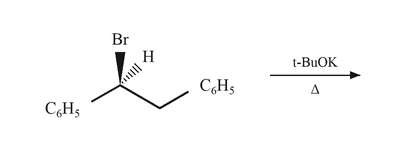
- 661 mark
Question 66
The major product of the following reaction is:

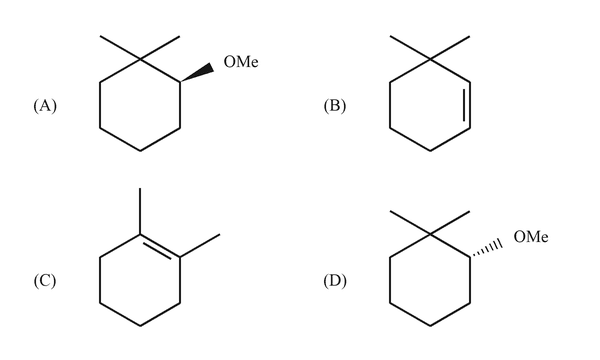
- 671 mark
Question 67
The major product of the following reaction is:
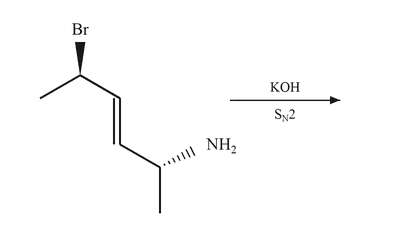

- 681 mark
Question 68
An 'Assertion' and a 'Reason' are given below. Choose the correct answer from the following options:
Assertion (A): Vinyl halides do not undergo nucleophilic substitution easily.
Reason (R): Even though the intermediate carbocation is stabilised by loosely held π-electrons, the cleavage is difficult because of strong bonding.
- 691 mark
Question 69
Increasing rate of reaction in the following compounds is:
(P)
(Q)
(R)
(S)
- 701 mark
Question 70
The major product of the following reaction is:
- 711 mark
Question 71
The decreasing order of reactivity of the following organic molecules towards solution is :
(P) 3-chlorocyclopropene
(Q) 3-chloro-1-methoxycyclopropene
(R)
(S)
- 721 mark
Question 72
Which of the following compounds will form the precipitate with aq. solution most readily?
- 731 mark
Question 73
The decreasing order of reactivity of the following compounds towards nucleophilic substitution () is:
(I) benzyl chloride,
(II) 2,3-dinitrobenzyl chloride
(III) 3,4-dinitrobenzyl chloride
(IV) 3,5-dinitrobenzyl chloride
- 741 mark
Question 74
The major product of the following reaction is:
- 751 mark
Question 75
A chloro compound "A"
(i) forms aldehydes on ozonolysis followed by the hydrolysis.
(ii) when vaporised completely 1.53 g of A, gives 448 mL of vapour at STP.
The number of carbon atoms in a molecule of compound A is _____.
- 761 mark
Question 76
The correct order of reactivity of the given chlorides with acetate in acetic acid is:
(P) 3-chloro-1-methylcyclohexene
(Q) 3-chloro-4-methylcyclohexene
(R) 5-chloro-3-methylcyclohexene
(S) 3-(chloromethyl)cyclohexene
- 771 mark
Question 77
Among the following compound I-IV, which one forms a yellow precipitate on reacting sequentially with (i) NaOH (ii) dil. (iii) ?
I 4-chlorotoluene,
II 3-chlorotoluene,
III 2-bromotoluene,
IV 2-chlorobenzyl iodide,
- 781 mark
Question 78
Which among the following pairs of the structures will give different products on ozonolysis?
(Consider the double bonds in the structures are rigid and not delocalised.)
- 791 mark
Question 79
Considering the above reactions, the compound 'X' and compound 'Y' respectively are:
- 801 mark
Question 80
Arrange the following in increasing order of reactivity towards nitration.
P p-xylene
Q bromobenzene
R mesitylene
S nitrobenzene
T benzene
Choose the correct answer from the options given below:
- 811 mark
Question 81
Observe structures of the following compounds
(1)
(2)
(3)
(4)
(5) 2-isopropyl-5-methylcyclohexan-1-ol
The total number of structures/compounds which possess asymmetric carbon atoms is ____.
- 821 mark
Question 82
Which among the following pairs has only herbicides?
- 831 mark
Question 83
Which one is most reactive towards reaction?
- 841 mark
Question 84
The correct order of increasing reactivity of C—X bond towards nucleophile in the following compounds is:
(I) (halobenzene)
(II) (1-halo-2,4-dinitrobenzene)
(III)
(IV)
- 851 mark
Question 85
Consider the reactions:
(i)
(ii)
The mechanisms of reactions (i) and (ii) are respectively:
- 861 mark
Question 86
Which one is a nucleophilic substitution reaction among the following?
- 871 mark
Question 87
Which of the following compounds undergoes nucleophilic substitution reaction most easily?
- 881 mark
Question 88
Which of the following acids does not exhibit optical isomerism?
- 891 mark
Question 89
Two possible stereo-structures of , which are optically active, are called.
- 901 mark
Question 90
Which of the following compounds will undergo racemisation when solution of KOH hydrolyses?
(i)
(ii)
(iii)
(iv)
- 911 mark
Question 91
In an reaction on chiral centres there is:
- 921 mark
Question 92
Which of the following biphenyls is optically active?
- 931 mark
Question 93
The hydrolysis reaction that takes place at the slowest rate, among the following is
- 941 mark
Question 94
Which of the following alkane cannot be made in good yield by Wurtz reaction?
- 951 mark
Question 95
The major product formed in dehydrohalogenation reaction of 2-Bromopentane is Pent-2-ene. This product formation is based on?
- 961 mark
Question 96
The correct sequence of bond enthalpy of 'C—X' bond is:
- 971 mark
Question 97
Elimination reaction of 2-Bromopentane to form pent-2-ene is:
P β-Elimination reaction
Q Follows Zaitsev rule
R Dehydrohalogenation reaction
S Dehydration reaction
- 981 mark
Question 98
The incorrect statement regarding chirality is:
- 991 mark
Question 99
Which of the following is suitable to synthesise chlorobenzene?