
Opening your dashboard
Class 12 Biology Chapter 4: Reproductive Health - Problems and Strategies Solutions
40 textbook questions with step-by-step answers, free to read, for ISC 2026-27.
Get talked through Ch 4, not just shown the answer
Reading a finished solution is not the same as being able to do it. The AI tutor takes one question at a time and works it with you, in your own words, until you can.
- Ask it out loud, in your own words
- It gives you the next step, not the answer
- Stuck on part (ii)? Start there
40 questions with solutions
1–5 marks · Mixed difficulty
- 11 mark
Question 1
According to the 2021 census report what is the population growth rate of India?
Solve with AIWritten solution
Solution:
Key idea: The population growth rate is the yearly percentage increase in the population. India holds a census every ten years; the last one was held in 2011, and the census due in 2021 was postponed and not held.
Step 1 — Check the census named in the question.
Since no census was held in 2021, the latest census figures are from 2011. The value asked for is therefore an estimate for the years around 2021.
Step 2 — Give the growth rate.
The book's text gives India's population growth rate as about 1 % a year. Estimates for the years around 2021 also put it close to 1 % a year, a little below it.
Step 3 — Compare with the 2011 census.
The census counted about 1,028.7 million people in 2001 and about 1,210.9 million in 2011. We find the increase over the ten years as a percentage of the 2001 figure.
Spread over ten years, this is about 1.6 % a year, so the growth rate has been falling since then.
Note: The book's answer prints "1 percent (1.10%)". The 1 % figure matches its text, and it is a rounded estimate, not a census result.
Therefore, India's population growth rate is about 1 % a year; no census was held in 2021, so this is an estimate (the 2011 census showed about 1.6 % a year for 2001–2011).
- 21 mark
Question 2
Which type of contraceptive is considered to be an ideal contraceptive?
Solve with AIWritten solution
Solution:
Key idea: A contraceptive is a method or device that prevents pregnancy. Whether a contraceptive is good is judged by how safe, effective and easy to use it is.
Step 1 — List the qualities of an ideal contraceptive.
An ideal contraceptive should have all of these qualities:
- it is user-friendly and easily available;
- it is effective, so pregnancy rarely occurs;
- it is reversible, so fertility returns when its use is stopped;
- it has no side effects, or the least possible;
- it does not interfere with sexual drive, desire or the sexual act.
Step 2 — Compare real methods with this ideal.
No single method has every quality, so people choose the method that suits their needs. For example, condoms are easily available and reversible and also lower the risk of sexually transmitted infections, but they must be used correctly every time; copper IUDs are highly effective and reversible but must be inserted by a trained health worker.
Therefore, an ideal contraceptive is user-friendly, easily available, effective and reversible, with no or least side effects, and it does not interfere with sexual drive or the sexual act.
- 31 mark
Question 3
Name any three natural methods of contraception.
Solve with AIWritten solution
Solution:
Key idea: Natural methods of contraception use no devices or medicines. They work by avoiding the chance of the ovum and the sperm meeting.
Step 1 — Describe periodic abstinence.
In periodic abstinence the couple avoids coitus from about day 10 to day 17 of the menstrual cycle. Ovulation usually happens around day 14 of a 28-day cycle, so these are the days on which fertilisation is most likely.
Step 2 — Describe coitus interruptus (withdrawal).
In coitus interruptus the male partner withdraws the penis from the vagina just before ejaculation, so that semen is not released inside.
Step 3 — Describe lactational amenorrhoea.
Lactational amenorrhoea means the absence of menstruation while a mother breastfeeds. While the baby is fed fully on breast milk, ovulation usually does not occur, so the chance of conception is low. This works only for up to about six months after the birth.
Watch out: Natural methods fail more often than other methods, because cycles vary in length and some sperms can be released before ejaculation.
Therefore, three natural methods of contraception are periodic abstinence, coitus interruptus (withdrawal) and lactational amenorrhoea.
- 41 mark
Question 4
What is the principle of contraception through barrier method?
Solve with AIWritten solution
Solution:
Key idea: Fertilisation can happen only if a sperm reaches the ovum in the fallopian tube.
Step 1 — Find the step that a barrier blocks.
Barrier methods place a physical barrier in the path of the sperms. Condoms cover the penis (or line the vagina, in the female condom), while diaphragms, cervical caps and vaults cover the cervix. The semen is therefore kept away from the cervix and uterus.
Step 2 — State the principle.
Since the sperms cannot reach the ovum, the two gametes never meet and fertilisation cannot take place. Barriers are often used along with spermicidal creams, jellies or foams, which kill sperms and make the method more effective.
Therefore, the principle of barrier methods is to prevent the ovum and the sperm from meeting by placing a physical barrier between them.
- 51 mark
Question 5
Name one barrier method used by males and females.
Solve with AIWritten solution
Solution:
Key idea: Barrier methods stop the sperms from reaching the ovum. Different devices are used by males and by females.
Step 1 — Name a barrier method for males.
The condom is a thin sheath, usually of latex (rubber), that covers the penis during coitus and collects the semen.
Step 2 — Name a barrier method for females.
The diaphragm (or a cervical cap or vault) is a rubber device inserted into the vagina to cover the cervix during coitus. Female condoms, which line the vagina, are also available.
Note: Condoms are the only contraceptives that also greatly lower the risk of sexually transmitted infections, including HIV.
Therefore, males use condoms, and females use diaphragms (or cervical caps).
- 61 mark
Question 6
How do oral pills help in preventing conception?
Solve with AIWritten solution
Solution:
Key idea: Oral contraceptive pills contain small doses of progestogens alone, or progestogen–oestrogen combinations. Progestogens are synthetic hormones that act like progesterone.
Step 1 — State how the pills are taken.
The usual pills are taken daily for 21 days, starting within the first five days of the menstrual cycle. After a gap of 7 days, during which menstruation occurs, the next course begins.
Step 2 — Explain the main action: no ovulation.
The hormones in the pill lower the release of FSH and LH from the pituitary. Without these hormones no follicle ripens fully, so no ovum is released and there is nothing for a sperm to fertilise.
Step 3 — Explain the extra actions.
The pills also make the cervical mucus thick, which slows the entry of sperms, and they make the lining of the uterus less suitable for implantation.
Note: Saheli, developed at the Central Drug Research Institute (CDRI), Lucknow, is a non-steroidal pill taken once a week.
Therefore, oral pills prevent conception mainly by inhibiting ovulation; they also thicken the cervical mucus to slow sperms and inhibit implantation.
- 71 mark
Question 7
Name two irreversible contraceptive techniques.
Solve with AIWritten solution
Solution:
Key idea: Surgical methods (sterilisation) are terminal methods, used by people who do not want any more children.
Step 1 — Name the method for males.
In vasectomy a small part of each vas deferens is cut and tied, so sperms cannot reach the urethra.
Step 2 — Name the method for females.
In tubectomy a small part of each fallopian tube is cut and tied, so the ovum cannot meet the sperms.
Step 3 — Explain why they are called irreversible.
Rejoining the cut tubes needs a second operation, and even then fertility often does not return. These methods are therefore described as very poorly reversible.
Therefore, the two irreversible techniques are vasectomy in males and tubectomy in females.
- 81 mark
Question 8
How do surgical methods help to prevent conception?
Solve with AIWritten solution
Solution:
Key idea: Conception (fertilisation) needs an ovum and a sperm to meet in the fallopian tube.
Step 1 — Explain the method in males.
In vasectomy each vas deferens is cut and tied. Sperms can no longer pass from the testes to the urethra, so the semen contains no sperms.
Step 2 — Explain the method in females.
In tubectomy each fallopian tube is cut and tied. The ovum cannot move down the tube, and sperms cannot move up to it.
Step 3 — Link both to conception.
In both operations the tubes that carry the gametes are blocked, so the ovum and the sperm can never meet.
Therefore, surgical methods prevent conception by blocking the transport of gametes, so the ovum and sperm cannot meet.
- 91 mark
Question 9
Vasectomy is performed on which part of the body?
Solve with AIWritten solution
Solution:
Key idea: The vas deferens is the tube that carries sperms from the epididymis towards the urethra. There is one on each side.
Step 1 — Name the part operated on.
Vasectomy is performed on the vas deferens of the male. A small part of each vas deferens is removed or tied.
Step 2 — Say how it is reached.
The vas deferens is reached through a small cut (or puncture) in the skin of the scrotum. The testes are not touched, so they go on making male hormones as before.
Therefore, vasectomy is performed on the vas deferens, which is reached through a small cut on the scrotum.
- 101 mark
Question 10
Name a contraceptive device that prevent implantation of ovum.
Solve with AIWritten solution
Solution:
Key idea: Intrauterine devices (IUDs) are placed in the uterus through the vagina by doctors or trained nurses. They may be non-medicated (Lippes loop), copper-releasing (CuT, Cu7, Multiload 375) or hormone-releasing (Progestasert, LNG-20).
Step 1 — Name the device.
An intrauterine device such as the copper T (or a loop) is the contraceptive device that makes the uterus unsuitable for implantation.
Step 2 — Explain how it works.
The copper ions released by a copper T mainly reduce the movement and the fertilising power of sperms, so fertilisation usually does not happen. The device also changes the lining of the uterus so that an embryo cannot implant in it.
Note: It is the early embryo (blastocyst), not the unfertilised ovum, that implants in the uterus.
Therefore, an intrauterine device such as the copper T (or a loop) prevents implantation.
- 112 marks
Question 11
What would be the basic intention to encourage each couple to restrict to have two children only?
Solve with AIWritten solution
Solution:
Key idea: India's Family Planning programme, started in 1951, encouraged a small family through slogans such as "Hum do Hamare do" (we two, our two).
Step 1 — Give the first intention: slowing population growth.
If each couple has only two children, the number of births falls, and the population grows more slowly. This eases the pressure on food, housing, jobs and natural resources.
Step 2 — Give the second intention: a better life for each family.
With fewer children, parents can give each child good food, health care and education. Spacing the births also protects the health of the mother.
Therefore, the basic intention is to check the rapid growth of population and to let every family give each child the basic necessities, so that it is a small, happy family.
- 122 marks
Question 12
Name two contraceptive methods that prevent fusion of gametes.
Solve with AIWritten solution
Solution:
Key idea: Fusion of gametes means fertilisation. Barrier methods prevent it by stopping the sperms from reaching the ovum.
Step 1 — Describe the condom.
A condom is a thin latex sheath worn over the penis during coitus. It collects the semen, so sperms do not enter the female tract. Female condoms, which line the vagina, work in the same way.
Step 2 — Describe diaphragms and cervical caps.
Diaphragms and cervical caps are rubber devices placed in the vagina to cover the cervix. They block the sperms from entering the uterus and are usually used with a spermicidal cream.
Therefore, condoms (used by males) and diaphragms or cervical caps (used by females) prevent the fusion of gametes.
- 132 marks
Question 13
How does copper T prevent pregnancy?
Solve with AIWritten solution
Solution:
Key idea: Copper T is a copper-releasing intrauterine device (IUD). A doctor or trained nurse places it in the uterus through the vagina, and it can stay there for several years.
Step 1 — Explain the main action of the copper.
The copper ions released from the device suppress the movement of sperms and reduce their fertilising capacity. As a result, fertilisation usually does not take place.
Step 2 — Explain the effect on the uterus.
The device also increases the phagocytosis (engulfing) of sperms by white blood cells in the uterus. In addition, it makes the lining of the uterus unsuitable for implantation, so an embryo cannot implant if fertilisation does happen.
Note: The copper T can be removed whenever a pregnancy is wanted, and fertility then returns. This makes it suitable for delaying pregnancy or spacing children.
Therefore, copper T prevents pregnancy mainly because its copper ions lower sperm motility and fertilising capacity, and it also increases phagocytosis of sperms and makes the uterus unsuitable for implantation.
- 142 marks
Question 14
Give full form of IUCD and ZIFT.
Solve with AIWritten solution
Solution:
Key idea: Each abbreviation names a method by what it is (a device) or by what is transferred and where (a zygote into a fallopian tube).
Step 1 — Expand IUCD.
IUCD stands for intrauterine contraceptive device. It is a device, such as the copper T, placed inside the uterus to prevent pregnancy.
Step 2 — Expand ZIFT.
ZIFT stands for zygote intra fallopian transfer. A zygote or early embryo (up to 8 blastomeres) formed in the laboratory is transferred into the fallopian tube.
Therefore, IUCD is intrauterine contraceptive device, and ZIFT is zygote intra fallopian transfer.
- 152 marks
Question 15
Define the technique of IVF.
Solve with AIWritten solution
Solution:
Key idea: In vitro means "in glass", that is, outside the body. In vitro fertilisation (IVF) is an assisted reproductive technology used when a couple cannot conceive naturally.
Step 1 — Collect the gametes.
Ova are taken from the woman's ovaries in a minor procedure, usually after hormone treatment that ripens several follicles. Sperms are collected from the partner or, if needed, from a donor.
Step 2 — Fertilise the ovum outside the body.
The ova and sperms are put together in a culture dish in the laboratory, where fertilisation takes place. The zygote is allowed to divide for a few days.
Step 3 — Transfer the embryo.
The early embryo is transferred into the woman's body: one with up to 8 blastomeres into the fallopian tube (ZIFT), or one with more than 8 blastomeres into the uterus (IUT). It then implants in the uterus and develops normally.
Note: Babies born in this way are called test tube babies, but they grow in the mother's uterus, not in a tube. The first such baby was born in Britain in 1978.
Therefore, IVF is a technique in which the ovum is fertilised by the sperm outside the body, in the laboratory, and the early embryo is then transferred into the female for further development.
- 162 marks
Question 16
What is amniocentesis?
Solve with AIWritten solution
Solution:
Key idea: Amniocentesis is a prenatal diagnostic test. It studies the amniotic fluid, which surrounds the foetus in the amniotic sac and contains cells shed by the foetus.
Step 1 — Describe how the sample is taken.
A thin, hollow needle, guided by ultrasound, is passed through the mother's abdominal wall into the amniotic sac, and a small amount of amniotic fluid (usually about 15–20 mL) is drawn out. It is usually done from about the 15th week of pregnancy.
Step 2 — Describe how the sample is analysed.
The foetal cells in the fluid are grown (cultured). Their chromosomes are examined (karyotype) to detect disorders such as Down's syndrome, and their DNA can be tested for gene disorders such as thalassaemia. Chemicals in the fluid are also measured; for example, a high level of alpha-fetoprotein (AFP) points to a neural tube defect such as spina bifida.
Note: The book gives the amount as about 10 mL and says the test is done at a very early stage; current practice takes about 15–20 mL, usually between 15 and 20 weeks. In India its use to find the sex of the foetus is banned by law.
Therefore, amniocentesis is a prenatal test in which a small amount of amniotic fluid is withdrawn with a needle, and the foetal cells and chemicals in it are analysed to detect chromosomal, genetic or metabolic disorders in the foetus.
- 172 marks
Question 17
What is the meaning of the term homogametic?
Solve with AIWritten solution
Solution:
Key idea: The sex chromosomes in humans are X and Y. A sex that has two similar sex chromosomes forms only one kind of gamete for them.
Step 1 — Give the meaning of the term.
Homogametic means producing only one type of gamete with respect to the sex chromosomes.
Step 2 — Apply it to humans.
A human female has 44 autosomes and two X chromosomes (44 + XX). In meiosis each egg receives one set of 22 autosomes and one X chromosome, so every egg is 22 + X. Since all her eggs carry X, the human female is homogametic.
Note: In birds the pattern is reversed: the male (ZZ) is homogametic and the female (ZW) is heterogametic.
Therefore, homogametic means producing only one type of gamete; human females are homogametic because all their eggs carry an X chromosome.
- 182 marks
Question 18
Why are males said to be heterogametic?
Solve with AIWritten solution
Solution:
Key idea: Heterogametic means producing two different types of gametes with respect to the sex chromosomes.
Step 1 — State the chromosomes of a male.
A human male has 44 autosomes and one X and one Y chromosome (44 + XY).
Step 2 — Follow the sex chromosomes into the sperms.
In meiosis the X and Y chromosomes separate into different cells. Half the sperms receive 22 + X and the other half receive 22 + Y, so the two types are formed in equal numbers.
Step 3 — Conclude.
Because a male forms two kinds of sperms, X-bearing and Y-bearing, he is heterogametic.
Therefore, males are heterogametic because they produce two types of sperms: half carry an X chromosome and half carry a Y chromosome.
- 192 marks
Question 19
List three important symptoms of AIDS.
Solve with AIWritten solution
Solution:
Key idea: AIDS (acquired immunodeficiency syndrome) is the late stage of infection with HIV (human immunodeficiency virus). HIV destroys helper T cells, so the body's immunity falls and germs that a healthy body would control cause repeated illness.
Step 1 — Explain where the symptoms come from.
A person may have HIV for years without symptoms. As the number of helper T cells falls, the person begins to suffer from infections and certain cancers that the immune system would normally stop.
Step 2 — List three important symptoms.
The important symptoms of AIDS are:
- long-lasting fever and a persistent cough;
- chronic diarrhoea with marked loss of weight (and swollen lymph nodes);
- repeated infections such as tuberculosis, pneumonia and fungal infections of the mouth, and certain cancers.
Note: There is no cure for HIV, but antiretroviral therapy (ART) keeps the virus under control, and people living with HIV who take it can lead long, healthy lives.
Therefore, three important symptoms of AIDS are long-lasting fever with persistent cough, chronic diarrhoea with weight loss, and repeated infections such as tuberculosis and pneumonia.
- 202 marks
Question 20
Which organisms cause syphilis and AIDS?
Solve with AIWritten solution
Solution:
Key idea: Sexually transmitted infections are caused by different kinds of microbes, such as bacteria and viruses.
Step 1 — Name the cause of syphilis.
Syphilis is caused by a bacterium, Treponema pallidum, a spiral-shaped bacterium (spirochaete).
Step 2 — Name the cause of AIDS.
AIDS is caused by a virus, HIV (human immunodeficiency virus). It is a retrovirus, which has RNA as its genetic material.
Note: Syphilis can be cured with antibiotics such as penicillin. HIV infection cannot be cured, but medicines can keep it under control.
Therefore, syphilis is caused by the bacterium Treponema pallidum, and AIDS is caused by the virus HIV.
- 213 marks
Question 21
What is the full form of RCH? Name three important strategies for successful implementation of this program.
Solve with AIWritten solution
Solution:
Key idea: RCH programmes aim to build a reproductively healthy society: people who are aware of reproduction-related matters and who have the facilities to look after their reproductive health and the health of their children.
Step 1 — Give the full form.
RCH stands for Reproductive and Child Health Care. The RCH programme was launched in India in 1997, and its work now continues under the National Health Mission.
Step 2 — Give the first strategy: creating awareness.
Government and non-government agencies spread correct information about reproduction-related matters through audio-visual media (radio, television, films) and print media (newspapers, magazines, posters). Parents, close relatives, teachers and friends also have a part in passing on this information.
Step 3 — Give the second strategy: sex education in schools.
Sex education in schools gives young people correct information at the right age. It helps them reject myths and clears misconceptions about sex-related matters, such as wrong beliefs about the changes of adolescence.
Step 4 — Give the third strategy: educating couples.
People of marriageable age and couples are told about the available birth control methods, care of the pregnant mother, care of the mother and child after birth, the importance of breastfeeding, and equal opportunities for girls and boys.
Therefore, RCH stands for Reproductive and Child Health Care, and three strategies are creating awareness through audio-visual and print media, sex education in schools, and educating couples and people of marriageable age about birth control and the care of mother and child.
- 223 marks
Question 22
Give three important reasons for the decline in the death rate in last two decades.
Solve with AIWritten solution
Solution:
Key idea: The death rate is the number of deaths per 1,000 people in a year. It falls when fewer people die of disease, poor living conditions or disasters.
Step 1 — Give the first reason: better medical facilities.
More hospitals and health centres, trained doctors and nurses, and effective medicines such as antibiotics now treat illnesses that used to kill many people.
Step 2 — Give the second reason: public health programmes.
Large immunisation programmes protect children against diseases such as measles, tetanus and polio; India was certified free of polio in 2014. Care in pregnancy and safer deliveries have also lowered the maternal mortality rate (MMR) and the infant mortality rate (IMR).
Step 3 — Give the third reason: better living conditions.
Safe drinking water, better sanitation, cleaner surroundings and better nutrition reduce infections such as diarrhoea and cholera.
Note: Timely relief during floods, famines and earthquakes has also reduced the number of deaths in such disasters.
Therefore, three important reasons for the fall in the death rate are better medical facilities, public health programmes such as mass immunisation, and healthier, more hygienic living conditions.
- 233 marks
Question 23
Explain three contraceptive methods that help in family planning.
Solve with AIWritten solution
Solution:
Key idea: Contraceptive methods help couples plan the number and spacing of children. They work by keeping the gametes apart, by preventing ovulation, or by making fertilisation and implantation unlikely.
Step 1 — Explain barrier methods.
Barrier methods place a physical barrier between the ovum and the sperms. Males use condoms, thin latex sheaths that cover the penis during coitus; females use diaphragms, cervical caps and vaults, which cover the cervix. They are often used with spermicidal creams, and condoms also lower the risk of sexually transmitted infections.
Step 2 — Explain intrauterine devices (IUDs).
IUDs are placed in the uterus through the vagina by doctors or trained nurses. They may be non-medicated (Lippes loop), copper-releasing (CuT, Cu7, Multiload 375) or hormone-releasing (Progestasert, LNG-20). Copper ions mainly reduce the movement and fertilising capacity of sperms, IUDs increase the phagocytosis of sperms in the uterus, and the hormone-releasing types make the uterus unsuitable for implantation and the cervix hostile to sperms. IUDs are well suited to delaying pregnancy or spacing children.
Step 3 — Explain oral pills.
Oral pills contain small doses of progestogens alone or progestogen–oestrogen combinations. They are taken daily for 21 days, starting within the first five days of the cycle, followed by a 7-day gap. They mainly inhibit ovulation; they also inhibit implantation and thicken the cervical mucus so that sperms enter less easily. Saheli, a non-steroidal pill taken once a week, has very few side effects.
Note: Progestogens are synthetic hormones that act like progesterone; the pills do not contain natural progesterone itself.
Therefore, three contraceptive methods used in family planning are barrier methods (condoms, diaphragms), intrauterine devices (copper T and others) and oral pills (progestogen alone or with oestrogen).
- 243 marks
Question 24
Give three ways of contraception that prevent fusion of gametes or fertilisation.
Solve with AIWritten solution
Solution:
Key idea: Fertilisation is the fusion of the sperm with the ovum. Any method that keeps sperms away from the ovum, or kills them first, prevents fertilisation.
Step 1 — Explain barrier methods.
Condoms (used by males) and diaphragms or cervical caps (used by females) are physical barriers. They stop the sperms from entering the uterus, so the sperms never reach the ovum.
Step 2 — Explain chemical methods (spermicides).
Vaginal tablets, creams, jellies and foams contain spermicides, chemicals that kill or immobilise sperms in the vagina. Used alone they often fail, so they are usually used with a diaphragm or a condom.
Step 3 — Explain natural methods.
In periodic abstinence the couple avoids coitus from about day 10 to day 17 of the menstrual cycle, the days around ovulation when fertilisation is most likely. In coitus interruptus the male partner withdraws before ejaculation so that semen is not released in the vagina.
Watch out: Natural methods fail fairly often, because cycles vary in length and some sperms may be released before ejaculation.
Therefore, three ways that prevent fertilisation are barrier methods (condoms, diaphragms, cervical caps), spermicidal chemicals, and natural methods such as periodic abstinence and coitus interruptus.
- 253 marks
Question 25
Name and explain two sterilisation techniques used to prevent conception.
Solve with AIWritten solution
Solution:
Key idea: Sterilisation is a surgical (terminal) method of contraception. It blocks the tubes that carry the gametes, so it is very effective but very poorly reversible.
Step 1 — Explain vasectomy.
Vasectomy is done in males. A small part of each vas deferens is removed or tied through a small cut on the scrotum. Sperms can then no longer reach the urethra, so the semen contains no sperms.
Step 2 — Explain tubectomy.
Tubectomy is done in females. A small part of each fallopian tube is removed or tied through a small cut in the abdomen or through the vagina. The ovum can then no longer meet the sperms or reach the uterus.
Step 3 — Compare their effect.
Neither operation affects the hormones or sexual activity, because the testes and ovaries are left in place. Both are chosen only by people who want no more children, because reversal surgery often does not restore fertility.
Watch out: After vasectomy some sperms remain stored beyond the cut, so another method is used for about three months, until a semen test shows no sperms.
Therefore, the two sterilisation techniques are vasectomy, which ties or cuts the vas deferens in males, and tubectomy, which ties or cuts the fallopian tubes in females, both blocking the transport of gametes.
- 263 marks
Question 26
What is amniocentesis? In which type of diagnosis does it help?
Solve with AIWritten solution
Solution:
Key idea: Amniocentesis is a prenatal diagnostic test. The amniotic fluid around the foetus contains cells shed by the foetus, and these cells carry the foetus's own chromosomes and genes.
Step 1 — Describe the procedure.
A thin, hollow needle, guided by ultrasound, is passed through the mother's abdominal wall into the amniotic sac, and a small amount of amniotic fluid (usually about 15–20 mL) is drawn out. It is usually done from about the 15th week of pregnancy, most often between 15 and 20 weeks. It carries a small risk of miscarriage, of about 1 in 200 or less.
Step 2 — Describe how the fluid is analysed.
The foetal cells are cultured and examined in the laboratory, and chemicals in the fluid are measured.
Step 3 — Name the type of diagnosis.
Amniocentesis helps in the prenatal diagnosis of genetic disorders:
- Chromosomal disorders: the karyotype shows an extra or missing chromosome, for example Down's syndrome (trisomy 21).
- Gene disorders: DNA tests on the cells detect disorders such as thalassaemia, sickle-cell anaemia and cystic fibrosis.
- Neural tube defects and metabolic disorders: a high level of alpha-fetoprotein (AFP) in the fluid points to spina bifida, and enzyme tests show some metabolic disorders.
Step 4 — Explain how the result is used.
If a serious disorder is found, the parents receive genetic counselling. With their doctors they can plan care for the baby, or decide on medical termination of pregnancy within the limits allowed by law.
Note: The book gives about 10 mL of fluid and says the test is done by the 12th week; current practice is about 15–20 mL from about the 15th week. In India the use of any prenatal test to find the sex of the foetus is banned by law (the PCPNDT Act).
Therefore, amniocentesis is the withdrawal and analysis of a small sample of amniotic fluid, and it helps in the prenatal diagnosis of genetic disorders, chromosomal, gene and metabolic, in the foetus.
- 273 marks
Question 27
Name three STDs. Give their causative organisms and two important symptoms of each.
Solve with AIWritten solution
Solution:
Key idea: Sexually transmitted infections (STIs) are caused by bacteria, viruses or protozoa passed on during sexual contact. Many of them cause no symptoms in the early stages, so early testing matters.
Step 1 — Describe gonorrhoea.
Gonorrhoea is caused by the bacterium Neisseria gonorrhoeae. Two important symptoms are:
- a discharge from the urethra or vagina;
- pain or a burning feeling when passing urine.
Step 2 — Describe syphilis.
Syphilis is caused by the bacterium Treponema pallidum. Two important symptoms are:
- a painless sore (chancre) where the infection entered, usually on the genitals or in the mouth;
- later, a skin rash (often on the palms and soles) with fever and swollen lymph nodes.
Step 3 — Describe AIDS.
AIDS is caused by HIV, the human immunodeficiency virus. Two important symptoms are:
- long-lasting fever with chronic diarrhoea and marked weight loss;
- repeated infections such as tuberculosis and pneumonia, because the immune system is weakened.
Note: The book lists a burning feeling while passing urine as a symptom of syphilis; that symptom is typical of gonorrhoea and chlamydia, while the sore of syphilis is usually painless. Gonorrhoea and syphilis are cured with antibiotics; HIV cannot be cured, but medicines keep it under control.
Therefore, three STDs are gonorrhoea (bacterium Neisseria gonorrhoeae: discharge and painful urination), syphilis (bacterium Treponema pallidum: painless genital sore, later a rash) and AIDS (HIV: long-lasting fever with weight loss, and repeated infections).
- 283 marks
Question 28
What is the need for assisted reproductive strategies? What is the principle behind ZIFT and GIFT?
Solve with AIWritten solution
Solution:
Key idea: Assisted reproductive technologies (ART) are special techniques that help couples who cannot have children naturally. Fertilisation may take place in the laboratory (in vitro) or inside the body (in vivo).
Step 1 — Explain the need for ART.
Many couples are unable to have children (infertility). The cause may lie in either partner, or both, and may be physical, congenital, immunological or psychological, or due to disease or drugs. Once the cause is found and cannot be corrected by medicines alone, ART can help such couples have children.
Step 2 — Explain the principle of ZIFT.
In ZIFT (zygote intra fallopian transfer) the ovum is fertilised by the sperm in the laboratory. The zygote or early embryo, with up to 8 blastomeres, is then transferred into the fallopian tube, from where it moves to the uterus and implants as in a natural pregnancy.
Step 3 — Explain the principle of GIFT.
In GIFT (gamete intra fallopian transfer) a gamete, the ovum, collected from a donor is transferred into the fallopian tube of a woman who cannot produce ova but can provide the right conditions. Fertilisation then takes place inside her body, and the embryo develops in her uterus.
Note: In clinics GIFT places both the ova and the sperms in the fallopian tube, and the ova are often the woman's own.
Therefore, ART is needed to help infertile couples have children; ZIFT transfers a zygote formed in the laboratory into the fallopian tube, while GIFT transfers a gamete (ovum) into the fallopian tube so that fertilisation happens inside the body.
- 293 marks
Question 29
Give three important reasons of infertility. Name three techniques that can help in such circumstances.
Solve with AIWritten solution
Solution:
Key idea: Infertility is the inability of a couple to conceive after a year or more of regular unprotected sexual intercourse. The cause may lie in the female, in the male, or in both; the WHO estimates that about 1 in 6 adults is affected at some time.
Step 1 — Give a reason in the female: poor egg production.
Ovulation may fail or be irregular because of hormone problems, for example too little FSH and LH from the pituitary, so few or no eggs are released.
Step 2 — Give a reason affecting the meeting of gametes: blocked tubes.
Blocked, damaged or twisted fallopian tubes, often the result of infections of the reproductive tract, stop the egg and the sperm from meeting.
Step 3 — Give a reason in the male: poor sperm production.
A low sperm count, or sperms with poor motility or abnormal shape, makes fertilisation unlikely.
Step 4 — Name three helpful techniques.
Assisted reproductive technologies can overcome these problems:
- IVF (in vitro fertilisation, test tube babies), in which fertilisation is done in the laboratory;
- GIFT (gamete intra fallopian transfer), in which an ovum is placed in the fallopian tube;
- ICSI (intra cytoplasmic sperm injection), in which one sperm is injected straight into the ovum.
Therefore, three reasons for infertility are poor egg production, blocked fallopian tubes and low or poor sperm production, and three helpful techniques are IVF, GIFT and ICSI.
- 303 marks
Question 30
Is a female responsible for sex of the child? Justify your answer.
Solve with AIWritten solution
Solution:
Key idea: In humans the sex of a child is decided at fertilisation by the sex chromosomes: XX gives a girl and XY gives a boy.
Step 1 — Find the gametes of the mother.
A woman's body cells contain 44 + XX chromosomes. Every egg formed by meiosis is 22 + X, so all her eggs carry an X chromosome.
Step 2 — Find the gametes of the father.
A man's body cells contain 44 + XY chromosomes. Meiosis forms two kinds of sperms in equal numbers: 22 + X and 22 + Y.
Step 3 — Combine the gametes.
The table shows the possible results of fertilisation.
Egg Sperm with X Sperm with Y X XX (girl) XY (boy) Each kind of sperm has an equal chance of fertilising the egg, so the chance of a girl is and the chance of a boy is , a ratio of 1 : 1.
Step 4 — Draw the conclusion.
Since every egg carries X, the mother's egg cannot decide the sex. The sex depends on whether an X-bearing or a Y-bearing sperm fertilises the egg, and this happens purely by chance. Neither parent can choose it, so it is wrong to hold the mother responsible for the sex of the child.
Therefore, no, the female is not responsible: the sex of the child depends, by chance, on whether an X-bearing or a Y-bearing sperm from the father fertilises the egg.
- 312 marks
Question 31
Differentiate between: Tubectomy and Vasectomy.
Solve with AIWritten solution
Solution:
Key idea: Tubectomy and vasectomy are sterilisation (surgical) methods of contraception. Each blocks the tube that carries the gametes in one sex.
Step 1 — Describe tubectomy.
Tubectomy is done in females. A small part of each fallopian tube is removed or tied through a small cut in the abdomen or through the vagina, so the ovum cannot meet the sperms or reach the uterus.
Step 2 — Describe vasectomy.
Vasectomy is done in males. A small part of each vas deferens is removed or tied through a small cut on the scrotum, so sperms cannot reach the urethra.
Step 3 — Set out the differences.
The table compares the two operations.
Feature Tubectomy Vasectomy Performed in Females Males Part tied or cut A small part of each fallopian tube A small part of each vas deferens Site of the cut Small cut in the abdomen, or through the vagina Small cut on the scrotum Effect Ova cannot reach the uterus or meet sperms Sperms cannot reach the urethra, so semen has no sperms When it starts to work At once After about three months, once stored sperms are cleared Therefore, tubectomy is done in females by cutting and tying the fallopian tubes so that ova cannot reach the uterus, while vasectomy is done in males by cutting and tying the vasa deferentia so that sperms cannot reach the urethra.
- 322 marks
Question 32
Differentiate between: IVF and GIFT.
Solve with AIWritten solution
Solution:
Key idea: IVF and GIFT are assisted reproductive technologies. They differ in what is transferred to the woman and in where fertilisation takes place.
Step 1 — Describe IVF.
In IVF (in vitro fertilisation) the ovum is fertilised by the sperm in the laboratory. The early embryo is then transferred into the woman: into the fallopian tube if it has up to 8 blastomeres (ZIFT), or into the uterus if it has more (IUT).
Step 2 — Describe GIFT.
In GIFT (gamete intra fallopian transfer) an ovum (a gamete) from a donor is transferred into the fallopian tube of a woman who cannot produce ova but can provide the right conditions. Fertilisation takes place inside her body.
Step 3 — Set out the differences.
The table compares the two techniques.
Feature IVF GIFT Full form In vitro fertilisation Gamete intra fallopian transfer What is transferred Embryo (fertilised ovum) Ovum (gamete) from a female donor Site of fertilisation Outside the body, in the laboratory Inside the body, in the fallopian tube Transferred into Uterus (or the fallopian tube in ZIFT) Fallopian tube of the receiving woman Note: In clinics GIFT places both the ova and the sperms in the fallopian tube, and the ova are often the woman's own.
Therefore, in IVF the ovum is fertilised outside the body and the embryo is transferred to the woman, while in GIFT an ovum (gamete) is transferred to the fallopian tube and fertilisation takes place inside the body.
- 332 marks
Question 33
Differentiate between: GIFT and ICSI.
Solve with AIWritten solution
Solution:
Key idea: GIFT and ICSI are assisted reproductive technologies. GIFT relies on fertilisation inside the body, while ICSI forces fertilisation in the laboratory.
Step 1 — Describe GIFT.
In GIFT (gamete intra fallopian transfer) an ovum from a donor is transferred into the fallopian tube of a woman who cannot produce ova but can provide the right conditions. Fertilisation takes place inside her fallopian tube.
Step 2 — Describe ICSI.
In ICSI (intra cytoplasmic sperm injection) a single sperm is injected with a fine needle directly into the cytoplasm of an ovum in the laboratory. The embryo formed is transferred to the uterus, usually at the 8–16-cell stage, as the book states. ICSI helps when the sperm count is very low or the sperms move poorly.
Step 3 — Set out the differences.
The table compares the two techniques.
Feature GIFT ICSI Full form Gamete intra fallopian transfer Intra cytoplasmic sperm injection Principle An ovum is placed in the fallopian tube to be fertilised there A sperm is injected directly into the ovum Site of fertilisation Inside the body (fallopian tube) Outside the body (laboratory) What is placed in the woman Gamete (ovum), in the fallopian tube Embryo, in the uterus Therefore, in GIFT a gamete (ovum) is placed in the fallopian tube and fertilisation happens inside the body, while in ICSI a sperm is injected into the ovum in the laboratory and the embryo is then placed in the uterus.
- 342 marks
Question 34
Differentiate between: IUI and ZIFT.
Solve with AIWritten solution
Solution:
Key idea: IUI and ZIFT are assisted reproductive technologies. IUI helps the sperms reach the ovum inside the body, while ZIFT transfers a zygote already formed in the laboratory.
Step 1 — Describe IUI.
In IUI (intra-uterine insemination) semen collected from the partner or a donor is placed in the vagina or the uterus. Fertilisation then takes place naturally in the fallopian tube. It helps when the sperm count is low or the sperms cannot reach the ovum on their own.
Step 2 — Describe ZIFT.
In ZIFT (zygote intra fallopian transfer) the ovum is fertilised in the laboratory, and the zygote or early embryo, with up to 8 blastomeres, is transferred into the fallopian tube.
Step 3 — Set out the differences.
The table compares the two techniques.
Feature IUI ZIFT Full form Intra-uterine insemination Zygote intra fallopian transfer What is introduced Semen from the partner or a donor Zygote or early embryo (up to 8 blastomeres) Site of fertilisation Inside the body (in vivo) Outside the body (in vitro) Introduced into Vagina or uterus Fallopian tube Therefore, in IUI semen is placed in the vagina or uterus and fertilisation happens inside the body, while in ZIFT a zygote formed in the laboratory is placed in the fallopian tube.
- 355 marks
Question 35
What do you understand by reproductive health? Name the programmes that have been initiated in India. In which ways do these programmes help people?
Solve with AIWritten solution
Solution:
Key idea: Health is not only the absence of disease. The World Health Organisation (WHO) describes reproductive health as total well-being in all aspects of reproduction: physical, emotional, behavioural and social.
Step 1 — Explain reproductive health.
A reproductively healthy society is one whose people have reproductive organs that are physically and functionally normal, and who have normal emotional and behavioural interactions in all sex-related matters. It includes freedom from sexually transmitted infections, safe pregnancy and childbirth, and access to information and contraception.
Step 2 — Name the programmes started in India.
India was among the first countries to start national programmes for reproductive health.
- Family Planning began in 1951. Campaigns such as "Hum do Hamare do" (we two, our two) told people about the advantages of a small family.
- Reproductive and Child Health Care (RCH) programmes, launched in 1997 and now part of the National Health Mission, cover a wider field: awareness about reproduction, and facilities and support for a reproductively healthy society.
Step 3 — Explain how the programmes help people.
The programmes help people in several ways:
- They give medical help and care for reproduction-related problems such as pregnancy, delivery, sexually transmitted infections, abortion, contraception, menstrual problems and infertility.
- Research leads to better techniques and new strategies, so that care becomes more efficient.
- The legal ban on using amniocentesis for sex determination helps to check female foeticide; the test is allowed only on medical advice, to check for foetal abnormalities.
- Mass child immunisation, such as the polio programme, makes sure children are immunised at the right time; India was certified polio-free in 2014.
Therefore, reproductive health is total well-being in all aspects of reproduction (physical, emotional, behavioural and social); India started the Family Planning (1951) and RCH programmes, which help through medical care, research, the ban on sex determination and mass immunisation.
- 365 marks
Question 36
What is demography? What has been the impact of population explosion in the world? Give some reasons for decline in death rate. What are the advantages of a small family?
Solve with AIWritten solution
Solution:
Key idea: A population grows when births exceed deaths. Over the last century the death rate has fallen much faster than the birth rate, and this caused a population explosion.
Step 1 — Define demography.
Demography is the scientific (statistical) study of human populations: their size, structure, distribution and how they change through births, deaths and migration.
Step 2 — Show the size of the population explosion.
The world population was about 1.6 billion in 1900, and it reached about 8 billion in 2022, according to the United Nations. We compare the two figures.
So the population became about five times larger in just over a century.
Step 3 — Describe the impact of the population explosion.
The rapid growth has had these effects:
- socio-economic problems, because of a shortage of space and food;
- more unemployment;
- a shortage of raw materials and housing, which harms the health of children and adults;
- urbanisation at the cost of forests, which upsets the ecological balance and uses up natural resources.
Step 4 — Give reasons for the decline in death rate.
The death rate fell because of better medical facilities, public health programmes such as immunisation, cleaner and more hygienic living conditions, and timely relief during floods, famines and earthquakes. The maternal and infant mortality rates (MMR and IMR) also fell sharply.
Step 5 — Give the advantages of a small family.
A small family has these advantages:
- each child gets the basic necessities, such as good food, health care and education;
- parents can look after the children well, and spacing the births protects the mother's health;
- the family has a better quality of life, as in the slogan "small family, happy family".
Note: The book gives the 2022 figure as 7.9 billion; the United Nations marked the world population reaching 8 billion in November 2022.
Therefore, demography is the scientific study of human populations; the population explosion (about 1.6 billion in 1900 to about 8 billion in 2022) has caused shortages, unemployment and ecological imbalance; the death rate fell with better medicine, public health and hygiene; and a small family gives each child better care and the family a better life.
- 375 marks
Question 37
What is the need for birth control methods? Name some effective contraceptive methods. How are barrier methods different from surgical methods?
Solve with AIWritten solution
Solution:
Key idea: Birth control means planning the number and spacing of children with the help of contraceptive methods. These methods work at different steps: keeping the gametes apart, stopping ovulation, preventing fertilisation or implantation, or blocking the tubes that carry the gametes.
Step 1 — Explain the need for birth control.
Birth control is needed for these reasons:
- The world population passed 8 billion in 2022 and still adds about 70 million people a year; India's population is now estimated at more than 1.4 billion.
- The earth's resources and its carrying capacity are limited, so fast population growth causes shortages of food, water, housing and energy, and damages the environment.
- Smaller, well-spaced families improve the health of mothers and children, help to remove hunger and poverty, and raise the quality of life.
Step 2 — Name effective contraceptive methods.
Effective methods include:
- barrier methods: condoms, diaphragms, cervical caps and vaults;
- intrauterine devices (IUDs): Lippes loop, copper T, Multiload 375, Progestasert, LNG-20;
- oral pills: daily progestogen or progestogen–oestrogen pills, and Saheli, taken once a week;
- injections and implants of progestogens, and emergency contraception within 72 hours;
- surgical methods: vasectomy and tubectomy.
Step 3 — Compare barrier methods with surgical methods.
The table sets out how barrier methods differ from surgical methods.
Feature Barrier methods Surgical methods Principle A physical barrier stops the ovum and sperm from meeting The tubes that carry the gametes are cut and tied (vas deferens or fallopian tubes) Examples Condoms (males); diaphragms, cervical caps (females) Vasectomy (males); tubectomy (females) How used Used each time at coitus; no operation A surgical operation, done once (terminal method) Reversibility Temporary: fertility returns when use stops Very poorly reversible Protection from STIs Condoms greatly lower the risk, including of HIV No protection Note: Older books say the population would double in 30–35 years; that was true at the 2 % yearly growth of the 1960s. World growth is now under 1 % a year, and the United Nations expects the population to peak at about 10.3 billion in the 2080s.
Therefore, birth control is needed because the population is still growing on a planet with limited resources; effective methods include barrier methods, IUDs, oral pills, injections or implants and surgical methods; barrier methods are temporary physical barriers used at each coitus, while surgical methods block the gamete-carrying tubes in a single, very poorly reversible operation.
- 385 marks
Question 38
What is the need for assisted reproductive strategies? Explain the basis of the following techniques: (i) IVF, (ii) ZIFT, (iii) ICSI and (iv) IUI.
Solve with AIWritten solution
Solution:
Key idea: Infertility is the inability of a couple to conceive, usually judged after 12 months or more of regular unprotected intercourse (WHO). Assisted reproductive technologies (ART) are medical techniques that help such couples to have children once doctors have found the cause.
Step 1 — Explain the need for assisted reproductive strategies.
Many couples cannot have children even after trying for a long time. The cause may lie in the female partner, the male partner or both, and it may be physical, congenital (present from birth), immunological or psychological, or it may come from diseases or drugs. Infertility clinics first diagnose the cause and give corrective treatment. When treatment alone does not work, ART can still help the couple to have a child, which is why these strategies are needed.
Step 2 — Explain the basis of IVF.
In vitro fertilisation (IVF) means fertilisation "in glass", that is, outside the body. Ova are collected from the woman under aseptic conditions and fertilised with sperms in the laboratory. The early embryo formed is then transferred into her reproductive tract (embryo transfer, ET), where it implants and develops. Children born this way are popularly called test tube babies, although they grow in the mother's uterus, not in a tube.
Step 3 — Explain the basis of ZIFT.
ZIFT stands for zygote intra fallopian transfer. After fertilisation in the laboratory, the zygote or early embryo with up to 8 blastomeres is placed in the fallopian tube, from where it moves down to the uterus as it would after natural fertilisation. An embryo with more than 8 blastomeres is placed directly in the uterus instead; this is intrauterine transfer (IUT).
Step 4 — Explain the basis of ICSI.
ICSI stands for intracytoplasmic sperm injection. A single sperm is injected straight into the cytoplasm of an ovum in the laboratory with a very fine glass needle. This helps when the sperm count is very low or the sperms cannot swim to or enter the ovum by themselves. The embryo formed is then transferred into the woman's uterus, where it develops until birth.
Step 5 — Explain the basis of IUI.
IUI stands for intrauterine insemination. Semen collected from the male partner or a healthy donor is processed and placed artificially in the uterus of the woman around the time of ovulation. Fertilisation then takes place naturally inside her body, in the fallopian tube, and a normal pregnancy follows. IUI is one form of artificial insemination (AI): in AI the semen may be placed in the vagina, while in IUI it is placed in the uterus. It helps when the male partner has a low sperm count or cannot inseminate.
Therefore, ART is needed to help infertile couples have children; IVF fertilises the ovum in the laboratory, ZIFT places the zygote or early embryo (up to 8 blastomeres) in the fallopian tube, ICSI injects one sperm into the ovum, and IUI places semen directly in the uterus.
- 395 marks
Question 39
Why is increased food production only a temporary solution for growing population? Name various ways the rate of population can be controlled. Explain any three mechanisms.
Solve with AIWritten solution
Solution:
Key idea: A population keeps growing as long as births exceed deaths. Extra food feeds the added people only for a while, because land, water and other resources are limited; lasting relief needs a lower birth rate, which contraception provides.
Step 1 — Explain why more food is only a temporary solution.
Food production can be raised, but not without limit, because the land, water and other natural resources of the earth are limited. While the population keeps growing, any extra food is soon shared among more people. The other problems of a large population, such as lack of space and housing, unemployment, shortage of raw materials and depletion of resources, also remain. Only checking the growth of the population can lastingly reduce hunger and poverty and improve the quality of life.
Step 2 — Name the ways in which population growth can be controlled.
The birth rate can be lowered by contraception together with social measures. The main contraceptive methods are natural methods, barrier methods, intrauterine devices (IUDs), oral pills, injections and implants, and surgical methods (sterilisation). Social measures include family planning and awareness programmes, education (especially of girls) and enforcing the legal minimum marriageable age (18 years for women and 21 years for men). Medical termination of pregnancy (MTP) ends an unwanted pregnancy, but it is not a method of contraception.
Step 3 — Explain mechanism 1, suppressing ovulation with oral pills.
Oral pills contain small doses of a progestogen (a synthetic progesterone-like hormone) alone, or a progestogen–oestrogen combination. Combined pills are taken daily for 21 days, starting within the first five days of the cycle, followed by a 7-day gap. The hormones act on the hypothalamus and pituitary, so the release of FSH and LH falls and no ovum is released (ovulation is inhibited). They also make implantation unlikely and thicken the cervical mucus, which hinders the entry of sperms.
Step 4 — Explain mechanism 2, preventing the meeting of sperm and ovum.
Barrier methods such as condoms, diaphragms, cervical caps and vaults physically stop sperms from reaching the ovum. IUDs such as copper T are placed in the uterus by a doctor or trained nurse. Every IUD increases the phagocytosis of sperms inside the uterus. In copper-releasing IUDs the copper ions mainly prevent fertilisation, by suppressing sperm motility and the fertilising capacity of sperms. Hormone-releasing IUDs also make the uterus unsuitable for implantation and the cervix hostile to sperms.
Step 5 — Explain mechanism 3, blocking the transport of gametes by surgery.
In vasectomy a small part of each vas deferens is removed or tied up through a small cut on the scrotum, so sperms cannot pass into the semen. In tubectomy a small part of each fallopian tube is removed or tied up, so the ovum and sperms cannot meet. These methods are highly effective, but their reversibility is very poor, so they are chosen only when no more children are wanted.
Note: The older estimate that the population could double in 30–35 years assumed growth of about 2 % a year, as in India in the 1970s and 1980s. In the 2020s India's population grows at about 1 % a year or a little less, so at that rate it would take roughly 70 years to double.
Therefore, extra food is only a temporary answer because resources are limited and a growing population soon uses up any increase; growth is controlled by natural, barrier, IUD, hormonal and surgical methods with family planning, and three mechanisms are suppressing ovulation (pills), preventing the meeting of gametes (barriers and IUDs) and blocking gamete transport (vasectomy and tubectomy).
- 405 marks
Question 40
Study the diagrams A and B given below and answer the questions that follow:
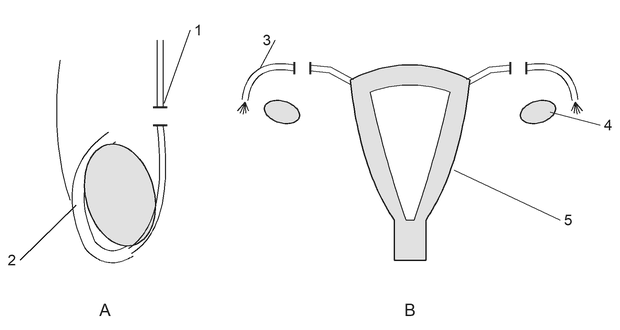
(i) Label the parts 1–5.
(ii) What does diagram A depict?
(iii) What does diagram B depict?
(iv) State one function each of parts 2 and 5.
Solve with AIWritten solution
Solution:
Key idea: Surgical methods of contraception (sterilisation) cut and tie the tubes that carry the gametes. In males the vas deferens is cut (vasectomy), and in females the fallopian tube is cut (tubectomy). The gonads themselves are left untouched.
Step 1 — Identify the parts labelled 1 to 5 (part i).
Diagram A shows a testis with a coiled tube along its side and a duct running upwards from it, and diagram B shows a uterus with a tube and an ovary on each side. Matching each number to its structure gives the labels below.
- 1 — Vas deferens, the duct that carries sperms up from the epididymis.
- 2 — Epididymis, the coiled tube lying along the testis.
- 3 — Oviduct (fallopian tube), the tube with a fringed funnel near the ovary.
- 4 — Ovary, the oval body beside the funnel of the tube.
- 5 — Uterus, the pear-shaped organ in the middle.
Step 2 — Identify what diagram A depicts (part ii).
In diagram A the vas deferens (1) is shown cut, with both cut ends tied. This is vasectomy, in which a small part of each vas deferens is removed or tied up through a small cut on the scrotum, so sperms cannot pass into the semen.
Step 3 — Identify what diagram B depicts (part iii).
In diagram B each fallopian tube (3) is shown cut and tied between the ovary and the uterus. This is tubectomy, in which a small part of each fallopian tube is removed or tied up through a small cut in the abdomen or through the vagina, so the ovum and sperms cannot meet.
Step 4 — State one function each of parts 2 and 5 (part iv).
The epididymis (2) stores sperms for a time, and the sperms mature and gain the ability to swim while passing through it. The uterus (5) is where the blastocyst implants, and the foetus then grows inside it, nourished through the placenta, until birth.
Note: After both operations the testes and ovaries go on making gametes and sex hormones; only the passage of the gametes is blocked.
Therefore, 1 is the vas deferens, 2 the epididymis, 3 the oviduct, 4 the ovary and 5 the uterus; diagram A shows vasectomy and diagram B tubectomy; the epididymis stores and matures sperms, and the uterus is the site of implantation and foetal growth.
What Class 12 Biology Ch 4 covers
The sections of the chapter, in the order the book takes them. Every question above comes from one of these.
- 01Reproductive Health - Problems and Strategies
- 02Population Explosion
- 03Population or Birth Control
- 04Medical Termination of Pregnancy (MTP)
- 05Amniocentesis
- 06Infertility
- 07Assisted Reproductive Technologies
More ways to study this chapter
The same chapter asked three other ways. Practise it, revise it, and see what the board has set on Ch 4 before.
- Competency-Based Questions (CBQ)Case study questions: a situation, and the part of the chapter that answers it.40questionsOpen
- Previous Year QuestionsQuestions that have actually appeared in board papers, each tagged with its year.20questionsOpen
- Practice QuestionsExtra questions per chapter, for when one attempt at a method is not enough.120questionsOpen
Ch 4 in past ISC papers
The same chapter as the board has actually asked it. These are worded differently from the textbook exercise, which is the point of reading them.
- 11 mark
Board paper question 1
Give a scientific term for each of the following:
The surgical removal of a section of fallopian tube.
Solve with AIWritten solution
Solution:
Key idea: Surgical methods of birth control (sterilisation) block the path of the gametes. In the male the vas deferens is cut and tied (vasectomy); in the female a small part of each fallopian tube is removed or tied (tubectomy).
Step 1 — Identify what is being described.
The stem describes an operation on the fallopian tube, the duct that carries the ovum from the ovary towards the uterus.
Step 2 — Name the procedure.
When a small section of the fallopian tube is removed (or the tube is tied and cut) through a small cut in the abdomen or through the vagina, the ovum can no longer meet the sperms. This operation is called tubectomy (tubal ligation).
Therefore, the scientific term is tubectomy.
- 21 mark
Board paper question 2
Expand the following abbreviations:
STD
Solve with AIWritten solution
Solution:
Key idea: Diseases or infections that spread from one person to another mainly through sexual contact are grouped together under one name.
Step 1 — Expand the letters.
S stands for Sexually, T for Transmitted and D for Disease(s).
Step 2 — Add the related term.
These diseases are also called venereal diseases (VD), and today the term sexually transmitted infections (STIs) is widely used. Examples are gonorrhoea, syphilis and genital herpes.
Therefore, STD stands for Sexually Transmitted Disease.
- 32 marks
Board paper question 3
Write a brief note on the causes of infertility.
Solve with AIWritten solution
Solution:
Key idea: Infertility is the inability of a couple to produce children (to conceive) in spite of regular unprotected sexual intercourse, usually for one year or more. The cause may lie in the male, in the female, or in both.
Step 1 — State the physical and physiological causes.
Defects of the reproductive organs can stop the gametes from forming or meeting. In males these include a low sperm count or sperms with poor motility or abnormal shape, and a blocked vas deferens. In females they include blocked fallopian tubes, failure of ovulation and defects of the uterus that prevent implantation.
Step 2 — State the hormonal and genetic causes.
An imbalance of reproductive hormones (such as FSH, LH, testosterone, oestrogen or progesterone) disturbs the formation of sperms or ova. Congenital or genetic disorders, such as undescended testes or chromosomal abnormalities, can also cause infertility.
Step 3 — State the causes from disease and lifestyle.
Infections, especially sexually transmitted diseases such as gonorrhoea and chlamydiasis, can scar and block the reproductive ducts. Drugs, smoking, alcohol, stress and poor nutrition lower the production and quality of gametes. In some cases the cause is immunological (for example antibodies against sperms) or psychological.
Therefore, infertility may be caused by defects of the reproductive organs or gametes, hormonal imbalance, genetic disorders, infections such as STDs, and harmful lifestyle factors like drugs, smoking and alcohol.
- 44 marks
Board paper question 4
State four causes and four consequences of population growth
Solve with AIWritten solution
Solution:
Key idea: A population grows when the birth rate is higher than the death rate. In India the death rate fell sharply after better health care, while the birth rate fell much more slowly, so the population grew very fast (population explosion).
Step 1 — State four causes of population growth.
The main causes are listed below.
- Decline in the death rate: better medical facilities, vaccines, antibiotics and hygiene let people live longer.
- Decline in the maternal mortality rate (MMR): fewer mothers die during pregnancy and childbirth.
- Decline in the infant mortality rate (IMR): more babies survive to become adults.
- Increase in the number of people of reproductive age: a large young population produces many children; illiteracy, lack of awareness of birth control and early marriage add to this.
Step 2 — State four consequences of population growth.
A rapidly growing population puts pressure on every resource. The main effects are listed below.
- Shortage of food, water and housing, leading to hunger and the growth of slums.
- Unemployment and poverty, because jobs and incomes do not grow as fast as the number of people.
- Over-use of natural resources, such as deforestation and loss of biodiversity as land is cleared for farms and homes.
- Pollution and overcrowding, with more waste, polluted air and water, and pressure on schools, hospitals and transport.
Therefore, population growth is caused by falling death, maternal mortality and infant mortality rates and by a large number of people of reproductive age; its consequences are shortages of food and housing, unemployment and poverty, over-use of resources, and pollution.
- 51 mark
Board paper question 5
Give scientific terms for each of the following:
Statistical study of human population.
Solve with AIWritten solution
Solution:
Key idea: The size, structure and changes of a human population (births, deaths, age groups, migration) are measured with statistics, and this study has its own name.
Step 1 — Identify the study described.
The stem asks for the term for the statistical study of human population.
Step 2 — Name the term.
This study is called demography (from the Greek demos, people). It records the size, density, birth rate, death rate, age and sex ratio of a population.
Therefore, the scientific term is demography.
- 61 mark
Board paper question 6
Expand the following abbreviations:
IUCD
Solve with AIWritten solution
Solution:
Key idea: Some contraceptive devices are placed inside the uterus by a doctor or trained nurse; they are named after where they are placed.
Step 1 — Expand the letters.
I stands for Intra, U for Uterine, C for Contraceptive and D for Device.
Step 2 — Give examples.
IUCDs (also called IUDs) include copper-releasing devices such as Cu T and Multiload 375, and hormone-releasing devices such as the levonorgestrel IUD. They are widely used for spacing children.
Therefore, IUCD stands for Intra-Uterine Contraceptive Device.
All 20 board paper questions for this chapter, solved the same way.
Class 12 Biology Ch 4 questions students ask
How many questions are there in Class 12 Biology Ch 4?
40 questions. Every one is solved step by step on this page.
Are these Class 12 Biology solutions free?
Yes. Every question and its full working is free to read, with no account needed.
Can I download the Class 12 Biology Ch 4 solutions as a PDF?
There is no PDF to download. Every solution is on this page instead, which means it is searchable, always the current syllabus, and readable on a phone. Use your browser's print option if you want it on paper.