
Opening your dashboard
Class 12 Biology Chapter 4 Reproductive Health - Problems and Strategies: Practice Questions
120 questions on Chapter 4, each worked through on its own page with the AI tutor. Class 12 Biology, ICSE 2026-27.
120 questions
1–4 marks · Mixed difficulty
- 11 mark
Question 1
A health officer compares four communities. Which one fits the description of a reproductively healthy society?
- 21 mark
Question 2
Reproductive health programmes need both strategies for implementation and a good support system. Which of the following belongs to the support system rather than to the strategies?
- 32 marks
Question 3
A wall poster shows the slogan 'Hum do Hamare do'.
(a) Name the national programme that runs this campaign and the year in which it began.
(b) What idea does the slogan teach families?
- 42 marks
Question 4
Under reproductive health strategies, people of marriageable age and young couples are specially targeted for education. Name any four topics on which they are educated.
- 53 marks
Question 5
Classify each activity below as a strategy for implementing reproductive health programmes, a support needed by the programmes, or a way the programme helps people.
(i) A nationwide polio drop campaign for all children.
(ii) A district hospital appoints trained doctors and nurses for its maternity ward.
(iii) A magazine publishes a series of articles on the spread of STDs.
(iv) Research leads to better techniques for providing care to people.
(v) Class 9 students attend lessons on changes during adolescence.
(vi) The government supplies equipment and medicines to rural health centres.
- 61 mark
Question 6
The population of India was 361 million in 1951 and 1417 million in 2022. By about how many times did it grow in this period?
- 73 marks
Question 7
Study the approximate world population figures below.
Year Human population 1650 0.5 billion 1830 1 billion 1930 2 billion 1980 4 billion (a) Calculate the time taken by the population to double in each interval.
(b) What trend do your answers show?
(c) Give one reason for this trend.
- 81 mark
Question 8
Demographers estimate that the human population may stabilise temporarily at 8–15 billion. Which two factors are expected to bring this about?
- 92 marks
Question 9
Give two reasons why a technologically advanced society depletes natural resources at a very fast rate.
- 103 marks
Question 10
Explain how each of the following has added to the population explosion.
(a) Massive child immunisation programmes, such as the polio programme.
(b) Better care of pregnant mothers and safer deliveries.
(c) Timely relief measures during floods, famines and earthquakes.
- 111 mark
Question 11
A woman with a regular 28-day menstrual cycle wishes to use periodic abstinence. Her menstruation began on 1 March (day 1 of the cycle). During which dates should the couple avoid coitus? (Hypothetical example.)
- 121 mark
Question 12
A mother relied on lactational amenorrhea after delivery, yet she conceived again about eight months later. Which statement best explains this? (Hypothetical case.)
- 131 mark
Question 13
A doctor wants to fit an intrauterine device that releases a hormone rather than copper ions. Which device should she choose?
- 142 marks
Question 14
Give reasons:
(a) A person at risk of sexually transmitted diseases is advised to use a condom rather than rely on a copper T.
(b) Spermicidal creams are often used along with a diaphragm.
- 153 marks
Question 15
A woman using oral contraceptive pills often forgets to take her daily pill.
(a) Suggest a hormonal method that does not need a pill every day.
(b) State two advantages of this method over oral pills.
- 163 marks
Question 16
Contraceptive methods can be grouped by how they act: P — preventing fusion of gametes; Q — preventing implantation of the ovum; R — preventing gamete production or movement of gametes. Place each method in group P, Q or R.
(i) Diaphragm
(ii) Copper T
(iii) Vasectomy
(iv) Cervical cap
(v) Tubectomy
(vi) Spermicidal cream
- 173 marks
Question 17
Draw a labelled diagram of a copper T placed in position inside the uterus. Label the copper T, the thin copper wire, the thread, the uterus, the cervix and the vagina. State one way in which the copper helps prevent pregnancy.
- 184 marks
Question 18
A doctor at a family welfare centre advises four couples. Recommend one suitable method for each, giving a reason. (Hypothetical cases.)
(a) A couple with two children who want no more children at all.
(b) A couple who want to delay their second child by about three years.
(c) A couple who also need protection against sexually transmitted diseases.
(d) A woman who had unprotected coitus and wants to avoid an unwanted pregnancy.
- 191 mark
Question 19
In one method of medical termination of pregnancy, a substance given intravaginally makes the uterus contract strongly so that the foetus is expelled. Which method is this?
- 201 mark
Question 20
Doctors recommend MTP under certain medical conditions. Which of the following is not an accepted reason for MTP?
- 211 mark
Question 21
About 45–50 million MTPs are performed every year in the world, and this is one-fifth of all conceived pregnancies in a year. About how many pregnancies are conceived in the world each year?
- 223 marks
Question 22
(a) What is done in the dilation and curettage (D and C) method of MTP?
(b) On which three factors does the choice of a method for MTP depend?
(c) Why has MTP been a debatable topic in many countries?
- 231 mark
Question 23
A 38-year-old pregnant woman is advised by her doctor to undergo amniocentesis. What is the most likely reason?
- 243 marks
Question 24
Foetal cells from an amniotic fluid sample are cultured and their karyotype is studied. The report shows three copies of chromosome 21.
(a) What type of abnormality is this?
(b) Name the disorder.
(c) What follow-up does the doctor arrange for the parents?
- 254 marks
Question 25
The diagram shows how a sample is taken from a pregnant woman's uterus for a prenatal test.
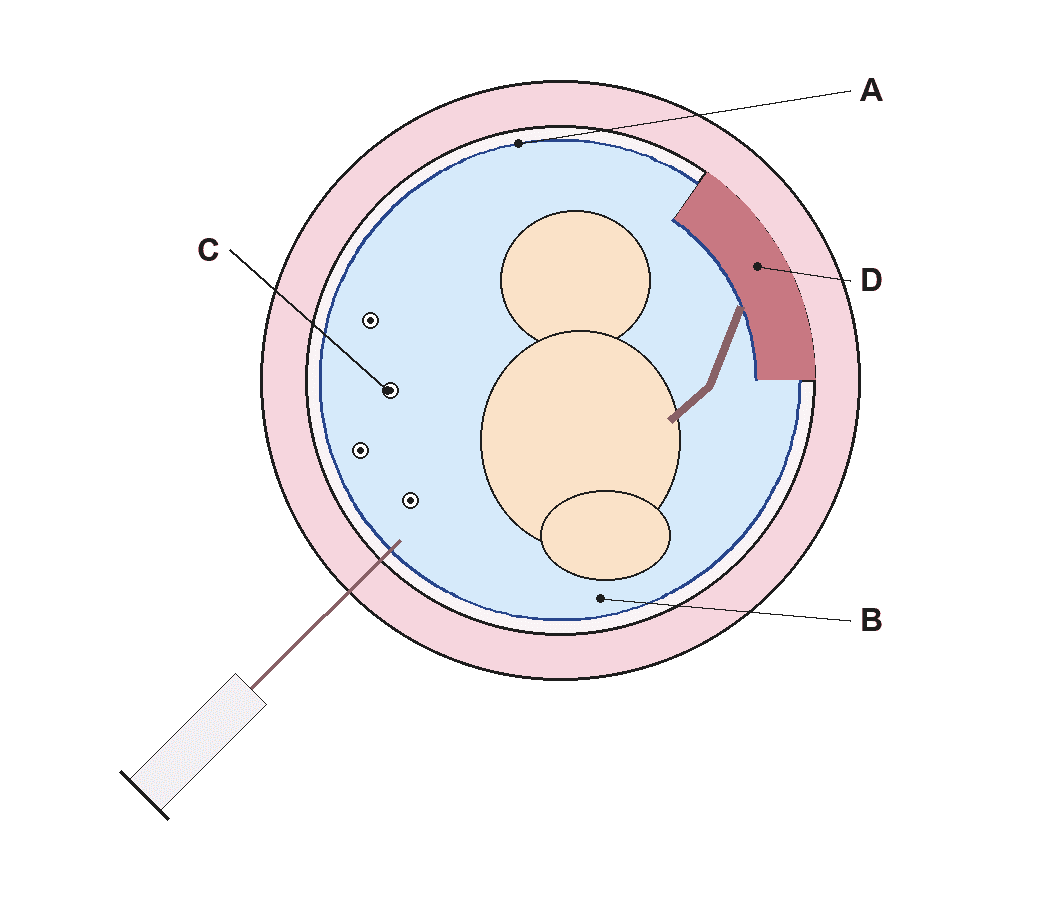
(a) Identify the parts labelled A, B, C and D.
(b) Why can a sample of B be used to study the chromosomes of the foetus?
(c) Besides chromosomal abnormalities, which other kind of disorder does this test aim to detect?
- 261 mark
Question 26
In which of the following cases does the cause of a couple's infertility lie with the female partner?
- 271 mark
Question 27
An infertility clinic has records of 200 couples (hypothetical data). If the causes among them follow the usual shares — female problem 30%, male problem 30%, both partners less fertile than average 20%, both partners infertile 10% — about how many couples are expected to have both partners less fertile than average?
- 281 mark
Question 28
Tests on a woman show that her pituitary releases too little gonadotropin, and her eggs do not mature for ovulation. Which cause and remedy match her case?
- 292 marks
Question 29
In a couple (hypothetical example), the egg and sperm fuse normally, yet each pregnancy ends early. Explain two reasons, both in the female reproductive tract, why implantation may be unsuccessful.
- 302 marks
Question 30
Explain how each of the following can make a woman infertile, and state how each is overcome.
(a) An infection in her reproductive tract.
(b) A twisted fallopian tube.
- 313 marks
Question 31
A man works long shifts beside a furnace in a glass factory and usually wears tight clothing (hypothetical example). His semen test shows a low sperm count.
(a) How might his working conditions be linked to his low sperm count?
(b) What temperature condition favours the production of healthy sperms?
(c) Suggest two changes that could help him.
- 321 mark
Question 32
Which of the following is NOT a step of intrauterine insemination (IUI)?
- 331 mark
Question 33
A doctor tells a couple that their embryo, now at the 6-blastomere stage in the laboratory, will be placed in the woman's fallopian tube. Which statement about this procedure is correct?
- 342 marks
Question 34
Sort the following assisted reproductive technologies into two groups — fertilisation inside the woman's body and fertilisation outside the body — and give the reason for each group.
IUI, GIFT, ZIFT, IUT, ICSI
- 352 marks
Question 35
In some rare cases of IVF, the baby develops in the uterus of a surrogate mother.
(a) What is the role of the surrogate mother?
(b) Why has this arrangement raised ethical and legal problems?
- 363 marks
Question 36
In both IVF and ICSI, the embryo is formed in the laboratory.
(a) State the one step in which ICSI differs from ordinary IVF.
(b) At what stage is the embryo placed in the female in ICSI?
(c) Where does the embryo develop until birth?
- 374 marks
Question 37
The diagram shows the human female reproductive tract.
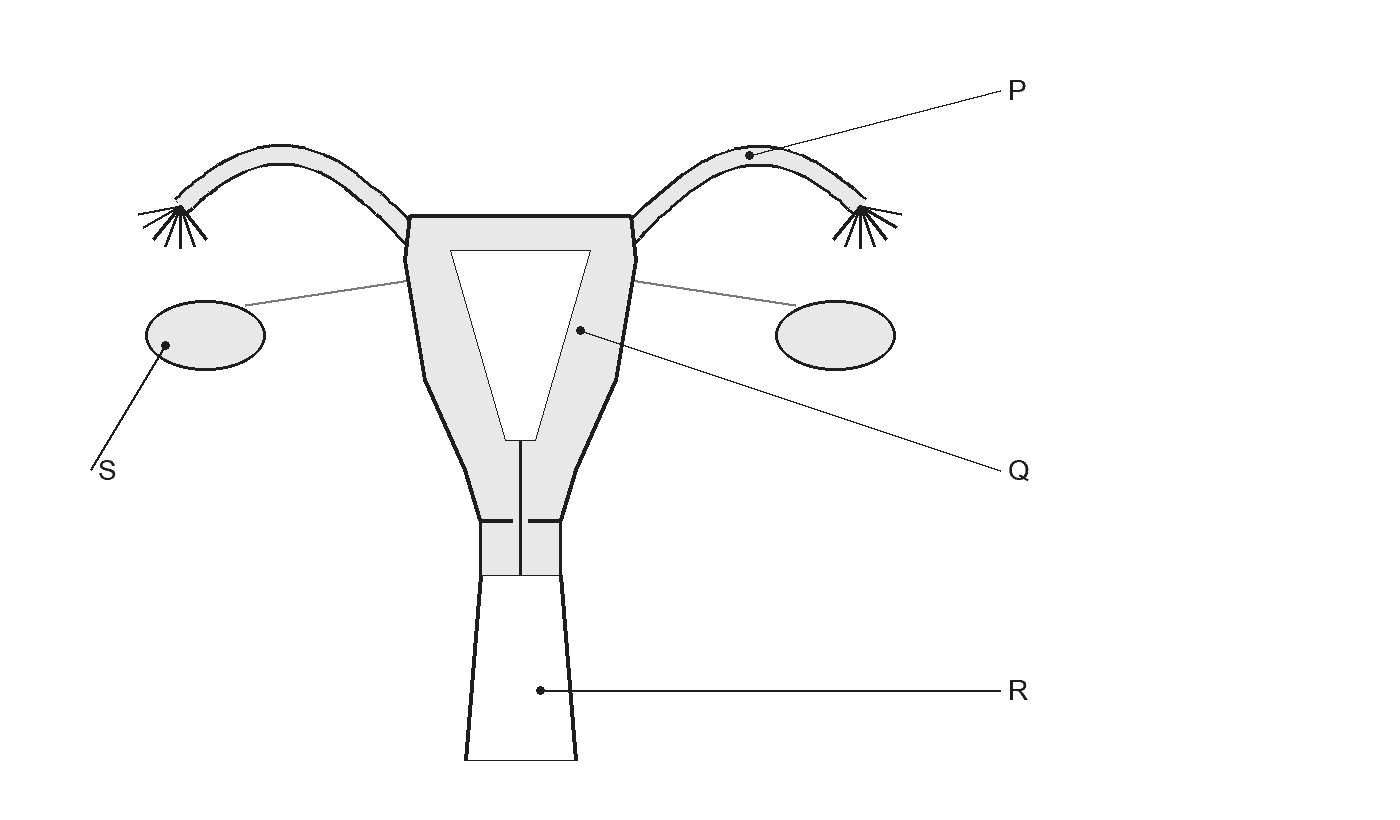
Write the letter of the part where:
(a) the zygote is placed in ZIFT;
(b) an embryo with more than 8 blastomeres is placed in IUT;
(c) the donor ovum is placed in GIFT;
(d) the semen may be introduced in IUI.
- 384 marks
Question 38
Three couples (hypothetical cases) visit an infertility clinic.
Couple P: both fallopian tubes of the wife are blocked; her ova and the husband's sperms are normal.
Couple Q: the husband's sperms are few and lack mobility; the wife is normal.
Couple R: the wife cannot produce ova, but her fallopian tubes and uterus are normal.
(a)–(c) Suggest a suitable assisted reproductive technology for each couple, with a reason.
(d) Why must the clinic first find the cause of each couple's infertility?
- 391 mark
Question 39
A woman has vaginal irritation, itching and discharge. A laboratory test of the discharge shows a protozoan. Which disease does she have, and which drug can treat it?
- 401 mark
Question 40
For which pair of sexually transmitted diseases is a vaccine available for prevention?
- 411 mark
Question 41
A hospital worker accidentally pricks a finger with a used syringe needle. Which two sexually transmitted infections is the worker chiefly at risk of?
- 423 marks
Question 42
A 19-year-old (hypothetical example) notices itching and slight pain in the genital region but hides it for months, afraid of what family and friends will think.
(a) Why do many people with STDs delay treatment like this?
(b) Name two complications that such a delay can lead to.
(c) Why is reaching young people of this age especially important in the control of STDs?
- 433 marks
Question 43
Gonorrhoea, syphilis and chlamydiasis can be completely cured if detected early, whereas genital herpes, hepatitis B and AIDS cannot. Explain this difference.
- 444 marks
Question 44
Four patients (hypothetical cases) show the symptoms below. Identify each STD and name its causative organism.
W: sores and lesions in the genital tract; later, sores in the mouth.
X: painful blisters around the genitals, with fever and swollen lymph nodes.
Y: small, flesh-coloured bumps in clusters in the genital area.
Z: fatigue, nausea, joint pain and yellowing of the skin and eyes.
- 452 marks
Question 45
AIDS has no cure, yet it is called a preventable disease. Explain both parts of this statement.
- 461 mark
Question 46
Which observation best supports the statement that it is the father, not the mother, who decides the sex of the child?
- 471 mark
Question 47
A man produces two kinds of sperm and a woman one kind of egg with respect to sex chromosomes. How many different sex-chromosome combinations are possible in their zygotes?
- 482 marks
Question 48
A district hospital recorded 1000 births in a year: 508 boys and 492 girls (hypothetical data).
(a) What split of boys and girls is expected, and why?
(b) Why are the observed numbers not exactly equal to the expected ones?
- 493 marks
Question 49
Draw a labelled chequerboard (cross chart) to show how the sex of a child is decided in humans, and state the chance of a child being a boy.
- 504 marks
Question 50
A couple plans to have children. Taking the chance of a boy or a girl as equal at each birth, find the probability that:
(a) both of their first two children are daughters;
(b) of two children, one is a son and one a daughter, in either order;
(c) after two daughters, their third child is a son.
(d) Explain why the answer to (c) is not affected by the earlier births.
- 511 mark
Question 51
Which one of the following is an IUCD?
- 521 mark
Question 52
The sterilisation in males is performed surgically by
- 531 mark
Question 53
Which of the following is not a sexually transmitted disease?
- 541 mark
Question 54
In vitro fertilisation or test tube babies technique involves
- 551 mark
Question 55
Human population was estimated to be 7.9 billion in
- 561 mark
Question 56
Certain characteristic demographic features of developing countries are
- 571 mark
Question 57
Which of the following birth control measures can be considered as the safest?
- 581 mark
Question 58
Consider the statements given below regarding contraception and answer as directed thereafter
(a) Medical Termination of Pregnancy (MTP) during first trimester is generally safe.
(b) Chances of conception are nil until mother breast feeds the infant up to two years.
(c) Intrauterine devices like Copper T are effective contraceptives.
(d) Contraception pills may be taken up to one week in a month to prevent conception.
Which two of the above statements are correct?
- 591 mark
Question 59
The following statement is true of IUI technique.
- 601 mark
Question 60
Amniocentesis is a technique which is used to
- 611 mark
Question 61
Copper T is an example of an ______ device.
- 621 mark
Question 62
The popular sign of family planning is ______.
- 631 mark
Question 63
______ is a surgical method in males as a contraceptive method.
- 641 mark
Question 64
______ is the scientific study of human population.
- 651 mark
Question 65
Oral pills contain small doses of ______ combinations to avoid pregnancy.
- 661 mark
Question 66
MTP is considered to be a safe method up to ______ weeks of pregnancy.
- 671 mark
Question 67
Another name for veneral diseases is ______.
- 681 mark
Question 68
In ______ technique the zygote or early embryos are transferred into the fallopian tube.
- 691 mark
Question 69
In ______ fertilisation the fusion of gametes occurs outside the body.
- 701 mark
Question 70
The term ICSI is an abbreviated form of ______.
- 711 mark
Question 71
Lactational amenorrhoea is when a baby is breast fed by the mother, chances of conception are minimal.
- 721 mark
Question 72
Oral contraceptive pills need to be taken for at least 27 days in a month without a break.
- 731 mark
Question 73
IUD devices block the transport of gametes.
- 741 mark
Question 74
Biologically, it is the gametes from father that determine the sex of a child and not the mother.
- 751 mark
Question 75
Syphilis is caused by a protozoan and causes sores and lesions in the genital tract.
- 764 marks
Question 76
Match the following:
Column A Column B 1. Progestasert (a) STD 2. IUI (b) IUD 3. IVF (c) Artificial insemination 4. HIV (d) Test tube baby - 771 mark
Question 77
A method of fertility control in males by tying of vas deferens.
- 781 mark
Question 78
A type of intrauterine device for birth control.
- 791 mark
Question 79
A method of tying of fallopian tubes in females for birth control.
- 801 mark
Question 80
A technique in which amniotic fluid surrounding the foetus is withdrawn to detect certain chromosomal disorders.
- 811 mark
Question 81
A disease that destroys the immune system and is an STD.
- 821 mark
Question 82
A scientific term for induced abortion.
- 831 mark
Question 83
A barrier method used by males to prevent conception in females.
- 841 mark
Question 84
A technique by which 'the babies formed are called test tube babies'.
- 851 mark
Question 85
Highly infectious diseases that spread from one person to another by sexual contact.
- 861 mark
Question 86
Estimated world population in 2021.
- 871 mark
Question 87
Assertion (A): Family planning is a programme to achieve total reproductive health among people.
Reason (R): RCH programmes create awareness among people about STD, AIDS, adolescence and related changes.
- 881 mark
Question 88
Assertion (A): Amniocentesis is often misused.
Reason (R): Amniocentesis is meant for determining the genetic disorders in the foetus, but it is being used to determine the sex of the foetus, leading to death of the normal female foetus.
- 891 mark
Question 89
Assertion (A): A pill called 'Saheli', a new oral contraceptive pill for the females, contains Saheli—a non-steroidal preparation.
Reason (R): This pill blocks the transport of ova and prevents fertilisation.
- 901 mark
Question 90
Assertion (A): There is a chance of fertilisation during 10–17 days of the menstrual cycle.
Reason (R): Ovulation occurs during the middle of a menstrual cycle.
- 911 mark
Question 91
Assertion (A): Barrier methods prevent physical meeting of sperms and ova.
Reason (R): Barrier methods prevent conception.
- 921 mark
Question 92
Assertion (A): Copper-T is a contraceptive device in human females.
Reason (R): Copper-T blocks fertilisation of egg in the fallopian tubes.
- 931 mark
Question 93
Assertion (A): HIV infection can be avoided by use of condoms.
Reason (R): Condoms secrete anti-viral interferons.
- 941 mark
Question 94
Assertion (A): Tubectomy prevents ova from reaching the uterus.
Reason (R): Vasectomy prevents sperms from entering the urethra.
- 951 mark
Question 95
Assertion (A): In zygote intra fallopian transfer (ZIFT), the zygote is transferred to the fallopian tubes of the female.
Reason (R): ZIFT is an in vivo fertilisation method.
- 961 mark
Question 96
Assertion (A): Intra cytoplasmic sperm injection (ICSI) is a procedure to form an embryo in vitro.
Reason (R): Sperm is directly injected into the ovum in the laboratory.
- 973 marks
Question 97
What do you think is the significance of reproductive health in a society?
- 982 marks
Question 98
Suggest the aspects of reproductive health which need to be given special attention in the present scenario.
- 993 marks
Question 99
Is sex education helps to:
- 1003 marks
Question 100
Do you think that reproductive health in our country has improved in the past 50 years? If yes, mention some such areas of improvement.
- 1012 marks
Question 101
Is the use of contraceptives justified?
- 1022 marks
Question 102
Removal of gonads cannot be considered as a contraceptive option. Why?
- 1032 marks
Question 103
Amniocentesis for sex determination is banned in our country. Is this ban necessary? Comment.
- 1042 marks
Question 104
Suggest some methods to assist infertile couples to have children.
- 1052 marks
Question 105
What are the measures one has to take to prevent from contracting STDs?
- 1063 marks
Question 106
State True/False with explanation.
(i) Abortions could happen spontaneously too. (True/False)
(ii) Infertility is defined as the inability to produce a viable offspring and is always due to abnormalities/defects in the female partner. (True/False)
(iii) Complete lactation could help as a natural method of contraception. (True/False)
(iv) Creating awareness about sex- related aspects is an effective method to improve reproductive health of the people. (True/False)
- 1073 marks
Question 107
Correct the following statements:
(i) Surgical methods of contraception prevent gamete formation.
(ii) All sexually transmitted diseases are completely curable.
(iii) Oral pills are very popular contraceptives among the rural women.
(iv) In E.T. techniques, embryos are always transferred into the uterus.
- 1083 marks
Question 108
Place contraceptives given into the right kind of category. Choose from the categories given below:
Category to choose: Natural, barrier, IUD, surgical, oral.
Contraceptive methods: Vasectomy, Copper T, Periodic abstinence, Condom, Cervical cap, Pills.
- 1093 marks
Question 109
A couple heard about the technique 'GIFT' to have a child and went to the doctor to understand the process.
(i) What is the full form of 'GIFT'?
(ii) Where does the fertilisation of ovum take place in this technique?
(iii) Will the development of foetus take place in mother who donates ovum?
(iv) Define the technique GIFT.
- 1102 marks
Question 110
Removal of gonads cannot be considered as contraceptive options, why?
- 1112 marks
Question 111
LNG-20 is a type of IUD. In what additional way does it function as a contraceptive?
- 1123 marks
Question 112
As a student of biology what would you suggest for the couple who are not able to conceive but want to have children?
- 1133 marks
Question 113
Give reasons for the following:
(i) Surgical methods of contraception cannot prevent gamete formation.
(ii) Oral pills are popular contraceptives among women.
- 1142 marks
Question 114
What are GIFT and ZIFT in relation to ART?
- 1151 mark
Question 115
The pathogen which causes Syphilis:
- 1161 mark
Question 116
Expand the following:
IUI
- 1171 mark
Question 117
Give a term for the following:
An ART in which eggs are removed from the ovary of the female, fertilised and then placed in her fallopian tube.
- 1182 marks
Question 118
What is reproductive fitness? Explain it with the help of an example.
- 1192 marks
Question 119
(i) Define and give the role of amniocentesis.
(ii) Name the causative agent and give any one symptom of Gonorrhoea.
- 1202 marks
Question 120
Give four causes of infertility in males.