
Opening your dashboard
Class 12 Biology Chapter 11: Adolescent Issues: Alcoholism and Drugs Solutions
69 textbook questions with step-by-step answers, free to read, for ISC 2026-27.
Get talked through Ch 11, not just shown the answer
Reading a finished solution is not the same as being able to do it. The AI tutor takes one question at a time and works it with you, in your own words, until you can.
- Ask it out loud, in your own words
- It gives you the next step, not the answer
- Stuck on part (ii)? Start there
69 questions with solutions
1–5 marks · Mixed difficulty
- 11 mark
Question 1
What is the period of adolescence in girls or boys?
Solve with AIWritten solution
Solution:
Key idea: Adolescence is the period of change from childhood to adulthood. It begins with puberty, when the body matures sexually, and it also brings mental, emotional and social changes.
Step 1 — Recall when adolescence begins.
Puberty usually starts about one to two years earlier in girls than in boys. So adolescence also begins and ends a little earlier in girls.
Step 2 — State the age ranges.
The textbook gives the period of adolescence as about 10–18 years for girls and about 12–19 years for boys. The World Health Organization (WHO) defines adolescence as the age of 10–19 years for everyone.
Note: These ages are typical values; the exact timing differs from person to person.
Therefore, adolescence lasts about 10–18 years of age in girls and 12–19 years in boys (10–19 years by the WHO definition).
- 21 mark
Question 2
What is another term given to habit forming drugs?
Solve with AIWritten solution
Solution:
Key idea: A psychotropic drug is one that acts on the brain (the central nervous system) and changes mood, perception, thinking or behaviour.
Step 1 — Recall what habit-forming drugs do.
Habit-forming drugs act on the brain to give pleasure, calm or excitement. The user therefore wants to take them again and again and may become dependent on them.
Step 2 — Name the term.
Because they act on the mind ("psyche"), habit-forming drugs are called psychotropic drugs. They are also called addictive drugs or drugs of abuse.
Note: Not every psychotropic medicine is habit-forming; most medicines for depression or epilepsy act on the brain without causing addiction.
Therefore, habit-forming drugs are also called psychotropic drugs.
- 31 mark
Question 3
Name a natural opiate.
Solve with AIWritten solution
Solution:
Key idea: Opiates are the natural drugs obtained from opium, the dried milky juice (latex) of the opium poppy, Papaver somniferum. The wider term opioids also covers semi-synthetic and synthetic drugs that act in the same way.
Step 1 — Recall where natural opiates come from.
Opium is obtained by cutting the unripe seed capsules of the poppy and drying the latex that oozes out. It contains natural alkaloids such as morphine and codeine.
Step 2 — Name a natural opiate.
Opium itself is a natural opiate, and so are its alkaloids morphine and codeine. Heroin is not natural, because it is made from morphine in the laboratory.
Therefore, opium is a natural opiate (its alkaloids morphine and codeine are natural opiates too).
- 41 mark
Question 4
Name two synthetic opiates?
Solve with AIWritten solution
Solution:
Key idea: Synthetic opioids are made entirely in the laboratory and are not obtained from the poppy. They act on the same opioid receptors in the brain and spinal cord as morphine, so they relieve pain and can also cause dependence.
Step 1 — Recall what "synthetic" means here.
A synthetic opiate is built up from simple chemicals, unlike morphine (taken from opium) or heroin (made from morphine).
Step 2 — Name two synthetic opiates.
Pethidine (also called meperidine) is used to relieve severe pain. Methadone is used to relieve pain and in the treatment of heroin addicts, as a long-acting substitute taken by mouth. Fentanyl and tramadol are other examples.
Note: Strictly, an opiate is a drug obtained from opium, so laboratory-made drugs such as these are better called synthetic opioids.
Therefore, pethidine and methadone are two synthetic opiates (synthetic opioids).
- 51 mark
Question 5
The plant from which opium is extracted.
Solve with AIWritten solution
Solution:
Key idea: Opium is the dried milky juice (latex) of the unripe seed capsules of the opium poppy.
Step 1 — Recall how opium is obtained.
Shallow cuts are made on the green, unripe seed capsules of the poppy. A milky latex oozes out, dries to a brown gum and is scraped off as raw opium.
Step 2 — Name the plant.
The opium poppy is Papaver somniferum of the family Papaveraceae. In India it may be grown only under a government licence, as the NDPS Act, 1985 controls it.
Therefore, opium is extracted from the opium poppy, Papaver somniferum.
- 61 mark
Question 6
Which are two main drugs derived from opium?
Solve with AIWritten solution
Solution:
Key idea: Opium contains several alkaloids, such as morphine, codeine, thebaine and papaverine. Morphine makes up about a tenth of raw opium.
Step 1 — Recall the main alkaloids of opium.
Of the alkaloids in opium, two are used most widely as drugs, both in medicine and as drugs of abuse.
Step 2 — Name the two main drugs.
Morphine is a strong painkiller, and codeine is a milder painkiller and cough suppressant. Heroin is made later from morphine, so it is not taken directly from opium.
Therefore, the two main drugs derived from opium are morphine and codeine.
- 71 mark
Question 7
A synthetic compound prepared from morphine by acetylation.
Solve with AIWritten solution
Solution:
Key idea: Acetylation adds acetyl groups () to a molecule. Morphine has two –OH groups, and acetylating both of them gives diacetylmorphine.
Step 1 — Work out what acetylation of morphine gives.
When morphine is treated with acetic anhydride, both of its –OH groups are changed to acetyl groups. The product is diacetylmorphine, which is heroin.
Step 2 — Describe heroin.
Heroin enters the brain faster than morphine and is changed back to morphine there, so it acts quickly and is highly addictive. It is commonly called smack, and an impure street form is known in India as brown sugar.
Note: The question calls heroin synthetic; strictly it is semi-synthetic, because it is made from the natural drug morphine.
Therefore, the compound is heroin (diacetylmorphine), commonly called smack.
- 81 mark
Question 8
Give scientific name of hemp plant from which cannabinoids are extracted.
Solve with AIWritten solution
Solution:
Key idea: Cannabinoids are chemicals made by the hemp plant that act on cannabinoid receptors in the body. The main one is THC (tetrahydrocannabinol).
Step 1 — Recall the source plant.
Cannabinoids are obtained from the leaves, flowering tops and resin of the hemp plant.
Step 2 — Give its scientific name.
The hemp plant is Cannabis sativa of the family Cannabaceae. Some botanists treat Indian hemp as a separate species, Cannabis indica, or as a variety of Cannabis sativa.
Therefore, the scientific name of the hemp plant is Cannabis sativa.
- 91 mark
Question 9
Which is the main system the cannabinoids act on?
Solve with AIWritten solution
Solution:
Key idea: Cannabinoids such as THC act by binding to cannabinoid receptors. CB1 receptors are found principally in the brain, and CB2 receptors mainly on cells of the immune system.
Step 1 — Recall where cannabinoids act in the body.
THC binds to CB1 receptors in the parts of the brain that control mood, memory, coordination and appetite. This is why cannabis gives a "high", weakens memory and slows reactions.
Step 2 — Recall the effect the textbook stresses.
The textbook states that cannabinoids are known for their effects on the cardiovascular system. They make the heart beat faster and can change blood pressure, which strains the heart.
Step 3 — Give the answer this chapter expects.
The answer expected in this chapter is the cardiovascular system (the heart and blood vessels).
Note: In current science the main site of action of cannabinoids is the brain, through CB1 receptors; the cardiovascular system is the system on which their effects are best known. If a question asks where cannabinoids bind, answer "the brain".
Therefore, the textbook answer is the cardiovascular system, although cannabinoids bind mainly to receptors in the brain.
- 101 mark
Question 10
List 5 important withdrawal symptoms of drugs.
Solve with AIWritten solution
Solution:
Key idea: Withdrawal symptoms are the unpleasant effects that appear when a person who has become dependent on a drug suddenly stops or reduces it.
Step 1 — Explain why withdrawal symptoms appear.
With regular use, the body adjusts its own working to the presence of the drug. When the drug is taken away, these adjusted systems over-react until the body readjusts, and this causes the symptoms.
Step 2 — List five withdrawal symptoms.
Five important withdrawal symptoms are listed below.
- Muscular cramps and body aches
- Headache
- Fever, often with chills
- Watering of the eyes and a running nose
- Sleeplessness (insomnia)
Other common symptoms are anxiety, shakiness (tremors), sweating, nausea and vomiting, and a strong craving for the drug.
Watch out: Severe withdrawal, for example from alcohol or barbiturates, can cause fits, so it should be managed under medical care.
Therefore, five withdrawal symptoms are muscular cramps, headache, fever, watering of the eyes and sleeplessness.
- 111 mark
Question 11
On which system does cocaine interfere with for transporting neurotransmitter?
Solve with AIWritten solution
Solution:
Key idea: Neurotransmitters carry signals across synapses between nerve cells. After a signal, transporter proteins pump the neurotransmitter dopamine back into the nerve cell that released it (reuptake).
Step 1 — Describe what cocaine does at the synapse.
Cocaine blocks the dopamine transporter, so dopamine is not taken back. It stays in the synapse and keeps stimulating the next nerve cell, which gives a feeling of euphoria and extra energy.
Step 2 — Name the system affected.
These synapses are in the brain, so cocaine interferes with the central nervous system.
Watch out: Cocaine does not stop dopamine from being made or released; it stops dopamine from being taken back.
Therefore, cocaine interferes with the transport of the neurotransmitter dopamine in the central nervous system.
- 121 mark
Question 12
Name the stimulant present in tea and coffee.
Solve with AIWritten solution
Solution:
Key idea: A stimulant is a drug that speeds up the activity of the central nervous system and makes a person feel alert.
Step 1 — Recall how the stimulant in tea and coffee works.
During the day the brain builds up adenosine, a chemical that signals tiredness. The stimulant in tea and coffee blocks the receptors for adenosine, so the person feels more awake.
Step 2 — Name the stimulant.
This stimulant is caffeine. It is also present in cola drinks, cocoa, chocolate and energy drinks.
Note: Too much caffeine can cause sleeplessness, restlessness and a fast heartbeat.
Therefore, the stimulant present in tea and coffee is caffeine.
- 131 mark
Question 13
Which drugs are taken by students to keep them awake and by weight watchers to reduce appetite?
Solve with AIWritten solution
Solution:
Key idea: Amphetamines are synthetic stimulants of the central nervous system. They increase the release of dopamine and noradrenaline in the brain.
Step 1 — Explain how the drug keeps a person awake.
By stimulating the brain, amphetamines delay sleep and hide the feeling of tiredness. For this reason they are called pep pills.
Step 2 — Explain how the drug reduces appetite.
Amphetamines also suppress hunger, which is why they were once given to people trying to lose weight.
Step 3 — Name the drugs.
Drugs with both effects, keeping a person awake and cutting appetite, are the amphetamines.
Watch out: Amphetamines are habit-forming. Misuse causes sleeplessness, a fast heartbeat, high blood pressure, anxiety and dependence, so they are prescription-only medicines and are no longer advised for weight loss.
Therefore, the drugs are amphetamines (pep pills).
- 141 mark
Question 14
Name a few hallucinogenic drugs.
Solve with AIWritten solution
Solution:
Key idea: Hallucinogens (psychedelic drugs) change perception, so the user sees or hears things that are not really there.
Step 1 — Recall where hallucinogens come from.
Some hallucinogens are taken from plants and fungi, and some are made in the laboratory from natural chemicals.
Step 2 — Name some hallucinogenic drugs.
LSD is made from lysergic acid of the ergot fungus, mescaline comes from the peyote cactus, and psilocybin comes from certain mushrooms. The textbook also groups the products of the hemp plant (charas, bhang, marijuana and hashish) with hallucinogens, because large doses can cause hallucinations. Datura and Atropa belladonna are poisonous plants with hallucinogenic effects.
Therefore, LSD, mescaline, psilocybin and the hemp products charas, bhang, marijuana and hashish are hallucinogenic drugs.
- 151 mark
Question 15
What is source of drug mescaline?
Solve with AIWritten solution
Solution:
Key idea: Mescaline is a natural hallucinogen, an alkaloid made by certain cacti.
Step 1 — Name the source plant.
Mescaline comes mainly from the peyote cactus, Lophophora williamsii, a small, spineless, button-shaped cactus. Its tops are dried and chewed. The San Pedro cactus also contains mescaline.
Step 2 — State where it grows.
The peyote cactus grows wild in the dry regions of northern Mexico and the south-western United States.
Therefore, mescaline is obtained from the peyote cactus of Mexico and the south-western United States.
- 161 mark
Question 16
What are barbiturates?
Solve with AIWritten solution
Solution:
Key idea: Sedatives are drugs that depress the activity of the central nervous system, so they calm a person and bring on sleep.
Step 1 — Say what barbiturates are.
Barbiturates are synthetic drugs made from barbituric acid; phenobarbital is one example.
Step 2 — Describe their action.
They strengthen the effect of GABA, the brain's main calming neurotransmitter. As a result they decrease anxiety and induce sleep, which is why they are commonly called sleeping pills.
Step 3 — Note their dangers and present use.
Barbiturates are habit-forming, and an overdose can stop breathing, especially when taken with alcohol. For sleep and anxiety they have now largely been replaced by safer drugs (benzodiazepines), though phenobarbital is still used to treat epilepsy.
Therefore, barbiturates are synthetic sedative drugs, commonly called sleeping pills, that decrease anxiety and induce sleep.
- 171 mark
Question 17
What are tranquillisers?
Solve with AIWritten solution
Solution:
Key idea: Tranquillisers are drugs that calm the mind. Common (minor) tranquillisers, such as diazepam (sold as Valium or Calmpose), are synthetic benzodiazepines.
Step 1 — State what tranquillisers do.
Tranquillisers reduce tension and anxiety and bring a feeling of calm. At ordinary doses the person stays awake.
Step 2 — Compare them with sedatives.
Sleeping pills (sedatives) are given mainly to bring on sleep. Tranquillisers cause drowsiness and sleep mainly at higher doses, which is why some books add "sleep" to their definition. Like sedatives, they are habit-forming and are sold only on prescription.
Note: The printed answer says that tranquillisers induce calmness and sleep; bringing on sleep is the main aim of sedatives, while tranquillisers do so mainly at higher doses.
Therefore, tranquillisers are drugs that reduce tension and anxiety and bring calmness, usually without putting the person to sleep at ordinary doses.
- 181 mark
Question 18
Which alcohol is used as drinking alcohol?
Solve with AIWritten solution
Solution:
Key idea: Alcohols are a family of organic compounds; only one of them is present in alcoholic drinks.
Step 1 — Identify the alcohol in drinks.
Beer, wine and spirits contain ethyl alcohol (ethanol, ), made by the fermentation of sugars by yeast.
Step 2 — Contrast it with other alcohols.
Methyl alcohol and isopropyl alcohol are poisonous to drink, so they must never be used in drinks.
Therefore, ethyl alcohol (ethanol) is used as drinking alcohol.
- 191 mark
Question 19
Name the term given for chronic dependence on alcohol.
Solve with AIWritten solution
Solution:
Key idea: Chronic dependence on alcohol means that a person cannot control drinking, needs more and more alcohol, and shows withdrawal symptoms on stopping.
Step 1 — Describe the condition.
A person in this condition goes on drinking regularly even though it harms health, work and family life.
Step 2 — Name the term.
This chronic dependence on alcohol is called alcoholism. Doctors today call it alcohol use disorder (or alcohol dependence).
Therefore, chronic dependence on alcohol is called alcoholism.
- 201 mark
Question 20
How soon is alcohol absorbed in the body?
Solve with AIWritten solution
Solution:
Key idea: Alcohol needs no digestion. It is a small molecule that mixes with both water and fat, so it passes straight through the lining of the stomach and intestine into the blood.
Step 1 — State where alcohol is absorbed.
About a fifth of the alcohol is absorbed through the stomach and about four-fifths through the small intestine.
Step 2 — State how soon it is absorbed.
Alcohol begins to enter the blood within about two minutes of being swallowed. On an empty stomach the blood alcohol level reaches its peak in about 30–60 minutes; food in the stomach slows this down.
Therefore, alcohol is absorbed very soon, entering the blood within about two minutes of being swallowed.
- 211 mark
Question 21
Give the food value of alcohol.
Solve with AIWritten solution
Solution:
Key idea: A food supplies energy and nutrients, such as proteins, vitamins and minerals, that the body needs for growth, repair and regulation.
Step 1 — Check whether alcohol supplies energy.
When alcohol is oxidised in the body it releases about 7 kcal (about 29 kJ) per gram, and the body uses this energy.
Step 2 — Check whether alcohol supplies nutrients.
Alcohol contains no proteins, vitamins or minerals, so it cannot build or repair the body. Its energy is called "empty calories". Heavy drinkers often eat poorly and lack vitamins, especially thiamine (vitamin B₁).
Note: The printed answer says simply that alcohol has no food value. This is true of nutrients, but alcohol does give energy.
Therefore, alcohol has no food (nutritive) value: it gives only empty calories, about 7 kcal per gram, with no nutrients.
- 221 mark
Question 22
People feel very jubilant after taking alcohol. What is its effect on the body and on what system?
Solve with AIWritten solution
Solution:
Key idea: Alcohol is a depressant of the central nervous system, not a stimulant.
Step 1 — Explain why drinkers feel jubilant.
Alcohol first depresses the parts of the brain (cerebral cortex) that control judgement and self-restraint. The drinker loses normal restraint (release of inhibitions), so they become talkative and cheerful.
Step 2 — State the real effect on the body.
With more alcohol, speech, reactions and coordination slow down. Very large amounts depress the breathing centre in the medulla and can cause unconsciousness.
Therefore, alcohol acts on the central nervous system as a depressant; the jubilant feeling comes from the release of inhibitions.
- 231 mark
Question 23
What is the effect of alcohol on cerebellum?
Solve with AIWritten solution
Solution:
Key idea: The cerebellum coordinates voluntary muscle movements and keeps the body balanced.
Step 1 — Describe what alcohol does to the cerebellum.
Alcohol depresses the cerebellum, so the muscles no longer work together smoothly.
Step 2 — Describe the signs.
The person begins to lose muscular control and balance. The person cannot walk in a straight line, staggers, tends to fall and may have slurred speech.
Therefore, alcohol makes the person lose muscular control and balance, so walking in a straight line becomes difficult.
- 241 mark
Question 24
What is a fatty liver syndrome?
Solve with AIWritten solution
Solution:
Key idea: The liver is the main centre for the metabolism of carbohydrates, fats and proteins, and it is also where most alcohol is broken down.
Step 1 — Explain how fat collects in the liver.
Breaking down large amounts of alcohol uses up a carrier molecule () that the liver also needs to burn fat. Fat breakdown therefore slows down, fat-making speeds up, and fat droplets collect inside the liver cells.
Step 2 — Describe the result.
After heavy drinking over a long period, the liver swells and becomes a store house of fat instead of a centre of metabolism. This is the first stage of alcohol-related liver disease. It is reversible if drinking stops, but continued drinking can lead to alcoholic hepatitis and cirrhosis.
Note: Fatty liver can also develop without alcohol, for example with obesity and diabetes.
Therefore, fatty liver syndrome is the build-up of fat in the liver cells after heavy drinking over a long period, so that the liver swells and becomes a store house of fat.
- 251 mark
Question 25
Name the condition that liver can lead to due to continued use of alcohol and degeneration of liver.
Solve with AIWritten solution
Solution:
Key idea: Long-term heavy drinking keeps damaging the liver cells.
Step 1 — Describe what happens to the liver.
Damaged liver cells die and are replaced by fibrous scar tissue. The liver becomes hard, shrunken and lumpy, and it can no longer work properly.
Step 2 — Name the condition.
This condition is cirrhosis of the liver. It cannot be reversed and can lead to liver failure and liver cancer.
Therefore, continued use of alcohol can lead to cirrhosis of the liver.
- 261 mark
Question 26
What is the meaning of the term increased reaction time?
Solve with AIWritten solution
Solution:
Key idea: Reaction time is the time between a stimulus (something seen or heard) and the body's response to it.
Step 1 — Explain why alcohol increases reaction time.
Alcohol depresses the central nervous system, so the brain processes information and sends out commands more slowly.
Step 2 — Explain what the term means in practice.
The person takes more time to respond, for example to brake or turn while driving. A car moving at 60 km/h covers about 17 m every second, so a delay of only half a second adds about 8 m before the brakes start working. For this reason India's legal limit for drivers is 30 mg of alcohol per 100 mL of blood.
Therefore, increased reaction time means that the person takes longer to respond to a stimulus, for example to brake or turn while driving.
- 271 mark
Question 27
If valium is taken along with alcohol, what is the effect on body?
Solve with AIWritten solution
Solution:
Key idea: Valium (diazepam) and alcohol are both depressants of the central nervous system. Both strengthen the effect of GABA, the brain's main calming neurotransmitter.
Step 1 — Explain how the two drugs combine.
Because they act in the same direction, each drug strengthens the other. The combined effect is much greater than that of either drug alone.
Step 2 — Describe the effect on the body.
The person becomes extremely drowsy and confused and loses coordination. Breathing may slow dangerously, which can lead to unconsciousness, coma and even death, so the two must never be taken together.
Therefore, taking valium with alcohol gives a highly increased sedative effect, which can dangerously slow breathing.
- 281 mark
Question 28
Which type of alcohol is used for external and should not be used for drinking?
Solve with AIWritten solution
Solution:
Key idea: Ethyl alcohol is the only alcohol in drinks; other alcohols are poisonous if swallowed.
Step 1 — Identify the alcohol for external use.
Isopropyl alcohol (propan-2-ol, rubbing alcohol), usually as a 70 % solution, is used to disinfect the skin before an injection and to clean thermometers and surfaces. It is labelled "for external use only" because it is poisonous to drink.
Step 2 — Name the other alcohol that must not be drunk.
Methyl alcohol (methanol) is used as an industrial solvent, as a fuel and in windscreen-washer fluid. Even a small amount swallowed can cause blindness or death, which is why spurious liquor containing methanol has caused tragedies.
Note: The printed answer says isopropyl alcohol is used to clean wounds. Current first aid cleans a wound with clean running water, because alcohol damages the tissue; isopropyl alcohol is used on unbroken skin.
Therefore, isopropyl alcohol (rubbing alcohol) is used externally and must not be drunk; methyl alcohol must not be drunk either.
- 291 mark
Question 29
From where is LSD obtained? What is its full form?
Solve with AIWritten solution
Solution:
Key idea: LSD is a hallucinogen. It is semi-synthetic, because it is made in the laboratory from a natural chemical.
Step 1 — State the source of LSD.
Lysergic acid is obtained from the ergot fungus, Claviceps purpurea, which grows on rye and other cereal grains. It is then converted into LSD in the laboratory; LSD was first made in 1938.
Step 2 — Give the full form.
LSD stands for lysergic acid diethylamide.
Therefore, LSD is obtained from the ergot fungus (made from its lysergic acid), and its full form is lysergic acid diethylamide.
- 301 mark
Question 30
Name a hallucinogen obtained from certain mushrooms.
Solve with AIWritten solution
Solution:
Key idea: Some mushrooms of the genus Psilocybe, often called "magic mushrooms", contain a natural hallucinogen.
Step 1 — Explain how it acts.
In the body this compound is changed to psilocin, which acts on serotonin receptors in the brain and causes hallucinations.
Step 2 — Name the hallucinogen.
The hallucinogen obtained from these mushrooms is psilocybin.
Watch out: Many wild mushrooms that look alike are deadly poisonous, so wild mushrooms should never be eaten unless identified by an expert.
Therefore, psilocybin is a hallucinogen obtained from certain mushrooms.
- 312 marks
Question 31
What is drug addiction?
Solve with AIWritten solution
Solution:
Key idea: Drug abuse is the use of a drug for non-medical purposes in amounts or ways that harm health. When it continues, the person becomes addicted.
Step 1 — Define drug addiction.
Drug addiction is a state in which a person has a periodic or persistent, strong urge (craving) to take a drug, cannot control its use and goes on taking it in spite of harm to their own health and to society.
Step 2 — List its main features.
An addicted person shows the features below.
- Compulsion: a strong urge to go on taking the drug.
- Tolerance: larger and larger doses are needed for the same effect.
- Physical dependence: withdrawal symptoms appear when the drug is stopped.
- Psychological dependence: the person feels unable to cope without the drug and neglects studies, work and family.
Step 3 — Explain why it is hard to give up.
Repeated use changes the brain's reward system, which depends on the neurotransmitter dopamine. Normal pleasures then feel weak and the drug feels necessary, so giving it up becomes very hard.
Therefore, drug addiction is a persistent, uncontrollable urge to take a drug, with tolerance and physical and mental dependence, which harms the person and society.
- 322 marks
Question 32
How do barbiturates affect the body?
Solve with AIWritten solution
Solution:
Key idea: Barbiturates are synthetic sedatives (sleeping pills). They depress the central nervous system by strengthening the effect of GABA, the brain's main calming neurotransmitter.
Step 1 — Describe the effect on the nervous system.
Barbiturates slow down the activity of the brain, so they reduce anxiety and induce sleep. Larger doses cause slurred speech, poor coordination and confusion, much like drunkenness.
Step 2 — Describe the dependence they cause.
With regular use, tolerance develops and the user becomes physically and emotionally dependent. If the drug is stopped suddenly, withdrawal symptoms appear: anxiety, tremors, sleeplessness and even fits. Withdrawal must therefore be done under medical care.
Step 3 — Describe the danger of overdose.
The dose that harms is not much larger than the dose that helps. An overdose depresses the breathing centre and can cause coma and death, and the danger is far greater when barbiturates are taken with alcohol.
Note: The chapter calls barbiturates "not addictive"; in fact they cause physical as well as emotional dependence and are habit-forming. For sleep and anxiety they have now largely been replaced by safer drugs (benzodiazepines).
Therefore, barbiturates depress the central nervous system, calming the person and inducing sleep, but they are habit-forming and an overdose, especially with alcohol, can stop breathing.
- 332 marks
Question 33
What is the effect of LSD on human body?
Solve with AIWritten solution
Solution:
Key idea: LSD (lysergic acid diethylamide) is a very powerful hallucinogen. It acts on serotonin receptors in the brain, which change how the brain handles sensory information.
Step 1 — Note how little LSD is needed.
As little as a few tens of micrograms (millionths of a gram), roughly 1 µg per kg of body mass, is enough to act.
Step 2 — Describe the effects on the mind.
The user sees bright colours, strange shapes and other things that are not there (hallucinations), and loses the normal sense of time, space and of their own body. Moods swing quickly, and a "bad trip" brings panic and terror, in which the user may act dangerously and cause accidents or self-harm.
Step 3 — Describe the effects on the body.
LSD dilates the pupils, makes the heart beat faster, raises blood pressure and body temperature, and causes sweating and poor coordination.
Step 4 — Describe the later effects.
Some users have flashbacks, sudden returns of the drug's visual effects weeks or months later. In people who are prone to mental illness, LSD can trigger lasting psychosis.
Watch out: The main dangers of LSD come from its effects on the mind and from accidents, not from direct destruction of nerve tissue.
Therefore, even tiny doses of LSD cause hallucinations, a distorted sense of time, space and body, panic and loss of judgement, with a faster heartbeat and raised blood pressure, and flashbacks can occur later.
- 342 marks
Question 34
Name the plant from where opium is derived.
Solve with AIWritten solution
Solution:
Key idea: Opium is the dried milky juice (latex) of the unripe seed capsules of the opium poppy.
Step 1 — Name the plant.
Opium is derived from the opium poppy, Papaver somniferum, of the family Papaveraceae. It is an annual herb with large white, pink or purple flowers.
Step 2 — Describe how opium is collected.
Shallow cuts are made on the green, unripe seed capsules. A milky latex oozes out, dries to a brown, sticky, strong-smelling and bitter gum, and is scraped off as raw opium.
Step 3 — Say what opium contains and how its growing is controlled.
Opium contains alkaloids such as morphine (about a tenth of its mass), codeine and thebaine. In India the poppy may be grown only under a government licence (NDPS Act, 1985), mainly in Madhya Pradesh, Rajasthan and Uttar Pradesh.
Therefore, opium is derived from the latex of the unripe seed capsules of the opium poppy, Papaver somniferum.
- 352 marks
Question 35
Which other derivatives of opium are also used as drugs?
Solve with AIWritten solution
Solution:
Key idea: Opium contains several alkaloids. Some are used as they are, and one, morphine, is also changed chemically into another drug.
Step 1 — Describe morphine.
Morphine is the main alkaloid of opium (about a tenth of its mass). It is a powerful painkiller used for severe pain, for example after surgery or in cancer, but it slows breathing and is highly addictive, so its use is strictly controlled.
Step 2 — Describe codeine.
Codeine is a milder painkiller and a cough suppressant, used in some cough syrups. It is also habit-forming, so codeine syrups are prescription-only medicines and are often misused.
Step 3 — Describe heroin.
Heroin (diacetylmorphine, called smack) is prepared from morphine by acetylation, so it is a semi-synthetic drug. It is highly addictive, its use is illegal in India, and injecting it with shared needles spreads HIV and hepatitis.
Therefore, the other opium derivatives used as drugs are morphine, codeine and heroin (made from morphine by acetylation).
- 362 marks
Question 36
Which plant and plant parts are used for obtaining cannabinoids?
Solve with AIWritten solution
Solution:
Key idea: Cannabinoids, such as THC (tetrahydrocannabinol), are made in tiny resin glands on the leaves and especially on the flowering tops of the plant.
Step 1 — Name the plant.
Cannabinoids are obtained from the hemp plant, Cannabis sativa.
Step 2 — Name the parts used and the products.
Different parts of the plant give different products, as the table shows.
Part of the plant used Product Dried leaves (ground into a paste or drink) Bhang Dried flowering tops Ganja Dried leaves and flowering tops Marijuana Resin collected from the flowering tops Charas (hashish) Step 3 — Explain why the products differ in strength.
The resin is richest in cannabinoids, so charas (hashish) is the strongest product, and bhang, made from the leaves, is the mildest.
Therefore, cannabinoids are obtained from the hemp plant, Cannabis sativa, using its dried leaves, flowering tops and resin.
- 372 marks
Question 37
What are the effects of hallucinogens on the body?
Solve with AIWritten solution
Solution:
Key idea: Hallucinogens are drugs that change perception, thought and mood. Most of them, such as LSD, mescaline and psilocybin, act on serotonin receptors in the brain.
Step 1 — Describe the effects on perception.
Hallucinogens alter a person's thoughts, feelings and perceptions. The person sees and hears things that do not exist (hallucinations), and colours and sounds seem distorted.
Step 2 — Describe the effects on the mind.
The person loses the normal sense of space and time and may feel cut off from their own body. Moods swing from joy to panic, judgement is poor, and accidents are common. Flashbacks can occur weeks later, and in people prone to mental illness a lasting psychosis can be triggered.
Step 3 — Describe the effects on the body.
Hallucinogens dilate the pupils and raise the heart rate, blood pressure and body temperature. Plant hallucinogens such as Datura can cause a very fast heartbeat, high fever, fits and even death in large doses.
Therefore, hallucinogens make a person see and hear things that do not exist and lose the sense of space and time, with mood swings, poor judgement, flashbacks and a faster heartbeat.
- 382 marks
Question 38
The plant that is used to obtain cocaine.
Solve with AIWritten solution
Solution:
Key idea: Cocaine is a natural alkaloid and a strong stimulant of the central nervous system.
Step 1 — Name the plant.
Cocaine is obtained from the coca plant, Erythroxylum coca, a shrub native to the Andes mountains of South America.
Step 2 — Name the part used.
Cocaine is extracted from the leaves of the coca plant, which people of the Andes have traditionally chewed.
Step 3 — State how cocaine acts.
Cocaine blocks the reuptake of dopamine in the brain, which gives euphoria and extra energy. It is highly addictive and can cause heart attacks and strokes.
Watch out: Coca is not cocoa. Cocoa comes from Theobroma cacao, the source of chocolate.
Therefore, cocaine is obtained from the leaves of the coca plant, Erythroxylum coca.
- 392 marks
Question 39
What kinds of drugs reduce anxiety and are used as sedatives?
Solve with AIWritten solution
Solution:
Key idea: Sedatives are depressant drugs. They slow down (depress) the activity of the central nervous system (the brain and spinal cord), so a person becomes calm and drowsy, and larger doses bring sleep.
Step 1 — State what a sedative does.
A sedative lowers the activity of the nerve cells of the brain, so irritability, excitement and anxiety fall. The person feels calm and sleepy, which is why doctors use these drugs for anxiety and sleeplessness.
Step 2 — Name the main kinds of sedative drugs.
Two groups of synthetic (man-made) medicines are used for this purpose.
- Barbiturates, such as phenobarbital, are the older "sleeping pills".
- Benzodiazepines, such as diazepam (sold under brand names such as Valium and Calmpose), are the main anti-anxiety sedatives in use today.
Some older antihistamines (allergy medicines such as promethazine) also make a person drowsy, and doctors sometimes use them for this sedative effect.
Step 3 — Explain why these drugs are taken only on a doctor's advice.
Regular use of these drugs can lead to dependence. They are also dangerous with alcohol, because two depressants taken together can slow breathing to a dangerous level.
Note: Benzodiazepines have largely replaced barbiturates for anxiety and sleep, because barbiturates have a narrow margin between a useful dose and a fatal one.
Therefore, the drugs that reduce anxiety and are used as sedatives are depressants of the central nervous system, mainly barbiturates and benzodiazepines such as diazepam (Valium, Calmpose).
- 402 marks
Question 40
What are barbiturates?
Solve with AIWritten solution
Solution:
Key idea: Barbiturates are a group of synthetic drugs made from barbituric acid. They are depressants: they slow down the activity of the central nervous system.
Step 1 — State what barbiturates are.
Barbiturates are man-made (synthetic) drugs, chemical derivatives of barbituric acid. They are sedatives, because they depress the activity of the brain. Since they bring on sleep, they are commonly called sleeping pills.
Step 2 — Describe their effects and medical use.
Small doses reduce anxiety and calm a person, and larger doses induce sleep. One barbiturate, phenobarbital, is still used by doctors to control epileptic fits.
Step 3 — Explain why they are dangerous when misused.
Regular use leads to tolerance and dependence, so stopping suddenly causes withdrawal symptoms such as anxiety, tremors and even fits. An overdose, or a dose taken with alcohol, can stop breathing, because both are depressants and their effects add up.
Note: Barbiturates are now rarely prescribed for sleep or anxiety; the safer benzodiazepines have largely replaced them.
Therefore, barbiturates are synthetic sedative drugs (sleeping pills) that depress the central nervous system, reduce anxiety and induce sleep, but they are habit-forming and can be fatal in overdose or with alcohol.
- 412 marks
Question 41
Which drugs are used as tranquillisers?
Solve with AIWritten solution
Solution:
Key idea: Tranquillisers are depressant drugs that calm a person. At the usual dose they reduce tension and anxiety without putting the person to sleep.
Step 1 — State what a tranquilliser is meant to do.
A tranquilliser acts on the brain to reduce tension and anxiety and bring calmness. Unlike a sleeping pill, at the usual dose it does not put the person to sleep, though larger doses do cause drowsiness.
Step 2 — Name the tranquillisers in common use.
The main tranquillisers used for anxiety belong to a group of synthetic drugs called benzodiazepines.
- Diazepam, sold under brand names such as Valium and Calmpose.
- Other drugs of the same group, such as lorazepam and alprazolam.
These are laboratory-made drugs, not plant products.
Step 3 — Note the care needed with these drugs.
Tranquillisers are prescription medicines. Regular use for several weeks can cause dependence, and taking them with alcohol greatly increases drowsiness and can dangerously slow breathing.
Therefore, the drugs used as tranquillisers are mainly benzodiazepines such as diazepam (Valium, Calmpose), which reduce tension and anxiety and bring calmness.
- 422 marks
Question 42
What are psychedelic drugs?
Solve with AIWritten solution
Solution:
Key idea: The word "psychedelic" means mind-altering (from the Greek words for "mind" and "visible"). These drugs change what a person sees, hears and feels, and make the person perceive things that are not there (hallucinations), so they are also called hallucinogens.
Step 1 — Define psychedelic drugs.
Psychedelic drugs are drugs that change a person's perception, feelings and thoughts. The user may see bright colours and strange shapes, hear sounds that do not exist and lose the sense of time and space. These false perceptions are called hallucinations.
Step 2 — Explain how they act.
Most of these drugs act on receptors for serotonin, a chemical messenger in the brain. This disturbs the way the brain processes information from the sense organs, so the user can panic or behave dangerously during a "bad trip".
Step 3 — Give examples.
The best-known psychedelic drugs are:
- LSD (lysergic acid diethylamide), made from a chemical of the ergot fungus;
- mescaline, from the peyote cactus;
- psilocybin, from certain mushrooms.
Hemp products such as charas, bhang, marijuana and hashish are grouped separately as cannabinoids, but in large doses they too cause hallucinations.
Therefore, psychedelic drugs are mind-altering drugs (hallucinogens) that change a person's perception, feelings and thoughts and cause hallucinations, for example LSD, mescaline and psilocybin.
- 432 marks
Question 43
Name a few hallucinogenic drugs.
Solve with AIWritten solution
Solution:
Key idea: Hallucinogens make a person see or hear things that do not exist. Some come directly from plants or fungi, while LSD is made in a laboratory from a fungal chemical (it is semi-synthetic).
Step 1 — Name the hallucinogens that come from fungi.
Two well-known hallucinogens come from fungi.
- LSD (lysergic acid diethylamide) is semi-synthetic: it is made in the laboratory from lysergic acid, obtained from the ergot fungus Claviceps purpurea, which grows on rye. It acts in tiny doses of a few micrograms.
- Psilocybin comes from certain mushrooms (Psilocybe species, called "magic mushrooms").
Step 2 — Name the hallucinogens that come from plants.
Several flowering plants also yield hallucinogens.
- Mescaline comes from the peyote cactus, Lophophora williamsii.
- Datura and Atropa belladonna (deadly nightshade) contain alkaloids such as atropine and scopolamine, which cause hallucinations and are poisonous.
Step 3 — Mention the hemp products.
Charas, bhang, ganja, marijuana and hashish come from the hemp plant, Cannabis sativa. They are classed as cannabinoids, but in large doses they cause hallucinations, so they are often listed with the hallucinogens.
Therefore, a few hallucinogenic drugs are LSD, psilocybin, mescaline and the alkaloids of Datura and belladonna, while hemp products such as charas, bhang and marijuana cause hallucinations in large doses.
- 442 marks
Question 44
How does alcohol affect liver cells?
Solve with AIWritten solution
Solution:
Key idea: The liver breaks down more than 90 % of the alcohol (ethanol) a person drinks. In liver cells the enzyme alcohol dehydrogenase turns ethanol into acetaldehyde, which is more toxic than alcohol, and a second enzyme, aldehyde dehydrogenase, turns acetaldehyde into acetate.
Step 1 — Follow alcohol into a liver cell.
Alcohol is carried straight from the intestine to the liver in the blood. Liver cells convert it into acetaldehyde, which damages their proteins and mitochondria before it is converted into acetate. So the cells that handle alcohol are the cells it harms most.
Step 2 — Explain how fat builds up in the liver cells.
While breaking down alcohol, liver cells use up their supply of the coenzyme NAD⁺ and produce excess NADH. This slows the breakdown of fats and speeds up the making of fats, so fat droplets collect inside the liver cells and the liver swells. This is fatty liver; it develops in most heavy drinkers and is reversible if drinking stops.
Step 3 — Explain inflammation and cirrhosis.
With continued heavy drinking, acetaldehyde and the stored fat injure and kill liver cells, and the liver becomes inflamed (alcoholic hepatitis). The dead cells are replaced by fibrous scar tissue, so the liver becomes shrunken, hard and lumpy. This is cirrhosis, which cannot be reversed and can end in liver failure.
Therefore, alcohol harms liver cells by forming toxic acetaldehyde and by making fat collect in them (fatty liver), and continued drinking inflames them and replaces them with fibrous tissue (cirrhosis).
- 452 marks
Question 45
Give names of a few beverages containing alcohol.
Solve with AIWritten solution
Solution:
Key idea: Every alcoholic drink contains ethyl alcohol (ethanol), made when yeast ferments sugars. Fermentation alone reaches only about 15 % alcohol, because more alcohol than this kills the yeast; distilling the fermented liquid concentrates the alcohol.
Step 1 — Name the fermented beverages.
These drinks are made by fermentation only, so their alcohol content is low.
- Beer, from malted barley: about 4–8 % alcohol.
- Wine, from grapes: about 10–15 % alcohol.
- Toddy, from the sap of palm trees: a few per cent alcohol.
Step 2 — Name the distilled beverages (spirits).
These drinks are made by distilling a fermented liquid, so their alcohol content is high, usually about 40 %.
- Arrack, rum (from sugarcane molasses), brandy (from wine), whisky (from grain), gin and vodka.
Therefore, a few beverages containing alcohol are fermented drinks such as beer, wine and toddy, and distilled spirits such as arrack, rum, brandy, whisky, gin and vodka.
- 462 marks
Question 46
How does alcoholism affect the family?
Solve with AIWritten solution
Solution:
Key idea: Alcoholism (alcohol dependence) is a condition in which a person cannot control their drinking. Its harm spreads from the drinker to the whole family.
Step 1 — Explain the money and care problems.
A person with alcoholism spends money on drink even when the family lacks money for food, rent or school fees, and may lose work through absence or poor performance. Children and other members of the family are neglected, and even well-off families can be ruined.
Step 2 — Explain the emotional harm.
Alcohol reduces self-control, so quarrels, abuse and violence at home become common. Children grow up with fear, frustration and insecurity, may do poorly at school, and are more likely to develop drinking problems themselves.
Step 3 — Mention the harm to an unborn child.
Alcohol drunk during pregnancy crosses the placenta to the baby. It can cause foetal alcohol spectrum disorders, such as low birth weight and lifelong learning problems.
Therefore, alcoholism harms the family through neglect and money problems, through quarrels and violence that leave the children frustrated and insecure, and through harm to an unborn child when alcohol is drunk during pregnancy.
- 472 marks
Question 47
Is alcohol a stimulant or depressant? Justify.
Solve with AIWritten solution
Solution:
Key idea: A stimulant increases the activity of the central nervous system (caffeine, cocaine), while a depressant decreases it (alcohol, barbiturates).
Step 1 — State the class of drug.
Alcohol is a depressant of the central nervous system, not a stimulant.
Step 2 — Explain why a drinker may at first seem stimulated.
Small amounts of alcohol first depress the parts of the cerebral cortex that control judgement and self-restraint. With these inhibitions released, the person talks more and feels cheerful and confident, so alcohol seems to stimulate. This comes from reduced control, not from increased brain activity.
Step 3 — Show the depressant effect at higher levels.
As the alcohol in the blood rises, more of the brain is depressed. Reaction time increases, speech is slurred, vision blurs, and the cerebellum can no longer coordinate balance and muscle movement. Very high levels depress the breathing centre in the medulla and can cause unconsciousness (coma) and death.
Therefore, alcohol is a depressant, because it slows down the activity of the central nervous system; its apparent stimulation is only the release of inhibitions.
- 482 marks
Question 48
What is dealcoholism?
Solve with AIWritten solution
Solution:
Key idea: Alcoholism is a treatable condition. Giving up alcohol needs medical treatment together with long-term emotional and social support.
Step 1 — Define dealcoholism.
Dealcoholism is the gradual process of treating a person with alcohol dependence so that the person gives up alcohol and returns to a normal life.
Step 2 — Describe the medical part of the treatment.
Under a doctor's care the person stops drinking (detoxification), and medicines relieve withdrawal symptoms such as tremors, sweating, anxiety and sleeplessness. Medical care matters because severe alcohol withdrawal can cause fits and delirium tremens (confusion with hallucinations). Doctors may also prescribe medicines that reduce the craving for alcohol.
Step 3 — Describe the support needed.
Counselling finds and treats the problems behind the drinking, such as stress, depression or loneliness. Family and friends give sympathetic understanding instead of blame, and voluntary organisations and self-help groups such as Alcoholics Anonymous help the person stay away from alcohol and avoid a relapse.
Therefore, dealcoholism is the gradual process of helping a person with alcoholism give up alcohol through medical treatment of withdrawal, counselling and the support of family, friends and voluntary organisations.
- 493 marks
Question 49
Give examples of a few stimulating drugs and their effects on the body.
Solve with AIWritten solution
Solution:
Key idea: Stimulants increase the activity of the central nervous system. They make a person alert, wakeful and energetic and raise the heart rate and blood pressure, but they are often followed by a "crash" of tiredness and low mood and can cause dependence.
Step 1 — Describe cocaine and its effects.
Cocaine is obtained from the leaves of the coca plant, Erythroxylum coca, native to South America. It blocks the transport of the chemical messenger dopamine back into nerve endings, so dopamine stays longer in the synapse and gives a strong feeling of euphoria, energy and self-confidence. It raises the heart rate and blood pressure, and large doses cause anxiety, fear, violence, hallucinations, fits, and even a heart attack or stroke. It is highly addictive.
Step 2 — Describe caffeine and its effects.
Caffeine, present in coffee, tea, cola drinks and chocolate, is a mild stimulant. It blocks the receptors for adenosine, a brain chemical that builds up the feeling of tiredness, so it increases alertness and delays sleep. Too much causes restlessness, a fast heartbeat and sleeplessness, and regular users who stop suddenly get headaches and tiredness, a sign of mild dependence.
Step 3 — Describe amphetamines and their effects.
Amphetamines ("pep pills") are synthetic stimulants that increase the release of dopamine and noradrenaline in the brain. They keep the user awake and reduce appetite and fatigue, but raise the heart rate and blood pressure, dilate the pupils (blurring vision) and impair judgement. Higher doses cause anxiety, aggression and hallucinations, and when the effect wears off the user feels exhausted and depressed.
Step 4 — Describe nicotine.
Nicotine in tobacco is also a stimulant. It makes the adrenal glands release adrenaline and noradrenaline, which raise the blood pressure and heart rate, and it is strongly addictive.
Therefore, cocaine, caffeine, amphetamines and nicotine are stimulating drugs; they increase alertness and energy and raise the heart rate and blood pressure, but cause sleeplessness, anxiety, hallucinations in large doses and dependence.
- 503 marks
Question 50
List some major factors leading to drug addiction. How can drug addicts be helped to lead a normal healthy life?
Solve with AIWritten solution
Solution:
Key idea: Drug addiction usually results from several factors acting together: the effect of the drug on the brain, the person's own feelings and personality, and pressures from friends, family and society. It is a treatable condition.
Step 1 — Explain the effect of the drug itself.
Even small doses of a drug change the chemistry of the brain and give a pleasant "high" (euphoria). The person wants to feel it again, especially to escape stress, and as tolerance develops, needs larger and larger doses.
Step 2 — Explain the personal and peer-group factors.
Curiosity, a wish for adventure and excitement, and a wish to feel independent and grown-up lead many young people to try drugs. Fear of being rejected by friends (peer pressure) pushes them further, and people who are emotionally unstable, impulsive, anxious or depressed are at greater risk.
Step 3 — Explain the family and social factors.
Broken homes, conflict, loneliness and lack of affection make a young person look for comfort elsewhere. Easy money, easy availability of drugs, stressful competition and advertisements that show alcohol and tobacco as stylish add to the risk.
Step 4 — Describe how people with an addiction can be helped.
They are helped through a planned programme, step by step.
- Detoxification: the drug is stopped under medical supervision, and medicines relieve the withdrawal symptoms.
- Counselling and psychotherapy: individual, group and family counselling deal with the problems behind the drug use and teach better ways to handle stress.
- Rehabilitation: vocational training, self-help groups, acceptance by family and society, and regular follow-up help the person lead a useful life and avoid a relapse.
Therefore, drug addiction is caused by the drug's "high" together with curiosity, peer pressure, personality and family or social problems, and people with an addiction are helped back to a healthy life by detoxification, counselling and rehabilitation with family support.
- 513 marks
Question 51
What are opiates and their effect on body?
Solve with AIWritten solution
Solution:
Key idea: Opium is the dried latex (milky juice) from the unripe capsules of the poppy, Papaver somniferum. Opiates are the drugs obtained from it; together with semi-synthetic and synthetic drugs that act in the same way they are called opioids, and all of them bind to opioid receptors in the central nervous system and the gut.
Step 1 — Define opiates.
Opiates are the pain-relieving drugs of opium. Its natural alkaloids are morphine and codeine, and heroin (diacetylmorphine) is made from morphine by acetylation.
Step 2 — Describe their effects as medicines.
By binding to opioid receptors in the brain, spinal cord and gut, these drugs strongly relieve pain and give calmness, drowsiness and a feeling of well-being. They also slow breathing, narrow the pupils and cause constipation. Morphine is a valuable painkiller after surgery and in cancer.
Step 3 — Describe the effects of misuse.
Tolerance and dependence develop quickly, and stopping the drug brings severe withdrawal symptoms. Regular users lose appetite and weight, lose interest in work and family, and have lowered sex-hormone levels with reduced fertility. An overdose depresses the breathing centre so that breathing stops, which can cause death.
Step 4 — Describe the infections from injecting.
Heroin is often injected. Sharing unsterile needles spreads HIV (which causes AIDS) and hepatitis B and C, and also causes abscesses and blood poisoning (septicaemia).
Therefore, opiates are pain-relieving drugs from the opium of the poppy (morphine, codeine and heroin made from morphine); they bind to opioid receptors, relieve pain and cause drowsiness and slow breathing, but misuse brings dependence, loss of weight and fertility, fatal overdose and infections such as HIV and hepatitis.
- 523 marks
Question 52
List a few withdrawal symptoms when drug is taken away and not given to the person. What is emotional or psychological addiction?
Solve with AIWritten solution
Solution:
Key idea: When a drug is taken regularly, the body adapts to it (physical dependence). If the drug is suddenly stopped, the body is thrown out of balance and shows withdrawal symptoms, which are often the opposite of the drug's effects.
Step 1 — Explain why withdrawal symptoms appear.
During regular use, the brain and body adjust their own working to the constant presence of the drug. When the drug is suddenly withdrawn, these adjustments are no longer balanced, so unpleasant symptoms appear for days or weeks.
Step 2 — List the common withdrawal symptoms.
The exact symptoms depend on the drug, but common ones are:
- anxiety, restlessness, irritability and sleeplessness;
- body ache, muscle cramps, abdominal pain and headache;
- sweating, shivering and goose flesh;
- watering of the eyes and nose;
- nausea, vomiting and diarrhoea;
- tremors (shaking) and a fast or irregular heartbeat.
In severe withdrawal from alcohol or sedatives, fits and confusion with hallucinations (delirium tremens) can occur, so withdrawal is managed under medical care.
Step 3 — Define emotional or psychological addiction.
Emotional (psychological) addiction is a strong craving or urge for a drug, either for the pleasure it gives or to avoid the distress of being without it. Without the drug, the person feels anxious, low and irritable, and life comes to revolve around getting and using it, even when the person knows the harm it does.
Therefore, withdrawal symptoms include anxiety, sleeplessness, body ache and cramps, headache, sweating, watering of the eyes and nose, vomiting, diarrhoea and tremors, while emotional (psychological) addiction is a strong craving for a drug for its pleasant effects or to avoid distress without it.
- 533 marks
Question 53
What are hallucinogens? Why are they called psychedelic drugs? Which types of drugs are used for children to stay awake and why?
Solve with AIWritten solution
Solution:
Key idea: Hallucinogens change perception, so the user sees and hears things that are not there. Stimulants do the opposite job to sedatives: they increase the activity of the central nervous system and fight sleep.
Step 1 — Define hallucinogens.
Hallucinogens are drugs that alter a person's thoughts, feelings and perceptions, so that the person hears sounds and sees things that do not exist (hallucinations). Examples are LSD, mescaline and psilocybin; hemp products such as charas and bhang also cause hallucinations in large doses.
Step 2 — Explain why they are called psychedelic drugs.
"Psychedelic" means mind-altering (from the Greek words for "mind" and "visible"). These drugs are called psychedelic because they change the way the mind perceives the world: the user sees bright lights, strange shapes and distorted objects and loses the sense of time and space.
Step 3 — Name the drugs misused to stay awake and explain why.
Some students misuse stimulants, mainly amphetamines ("pep pills") and large amounts of caffeine, to stay awake for long hours of study. They do this because stimulants increase the activity of the central nervous system (amphetamines raise the release of dopamine and noradrenaline), which keeps a person alert and drives away sleep. The alertness is false: afterwards the user feels exhausted, nervous and unable to concentrate, and amphetamines cause dependence.
Note: Amphetamines are prescription-only medicines; taking them without a doctor's advice is harmful and illegal.
Therefore, hallucinogens are drugs that make a person perceive things that do not exist, they are called psychedelic because they alter the mind's perception, and stimulants such as amphetamines (pep pills) are misused by students to stay awake because they stimulate the central nervous system.
- 542 marks
Question 54
Amphetamines and sedative drugs
Solve with AIWritten solution
Solution:
Key idea: Amphetamines are stimulants: they increase the activity of the central nervous system. Sedatives are depressants: they decrease it.
Step 1 — State the basic difference.
Amphetamines and sedatives act on the same nervous system in opposite directions, so their effects are opposite.
Step 2 — Compare the two groups feature by feature.
The table sets the two groups side by side.
Feature Amphetamines Sedative drugs Group Stimulants Depressants Action on the central nervous system Increase its activity (more dopamine and noradrenaline are released) Decrease its activity Effect Wakefulness, alertness, less appetite, faster heartbeat and higher blood pressure Calmness, drowsiness and sleep; slower breathing at high doses Medical use Attention-deficit hyperactivity disorder (ADHD) and narcolepsy, on prescription only Anxiety, sleeplessness and fits, on prescription only Misuse "Pep pills" taken to stay awake, for example by students or long-distance drivers Overdose, especially with alcohol, can stop breathing Examples Amphetamine, methamphetamine (synthetic) Barbiturates; benzodiazepines such as diazepam (Valium, Calmpose) Therefore, amphetamines stimulate the central nervous system and keep a person awake and alert, whereas sedatives depress it and bring calmness and sleep.
- 552 marks
Question 55
Opioids and Cannabinoids
Solve with AIWritten solution
Solution:
Key idea: Opioids and cannabinoids are two groups of drugs named after the receptors they bind to in the body: opioid receptors and cannabinoid receptors.
Step 1 — State the basic difference.
Opioids come from the poppy plant and act mainly as painkillers and depressants, whereas cannabinoids come from the hemp plant and mainly change mood and perception.
Step 2 — Compare the two groups feature by feature.
The table sets the two groups side by side.
Feature Opioids Cannabinoids Source Latex from the unripe capsules of the poppy, Papaver somniferum (heroin is made from it; some opioids are fully synthetic) Flowering tops, leaves and resin of the hemp plant, Cannabis sativa Main active chemical Morphine (also codeine) THC (tetrahydrocannabinol) Receptors Opioid receptors in the central nervous system and the gut Cannabinoid receptors, mainly in the brain Main effects Strong pain relief, drowsiness, slow breathing, constipation Relaxed "high" feeling, altered perception, poor memory and coordination; faster heartbeat (effect on the cardiovascular system) Main danger Highly addictive; an overdose can stop breathing Dependence with regular use; heavy use can trigger psychosis in some people Examples Opium, morphine, codeine, heroin (smack) Marijuana, hashish, charas, ganja, bhang Therefore, opioids are obtained from the poppy and bind to opioid receptors to relieve pain and depress the body, whereas cannabinoids are obtained from the hemp plant and bind to cannabinoid receptors in the brain to change mood and perception.
- 562 marks
Question 56
Methyl alcohol and ethyl alcohol
Solve with AIWritten solution
Solution:
Key idea: Methyl alcohol (methanol) and ethyl alcohol (ethanol) are the two simplest alcohols. Ethanol is the alcohol of alcoholic drinks; methanol is a deadly poison when swallowed.
Step 1 — State the basic difference.
The two alcohols differ by one carbon atom, but the body breaks them down into very different products, so one is intoxicating and the other is a dangerous poison.
Step 2 — Compare the two alcohols feature by feature.
The table sets the two alcohols side by side.
Feature Methyl alcohol Ethyl alcohol Formula Other names Methanol, wood alcohol (first obtained by heating wood) Ethanol, grain alcohol, drinking alcohol How it is made Industrially from carbon monoxide and hydrogen By fermentation of sugars by yeast Breakdown in the body Formaldehyde and formic acid, which damage the optic nerve and make the blood acidic Acetaldehyde and then acetate; intoxicating and harmful in large amounts Drinking Highly poisonous: about 10 mL can cause permanent blindness and about 30 mL can kill Present in beer, wine and spirits; still harmful to health Uses Solvent for lacquers and varnishes, fuel, making formaldehyde, denaturing ethanol (methylated spirit) Beverages, solvent, antiseptic (hand sanitisers), fuel blended with petrol Note: Illicit liquor (hooch) is sometimes mixed with methanol, which causes the mass poisonings reported in the news. Methanol was once used as an antifreeze in car radiators; ethylene glycol is used for this now.
Therefore, methyl alcohol (wood alcohol) is a highly poisonous industrial alcohol that can cause blindness or death, whereas ethyl alcohol (ethanol) is the alcohol made by fermentation and present in alcoholic beverages.
- 572 marks
Question 57
Hallucinogens and sedatives
Solve with AIWritten solution
Solution:
Key idea: Hallucinogens alter perception, whereas sedatives depress the central nervous system and calm a person.
Step 1 — State the basic difference.
Hallucinogens disturb the way the brain handles information from the senses, while sedatives slow the brain down; so the first cause false perceptions and the second cause calmness and sleep.
Step 2 — Compare the two groups feature by feature.
The table sets the two groups side by side.
Feature Hallucinogens Sedatives Nature Psychedelic (mind-altering) drugs; most act on serotonin receptors Depressants of the central nervous system Effect The person sees and hears things that do not exist and loses the sense of time and space; panic in a "bad trip" The person feels calm and sleepy and anxiety falls; breathing slows at high doses Medical use No routine medical use (psilocybin is being tested for depression in clinical trials) Prescribed for anxiety, sleeplessness and fits Dependence Tolerance builds quickly, but little physical dependence Physical dependence; sudden withdrawal can cause fits Examples LSD (active in a few micrograms), mescaline, psilocybin Barbiturates; benzodiazepines such as diazepam (Valium, Calmpose) Therefore, hallucinogens alter perception and make a person see and hear things that do not exist, whereas sedatives depress the central nervous system and bring calmness and sleep.
- 585 marks
Question 58
How do narcotic drugs affect the body?
Solve with AIWritten solution
Solution:
Key idea: In biology, narcotic drugs are the opioids: opium and its products morphine, codeine and heroin, and the synthetic drugs pethidine and methadone. They bind to opioid receptors in the brain, spinal cord and gut, the same receptors on which the body's own painkillers (endorphins) act.
Step 1 — Describe the effect on pain and mood.
By binding to opioid receptors, narcotics block pain signals strongly and reduce anxiety and tension, giving a feeling of calm well-being (euphoria). This is why morphine is a valuable painkiller after surgery and in cancer.
Step 2 — Describe how they depress body functions.
Narcotics depress the central nervous system. They cause drowsiness and lethargy, slow the breathing rate, may lower blood pressure, narrow the pupils and slow the gut, causing constipation.
Step 3 — Describe tolerance, addiction and its effects on health.
With repeated use the body needs larger doses for the same effect (tolerance), and physical and mental dependence develop quickly. People addicted to narcotics lose appetite and weight, become malnourished, lose interest in work and family, and have lowered sex-hormone levels with reduced fertility.
Step 4 — Describe the withdrawal symptoms.
When the drug is not available, withdrawal symptoms appear: vomiting, diarrhoea, shivering, twitching, sweating, goose flesh, watering of the eyes and nose, abdominal and muscle cramps, and sleeplessness.
Step 5 — Describe the effect of an overdose.
A large dose depresses the breathing centre in the medulla so much that breathing stops, which can cause death. Doctors reverse an overdose with an antidote, naloxone.
Step 6 — Describe the infections spread by injecting.
Heroin is often injected. Sharing unsterile needles spreads HIV (which causes AIDS) and hepatitis B and C, and causes abscesses and blood poisoning (septicaemia).
Note: In Indian law (the NDPS Act, 1985) "narcotic drugs" also include coca (cocaine) and cannabis; this answer uses the biological meaning, the opioids.
Therefore, narcotic drugs relieve pain and cause drowsiness by binding to opioid receptors, but they slow breathing, cause tolerance, addiction and withdrawal symptoms, loss of weight and fertility, fatal overdose and, when injected, infections such as HIV and hepatitis.
- 595 marks
Question 59
What are derivatives of drugs? How do they affect the body?
Solve with AIWritten solution
Solution:
Key idea: A derivative of a drug is a substance obtained from a parent drug, either directly or by a chemical change, or a laboratory-made drug that acts in the same way. The best-known example is opium, the dried latex of the poppy Papaver somniferum, and its derivatives; all of them bind to opioid receptors in the central nervous system and the gut.
Step 1 — Describe morphine.
Morphine is the main natural alkaloid of opium (about a tenth of its weight). It is a powerful painkiller and sedative, used after surgery and for cancer pain, but misuse quickly leads to tolerance and addiction.
Step 2 — Describe codeine.
Codeine is another natural alkaloid of opium (it is also made from morphine). It is a milder painkiller and a cough suppressant used in some cough syrups. It is safer than morphine at medical doses, but misuse of codeine cough syrups causes dependence, so they are sold only on prescription.
Step 3 — Describe heroin.
Heroin (smack) is diacetylmorphine, a semi-synthetic drug made from morphine by acetylation. It is a white, odourless, bitter crystalline powder. It enters the brain faster than morphine and gives an intense "rush", so it is highly addictive; in India its use is banned. Withdrawal brings vomiting, diarrhoea, shivering, twitching and cramps, and sharing needles spreads HIV and hepatitis B and C.
Step 4 — Describe the synthetic opioids pethidine and methadone.
Pethidine and methadone are made entirely in the laboratory. They differ in structure from morphine but act on the same receptors, so they are powerful painkillers and depressants that can cause addiction. Methadone is also used, under medical supervision, to treat heroin dependence (opioid substitution therapy).
Step 5 — Summarise how these derivatives affect the body.
All of them relieve pain, cause drowsiness, lethargy and a feeling of well-being, slow breathing, may lower blood pressure and cause constipation. Repeated use builds tolerance and dependence, and an overdose can stop breathing.
Therefore, the derivatives of opium are morphine and codeine (natural), heroin (semi-synthetic) and drugs such as pethidine and methadone (synthetic); they relieve pain and depress breathing and the nervous system, and misuse leads to addiction, withdrawal symptoms and possibly fatal overdose.
- 605 marks
Question 60
List short-term and long-term effects of alcoholism.
Solve with AIWritten solution
Solution:
Key idea: Alcohol (ethanol) is absorbed quickly and carried by the blood to every organ. It is a depressant of the central nervous system, and the liver breaks most of it down. Short-term effects follow a single bout of drinking; long-term effects follow regular heavy drinking over months or years.
Step 1 — Explain how quickly alcohol enters the blood.
Alcohol needs no digestion. About a fifth of it is absorbed through the stomach wall and the rest through the small intestine, so it reaches the blood within minutes, and faster on an empty stomach.
Step 2 — Explain the short-term effect on the skin and body temperature.
Alcohol widens (dilates) the blood vessels of the skin, so more blood flows to the skin; the skin turns rosy and the person feels warm. The warmth is false: more heat is lost from the skin, so the internal (core) body temperature falls, which is dangerous in cold weather.
Step 3 — Explain the short-term effects on the brain and body.
As a depressant, alcohol first causes loss of judgement and self-control (cortex). Then come blurred or double vision, slurred speech, a longer reaction time and loss of balance and muscle coordination (cerebellum). Alcohol also reduces the release of antidiuretic hormone, so more urine is passed and the body loses water. Very high levels cause vomiting, memory blackouts, unconsciousness and even death from depressed breathing (alcohol poisoning).
Step 4 — Explain the long-term effects on the liver and digestive organs.
Regular heavy drinking causes fatty liver, then inflammation of the liver (alcoholic hepatitis) and finally cirrhosis, in which liver cells are replaced by fibrous scar tissue. It also inflames the stomach lining (gastritis, ulcers) and the pancreas (pancreatitis).
Step 5 — Explain the long-term effects on the brain, heart and general health.
Alcohol damages nerve cells and shrinks the brain, causing loss of memory, and lack of vitamin B₁ can lead to serious brain disease. It raises blood pressure, weakens the heart muscle and increases the risk of cancers of the mouth, throat, food pipe, liver and breast. Since alcohol gives about 7 kcal per gram but no nutrients (empty calories), heavy drinkers are often malnourished, and dependence develops, with fits and delirium tremens (confusion with hallucinations) on sudden withdrawal.
Step 6 — Mention the effects on family and society.
Loss of judgement and self-control leads to neglect of the family, quarrels and violence, road accidents and crime.
Note: The World Health Organization (2024 report) estimated that alcohol caused about 2.6 million deaths worldwide in 2019.
Therefore, the short-term effects of alcohol are rapid absorption, a false feeling of warmth with loss of body heat, loss of judgement, blurred vision, slurred speech, longer reaction time, loss of coordination and dehydration, while the long-term effects are fatty liver and cirrhosis, gastritis, brain and nerve damage, heart disease, cancers, malnutrition, dependence and harm to family and society.
- 615 marks
Question 61
How does alcoholism affect an individual, family and society?
Solve with AIWritten solution
Solution:
Key idea: Alcoholism (alcohol dependence) is a condition in which a person cannot control their drinking. Alcohol is a depressant of the nervous system and a poison to many organs, so its harm spreads from the individual to the family and to society.
Step 1 — Describe the effects on the individual's nervous system.
Alcohol depresses the brain. The person loses judgement, will power and self-control, has blurred vision and slurred speech, loses muscular coordination and reacts slowly; very large amounts cause blackouts, coma or death.
Step 2 — Describe the effects on the individual's body organs.
Long-term drinking causes fatty liver and cirrhosis, gastritis and pancreatitis, high blood pressure and a weak heart muscle, damage to nerve cells, a higher risk of several cancers and malnutrition. The person also develops dependence, with withdrawal symptoms when alcohol is stopped.
Step 3 — Describe the effects on the family.
The person spends money on drink even when there is not enough for food or school fees, neglects the family, and often quarrels or becomes violent. Children grow up with fear, frustration and insecurity, and alcohol drunk during pregnancy can harm the unborn baby.
Step 4 — Describe the effects on society.
Drunken drivers cause road accidents, because alcohol impairs judgement and increases reaction time. Reduced self-control leads to crime and violence, absence from work lowers productivity, and illicit distillation and sale of spurious liquor (sometimes poisoned with methanol) lead to illegal trade and mass poisonings.
Therefore, alcoholism harms the individual by depressing the nervous system and damaging the liver, stomach, heart and brain, harms the family through neglect, money problems and violence, and harms society through accidents, crime, lost work and illegal liquor trade.
- 625 marks
Question 62
Why is it advised not to drive after taking alcohol?
Solve with AIWritten solution
Solution:
Key idea: Safe driving needs alertness, sound judgement, clear vision and quick reactions. Alcohol is a depressant of the central nervous system and weakens every one of these, even in small amounts.
Step 1 — Explain the effect on judgement.
Alcohol impairs the cortex, so the driver cannot judge distance and speed accurately. At the same time inhibitions are released, so the driver becomes over-confident and reckless, speeding and overtaking dangerously.
Step 2 — Explain the effect on coordination.
Alcohol disturbs the coordination between brain, eyes and muscles (the cerebellum is affected), so the driver has poor control over steering, brakes and the vehicle as a whole.
Step 3 — Explain the effect on alertness and vision.
The driver becomes less alert, cannot concentrate and fails to notice people and objects at the side of the road. Vision becomes blurred, so road signs, signals, stop lights, dividers and turns are missed.
Step 4 — Explain the effect on reaction time.
A sober, alert driver needs about 0.7 second (roughly two-thirds of a second) to see a danger and press the brake. Alcohol lengthens this reaction time, and during the extra time the vehicle keeps moving at full speed before braking even begins, so an emergency stop often comes too late.
Step 5 — Mention the careless behaviour and the law.
A drunken driver drives rashly and discourteously and does not give way. In India, driving with more than 30 mg of alcohol per 100 mL of blood is an offence under section 185 of the Motor Vehicles Act, 1988.
Therefore, a person should not drive after taking alcohol, because alcohol impairs judgement, coordination, alertness and vision and increases reaction time, so drunken driving kills and disables many innocent people.
- 635 marks
Question 63
List a few factors that lead to drug addiction.
Solve with AIWritten solution
Solution:
Key idea: Drug addiction rarely has a single cause. It usually results from the effect of the drug on the brain together with the person's own feelings and pressures from friends, family and society.
Step 1 — Explain the biochemical effect of the drug.
Even small amounts of a drug produce noticeable chemical changes in the brain and a pleasant "high". The person wants this feeling again, to escape problems or relieve stress, and takes more and more as tolerance develops.
Step 2 — Explain curiosity and adventure.
Many young people try a drug out of curiosity, for a new sensation or thrill, or to feel independent and grown-up.
Step 3 — Explain peer pressure.
Adolescents spend much time with friends and fear being rejected or laughed at, so they find it hard to refuse when friends use drugs.
Step 4 — Explain the role of personality and mental health.
People who are emotionally unstable, immature or impulsive, or who are anxious or depressed, fall more easily into drug use.
Step 5 — Explain the family and social environment.
Broken homes, unhealthy attitudes of parents, loneliness and lack of affection, easy access to money and drugs, and living near crime-dominated places all increase the risk.
Step 6 — Explain stress and the wish to escape.
Stress from studies or work, frustration, failure, and a false belief that drugs improve performance lead people to use drugs as an escape from their problems.
Therefore, the factors that lead to drug addiction are the "high" the drug gives, curiosity and adventure, peer pressure, an unstable or anxious personality, an unhappy family or social environment, and stress with the wish to escape from problems.
- 645 marks
Question 64
What is deaddiction? Why does it take time?
Solve with AIWritten solution
Solution:
Key idea: Drug addiction is a chronic, treatable condition in which both the body (physical dependence) and the mind (psychological dependence) are affected, so its treatment is slow and needs several kinds of help.
Step 1 — Define de-addiction.
De-addiction is the treatment that helps a person with a drug addiction give up the drug and return to a normal, useful life. It takes place in phases.
Step 2 — Describe detoxification.
The drug is stopped (sometimes gradually) under medical supervision, and specific medicines help the person through the physical and emotional withdrawal symptoms. For heroin dependence, doctors may give a substitute medicine such as methadone or buprenorphine under supervision.
Step 3 — Describe psychotherapy and counselling.
Psychologists and counsellors give individual and group counselling under strict supervision, with proper diet and rest. They help the person understand the causes of the drug use, reduce stress and learn new ways of solving problems.
Step 4 — Describe family counselling and rehabilitation.
Social workers counsel the family and neighbours so that they accept and support the person instead of rejecting them. Rehabilitation through vocational training and regular follow-up helps the person lead a useful life.
Step 5 — Explain why de-addiction takes time.
Several reasons make the road to recovery long.
- Physical dependence means withdrawal symptoms last days or weeks and must be controlled slowly.
- Psychological craving lasts much longer, because the brain's reward system recovers slowly, and places, people or stress can trigger the urge again.
- The stress and problems that led to drug use must be solved, which takes time.
- Without family support the person often relapses, so treatment needs a team of specialists and long follow-up.
Therefore, de-addiction is the treatment that helps a person give up a drug through detoxification, counselling, family support and rehabilitation, and it takes time because physical and psychological dependence, the underlying problems and the risk of relapse all need long, patient care.
- 655 marks
Question 65
How does alcoholism affect liver and other body organs?
Solve with AIWritten solution
Solution:
Key idea: The liver breaks down more than 90 % of the alcohol (ethanol) a person drinks: alcohol dehydrogenase turns it into toxic acetaldehyde, which is then turned into acetate. So the liver is the organ most harmed, but alcohol carried in the blood also damages the stomach, pancreas, kidneys, brain and heart.
Step 1 — Explain the first stage of liver damage, fatty liver.
While breaking down alcohol, liver cells produce excess NADH, which slows the breakdown of fats and speeds up fat-making. Fat collects in the liver cells, so the liver becomes a store-house of fat and swells. This fatty liver develops in most heavy drinkers (about 90 %) and is reversible if drinking stops.
Step 2 — Explain the later stages, alcoholic hepatitis and cirrhosis.
Acetaldehyde and the stored fat injure liver cells, so the liver becomes inflamed (alcoholic hepatitis). With continued drinking the dead cells are replaced by fibrous scar tissue, and the liver shrinks and hardens (cirrhosis). Cirrhosis cannot be reversed and can lead to liver failure and liver cancer.
Step 3 — Explain the effect on the stomach and pancreas.
Alcohol increases the flow of gastric juice and irritates the stomach lining. High doses, especially on an empty stomach, cause painful inflammation of the lining (gastritis) and ulcers, and heavy drinking also inflames the pancreas (pancreatitis).
Step 4 — Explain the effect on the kidneys.
Alcohol reduces the release of antidiuretic hormone from the pituitary gland, so the kidneys pass more water into the urine. The body becomes dehydrated, the urine and wastes become more concentrated, and long-term drinking also raises blood pressure, which strains the kidneys.
Step 5 — Explain the effect on the brain and nerves.
Alcohol depresses the cortex (loss of judgement) and the cerebellum (loss of muscular coordination). Long-term drinking damages nerve cells, shrinks the brain and causes memory loss, and lack of vitamin B₁ can lead to serious brain disease.
Step 6 — Explain the effect on the heart and nutrition.
Heavy drinking raises blood pressure, weakens the heart muscle (cardiomyopathy) and causes an irregular heartbeat. Alcohol gives about 7 kcal per gram but no nutrients (empty calories), so heavy drinkers often lack vitamins such as B₁ and folic acid.
Step 7 — Explain the role of the lungs and skin.
A small part of the alcohol (a few per cent) leaves the body unchanged in exhaled air, sweat and urine. This gives the drinker's breath its smell and is the basis of the breath test for drunken driving.
Note: Older textbooks give 75 % for fatty liver among alcoholics; current studies find it in about 90 % of heavy drinkers.
Therefore, alcoholism damages the liver most, causing fatty liver, alcoholic hepatitis and cirrhosis, and it also causes gastritis and pancreatitis, dehydration that strains the kidneys, brain and nerve damage, high blood pressure with heart damage, and malnutrition.
- 665 marks
Question 66
What is addiction and dependence? How are they related?
Solve with AIWritten solution
Solution:
Key idea: Addiction and dependence are closely linked but not the same. Addiction is mainly a psychological attachment to a drug; dependence is the body's adaptation to it, shown by withdrawal symptoms. The World Health Organization now classes them as disorders due to substance use, health conditions that can be treated.
Step 1 — Define addiction.
Addiction to a drug or alcohol is a psychological attachment to its effects, such as euphoria and a temporary feeling of well-being. It makes a person use the drug again and again, with a strong craving and loss of control, even when they know it is harming them.
Step 2 — Define dependence.
Dependence is the tendency of the body to show characteristic and unpleasant withdrawal symptoms when regular doses of a drug or alcohol are stopped suddenly. The symptoms include anxiety, shakiness (tremors), sweating, nausea, vomiting, diarrhoea, muscle cramps, headache and poor concentration.
Step 3 — Explain how tolerance links the two.
With repeated use, the receptors in the body become less responsive to the drug (tolerance), so they respond only to higher doses. The person therefore takes larger doses, which deepens the addiction and makes the body more dependent.
Step 4 — Explain the vicious circle.
Addiction drives the person to seek the drug, and dependence punishes every attempt to stop with withdrawal symptoms, which are relieved only by taking the drug again. Each feeds the other, so the person may ignore social norms and responsibilities to get the drug.
Step 5 — Explain how the circle is broken.
Medical treatment controls the withdrawal symptoms, counselling deals with the craving and its causes, and family support helps the person stay drug-free.
Note: Dependence can occur without addiction; for example, a patient on long-term prescribed painkillers may have withdrawal symptoms on stopping them without any craving.
Therefore, addiction is a psychological attachment to the effects of a drug, dependence is the body's reliance on it shown by withdrawal symptoms, and they are related because tolerance pushes up the dose and withdrawal pushes the person back to the drug, forming a vicious circle.
- 675 marks
Question 67
List some measures to prevent and control drug abuse.
Solve with AIWritten solution
Solution:
Key idea: Prevention is better than cure. Since drug and alcohol use usually begins in adolescence, prevention depends mainly on parents, teachers and friends, with professional help when needed.
Step 1 — Avoid undue peer pressure.
Every child has a personality of their own, which should be respected. Parents and teachers should not push a child beyond their capacity in studies, sports or other activities, because this pressure is a common reason for turning to drugs.
Step 2 — Use education and counselling.
Children should be taught to face problems and stress and to accept disappointments and failures as a part of life. Their energy should be channelled into healthy activities such as reading, music, yoga, sports and other co-curricular activities.
Step 3 — Seek help from parents and peers.
When young people feel troubled, they should get help from parents and close friends at once. Elders should let them express their anxieties and feelings of guilt, listen to them and guide them properly.
Step 4 — Look for danger signs.
Parents, teachers and friends should watch for warning signs such as a sudden fall in studies, unexplained absence, withdrawal from family and friends, mood changes or aggressive behaviour. Friends who notice drug or alcohol use should tell parents or teachers so that the cause can be found and treated.
Step 5 — Seek professional and medical help.
Qualified psychologists, psychiatrists, and de-addiction and rehabilitation programmes help people who have already started using drugs to give them up completely.
Step 6 — Support the person to overcome stress.
Young people should be helped to accept themselves, face their problems and talk to family, friends or teachers instead of escaping into drugs.
Note: In India the Nasha Mukt Bharat Abhiyaan (Drug-Free India Campaign), launched in 2020, spreads awareness in schools and colleges and links people to de-addiction services.
Therefore, drug abuse can be prevented and controlled by avoiding undue pressure on children, education and counselling, help from parents and peers, watching for danger signs, professional and medical help, and helping young people face stress instead of escaping into drugs.
- 685 marks
Question 68
What is the effect of alcohol on stomach, liver and kidneys?
Solve with AIWritten solution
Solution:
Key idea: Alcohol (ethanol) is absorbed without digestion and carried by the blood to every organ. The liver breaks down more than 90 % of it, turning it into toxic acetaldehyde and then acetate, so the liver is harmed most, but the stomach and kidneys are harmed too.
Step 1 — Explain the effect on the stomach.
Alcohol increases the flow of gastric juice and irritates the stomach lining. High doses, especially on an empty stomach, cause painful inflammation of the stomach lining called gastritis, and repeated injury can produce stomach ulcers and bleeding.
Step 2 — Explain how fat collects in the liver.
While breaking down alcohol, liver cells produce excess NADH, which slows the breakdown of fats and speeds up fat-making. Fat collects in the liver cells, and the liver becomes a store-house of fat and swells (fatty liver). This develops in most heavy drinkers (about 90 %) and is reversible if drinking stops.
Step 3 — Explain how the liver is scarred.
Acetaldehyde and the stored fat injure and kill liver cells, causing inflammation (alcoholic hepatitis). With continued drinking the dead cells are replaced by fibrous scar tissue, so the liver shrinks and hardens. This is cirrhosis, which cannot be reversed and can lead to liver failure.
Step 4 — Explain the effect on the kidneys.
Alcohol reduces the release of antidiuretic hormone from the pituitary gland, so the kidneys reabsorb less water and pass more urine. The tissues become dehydrated and the nitrogenous wastes in the urine become more concentrated, which disturbs normal excretion. Long-term drinking also raises blood pressure, which damages the kidneys, and a small part of the alcohol itself is excreted in the urine.
Note: Older textbooks give 75 % for fatty liver among alcoholics; current studies find it in about 90 % of heavy drinkers.
Therefore, alcohol causes gastritis and ulcers in the stomach, fatty liver and then cirrhosis in the liver, and dehydration with concentrated wastes in the kidneys because it reduces the release of antidiuretic hormone.
- 695 marks
Question 69
List a few symptoms of drug addiction. What changes do they bring in adolescents?
Solve with AIWritten solution
Solution:
Key idea: Drug addiction shows itself in the body (tolerance, dependence, withdrawal, poor health) and in behaviour. In adolescents, who are still building their studies, relationships and identity, these changes are especially damaging.
Step 1 — List the physical symptoms of drug addiction.
A person with a drug addiction shows several physical signs.
- A strong urge to continue the drug and progressive tolerance, so larger and larger doses are taken.
- Physical and mental dependence, with withdrawal symptoms (body ache, cramps, headache, watering of the eyes, vomiting, sleeplessness) when the drug is stopped.
- Loss of appetite and weight, malnutrition, tiredness and neglect of personal hygiene.
- Infections such as HIV (which causes AIDS) and hepatitis B and C from shared syringes.
Step 2 — Describe the change in relationships.
Adolescents with an addiction withdraw from family and friends, deceive them and prefer the company of other drug users. Their relationships with family and friends become worse, and their energy goes into getting the drug.
Step 3 — Describe the change in studies and work.
Their performance in studies falls sharply. They miss school or college without explanation, cannot concentrate and lose interest in hobbies and activities they used to enjoy.
Step 4 — Describe the change in behaviour and mood.
They become moody, depressed, aggressive and rebellious, sleep and eat at odd times, and lose self-esteem. Some steal money or turn to crime or drug trafficking to pay for drugs, and some take dangerous overdoses.
Therefore, the symptoms of drug addiction are craving, tolerance, dependence with withdrawal symptoms, poor health and infections, and in adolescents it brings withdrawal from family and friends, falling performance in studies, mood changes and aggression, and crime to pay for drugs.
What Class 12 Biology Ch 11 covers
The sections of the chapter, in the order the book takes them. Every question above comes from one of these.
- 01Adolescence
- 02Drugs and Related Terms
- 03Types of Drugs
- 04Drugs as a Social Stigma
- 05Alcohol Abuse and Effects of Alcohol
- 06Alcoholism, Dealcoholism and Addiction
- 07Combined Effects of Drugs and Alcohol
More ways to study this chapter
The same chapter asked three other ways. Practise it, revise it, and see what the board has set on Ch 11 before.
- Competency-Based Questions (CBQ)Case study questions: a situation, and the part of the chapter that answers it.40questionsOpen
- Previous Year QuestionsQuestions that have actually appeared in board papers, each tagged with its year.6questionsOpen
- Practice QuestionsExtra questions per chapter, for when one attempt at a method is not enough.104questionsOpen
Ch 11 in past ISC papers
The same chapter as the board has actually asked it. These are worded differently from the textbook exercise, which is the point of reading them.
- 12 marks
Board paper question 1
Differentiate between:
(i) Cannabinoids and Barbiturates
(ii) Biotic potential and Carrying capacity.
Solve with AIWritten solution
Solution:
Key idea: This question has two unrelated parts. Part (i) compares two groups of drugs that act on the nervous system in different ways. Part (ii) compares two ideas from population ecology: how fast a population could grow, and how large it can finally become.
Step 1 — (i) Compare cannabinoids and barbiturates.
Cannabinoids are natural chemicals of the hemp plant that change perception, while barbiturates are man-made medicines that slow down (depress) the brain. The table sets out the differences.
Feature Cannabinoids Barbiturates Source Natural: obtained from the hemp plant, Cannabis sativa Synthetic: made in the laboratory from barbituric acid Type of drug Psychotropic; change perception, thoughts and mood Sedatives (depressants) of the central nervous system Main effect Altered perception and judgement; they also affect the heart and blood vessels (cardiovascular system) Calm the person and bring on sleep; large doses slow breathing and can kill Examples Marijuana, hashish, charas, ganja Phenobarbital, secobarbital Step 2 — (ii) Compare biotic potential and carrying capacity.
Biotic potential describes growth under ideal conditions, while carrying capacity is the limit that real conditions set. The table sets out the differences.
Feature Biotic potential Carrying capacity Meaning The maximum rate at which a population can increase when resources are unlimited and conditions are ideal The maximum population size that a habitat can support for a long time with its limited resources Symbol , the intrinsic rate of natural increase Growth curve Exponential growth; a J-shaped curve Logistic growth levels off at ; an S-shaped (sigmoid) curve Depends on Birth rate, age at first reproduction and number of young of the species Food, space, shelter and other resources of the habitat Watch out: Barbiturates were once described in some books as not addictive; in fact they are habit-forming and cause both physical and psychological dependence.
Therefore, (i) cannabinoids are natural psychotropic drugs from Cannabis sativa, while barbiturates are synthetic sedatives; (ii) biotic potential is the maximum possible rate of increase under ideal conditions, while carrying capacity is the maximum population size a habitat can support.
- 21 mark
Board paper question 2
Each of the following questions has four choices. Choose the best option in each case :
Opium is obtained from :
Solve with AIAnswer
- Correct
(A) Papaver somniferum
(B) Cannabis sativa
(C) Erythroxylum coca
(D) Datura metel
Answer: (A) Papaver somniferum
Key idea: Opioids are drugs that bind to opioid receptors in the brain and gut. Opium is the dried milky latex of the poppy plant, Papaver somniferum.
Step 1 — Recall how opium is collected.
The unripe seed capsules of the poppy are cut, and the milky latex that oozes out is dried. This dried latex is opium.
Step 2 — Link opium to its products.
Opium contains morphine, a strong painkiller and sedative. Codeine is another alkaloid of opium, and heroin (smack) is made by acetylating morphine, so all these opioids come from this plant. (Some other opioids, such as pethidine and fentanyl, are fully synthetic.)
Step 3 — Match with the options.
The poppy plant is Papaver somniferum, which is option (A).
Why the others are wrong:
- (B) Cannabis sativa (hemp) is the source of cannabinoids such as marijuana, hashish, charas and ganja, not of opium.
- (C) Erythroxylum coca (coca plant) is the source of the stimulant cocaine.
- (D) Datura is a plant with hallucinogenic properties; it does not yield opium.
Therefore, opium is obtained from the poppy, Papaver somniferum, so the answer is (A).
- 32 marks
Board paper question 3
List any four reasons for drug addictions.
Solve with AIWritten solution
Solution:
Key idea: Drug addiction usually starts in adolescence, a period of curiosity, experimentation and stress. Most reasons for starting drugs are social or emotional, and the drug's pleasant effect then keeps the person taking it.
Step 1 — Give reasons that come from curiosity and friends.
Two common reasons arise from the young person's own nature and from friends.
- Curiosity and the wish for adventure or excitement: Young people want to try something new and see what a drug feels like.
- Peer pressure: Friends who take drugs push others to join in, and the young person wants to be accepted by the group.
Step 2 — Give reasons that come from stress and the home.
Two more reasons arise from stress and from conditions at home.
- Escape from stress and problems: Pressure to do well in examinations, failure, frustration or depression make some people use drugs to forget their problems for a while.
- Unstable or unsupportive family: Quarrels at home, lack of attention from parents, or a family member who already takes drugs make a young person more likely to begin.
Other reasons include the false belief that drugs improve performance, easy availability of drugs, and glamorous pictures of drugs in films and the media.
Therefore, four reasons for drug addiction are curiosity and the wish for excitement, peer pressure, escape from stress or frustration, and an unstable family background.
- 42 marks
Board paper question 4
List any four effects of alcoholism on human health.
Solve with AIWritten solution
Solution:
Key idea: Alcohol (ethanol) is a depressant of the central nervous system. In the body it is broken down mainly in the liver, so long-term heavy drinking (alcoholism) damages the liver, the brain and many other organs.
Step 1 — Give effects on the liver and the nervous system.
The liver and the brain are harmed first, because the liver breaks alcohol down and the brain is where it acts.
- Liver damage: Fat collects in liver cells (fatty liver); later the liver becomes inflamed (alcoholic hepatitis) and its cells are replaced by scar tissue (cirrhosis), so the liver can no longer work properly.
- Damage to the nervous system: Alcohol slows reflexes and increases the reaction time, impairs judgement, coordination and memory, and long use damages brain cells.
Step 2 — Give effects on other organs.
Alcohol carried in the blood also harms the heart and the digestive organs.
- Heart and blood vessels: Heavy drinking raises blood pressure and weakens the heart muscle (cardiomyopathy), which can lead to heart failure.
- Digestive system and cancer: Alcohol irritates the stomach lining (gastritis, ulcers), damages the pancreas, and raises the risk of cancers of the mouth, throat, food pipe and liver.
A woman who drinks during pregnancy can also harm her baby (foetal alcohol syndrome).
Therefore, four effects of alcoholism on health are cirrhosis of the liver, damage to the brain and nerves (poor memory, judgement and coordination), high blood pressure with heart damage, and gastritis with a higher risk of cancer.
- 51 mark
Board paper question 5
Answer the following questions briefly.
Which drug is extracted from the leaves shown in the image given below?
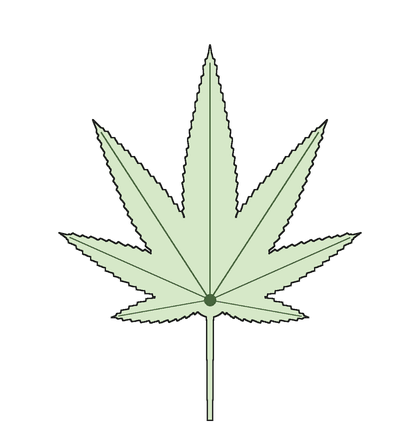 Solve with AI
Written solution
Solution:
Key idea: Some drugs are obtained directly from plants. The hemp plant, Cannabis sativa, has a typical leaf: palmately compound, with five to seven (sometimes more) long, narrow leaflets with saw-toothed (serrated) edges spreading from one point.
Step 1 — Identify the plant from the leaf.
The leaf in the picture has seven narrow, serrated leaflets radiating from the tip of the leaf stalk. This is the leaf of the hemp plant, Cannabis sativa.
Step 2 — Name the drug.
The dried leaves (and flower tops) of Cannabis sativa give the drug marijuana (known as bhang when made from the leaves). It contains cannabinoids, mainly THC (tetrahydrocannabinol), which act on the brain and change perception and mood.
Therefore, the drug extracted from these leaves of Cannabis sativa is marijuana (bhang), a cannabinoid drug.
- 63 marks
Board paper question 6
Study the chemical structure of an addictive drug shown below and answer the questions that follow.

(i) Mention the scientific name of the source plant of the above drug.
(ii) State any one effect of this drug on human body.
(iii) What is meant by withdrawal symptom?
Solve with AIWritten solution
Solution:
Key idea: Cannabinoids are the chemicals of the hemp plant that act on cannabinoid receptors in the body. Many of them share a recognisable structure: a benzene ring carrying oxygen groups (two –OH groups, a resorcinol ring, in cannabigerol and cannabidiol), a straight five-carbon (pentyl) chain, and a branched, terpene-derived chain or ring on the carbon between the two oxygens. The structure shown has all three features, so it is a cannabinoid.
Step 1 — (i) Name the source plant.
The cannabinoids used as drugs come from the hemp plant, so the source plant is Cannabis sativa. The drugs marijuana, hashish, charas and ganja are all obtained from its leaves, flower tops and resin.
Step 2 — (ii) State one effect on the human body.
Cannabinoid drugs act on cannabinoid receptors in the brain. They affect the cardiovascular system: they speed up the heartbeat and change blood pressure. They also change perception, mood and judgement and slow the reaction time, which makes driving dangerous.
Step 3 — (iii) Explain withdrawal symptoms.
When a person takes a drug or alcohol regularly, the body gets used to it (dependence). If the regular dose is suddenly stopped, the body reacts with a set of unpleasant signs called withdrawal symptoms, such as anxiety, shakiness (tremors), nausea, sweating and sleeplessness. They go away when the drug is taken again, which is why dependence is hard to break. Some withdrawal symptoms are severe or even life-threatening, so withdrawal should take place under medical supervision.
Note: The exact compound drawn is cannabigerol (CBG, ), a cannabinoid of Cannabis sativa. By itself it does not give the 'high'; the effects of cannabis drugs come mainly from THC, a closely related cannabinoid of the same plant.
Therefore, (i) the source plant is Cannabis sativa; (ii) cannabinoids affect the cardiovascular system, raising the heart rate, and alter perception and judgement; (iii) withdrawal symptoms are the unpleasant signs, such as anxiety, tremors, nausea and sweating, that appear when the regular use of a drug or alcohol is suddenly stopped.
Class 12 Biology Ch 11 questions students ask
How many questions are there in Class 12 Biology Ch 11?
69 questions. Every one is solved step by step on this page.
Are these Class 12 Biology solutions free?
Yes. Every question and its full working is free to read, with no account needed.
Can I download the Class 12 Biology Ch 11 solutions as a PDF?
There is no PDF to download. Every solution is on this page instead, which means it is searchable, always the current syllabus, and readable on a phone. Use your browser's print option if you want it on paper.