
Opening your dashboard
Class 12 Biology Chapter 11 Adolescent Issues: Alcoholism and Drugs: Previous Year Questions
6 questions on Chapter 11, each solved step by step. Class 12 Biology, ICSE 2026-27.
6 questions with solutions
1–3 marks · Easy difficulty
- 12 marks
Question 1
Differentiate between:
(i) Cannabinoids and Barbiturates
(ii) Biotic potential and Carrying capacity.
Solve with AIWritten solution
Solution:
Key idea: This question has two unrelated parts. Part (i) compares two groups of drugs that act on the nervous system in different ways. Part (ii) compares two ideas from population ecology: how fast a population could grow, and how large it can finally become.
Step 1 — (i) Compare cannabinoids and barbiturates.
Cannabinoids are natural chemicals of the hemp plant that change perception, while barbiturates are man-made medicines that slow down (depress) the brain. The table sets out the differences.
Feature Cannabinoids Barbiturates Source Natural: obtained from the hemp plant, Cannabis sativa Synthetic: made in the laboratory from barbituric acid Type of drug Psychotropic; change perception, thoughts and mood Sedatives (depressants) of the central nervous system Main effect Altered perception and judgement; they also affect the heart and blood vessels (cardiovascular system) Calm the person and bring on sleep; large doses slow breathing and can kill Examples Marijuana, hashish, charas, ganja Phenobarbital, secobarbital Step 2 — (ii) Compare biotic potential and carrying capacity.
Biotic potential describes growth under ideal conditions, while carrying capacity is the limit that real conditions set. The table sets out the differences.
Feature Biotic potential Carrying capacity Meaning The maximum rate at which a population can increase when resources are unlimited and conditions are ideal The maximum population size that a habitat can support for a long time with its limited resources Symbol , the intrinsic rate of natural increase Growth curve Exponential growth; a J-shaped curve Logistic growth levels off at ; an S-shaped (sigmoid) curve Depends on Birth rate, age at first reproduction and number of young of the species Food, space, shelter and other resources of the habitat Watch out: Barbiturates were once described in some books as not addictive; in fact they are habit-forming and cause both physical and psychological dependence.
Therefore, (i) cannabinoids are natural psychotropic drugs from Cannabis sativa, while barbiturates are synthetic sedatives; (ii) biotic potential is the maximum possible rate of increase under ideal conditions, while carrying capacity is the maximum population size a habitat can support.
- 21 mark
Question 2
Each of the following questions has four choices. Choose the best option in each case :
Opium is obtained from :
Solve with AIAnswer
- Correct
(A) Papaver somniferum
(B) Cannabis sativa
(C) Erythroxylum coca
(D) Datura metel
Answer: (A) Papaver somniferum
Key idea: Opioids are drugs that bind to opioid receptors in the brain and gut. Opium is the dried milky latex of the poppy plant, Papaver somniferum.
Step 1 — Recall how opium is collected.
The unripe seed capsules of the poppy are cut, and the milky latex that oozes out is dried. This dried latex is opium.
Step 2 — Link opium to its products.
Opium contains morphine, a strong painkiller and sedative. Codeine is another alkaloid of opium, and heroin (smack) is made by acetylating morphine, so all these opioids come from this plant. (Some other opioids, such as pethidine and fentanyl, are fully synthetic.)
Step 3 — Match with the options.
The poppy plant is Papaver somniferum, which is option (A).
Why the others are wrong:
- (B) Cannabis sativa (hemp) is the source of cannabinoids such as marijuana, hashish, charas and ganja, not of opium.
- (C) Erythroxylum coca (coca plant) is the source of the stimulant cocaine.
- (D) Datura is a plant with hallucinogenic properties; it does not yield opium.
Therefore, opium is obtained from the poppy, Papaver somniferum, so the answer is (A).
- 32 marks
Question 3
List any four reasons for drug addictions.
Solve with AIWritten solution
Solution:
Key idea: Drug addiction usually starts in adolescence, a period of curiosity, experimentation and stress. Most reasons for starting drugs are social or emotional, and the drug's pleasant effect then keeps the person taking it.
Step 1 — Give reasons that come from curiosity and friends.
Two common reasons arise from the young person's own nature and from friends.
- Curiosity and the wish for adventure or excitement: Young people want to try something new and see what a drug feels like.
- Peer pressure: Friends who take drugs push others to join in, and the young person wants to be accepted by the group.
Step 2 — Give reasons that come from stress and the home.
Two more reasons arise from stress and from conditions at home.
- Escape from stress and problems: Pressure to do well in examinations, failure, frustration or depression make some people use drugs to forget their problems for a while.
- Unstable or unsupportive family: Quarrels at home, lack of attention from parents, or a family member who already takes drugs make a young person more likely to begin.
Other reasons include the false belief that drugs improve performance, easy availability of drugs, and glamorous pictures of drugs in films and the media.
Therefore, four reasons for drug addiction are curiosity and the wish for excitement, peer pressure, escape from stress or frustration, and an unstable family background.
- 42 marks
Question 4
List any four effects of alcoholism on human health.
Solve with AIWritten solution
Solution:
Key idea: Alcohol (ethanol) is a depressant of the central nervous system. In the body it is broken down mainly in the liver, so long-term heavy drinking (alcoholism) damages the liver, the brain and many other organs.
Step 1 — Give effects on the liver and the nervous system.
The liver and the brain are harmed first, because the liver breaks alcohol down and the brain is where it acts.
- Liver damage: Fat collects in liver cells (fatty liver); later the liver becomes inflamed (alcoholic hepatitis) and its cells are replaced by scar tissue (cirrhosis), so the liver can no longer work properly.
- Damage to the nervous system: Alcohol slows reflexes and increases the reaction time, impairs judgement, coordination and memory, and long use damages brain cells.
Step 2 — Give effects on other organs.
Alcohol carried in the blood also harms the heart and the digestive organs.
- Heart and blood vessels: Heavy drinking raises blood pressure and weakens the heart muscle (cardiomyopathy), which can lead to heart failure.
- Digestive system and cancer: Alcohol irritates the stomach lining (gastritis, ulcers), damages the pancreas, and raises the risk of cancers of the mouth, throat, food pipe and liver.
A woman who drinks during pregnancy can also harm her baby (foetal alcohol syndrome).
Therefore, four effects of alcoholism on health are cirrhosis of the liver, damage to the brain and nerves (poor memory, judgement and coordination), high blood pressure with heart damage, and gastritis with a higher risk of cancer.
- 51 mark
Question 5
Answer the following questions briefly.
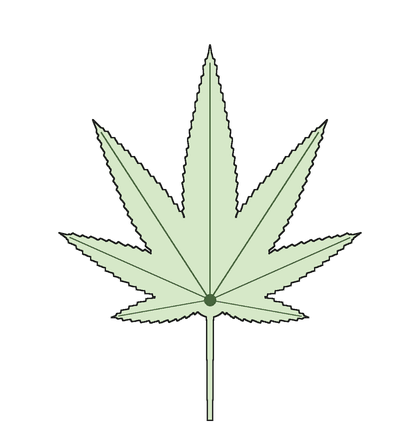
Which drug is extracted from the leaves shown in the image given below?
 Solve with AI
Written solution
Solution:
Key idea: Some drugs are obtained directly from plants. The hemp plant, Cannabis sativa, has a typical leaf: palmately compound, with five to seven (sometimes more) long, narrow leaflets with saw-toothed (serrated) edges spreading from one point.
Step 1 — Identify the plant from the leaf.
The leaf in the picture has seven narrow, serrated leaflets radiating from the tip of the leaf stalk. This is the leaf of the hemp plant, Cannabis sativa.
Step 2 — Name the drug.
The dried leaves (and flower tops) of Cannabis sativa give the drug marijuana (known as bhang when made from the leaves). It contains cannabinoids, mainly THC (tetrahydrocannabinol), which act on the brain and change perception and mood.
Therefore, the drug extracted from these leaves of Cannabis sativa is marijuana (bhang), a cannabinoid drug.
- 63 marks
Question 6
Study the chemical structure of an addictive drug shown below and answer the questions that follow.

(i) Mention the scientific name of the source plant of the above drug.
(ii) State any one effect of this drug on human body.
(iii) What is meant by withdrawal symptom?
Solve with AIWritten solution
Solution:
Key idea: Cannabinoids are the chemicals of the hemp plant that act on cannabinoid receptors in the body. Many of them share a recognisable structure: a benzene ring carrying oxygen groups (two –OH groups, a resorcinol ring, in cannabigerol and cannabidiol), a straight five-carbon (pentyl) chain, and a branched, terpene-derived chain or ring on the carbon between the two oxygens. The structure shown has all three features, so it is a cannabinoid.
Step 1 — (i) Name the source plant.
The cannabinoids used as drugs come from the hemp plant, so the source plant is Cannabis sativa. The drugs marijuana, hashish, charas and ganja are all obtained from its leaves, flower tops and resin.
Step 2 — (ii) State one effect on the human body.
Cannabinoid drugs act on cannabinoid receptors in the brain. They affect the cardiovascular system: they speed up the heartbeat and change blood pressure. They also change perception, mood and judgement and slow the reaction time, which makes driving dangerous.
Step 3 — (iii) Explain withdrawal symptoms.
When a person takes a drug or alcohol regularly, the body gets used to it (dependence). If the regular dose is suddenly stopped, the body reacts with a set of unpleasant signs called withdrawal symptoms, such as anxiety, shakiness (tremors), nausea, sweating and sleeplessness. They go away when the drug is taken again, which is why dependence is hard to break. Some withdrawal symptoms are severe or even life-threatening, so withdrawal should take place under medical supervision.
Note: The exact compound drawn is cannabigerol (CBG, ), a cannabinoid of Cannabis sativa. By itself it does not give the 'high'; the effects of cannabis drugs come mainly from THC, a closely related cannabinoid of the same plant.
Therefore, (i) the source plant is Cannabis sativa; (ii) cannabinoids affect the cardiovascular system, raising the heart rate, and alter perception and judgement; (iii) withdrawal symptoms are the unpleasant signs, such as anxiety, tremors, nausea and sweating, that appear when the regular use of a drug or alcohol is suddenly stopped.