Explain the concept of relative velocity using the examples on the relative velocity of one-dimensional motion.
Question 953 marksMedium
Explain the concept of relative velocity using the examples on the relative velocity of one-dimensional motion. Using parallelogram law of addition of vectors, obtain an expression for the relative velocity of a body in two-dimensional motion.
Solution:
Concept: The relative velocity of body A with respect to body B is the velocity with which A appears to move to an observer moving with B: vAB=vA−vB.
Step 1 — The idea, with one-dimensional examples. Two cars move on a straight road, car A at 60km h−1 and car B at 40km h−1. If they move in the same direction, a passenger in B sees A moving ahead at
vAB=60−40
vAB=20km h−1
If they move in opposite directions, the passenger in B sees A moving (towards B before they pass, away from B after) at
vAB=60+40
vAB=100km h−1
If they have equal velocities, each appears to the other to be at rest. In one dimension, with signs for direction,
vAB=vA−vB
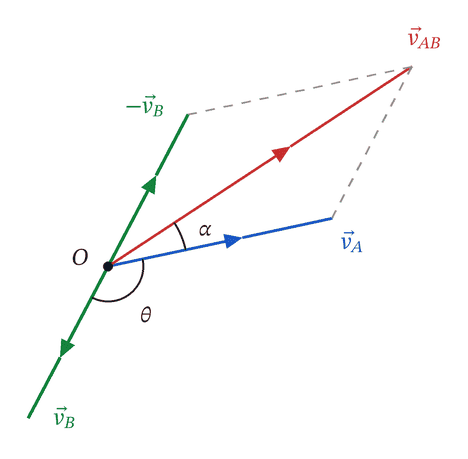
Step 2 — Two dimensions: subtract by adding the negative. Let A and B move with velocities vA and vB at an angle θ to each other. Then
vAB=vA+(−vB)
So we draw vA and −vB from one point O and complete the parallelogram; its diagonal from O is vAB:
Step 3 — Find the magnitude. The angle between vA and −vB is 180∘−θ. The parallelogram law gives
vAB=vA2+vB2+2vAvBcos(180∘−θ)
vAB=vA2+vB2−2vAvBcosθ
Step 4 — Find the direction. If vAB makes an angle α with vA, the parallelogram law gives
tanα=vA+vBcos(180∘−θ)vBsin(180∘−θ)
tanα=vA−vBcosθvBsinθ
Therefore, vAB=vA−vB; in two dimensions its magnitude is vA2+vB2−2vAvBcosθ and it makes an angle α with vA given by tanα=vA−vBcosθvBsinθ.