
Question 943 marksMedium
Explain triangle law of vector addition. Discuss commutative and associative properties of vector addition.
Confirming your payment
Sign up now and get 250 free tokens.
Motion in a Plane - Vectors · Question 94 of 101
Explain triangle law of vector addition. Discuss commutative and associative properties of vector addition.
Solution:
Concept: Vectors are added head to tail; the order and the grouping of the vectors do not change the sum.
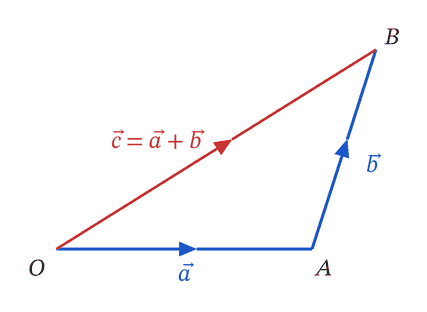
Step 1 — Triangle law. If two vectors are represented in magnitude and direction by two sides of a triangle taken in the same order, their resultant is represented by the third side taken in the opposite order. In the figure and , and
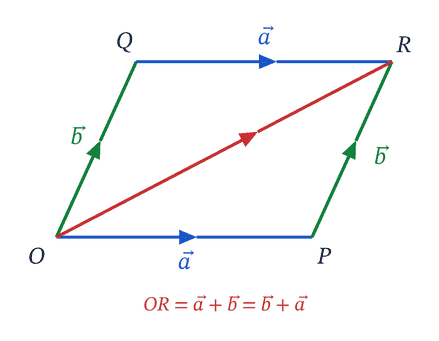
Step 2 — Commutative property. The order of adding two vectors does not matter:
To show this, we complete the parallelogram OPRQ, with sides OP and QR both representing , and sides OQ and PR both representing . In triangle OPR, ; in triangle OQR, . Both equal the same diagonal OR:
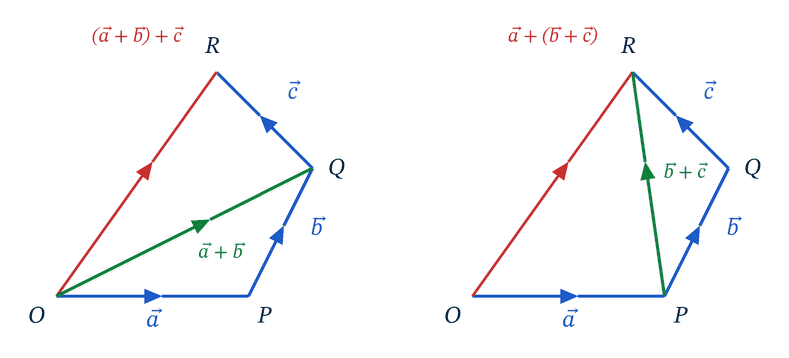
Step 3 — Associative property. The way three vectors are grouped does not matter:
To show this, we draw , and head to tail. In triangle OPQ, , so the first grouping gives
In triangle PQR, , so the second grouping gives
Both groupings give the same vector OR:
Therefore, by the triangle law the third side taken in the opposite order is the resultant; vector addition is commutative, , and associative, .