
Opening your dashboard
Class 11 Maths Chapter 3: Angles and Arc Lengths Solutions
26 textbook questions with step-by-step answers, free to read, for ISC 2026-27.
Get talked through Ch 3, not just shown the answer
Reading a finished solution is not the same as being able to do it. The AI tutor takes one question at a time and works it with you, in your own words, until you can.
- Ask it out loud, in your own words
- It gives you the next step, not the answer
- Stuck on part (ii)? Start there
26 questions with solutions
1–3 marks · Mixed difficulty
The first 20 solutions are on this page. This chapter is a long one, so the rest open on their own page to keep this one quick to load.
- 13 marks
Question 1
Express the following angles in degrees: .
Solve with AIWritten solution
Solution:
Key idea: radians equal , so to change radians to degrees we multiply by .
Step 1 — Convert .
We multiply by , so the cancels.
Step 2 — Convert .
We multiply by and divide 180 by 15 first.
Step 3 — Convert .
We multiply by and divide 180 by 18 first.
Step 4 — Convert .
We multiply by and divide 180 by 90 first.
Answer: , , ,
- 23 marks
Question 2
Express the following angles in radians
(i)
(ii)
(iii) .
Solve with AIWritten solution
Solution:
Key idea: equals radians, so to change degrees to radians we multiply by . Minutes are first changed to degrees using .
Step 1 — Convert to radians.
We first write one minute as a fraction of a degree.
Now we multiply by to change degrees to radians.
rad
rad
Step 2 — Convert to radians.
We multiply by and cancel the common factor 20.
rad
rad
Step 3 — Convert to radians.
We multiply by and cancel the common factor 45.
rad
rad
Answer: (i) rad, (ii) rad, (iii) rad
- 33 marks
Question 3
Express in radians and also in degrees the angle of a regular polygon of
(i) 40 sides,
(ii) sides.
Solve with AIWritten solution
Solution:
Key idea: A polygon of sides can be cut into triangles from one vertex, so its interior angles add up to radians. In a regular polygon all angles are equal, so we divide the sum by .
Step 1 — Find each angle of a regular polygon of sides in radians.
We divide the angle sum by the number of angles.
Each angle rad
Step 2 — Write the same angle in degrees.
We use rad .
Each angle
Step 3 — Put to get the radian measure for 40 sides.
We replace by 40 in the result of Step 1.
Each angle rad
rad
Step 4 — Change this angle to degrees.
We multiply by .
Answer: (i) rad ; (ii) rad
- 43 marks
Question 4
In a circle of diameter 40 cm, the length of a chord is 20 cm. Find the length of minor and major arc of the chord.
Solve with AIWritten solution
Solution:
Key idea: We find the angle the chord makes at the centre, then use arc length with in radians. The major arc is the rest of the circumference.
Step 1 — Find the radius.
The radius is half the diameter.
cm
Step 2 — Find the angle at the centre.
Let the chord be and the centre . The radii and are 20 cm each, and the chord is also 20 cm, so triangle has three equal sides and is equilateral.
rad
Step 3 — Find the minor arc.
We use with the angle from Step 2.
cm
Step 4 — Find the major arc.
The major arc is the whole circumference minus the minor arc.
Circumference
cm
Major arc
cm
With these are about 20.95 cm and 104.76 cm.
Answer: Minor arc cm, major arc cm
- 53 marks
Question 5
The length of a pendulum is 8 m while the pendulum swings through 1.5 rad, find the length of the arc through which the tip of the pendulum passes.
Solve with AIWritten solution
Solution:
Key idea: The tip of the pendulum moves on a circle whose radius is the length of the pendulum, so the arc it travels is with in radians.
Step 1 — Write down the radius and the angle.
The radius is the length of the pendulum, and the angle is already in radians.
m
rad
Step 2 — Find the arc length.
We substitute these values into .
m
Answer: The tip passes through an arc of 12 m.
- 63 marks
Question 6
The minute hand of a clock is 15 cm long. How far does the tip of the hand move during 40 minutes? (Take )
Solve with AIWritten solution
Solution:
Key idea: The minute hand makes a full turn in 60 minutes, so it turns each minute. The tip moves along an arc, so we use the arc-length formula with the angle in radians.
Step 1 — Find the angle turned in 40 minutes.
The hand turns each minute.
Step 2 — Change the angle to radians.
We multiply by .
rad
Step 3 — Find the distance moved by the tip.
The radius is the length of the hand, 15 cm.
cm
Answer: The tip moves 62.8 cm.
- 73 marks
Question 7
A central angle of a circle of radius 50 cm intercepts an arc of 10 cm. Express the central angle in radians and in degrees.
Solve with AIWritten solution
Solution:
Key idea: The angle in radians is . We then multiply by to get degrees; this exercise takes as .
Step 1 — Find the angle in radians.
We divide the arc by the radius.
rad
Step 2 — Change the angle to degrees.
We multiply by and use .
Step 3 — Change the fraction of a degree to minutes.
One degree is .
Step 4 — Change the fraction of a minute to seconds.
One minute is .
This is about .
Note: the book prints ; the exact value with is , which rounds to .
Answer: rad
- 83 marks
Question 8
The moon's distance from the earth is 3,60,000 km and its diameter subtends an angle of at the eye of the observer. Find the diameter of the moon.
Solve with AIWritten solution
Solution:
Key idea: The moon is very far away, so its diameter is almost the same as an arc of a circle of radius 3,60,000 km with the observer at the centre. So the diameter is about with in radians; this exercise takes as .
Step 1 — Change to degrees.
One degree is .
Step 2 — Change the angle to radians.
We multiply by .
rad
Step 3 — Find the diameter.
We multiply the distance by the angle in radians.
km
Step 4 — Put .
We multiply and simplify.
km
Answer: The diameter of the moon is km (about 3248 km).
- 93 marks
Question 9
A railway train is travelling on a curve of 750 m radius at the rate of 30 km/h, through what angle has it turned in 10 seconds?
Solve with AIWritten solution
Solution:
Key idea: We find the distance moved along the curve (this is the arc), then the angle turned is in radians.
Step 1 — Change the speed to metres per second.
The radius is in metres and the time in seconds, so the speed must be in m/s.
km/h m/s
m/s
Step 2 — Find the arc travelled in 10 seconds.
Distance is speed multiplied by time.
m
Step 3 — Find the angle turned.
We divide the arc by the radius of the curve.
rad
Answer: The train turns through radian.
- 103 marks
Question 10
A horse is tethered to a stake by a rope 810 cm long. If the horse moves along the circumference of a circle always keeping the rope tight, find how far it will have gone when the rope has traced out an angle of ?
Solve with AIWritten solution
Solution:
Key idea: The horse moves on a circle whose radius is the rope, so the distance it goes is the arc with in radians. This exercise takes as 22/7.
Step 1 — Change the angle to radians.
We multiply by .
rad
Step 2 — Find the arc.
The radius is the rope, 810 cm.
cm
Answer: The horse goes 990 cm (9.9 m).
- 113 marks
Question 11
The area of a sector is and its angle is . Find the radius. ()
Solve with AIWritten solution
Solution:
Key idea: A sector of angle is of the whole circle, so its area is . We put in the known area and solve for .
Step 1 — Write the equation for the area.
The angle is and .
Step 2 — Simplify the left side.
, so the coefficient is one tenth of 3.14.
Step 3 — Solve for .
We divide both sides by 0.314.
Step 4 — Take the square root.
A radius is positive, so we take the positive root.
cm
Answer: The radius is 4 cm.
- 123 marks
Question 12
Find the area of sector of a circle, radius 5 m bounded by an arc of length 8 m.
Solve with AIWritten solution
Solution:
Key idea: The area of a sector is . Since the arc is , this can be written as , so we do not need the angle at all.
Step 1 — Write down the radius and the arc length.
Both are given in the question.
m
m
Step 2 — Find the area of the sector.
We substitute into Area .
Area
Answer: The area of the sector is .
- 133 marks
Question 13
The diagram shows a windscreen wiper cleaning a car windscreen.
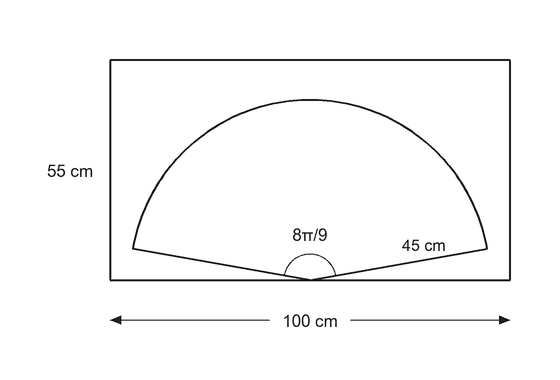
(i) What is the length of the arc swept out?
(ii) What area of the windscreen is not cleaned? ()
Solve with AIWritten solution
Solution:
Key idea: The wiper blade of length 45 cm turns through rad, so it sweeps an arc of radius 45 cm and cleans a sector. We use arc and sector area .
Step 1 — Find the length of the arc swept out.
We multiply the radius by the angle in radians.
Arc
cm
Step 2 — Find the area of the windscreen.
The windscreen is a rectangle 100 cm by 55 cm.
Area
Step 3 — Find the area cleaned by the wiper.
The cleaned part is a sector of radius 45 cm.
Area
Step 4 — Find the area not cleaned.
We subtract the cleaned area from the whole windscreen.
Area not cleaned
Answer: (i) 125.6 cm (about 126 cm); (ii)
- 143 marks
Question 14
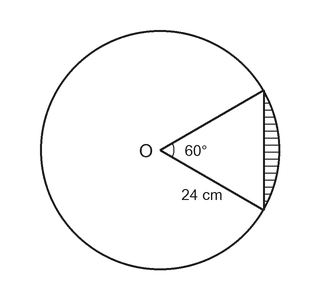
Find the area of the shaded segment.
 Solve with AI
Written solution
Solution:
Key idea: The area of the segment is the area of the sector minus the area of the triangle formed by the two radii and the chord. This exercise takes as , and we use .
Step 1 — Write the radius and angle in radians.
The figure gives the radius and the angle at the centre.
cm
rad
Step 2 — Find the area of the sector.
We use .
Area
Step 3 — Find the area of the triangle.
The two radii are equal and the angle between them is , so the triangle is equilateral with side 24 cm.
Area
Step 4 — Find the area of the segment.
We subtract the triangle from the sector.
Area
Answer: The shaded segment has area about .
- 153 marks
Question 15
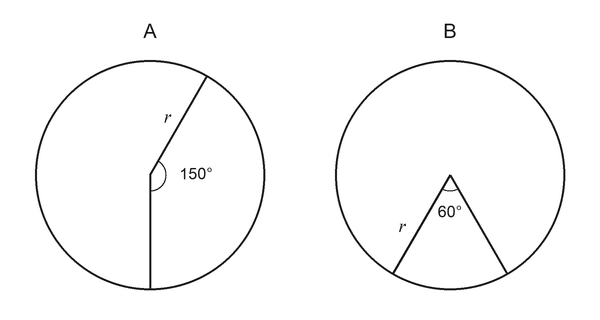
What is the ratio of the areas of the major sector in diagram A to the minor sector in diagram B?
 Solve with AI
Written solution
Solution:
Key idea: Both circles have the same radius . For equal radii the area of a sector is proportional to its angle, because area .
Step 1 — Find the angle of the major sector in diagram A.
The minor sector in A has angle , and the two sectors together make a full turn.
Major angle
Step 2 — Note the angle of the minor sector in diagram B.
The figure marks it directly.
Minor angle
Step 3 — Form the ratio of the areas.
The factor is the same in both, so it cancels.
Ratio
Answer: The ratio is .
- 161 mark
Question 16
Convert into radian measure.
Solve with AIAnswer
- Correct
(A) rad
(B) rad
(C) rad
(D) None of these
Answer: (A) rad
Key idea: We first write the minutes as a fraction of a degree, then multiply by to change degrees to radians.
Step 1 — Change to degrees.
One degree is .
Step 2 — Write the whole angle in degrees.
We add the fraction to .
Step 3 — Change to radians.
We multiply by .
rad
Why the others are wrong:
- (B) comes from forgetting to multiply by ; it is far more than one full turn.
- (C) is the radian measure of ; it drops the 3 in .
- (D) is wrong because (A) is the correct value.
So the correct option is (A).
- 171 mark
Question 17
Find the degree measure corresponding to the radian measure .
Solve with AIAnswer
(A)
- Correct
(B)
(C)
(D) None of these
Answer: (B)
Key idea: To change radians to degrees we multiply by .
Step 1 — Multiply by .
The cancels.
Step 2 — Simplify.
We divide 180 by 6 first.
Why the others are wrong:
- (A) is rad, not .
- (C) is rad; it leaves out the factor .
- (D) is wrong because (B) is the correct value.
So the correct option is (B).
- 181 mark
Question 18
Find the perimeter of the shape drawn here
 Solve with AI
Answer
(A) 280 cm
(B) 253 cm
(C) 340 cm
- Correct
(D) 305 cm
Answer: (D) 305 cm
Key idea: The shape is a sector, so its perimeter is two radii plus the arc, with arc and in radians.
Step 1 — Change the angle to radians.
We multiply by .
rad
Step 2 — Find the arc.
The radius is 70 cm and .
Arc
cm
Step 3 — Find the perimeter.
We add the two radii to the arc.
Perimeter
cm
Why the others are wrong:
- (A) 280 cm would leave an arc of cm, which is the arc for an angle of 2 rad (about ), not .
- (B) 253 cm would leave an arc of cm, i.e. an angle of rad (about ), not .
- (C) 340 cm would leave an arc of cm, i.e. an angle of rad (about ), not .
So the correct option is (D).
- 191 mark
Question 19
The radius of the circle whose arc of length 15 cm makes an angle of radian at the centre, is
Solve with AIAnswer
(A) 10 cm
(B) cm
- Correct
(C) 20 cm
(D) cm
Answer: (C) 20 cm
Key idea: Arc length is with in radians, so the radius is .
Step 1 — Write down the arc and the angle.
Both are given, and the angle is already in radians.
cm
rad
Step 2 — Find the radius.
We divide the arc by the angle.
cm
Why the others are wrong:
- (A) With cm the arc would be cm, not 15 cm.
- (B) : it multiplies by instead of dividing.
- (D) With cm the arc would be cm, not 15 cm.
So the correct option is (C).
- 201 mark
Question 20
The acute angle in radians between the minute and the hour hand of a clock when the time is 4:20, is
Solve with AIAnswer
- Correct
(A)
(B)
(C)
(D)
Answer: (A)
Key idea: We measure both hands clockwise from 12. The minute hand moves per minute; the hour hand moves per hour and per minute.
Step 1 — Find the position of the minute hand.
At 20 minutes past, the minute hand has moved 20 steps of .
Step 2 — Find the position of the hour hand.
It has passed 4 full hours and moved on for 20 more minutes.
Step 3 — Find the angle between the hands.
We subtract the two positions.
Step 4 — Change to radians.
We multiply by .
rad
Why the others are wrong:
- (B) comes from moving the hour hand per minute instead of (it would sit at ).
- (C) comes from placing the hour hand on 5 (), but at 4:20 it is only one-third of the way from 4 to 5.
- (D) is the gap between two numerals that are two hours apart; the hands here are only apart.
So the correct option is (A).
- 211 mark
Question 21
Find the angle in radians through which a pendulums swings if its length is 75 cm and the tip describes an arc of length 21 cm.
- 221 mark
Question 22
If the arcs of the same lengths in two circles subtend angles and at the centre, find the ratio of their radii.
- 231 mark
Question 23
A horse is tied to a post by a rope. If it moves along a circular path, keeping the rope tight and describes 132 m when it has traced out an angle of at the centre, then the length of the rope is
- 241 mark
Question 24
A circular wire of radius 15 cm is cut and bent so as to lie along the circumference of a loop of radius 120 cm. The angle subtended by it at the centre is
- 251 mark
Question 25
A train is travelling along a curve of radius 700 m at 21 km/hr. The angle in radians through which the train turns in 2 minutes is
- 261 mark
Question 26
The perimeter of a certain sector of a circle is equal to the length of the arc of the semicircle. then the angle at the centre of the sector in radians is
What Class 11 Maths Ch 3 covers
The sections of the chapter, in the order the book takes them. Every question above comes from one of these.
- 01Angles and Their Measurement
- 02Relation Between Radians and Degrees
- 03Length of an Arc and Area of a Sector
More ways to study this chapter
The same chapter asked three other ways. Practise it, revise it, and see what the board has set on Ch 3 before.
Class 11 Maths Ch 3 questions students ask
How many questions are there in Class 11 Maths Ch 3?
26 questions. Every one is solved step by step on this page.
Are these Class 11 Maths solutions free?
Yes. Every question and its full working is free to read, with no account needed.
Can I download the Class 11 Maths Ch 3 solutions as a PDF?
There is no PDF to download. Every solution is on this page instead, which means it is searchable, always the current syllabus, and readable on a phone. Use your browser's print option if you want it on paper.