
Opening your dashboard
Class 11 Maths Chapter 3 Angles and Arc Lengths: Competency-Based Questions (CBQ)
40 questions on Chapter 3, each worked through on its own page with the AI tutor. Class 11 Maths, ICSE 2026-27.
40 questions
1–5 marks · Mixed difficulty
- 11 mark
Question 1
Competency: Application
A drone's flight software stores every direction as an angle in standard position: measured from East (the line ), anticlockwise taken as positive, with North along . The ground team, however, radios directions as bearings, measured clockwise from North. The team asks the drone to fly on a bearing of .
Which angle, between and , should be entered in the flight software?
- 24 marks
Question 2
Competency: Analysis & Evaluation
Seen from above, the jib of a tower crane starts pointing along (East). Turning anticlockwise is taken as positive. The power cable to the cab twists as the jib turns, so the total angle turned from the start must always stay between and (one and a half turns either way). (Hypothetical data.)
During a shift the operator turns the jib through , then , then .
(a) Find the total angle turned from the start after these three moves, and state whether the cable limit has been crossed.
(b) In which quadrant does the jib now point? Give the smallest positive angle that has the same terminal side.
(c) The next load lies in the direction of the angle (measured from ). The operator can reach it by turning clockwise or anticlockwise. Which way must the jib turn, and through how many degrees? Give a reason.
- 31 mark
Question 3
Competency: Understanding
In a "double twist", a diver turns about her vertical axis through two complete turns in the same direction and enters the water facing exactly the way she faced at the start.
Assertion (A): Since she finishes facing the same way, the angle through which the diver has turned is .
Reason (R): Angles whose measures differ by a whole number of complete turns ( each) have the same initial side and the same terminal side.
- 43 marks
Question 4
Competency: Application
A surveyor checks the boundary of a five-sided field . She starts at facing , walks along each straight side and, at every corner, turns left (anticlockwise) to face the next side, until she is back at facing again. Her instrument records the angle she turns through at each corner. (Hypothetical data.)
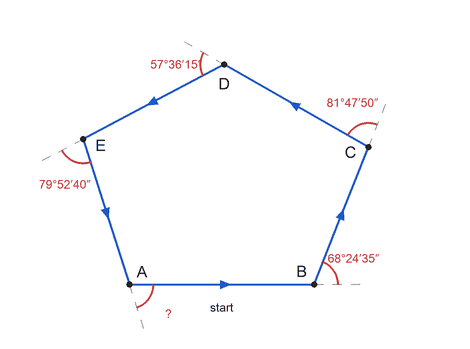
The turns at , , and are , , and . The page with the turn at is lost.
(a) Through what total angle has she turned during the whole walk? Give a reason.
(b) Find the turn at in degrees, minutes and seconds.
(c) Find the interior angle of the field.
- 51 mark
Question 5
Competency: Analysis & Evaluation
The dial of a combination lock turns about its centre. Starting with the pointer at the zero mark each time, Ravi turns the dial through anticlockwise, and Meena turns it through clockwise.
Assertion (A): Both dials stop with the pointer at the same mark.
Reason (R): Two angles have the same terminal side whenever the sum of their measures is a multiple of .
- 64 marks
Question 6
Competency: Application
A motor shaft carries an encoder that sends one pulse for every equal step of rotation, pulses in one complete revolution. The controller counts anticlockwise pulses as positive and clockwise pulses as negative. The shaft starts at its home position. (Hypothetical data.)
(a) Through what angle does the shaft turn for one pulse? Give it in minutes and in radians.
(b) The shaft now turns through pulses and then pulses. Find the total angle turned, in degrees, and describe it in complete revolutions and the direction of turning.
(c) The controller must now bring the shaft back to its home position along the shorter way round. How many pulses, and in which direction, should it send?
- 71 mark
Question 7
Competency: Application
A car has a steering ratio of , which means the front road wheels turn through for every the steering wheel turns. From full left lock to full right lock the steering wheel turns through complete turns, and straight ahead is exactly halfway. (Hypothetical data.)
Through what greatest angle, in radians, can the front wheels turn to one side from straight ahead?
- 81 mark
Question 8
Competency: Analysis & Evaluation
Asha cuts a piece of string exactly as long as the radius of a circular steel plate. She lays it along the rim of the plate and joins both ends of the string to the centre with straight lines.
Assertion (A): The angle formed at the centre is smaller than .
Reason (R): The arc that subtends an angle of at the centre of a circle is longer than the radius of that circle.
- 91 mark
Question 9
Competency: Application
A screw moves forward mm for every complete turn (its pitch is mm). A small motor turns the screw through an angle of radians.
How far does the screw move forward?
- 104 marks
Question 10
Competency: Analysis & Evaluation
A designer covers a floor with tiles shaped as regular polygons. Wherever tiles meet at a point, their angles at that point must add up to exactly one complete turn, radians, with no gap and no overlap. The interior angle of a regular polygon with sides is radians.
(a) Find, in radians, the interior angle of a regular hexagonal tile.
(b) At one point, a square tile, a regular hexagonal tile and one more regular tile fit exactly. Find, in radians, the angle of the third tile at that point and the number of its sides.
(c) Can three regular pentagonal tiles fit exactly round a point? If not, find the gap, in degrees.
- 111 mark
Question 11
Competency: Application
In a triple Axel jump, a figure skater turns through complete turns while in the air. Suppose one such jump keeps her in the air for s. (Hypothetical data.)
What is her average rate of turning in the air?
- 121 mark
Question 12
Competency: Understanding
The lamp of a lighthouse turns at a steady rate and makes one complete turn every seconds. (Hypothetical data.)
Assertion (A): The beam turns through radian every second.
Reason (R): One complete turn is an angle of radians.
- 131 mark
Question 13
Competency: Application
The speedometer of a car has marks from to km/h spread evenly round an arc of of its dial. The needle turns about the centre of the dial.
Through what angle, in radians, does the needle turn from the mark to the km/h mark?
- 144 marks
Question 14
Competency: Analysis & Evaluation
A ship's radar screen is a circle of radius cm. The centre is the ship and the rim shows a range of km, so the screen is drawn to scale. A rain cloud fills the sector between the bearings and , from out to the rim, as shaded. (Hypothetical data.)
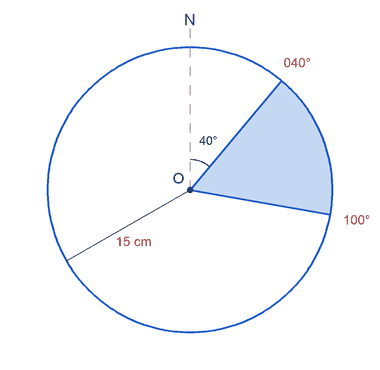
(a) Find the angle of the shaded sector in radians.
(b) Find the area of the shaded sector on the screen. Take .
(c) Find the actual area of sea covered by the cloud. Take .
- 151 mark
Question 15
Competency: Analysis & Evaluation
A curved kerb at a road corner is an arc of a circle of radius m, and it turns through . Rohit works out its length as .
Assertion (A): The kerb is m long.
Reason (R): In the formula , the angle must be measured in radians.
- 164 marks
Question 16
Competency: Application
A security camera is fixed at the centre of a circular courtyard of radius m. It sees everything within a horizontal angle of (its field of view), right up to the boundary wall. (Hypothetical data.) Take .

(a) Find the length of the boundary wall that the camera can see.
(b) Find the area of the courtyard floor in its view.
(c) More cameras of the same kind are to be fixed at , pointing in different directions, so that the whole wall is seen. What is the least number of cameras needed in all? With that number, by how many degrees, in total, do the views overlap?
- 171 mark
Question 17
Competency: Application
In shot put, a throw counts only if the shot lands inside a sector of the field whose vertex is at the centre of the throwing circle. Take the angle of this sector as . Ground staff mark the part of the sector up to m from the vertex.
What is the area of this marked part? Take .
- 184 marks
Question 18
Competency: Analysis & Evaluation
Two gears and mesh at , as shown. The pitch circle of has radius cm and that of has radius cm. As the gears turn without slipping, equal lengths of the two pitch circles pass the point . Anticlockwise turning is taken as positive. (Hypothetical data.)
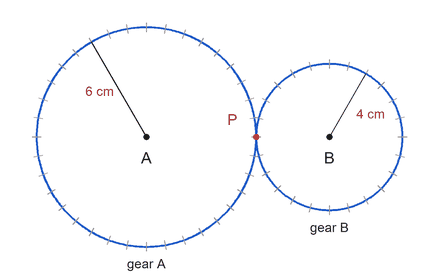
(a) Gear turns through . Find the length of its pitch circle that passes .
(b) Through what angle does gear turn at the same time? Give it in radians and in degrees.
(c) Gear makes complete turns anticlockwise. Find the angle turned by gear in radians, with its sign, and describe it in turns.
- 191 mark
Question 19
Competency: Understanding
A CD spins at a steady rate about its centre. Point is near the outer edge of the disc and point is near the central hole.
Assertion (A): In one second, travels a longer distance than .
Reason (R): In one second every point of the disc turns through the same angle about the centre, and the distance a point moves along its circle is , where is its distance from the centre.
- 204 marks
Question 20
Competency: Analysis & Evaluation
On a map of scale , a bend in a road is drawn from to as an arc of a circle with centre and radius cm. The arc subtends at . A car enters the bend at heading on a bearing of and turns to its right all along the bend. (Hypothetical data.) Take .
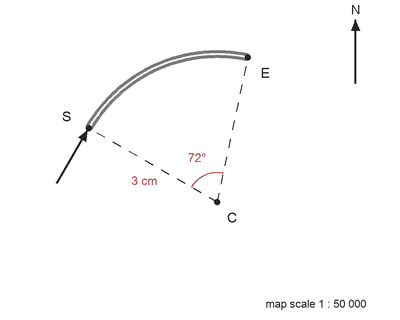
(a) Find the length of the bend on the map.
(b) Find the actual length of the bend in kilometres.
(c) On what bearing is the car heading when it leaves the bend at ? Give a reason.
- 211 mark
Question 21
Competency: Analysis & Evaluation
A rangoli design contains a motif in the shape of a sector of a circle. Its two straight edges are cm long and its curved edge is cm long.
Assertion (A): The angle of the motif at the centre is radians.
Reason (R): One radian is approximately equal to .
- 224 marks
Question 22
Competency: Application
The plan of a room shows a door cm wide, hinged at . From the closed position it opens through , where a stopper on the wall holds it, as shown. (Hypothetical data.) Take .
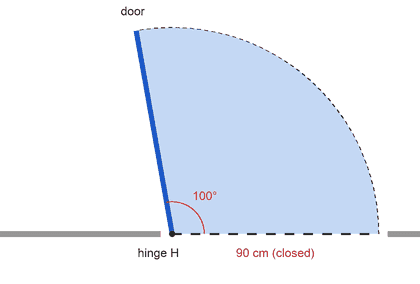
(a) Find the length of the path traced by the outer edge of the door as it opens fully.
(b) Find the area of floor swept by the door as it opens fully. Give your answer in and in .
(c) To make room for a shoe rack, the stopper is moved so that the door opens through only . By how much does the swept area decrease?
- 231 mark
Question 23
Competency: Application
In a belt drive, the belt touches the larger pulley, of radius cm and centre , all the way round an angle of at , as shown.
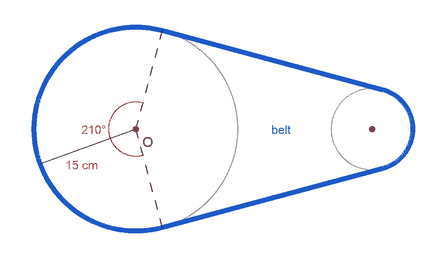
What length of belt is in contact with the larger pulley? Take .
- 241 mark
Question 24
Competency: Analysis & Evaluation
Geostationary satellites move in a circle of radius about km about the centre of the Earth, above the equator. Take the radius of the Earth as km.
Assertion (A): Two geostationary satellites apart (as seen from the Earth's centre) are farther apart, measured along their orbit, than two places on the equator whose longitudes differ by .
Reason (R): An angle of is equal to radian.
- 253 marks
Question 25
Competency: Analysis & Evaluation
More than 2000 years ago, Eratosthenes estimated the size of the Earth. At noon on midsummer day the Sun was directly overhead at Syene (). At the same moment, at Alexandria (), due north of Syene, the Sun's rays made an angle of with a vertical stick. The Sun's rays are parallel, so this is also the angle at the centre of the Earth. Take the distance from Syene to Alexandria along the Earth's surface as km. (Hypothetical data.)
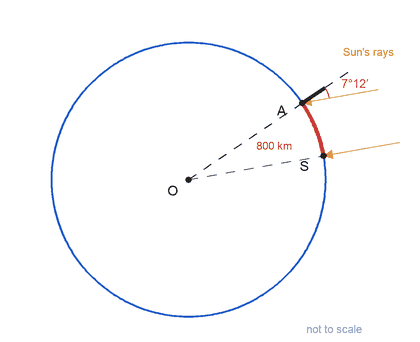
(a) Express in radians.
(b) What fraction of a complete circle is ? Hence estimate the circumference of the Earth.
(c) Estimate the radius of the Earth, using , to the nearest km.
- 261 mark
Question 26
Competency: Application & Analysis
A wall clock is running hour minutes fast. Priya puts it right by turning only the minute hand backwards until the clock shows the correct time; the hour hand moves with it.
Taking anticlockwise turning as positive (as seen from the front of the clock), the angle traced out by the minute hand is :
- 271 mark
Question 27
Competency: Analysis
In a gearbox, the output shaft always turns through exactly one-third of the angle turned by the input shaft, in the same sense. Each shaft carries a pointer that starts along . In a test, the input shaft turns anticlockwise through an angle , less than one complete revolution, and its pointer stops in the fourth quadrant.
Assertion (A): The pointer on the output shaft stops in the second quadrant.
Reason (R): If , then .
- 281 mark
Question 28
Competency: Application & Analysis
The elbow joint of a robot arm can bend from up to radians, and no further. (Hypothetical data.) Four target positions need the elbow to bend through the angles below.
Which target can the robot arm reach? (Take .)
- 291 mark
Question 29
Competency: Analysis
Two round cakes of the same height have diameters cm and cm. Ravi cuts a slice with an angle of at the centre from the larger cake. Meera wants a slice from the smaller cake with exactly the same top area. (Hypothetical data.)
The angle of Meera's slice at the centre should be :
- 301 mark
Question 30
Competency: Understanding
A company logo is a sector of a circle of radius with angle radians at the centre. For a large banner, the designer makes a new version with twice the radius and half the angle.
Assertion (A): The curved edge of the new logo has the same length as the curved edge of the old one.
Reason (R): The area of a sector of radius and angle radians is .
- 311 mark
Question 31
Competency: Analysis
A school weather station has a wind vane that turns freely about a vertical axis. Its sensor records the total angle the vane has turned through since it was switched on with the arrow along , counting anticlockwise turns (seen from above) as positive. At noon the arrow points along , as shown, below . (Hypothetical data.)
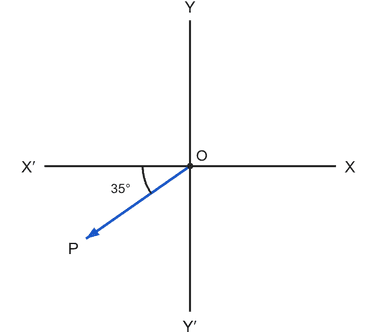
Which of the following can NOT be the sensor's reading at noon?
- 322 marks
Question 32
Competency: Application
Take the longitude of Kolkata as E and that of Mumbai as E. The Earth turns from west to east through in hours, so local noon (the moment the Sun is highest in the sky) reaches a place farther east earlier.
(a) Find the difference between the two longitudes in degrees and minutes.
(b) How many minutes earlier does local noon come in Kolkata than in Mumbai?
- 332 marks
Question 33
Competency: Evaluation
An angle-measuring app on a phone shows angles in radians, rounded to decimal places. Rhea measures the angle between two edges of a floor tile and the app shows rad. Rhea says, "So the angle is exactly ." (Hypothetical data.) Take .
(a) Show that an angle of exactly would be shown as rad.
(b) Is Rhea's conclusion justified? Find the range of angles, in degrees correct to decimal places, that the app would show as rad.
- 342 marks
Question 34
Competency: Application & Analysis
The hour hand of a wall clock is cm long. During a lesson, the tip of the hour hand moves cm along its circular path. (Hypothetical data.) Take .
(a) Find the angle turned by the hour hand, in radians and in degrees.
(b) How long did the lesson last?
- 352 marks
Question 35
Competency: Application
Four members of a surveying club each measure the same angle (between two flagpoles, as seen from a peg) with a theodolite. Their readings are , , and . (Hypothetical data.)
(a) Find the mean of the four readings in degrees, minutes and seconds.
(b) Which reading is farthest from the mean, and by how much?
- 363 marks
Question 36
Competency: Evaluation
An architect offers two designs for a sector-shaped glass window above a door. Design A has radius m and angle at the centre. Design B has radius m and angle at the centre. A metal frame runs all round each window: along both straight edges and the curved edge. (Hypothetical data.) Take .
(a) Find the area of glass in each design, in , correct to decimal places.
(b) Find the length of frame each design needs, in m, correct to decimal places.
(c) The owner says, "Design B is better in every way." Do you agree? Give a reason.
- 373 marks
Question 37
Competency: Analysis & Evaluation
A road engineer sets out a circular curve of radius m. The angle subtended by the curve at the centre of the circle is measured as . (Hypothetical data.)
(a) Express this angle in degrees as a decimal.
(b) Find the length of the curve, correct to decimal places, using .
(c) A trainee uses instead. By how much does the trainee's length differ? The site allows an error of up to m in this length. Is the value good enough here?
- 383 marks
Question 38
Competency: Creativity
A floor-cleaning robot starts facing along . Its programme has exactly three turns, made one after another on the spot, with anticlockwise turns (seen from above) taken as positive. The programme must obey these rules:
- each turn is more than and less than in size;
- at least one turn is clockwise and at least one is anticlockwise;
- at the end, the robot faces along the terminal side of the angle (measured from ).
(a) Write one programme that obeys all three rules, and show that it works.
(b) Find the largest possible total angle (the sum of the three signed turns) for a programme that obeys the rules, and give a programme that has this total.
- 395 marks
Question 39
Competency: Application & Analysis
A theatre has a circular revolving stage that turns about its centre . A mark on the rim lies along the line when the play begins. Seen from above, anticlockwise turns are taken as positive. Three crew members logged the stage's turn in each of the four scenes, each in a different unit, as shown in the table. (Hypothetical data.) Take .
Scene Sense of turning Turn as logged 1 anticlockwise 2 anticlockwise radian 3 anticlockwise revolution 4 clockwise radian (a) Express the turn in each scene as a signed angle in radians, in terms of .
(b) Find the total angle turned by the stage after the four scenes, in degrees, and state the quadrant in which the mark on the rim then lies.
(c) An actor stands still on the stage, m from , throughout the play. In which scene does the actor travel the greatest distance, and how far is it?
- 404 marks
Question 40
Competency: Application & Evaluation
A circular pond with centre is surrounded by a ring-shaped garden, as shown. The pond has radius m and the outer edge of the garden has radius m. Straight paths along radii divide the garden into flower beds of equal size; the figure shows one bed, shaded, with its two paths; the dashed lines and only mark the radii. Walking along the outer edge of this bed, from one path to the next, the gardener covers m. Treat the paths as lines. (Hypothetical data.) Take .
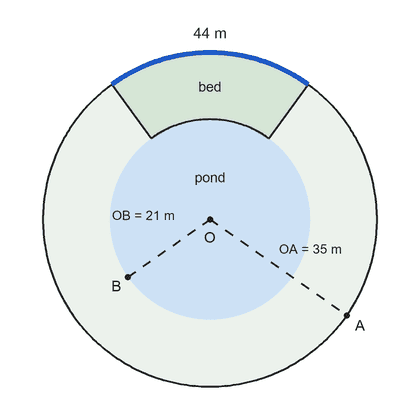
(a) Find the angle of the bed at , in radians and in degrees.
(b) How many beds are there? Find the area of one bed.
(c) The garden committee plans to replant the garden as equal beds. A member claims that each new bed will still have an area of more than and an outer edge longer than m. Check both parts of the claim.