
Opening your dashboard
Class 11 Maths Chapter 13: Straight Line Solutions
177 textbook questions with step-by-step answers, free to read, for ISC 2026-27.
Get talked through Ch 13, not just shown the answer
Reading a finished solution is not the same as being able to do it. The AI tutor takes one question at a time and works it with you, in your own words, until you can.
- Ask it out loud, in your own words
- It gives you the next step, not the answer
- Stuck on part (ii)? Start there
177 questions with solutions
1–3 marks · Mixed difficulty
The first 9 solutions are on this page. This chapter is a long one, so the rest open on their own page to keep this one quick to load.
- 13 marks
Question 1
Find the slope of a line whose inclination is
(i)
(ii)
(iii)
(iv)
(v)
Solve with AIWritten solution
Solution:
Concept: If a line makes an angle (its inclination, ) with the positive direction of the -axis, its slope is . The slope of the line through and is (rise over run), provided ; a vertical line has no finite slope.
(i)
Step 1 — Use . The slope is the tangent of the inclination, and is a standard value:
Slope .
(ii)
Step 1 — Use . We take the tangent of the inclination:
Slope .
(iii)
Step 1 — Use . We take the tangent of the inclination:
Slope .
(iv)
Step 1 — Write as a difference of standard angles. Since , we use :
Step 2 — Rationalise the denominator. We multiply the top and bottom by :
Slope .
(v)
Step 1 — Use . The angle is , so its tangent is negative:
Slope .
Watch out: An obtuse inclination always gives a negative slope, because the line falls as we move to the right.
Therefore, the slopes are (i) , (ii) , (iii) , (iv) , (v) .
- 23 marks
Question 2
Find the slope and inclination of the line through each pair of the following points:
(i) and
(ii) and
(iii) and
(iv) and
Solve with AIWritten solution
Solution:
Concept: If a line makes an angle (its inclination, ) with the positive direction of the -axis, its slope is . The slope of the line through and is (rise over run), provided ; a vertical line has no finite slope.
Once is known, the inclination is the angle in with : acute when , obtuse when .
(i) and
Step 1 — Find the slope. We divide the rise by the run:
Step 2 — Find the inclination. We need the angle whose tangent is :
Slope , inclination .
(ii) and
Step 1 — Find the slope. We divide the rise by the run and simplify, using :
Step 2 — Find the inclination. The slope is negative, so is obtuse; since , we take :
Slope , inclination .
(iii) and
Step 1 — Find the slope. We divide the rise by the run:
Step 2 — Find the inclination. The slope is positive, so is acute; from the tables, the angle whose tangent is is
Slope , inclination .
(iv) and
Step 1 — Find the slope. We divide the rise by the run:
Step 2 — Find the inclination. The slope is positive, so is acute; from the tables,
Slope , inclination .
Therefore, (i) , ; (ii) , ; (iii) , ; (iv) , .
- 33 marks
Question 3
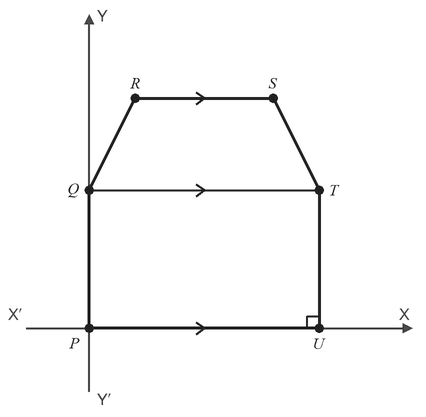
In the hexagon , . Which sides or diagonals have
(i) positive slope
(ii) negative slope
(iii) zero slope
(iv) infinite slope?
 Solve with AI
Written solution
Solution:
Concept: As we move from left to right, a line that rises has a positive slope, a line that falls has a negative slope, a horizontal line (parallel to the -axis) has zero slope and a vertical line (parallel to the -axis) has an infinite (undefined) slope.
Step 1 — Read the figure. The figure shows that is the origin, lies along the -axis and along the -axis. and are parallel to , so they are horizontal; is vertical (the right angle at ). Going from left to right, and rise from , while and come down again to .
Step 2 — List all the segments. A hexagon has sides and diagonals, so there are segments to sort:
Step 3 — Sort the rising segments. Each of these goes up as we move to the right (its right end is higher than its left end):
Step 4 — Sort the falling segments. Each of these goes down as we move to the right:
Step 5 — Sort the horizontal and vertical ones. The horizontal segments are the three parallel lines, and the vertical ones are the two sides along and :
Check: , so every side and diagonal has been placed exactly once.
Therefore, (i) ; (ii) ; (iii) ; (iv) .
- 43 marks
Question 4
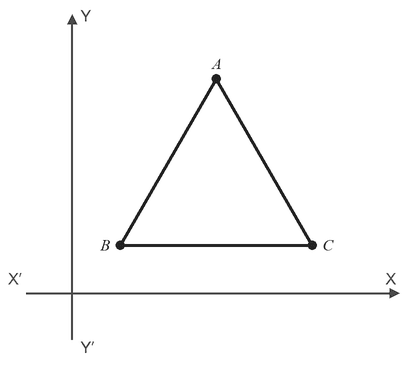
The side of an equilateral is parallel to the -axis. What are the slopes of its sides?
 Solve with AI
Written solution
Solution:
Concept: If a line makes an angle (its inclination, ) with the positive direction of the -axis, its slope is . The slope of the line through and is (rise over run), provided ; a vertical line has no finite slope.
Step 1 — Draw the triangle. Each angle of an equilateral triangle is . We place parallel to the -axis with above it, on the left and on the right:

Step 2 — Slope of . Since is parallel to the -axis, its inclination is :
Step 3 — Slope of . The side makes with , that is, with the positive direction of the -axis, so its inclination is :
Step 4 — Slope of . At the interior angle is , so makes with the positive -direction:
Note: If is drawn below , the slopes of and swap, but the three slopes are still , and .
Therefore, the slopes of the sides are (for ), and .
- 53 marks
Question 5
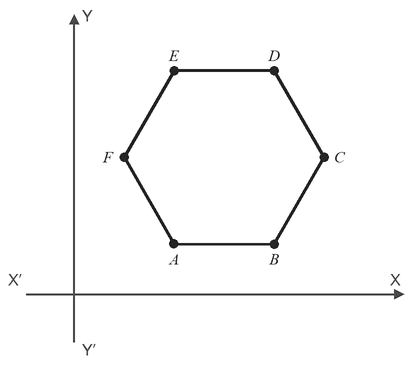
In a regular hexagon , the -axis. What are the slopes of its sides?
 Solve with AI
Written solution
Solution:
Concept: If a line makes an angle (its inclination, ) with the positive direction of the -axis, its slope is . The slope of the line through and is (rise over run), provided ; a vertical line has no finite slope.
Step 1 — Find the turning angle. Each interior angle of a regular hexagon is , so at each corner the direction of travel turns through the exterior angle
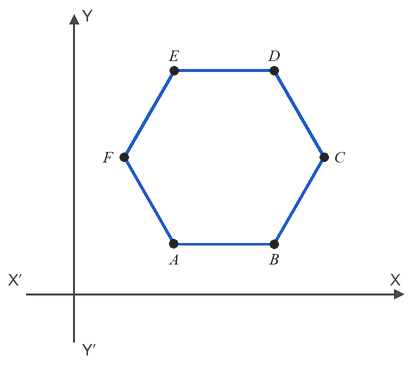
Step 2 — Find the direction of each side. We go round the hexagon anticlockwise starting along in the positive -direction (figure). The directions are , , , , , for , , , , , :
Step 3 — Convert each direction to an inclination. A line's inclination lies between and , so we subtract from directions of or more. This gives inclinations , , , , , .
Step 4 — Take tangents. We use the standard values , and of , and :
Watch out: Opposite sides of a regular hexagon are parallel, so they must have equal slopes ( and , and , and ); this is a quick check.
Note: If the letters run clockwise instead, the slopes of and become and those of and become ; the three values , and are the same.
Therefore, the slopes of are .
- 63 marks
Question 6
Using slopes determine which of the following sets of three points are collinear.
(i) ;
(ii) ;
(iii) ;
(iv) .
Solve with AIWritten solution
Solution:
Concept: Three points , , are collinear when the slope of equals the slope of : the two segments then have the same direction and share the point , so they lie on one line.
(i) , ,
Step 1 — Find both slopes. We use rise over run for and for :
Step 2 — Compare. The slopes and differ, so the points are not collinear.
(ii) , ,
Step 1 — Find both slopes. We use rise over run again:
Step 2 — Compare. The slopes differ, so the points are not collinear.
(iii) , ,
Step 1 — Find both slopes. We use rise over run:
Step 2 — Compare. The slopes are equal and is common, so the points are collinear.
(iv) , ,
Step 1 — Find both slopes. We use rise over run:
Step 2 — Compare. The slopes differ, so the points are not collinear.
Therefore, only the points in (iii) are collinear.
- 73 marks
Question 7
Find if the slope of the line joining , is .
Solve with AIWritten solution
Solution:
Concept: If a line makes an angle (its inclination, ) with the positive direction of the -axis, its slope is . The slope of the line through and is (rise over run), provided ; a vertical line has no finite slope.
Step 1 — Write the slope in terms of . The run is , so
Step 2 — Set it equal to the given slope. We equate the two expressions for the slope:
Step 3 — Solve for . Multiplying both sides by clears the fractions:
Check: We put back into the slope:
Therefore, .
- 83 marks
Question 8
Find the angle between the lines whose slopes are (i) and , (ii) and .
Solve with AIWritten solution
Solution:
Concept: If two lines have slopes and , the acute angle between them is given by
(the formula needs ; when the lines are perpendicular).
(i) ,
Step 1 — Substitute in the formula. We put the two slopes into the angle formula:
Step 2 — Read the angle. From the tables, the acute angle whose tangent is is
(ii) ,
Step 1 — Substitute in the formula. We put the two slopes into the angle formula:
Step 2 — Read the angle. From the tables, the acute angle whose tangent is is
Note: The obtuse angle between the same lines is the supplement, ; the formula with the modulus gives the acute one.
Therefore, the angle is (i) , (ii) .
- 93 marks
Question 9
Find the slope of the line which makes an angle of with a line of slope .
[Hint. As the angle is given, so use complete angle formula and get two values of the slope].
Solve with AIWritten solution
Solution:
Concept: If two lines have slopes and , the acute angle between them is given by
(the formula needs ; when the lines are perpendicular).
When the angle is given and a slope is unknown, the modulus gives two cases: .
Step 1 — Set up the equation. Let the required slope be . With and :
Step 2 — Clear the fractions. Multiplying the top and bottom of the left side by gives
Step 3 — Take the sign. We cross-multiply and solve:
Step 4 — Take the sign. We cross-multiply and solve:
Check: For the expression inside the modulus is
Its modulus is , equal to .
Therefore, the slope is or .
- 103 marks
Question 10
Find the interior angles of the triangle whose vertices are , and .
- 113 marks
Question 11
Find the slope of a line parallel to a line whose slope is
(i)
(ii)
(iii)
(iv)
- 123 marks
Question 12
Find the slope of a line parallel to the line which passes through each pair of the following points:
(i) and ,
(ii) and ,
(iii) and ,
(iv) and .
- 133 marks
Question 13
Find the slope of a line perpendicular to the line whose slope is
(i)
(ii)
(iii)
(iv)
(v)
(vi) Infinite
- 143 marks
Question 14
Find the slope of a line perpendicular to the line which passes through each pair of the following points:
(i) and ;
(ii) and ;
(iii) and ;
(iv) and .
- 153 marks
Question 15
In rect. , slope of . State the slopes of (i) , (ii) , (iii) .
- 163 marks
Question 16
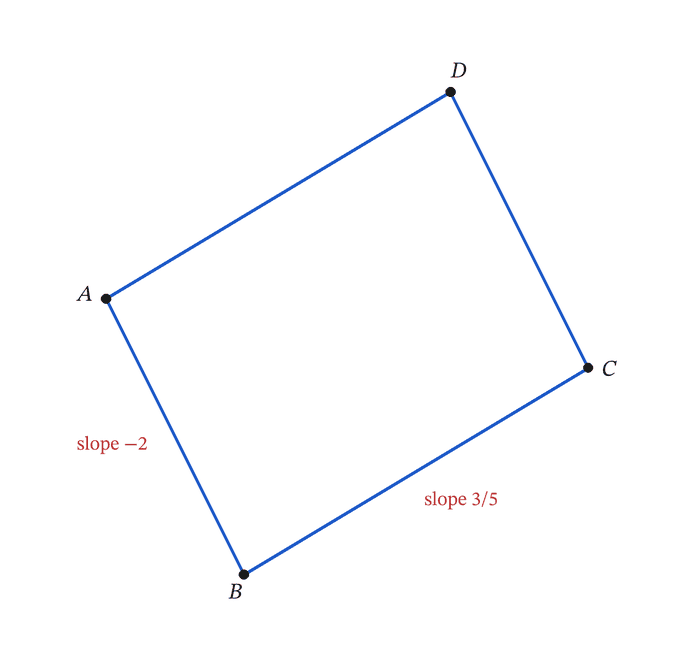
In parallelogram , slope of , slope of . State the slopes of
(i) ,
(ii) ,
(iii) the altitude to ,
(iv) the altitude to .
- 173 marks
Question 17
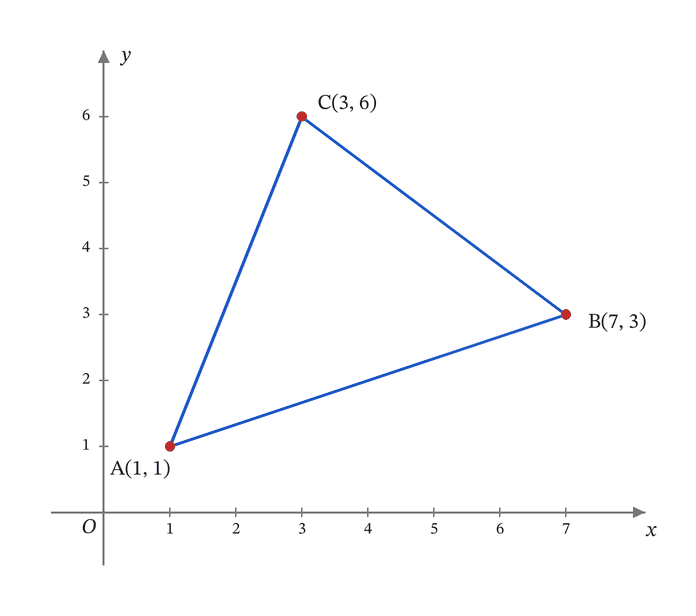
The vertices of a are , and . State the slope of the altitude to
(i) ,
(ii) ,
(iii) .
- 183 marks
Question 18
The line joining and is perpendicular to the line joining and . Find .
- 193 marks
Question 19
Show that the tangent of an angle between the lines and is .
- 203 marks
Question 20
State the equation of the line which has the -intercept
(i) and slope
(ii) and slope
(iii) and is parallel to
(iv) and is inclined at to the -axis
(v) and is equally inclined to the axes
- 213 marks
Question 21
What will be the value of and if the straight line passes through the points and ?
- 223 marks
Question 22
Find the equation of the straight line through the given point and having the given slope if
(i) ,
(ii) ,
- 233 marks
Question 23
Find the equation of the line through the point making an angle of with the -axis.
- 243 marks
Question 24
Find the equation to the straight line passing through
(i) the origin and perpendicular to
(ii) the point and parallel to
(iii) the point and (a) parallel to, (b) perpendicular to
- 253 marks
Question 25
Find the equation to the line which is perpendicular to the line at the point where it meets the -axis.
- 263 marks
Question 26
Find the equation of the two lines through the point which make an acute angle of with the line .
- 273 marks
Question 27
The line through with gradient meets the -axis at and the -axis at . The line through with gradient meets the -axis at and the -axis at . Find in terms of , the co-ordinates of , , and . Obtain expressions for and , where is the point .
- 283 marks
Question 28
Write down the slopes of the lines
(i) joining and
(ii) joining and
(iii) parallel to the line joining and
(iv) perpendicular to the line joining and
- 293 marks
Question 29
Find the equations of the lines joining the points
(i) and
(ii) and
(iii) and
What is the length of the portion of the line in (c) intercepted between the axes of co-ordinates?
- 303 marks
Question 30
Given the vertices , and of , find
(i) the equation of the side
(ii) the equation of the median through
(iii) the equation of the altitude through
(iv) the equation of the perpendicular bisector of the side
- 313 marks
Question 31
The points , and are , and , respectively. produced cuts the -axis at and produced cuts the -axis at . Find the co-ordinates of the points and . Find the equation of the straight line joining the mid-points of and (where is the origin), and verify that this line passes through the mid-point of .
- 323 marks
Question 32
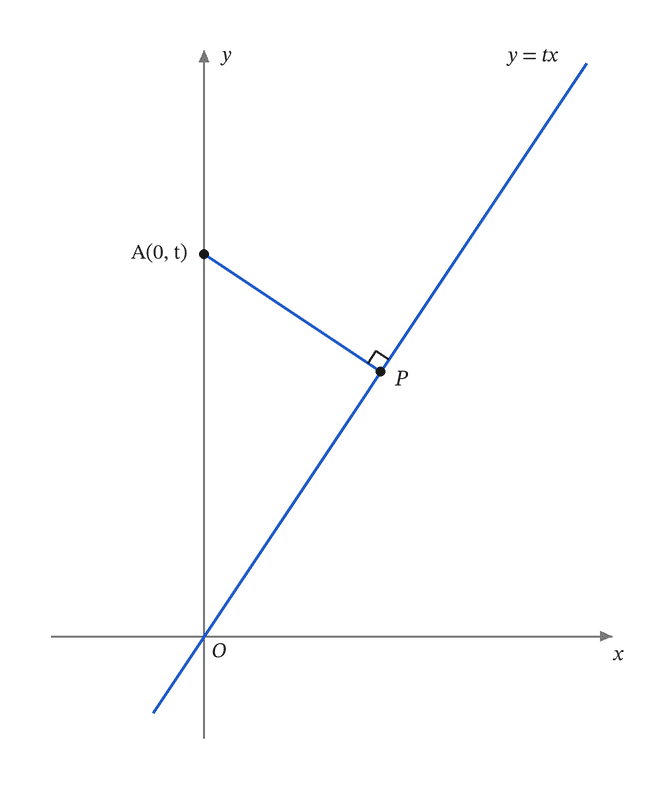
A line through the point meets the variable line at right angles at the point . Find, in terms of , the co-ordinates of .
Find the value of for which lies on the curve .
- 333 marks
Question 33
The point is the foot of the perpendicular from to the line whose equation is . Determine
(i) the equation of the line
(ii) the co-ordinates of
(iii) the area of , where is the origin
- 343 marks
Question 34
Find the equation of the line joining the origin to the point of intersection of and .
- 353 marks
Question 35
Find the equation to the straight line which passes through the point of intersection of the lines and and is perpendicular to the line .
- 361 mark
Question 36
Answer true or false: Equation of the line passing through the point and perpendicular to the line is
- 373 marks
Question 37
The vertex of an equilateral triangle is and the equation of the opposite side is . Then, show that equations of the other two sides are
- 383 marks
Question 38
Find the equation of the diagonals of the square formed by the lines , , and
- 393 marks
Question 39
Write down the equation of the straight line cutting off intercepts and from the axes where
(i) ,
(ii) ,
(iii) ,
- 403 marks
Question 40
Determine the -intercept '' and the -intercept '' of the following lines. Sketch each.
(i)
(ii)
- 413 marks
Question 41
Find the equation of the line which makes equal intercepts on the axes and passes through the point .
- 423 marks
Question 42
Write down the equation of the line which makes an intercept of on the -axis and on the -axis. Given that the line passes through the point , find the numerical value of .
- 433 marks
Question 43
Find the equation of the straight line which passes through the point and has intercept on the axes equal in magnitude but opposite in sign.
- 443 marks
Question 44
A straight line passes through and the portion of the line intercepted between the axes is bisected at this point. Find its equation.
- 453 marks
Question 45
Show that the three points , and lie on a straight line. Further find
(i) its intercepts on the axes;
(ii) the length of the portion of the line intercepted between the axes;
(iii) the slope of the line.
- 463 marks
Question 46
Find the equation of the straight line which passes through the point and cuts off positive intercepts on the and -axes which are in the ratio .
- 473 marks
Question 47
Find the equation of the straight line at a distance of units from the origin such that the perpendicular from the origin to the line makes an angle , given by the equation , with the positive direction of the axis of .
- 483 marks
Question 48
Show on a diagram the position of the straight line in relation to the co-ordinate axes, indicating clearly which angle is and which length is units. Find
(i) the equation of the straight line parallel to that given line and passing through the point ;
(ii) the length of the perpendicular from the origin onto this line;
(iii) the distance between the two parallel straight lines.
- 493 marks
Question 49
A straight line passes through the point and cuts off a triangle of area units from the axes of co-ordinates. Find the equations of the straight line.
- 503 marks
Question 50
A straight line passes through the points and . The length of the line segment contained between the axes is and the product of the intercepts on the axes is . Calculate the values of and and find the equation of the straight line.
- 513 marks
Question 51
Write down the slopes of the following lines:
(i)
(ii)
(iii)
(iv)
(v)
- 523 marks
Question 52
Find the value of such that the line is
(i) parallel to the line
(ii) perpendicular to it.
- 533 marks
Question 53
Prove that the lines (i) and are mutually perpendicular; (ii) and are parallel.
- 543 marks
Question 54
Find the slope of the line which is perpendicular to the line .
- 553 marks
Question 55
Determine the angle between the lines whose equations are
(i) and
(ii) and
- 563 marks
Question 56
Use tables to find the acute angle between the lines and .
- 573 marks
Question 57
Reduce the following equations to the normal form and find the values of and .
(i)
(ii) (Use tables)
- 583 marks
Question 58
Put the equation in the form and indicate clearly in a rough diagram the position of the straight line and the meaning of the constant and .
- 593 marks
Question 59
If and represents the same line, find in terms of , , .
- 603 marks
Question 60
Show that and are on opposite sides of .
- 613 marks
Question 61
The sides of a triangle are given by the equations , , and ; show that the origin lies within the triangle.
- 623 marks
Question 62
Find by calculation whether the points , lie in the same, adjacent, or opposite angles formed by the straight lines , and .
- 633 marks
Question 63
Find the co-ordinates of the point of intersection of the straight lines
(i)
(ii)
- 643 marks
Question 64
Find the area of the triangle formed by the lines , and .
[Hint. First find the co-ordinates of the vertices of the triangle by solving the equations taken two at a time. Now apply area formula.]
- 653 marks
Question 65
Find the orthocentre of the triangle whose angular points are , , .
[Note. Orthocentre is the point of intersection of the altitudes]
- 663 marks
Question 66
The vertices of a triangle are , and . Write down the equations of and the perpendicular from to and hence find the co-ordinates of the foot of the perpendicular.
- 673 marks
Question 67
Find the equation of the straight line passing through the point of intersection of the two lines and and parallel to the straight line .
[Hint. Find the pt. of intersection and use the eqn. ].
- 683 marks
Question 68
Find the equation of the line through the intersection of and , and perpendicular to the line .
- 693 marks
Question 69
Prove that the three lines , , and meet in a point.
- 703 marks
Question 70
For what value of are the three lines , and concurrent?
- 713 marks
Question 71
The co-ordinates of , and are , and respectively. is the mid-pt. of and lies on and is such that , lies on and is such that .
Find the equation of the lines , and and prove that lines are concurrent.
- 723 marks
Question 72
The sides of a triangle are , , and have equations , , , respectively. Find the equation of the three medians of the triangle and verify that they are concurrent.
- 733 marks
Question 73
Show that the lines , and are concurrent if .
- 743 marks
Question 74
Prove that the lines , and are concurrent.
- 753 marks
Question 75
Prove that the medians of a triangle are concurrent.
- 763 marks
Question 76
Find the distance of the point from the line in the following cases:
(i) , is
(ii) , is
- 773 marks
Question 77
Calculate the length of the perpendicular from to the straight line and show that it is twice the length of the perpendicular from .
- 783 marks
Question 78
The points , , are the vertices of a triangle. Find the length of the perp. from to and hence the area of the .
- 793 marks
Question 79
Find the lengths of altitudes of the triangle whose sides are given by , and .
- 803 marks
Question 80
If is the perpendicular distance of the origin from the line whose intercepts on the axes are and , show that
- 813 marks
Question 81
Find the perpendicular distance between the lines
(i)
(ii)
(iii)
- 823 marks
Question 82
Find the equations of two straight lines which are parallel to the straight line , and a unit distance from the point .
- 833 marks
Question 83
Find the equations of the two straight lines drawn through the point on which the perpendiculars dropped from the point are each of unit length.
- 843 marks
Question 84
A straight line is parallel to the lines and , and lies between them. Find its equation if its distances from these lines are in the ratio .
- 853 marks
Question 85
Find the equation of the locus of a point which is equidistant from the st. line and the origin.
- 863 marks
Question 86
A point is such that the sum of the squares of its distances from the two axes of co-ordinates is equal to the square of its distance from the line . Find the equation of the locus of .
- 873 marks
Question 87
Show that the equation to the parallel line mid-way between the parallel lines and is
- 883 marks
Question 88
Prove that the line is mid-parallel to the lines and .
- 893 marks
Question 89
If the equation of the base of an equilateral triangle is and the vertex is , then find the length of the side of the triangle.
- 903 marks
Question 90
If is the length of perpendicular from the origin on the line and , , are in A.P. then show that
- 913 marks
Question 91
Find the equations of the lines bisecting the angles between the following pairs of straight lines writing first the bisector of the angle in which the origin lies:
(i)
(ii)
- 923 marks
Question 92
Find the equations of the bisectors of the angles between and . Show that these bisectors are at right angles to each other.
- 933 marks
Question 93
Find the locus of a point which moves so that the perpendiculars drawn from it to the two straight lines , are equal.
- 943 marks
Question 94
Find the equations of the lines bisecting the angles between the lines and . Find, without using the tables, the tangent of an angle between one of these bisectors and one of the original lines.
- 953 marks
Question 95
Find the bisector of the acute angle between the lines:
(i) and
(ii) and .
- 963 marks
Question 96
Prove that the perpendiculars drawn from any point of the line to the lines and are equal in length.
- 973 marks
Question 97
A triangle is formed by the lines whose equations are , , and . Find (i) the bisector of the interior angle at B, and (ii) the bisector of the exterior angle at .
- 983 marks
Question 98
Find the centre of the inscribed circle of the triangle the equations of whose sides are , and .
- 993 marks
Question 99
The co-ordinates of , , are respectively , and . Find (i) the equation of the straight line which bisects the angle internally; (ii) the co-ordinates of the point where this straight line meets the straight line joining to the middle point of .
- 1003 marks
Question 100
Find the equation of the straight line which passes through the point and is
(i) parallel, (ii) perpendicular to the straight line .
- 1013 marks
Question 101
Find the equation of the straight line which is such that
(i) it passes through the point and is parallel to the line .
(ii) it passes through the point and is perpendicular to the line .
- 1023 marks
Question 102
Find the equation of the straight line which passes through
(i) the origin and the point of intersection of the st. lines , ;
(ii) the point and the intersection of the lines and ;
(iii) the origin and the point of intersection of the lines and .
- 1033 marks
Question 103
Show that the equation represents the line joining the origin to the point of intersection of the lines and .
- 1043 marks
Question 104
Find the equation of the line through the intersection of and and parallel to .
- 1053 marks
Question 105
Find the equation of the line through the intersection of and and parallel to .
- 1063 marks
Question 106
Find the equation of the line through the intersection of and , and perpendicular to the line .
- 1073 marks
Question 107
Find the equation of the straight line which passes through the intersection of and and cuts off equal intercepts from the axes.
- 1083 marks
Question 108
Find the locus of a point which moves so that its distance from the -axis is .
- 1093 marks
Question 109
Find the locus of a point which moves so that its distance from the origin is .
- 1103 marks
Question 110
Find the locus of a point which moves so that the sum of the squares of its distances from the points and is .
- 1113 marks
Question 111
Find the locus of a point which moves so that its distance from the -axis is half its distance from the -axis.
- 1123 marks
Question 112
Find the locus of a point which moves so that its distance from the -axis is equal to its distance from the point .
- 1133 marks
Question 113
Find the locus of a point which is equidistant from the points and .
- 1143 marks
Question 114
and are two given points. A point moves so that . Find the locus of .
- 1153 marks
Question 115
Find the locus of a point such that the sum of its distances from the points and is .
- 1163 marks
Question 116
Find the locus of a point, so that the join of points and subtends a right angle at the moving point.
- 1173 marks
Question 117
Two points and with co-ordinates , are given. A point moves so that the area of is constant and equal to square units. Find the equation to the locus of the point .
- 1183 marks
Question 118
Show that lies on the locus .
- 1193 marks
Question 119
Does the point lie on the curve ?
- 1203 marks
Question 120
Find the condition that the point may lie on the curve .
- 1213 marks
Question 121
If the line passes through the point , find .
- 1223 marks
Question 122
is the point and is the point . Find a point on the line , which is equidistant from and .
- 1233 marks
Question 123
The co-ordinates of the point are and a point has coordinates . Express in terms of and . Given that is the foot of the perpendicular from to the -axis and that the point moves so that the lengths and are equal, prove that the locus of is . Find the co-ordinates of one of the two points on the curve whose distance from is units.
- 1243 marks
Question 124
Find the ratio in which the line joining the points and is divided by the curve .
- 1253 marks
Question 125
is a line of fixed length, units, joining the points and which lies on the positive -axis. is a point on distant units from . Express the co-ordinates of and in terms of . Find the locus of as varies.
- 1263 marks
Question 126
A rod of length slides with its ends on two perpendicular lines. Find the locus of its mid-point.
- 1273 marks
Question 127
If is the origin and is a variable point on , find the locus of the mid-point of .
- 1283 marks
Question 128
Find the locus of a point which moves such that square of its distance from the point is numerically equal to its distance from the line .
- 1293 marks
Question 129
The lines and intersect at . Without finding the co-ordinates of prove that the equation of the line through and the origin of co-ordinates is perpendicular to .
- 1303 marks
Question 130
A point moves so that its distance from the line given by is equal to its distance from the point . Show that the locus of is .
- 1313 marks
Question 131
, are two fixed points and is a point which moves on the line . Find the locus of the centroid of the triangle .
- 1323 marks
Question 132
Find the Cartesian equation of the curve whose parametric equations are:
(i) ,
(ii) ,
(iii) ,
(iv) ,
- 1333 marks
Question 133
Find the locus of the point of intersection of the lines and , where is a parameter.
- 1343 marks
Question 134
Find the intersection of the lines , . Show that lies on the curve whose equation is . Sketch this curve.
- 1353 marks
Question 135
Find the locus of the middle point of the portion of the line , where is a constant, intercepted between the axes.
[Hint. Find the co-ordinates of the mid-point. Put equal to its abscissa and equal to its ordinate, and then eliminate .]
- 1361 mark
Question 136
Find a point on the -axis which is equidistant from the points and .
- 1371 mark
Question 137
Find the slope of the line which passes through the origin and mid-point of the line segment joining the points and .
- 1381 mark
Question 138
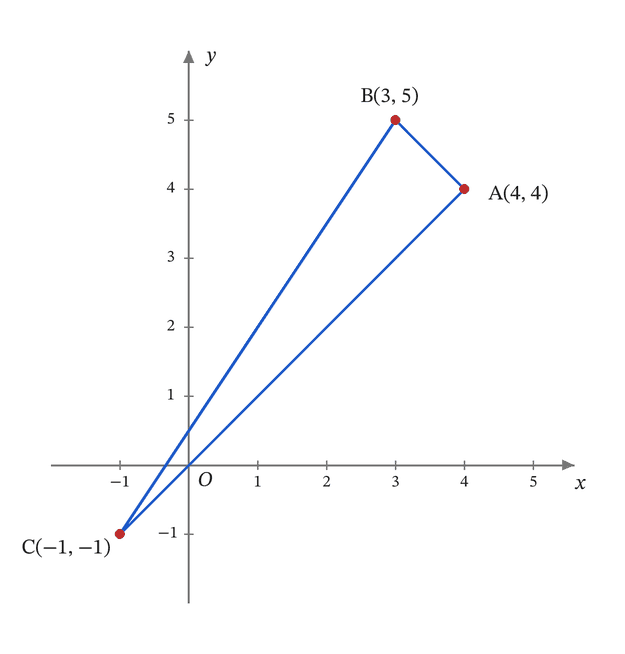
If , and are the vertices of a triangle, show that .
- 1391 mark
Question 139
Find the coordinates of the point which divides the line joining and in the ratio .
- 1401 mark
Question 140
The coordinates of the vertices of a triangle are , and . If the centroid of the triangle is at the origin, show that .
- 1411 mark
Question 141
Find the value of for which the points , and are collinear.
- 1421 mark
Question 142
Find the angle between the -axis and the line joining the points and .
- 1431 mark
Question 143
Find the equation of a straight line on which length of perpendicular from the origin is units and the line makes an angle of with the positive direction of -axis.
- 1441 mark
Question 144
Reduce the equation of the straight line to normal form and find the perpendicular distance of the line from the origin.
- 1451 mark
Question 145
Find the equation of the line passing through and making angle with -axis.
- 1461 mark
Question 146
Find the equation of the line which passes through the point and cuts off equal intercepts from the axes.
- 1471 mark
Question 147
True or False! The line joining the points and is perpendicular to the line joining the points and .
- 1481 mark
Question 148
Find the angle between the lines joining the points and and the line joining the points and .
- 1491 mark
Question 149
Find the equation of the line through the points and .
- 1501 mark
Question 150
Find the equation of the line through the intersection of the lines and having slope .
- 1511 mark
Question 151
Find the distance of the point from the line .
- 1521 mark
Question 152
Find the distance between the parallel lines and .
- 1531 mark
Question 153
Find the equation of a line drawn perpendicular to the line through the point where it meets the -axis.
- 1541 mark
Question 154
Find the value of so that the three lines , and are concurrent.
- 1551 mark
Question 155
Find the equation of the bisector of the angle in which the origin lies between the lines and .
- 1561 mark
Question 156
Find the angle between the lines and .
- 1571 mark
Question 157
Show that the tangent of an angle between the lines and is .
- 1581 mark
Question 158
The equation of the line passing through the point with slope zero is
- 1591 mark
Question 159
If is the point of intersection of the straight lines and , then the value of is equal to
- 1601 mark
Question 160
The vertices of are , and . Find the length of a median of the triangle passing through the point .
- 1611 mark
Question 161
If is the reflection of in -axis and is the reflection of in -axis, then is equal to
- 1621 mark
Question 162
The two lines and are perpendicular if
- 1631 mark
Question 163
The line divides the line joining the points and in the ratio
- 1641 mark
Question 164
The area (in sq. units) of a triangle formed by the points , and is
- 1651 mark
Question 165
If the three points , and are collinear, then which is correct?
- 1661 mark
Question 166
A triangle has a vertex at and the mid-points of the two sides through it are and . Then the centroid of the triangle is
- 1671 mark
Question 167
The co-ordinates of the points dividing internally the line joining the points and in the ratio is
- 1681 mark
Question 168
The equation of the line parallel to the line and passing through is
- 1691 mark
Question 169
If a straight line passing through the point is such that its intercepted portion between the co-ordinate axes is bisected at , then its equation is
- 1701 mark
Question 170
A line cuts off equal intercepts on the co-ordinate axes. The angle made by this line with the positive direction of -axis is
- 1711 mark
Question 171
The -intercept of the line passing through and perpendicular to the line is
- 1721 mark
Question 172
If the straight line is perpendicular to the line passing through the point and then equals
- 1731 mark
Question 173
Consider the set of all lines such that . Which one of the following statements is true?
- 1741 mark
Question 174
If the line passes through the point which divides the line segment joining the point and in the ratio , then equals
- 1751 mark
Question 175
The points , and
- 1761 mark
Question 176
A line passes through and is perpendicular to the line . What is its -intercept?
- 1771 mark
Question 177
If the straight line always passes through , then are in
What Class 11 Maths Ch 13 covers
The sections of the chapter, in the order the book takes them. Every question above comes from one of these.
- 01Slope of a Line and Angle between Two Lines
- 02Parallel and Perpendicular Lines
- 03Standard Forms of the Equation of a Line
- 04General Equation of a Line and its Reduction
- 05Position of Points, Intersection and Concurrency of Lines
- 06Distance of a Point from a Line and between Parallel Lines
More ways to study this chapter
The same chapter asked three other ways. Practise it, revise it, and see what the board has set on Ch 13 before.
Class 11 Maths Ch 13 questions students ask
How many questions are there in Class 11 Maths Ch 13?
177 questions. Every one is solved step by step on this page.
Are these Class 11 Maths solutions free?
Yes. Every question and its full working is free to read, with no account needed.
Can I download the Class 11 Maths Ch 13 solutions as a PDF?
There is no PDF to download. Every solution is on this page instead, which means it is searchable, always the current syllabus, and readable on a phone. Use your browser's print option if you want it on paper.