
Opening your dashboard
Class 11 Maths Chapter 13 Straight Line: Competency-Based Questions (CBQ)
40 questions on Chapter 13, each worked through on its own page with the AI tutor. Class 11 Maths, ICSE 2026-27.
40 questions
1–5 marks · Mixed difficulty
- 14 marks
Question 1
Competency: Application
(Hypothetical data.) A park ranger maps a hill trail on a vertical section. Each point is written as (horizontal distance from the start, height above the start), both in metres. The trail is made of three straight stretches joining , , and .
(a) Find the slope of each stretch , and . The park fixes a handrail on every stretch steeper than a gradient (a rise of m for every m of horizontal run). Which stretch needs a handrail, and over what horizontal distance?
(b) At the trail bends from onto . Find the acute angle between these two stretches, to the nearest .
(c) A signboard at gives the inclination of the straight line from to . Find this inclination to the nearest .
- 21 mark
Question 2
Competency: Analysis & Evaluation
(Hypothetical data.) Road signs in hilly areas often give the steepness of a road as a percentage gradient: a gradient means the road rises m for every m measured horizontally. Road P is a straight road with a gradient. Road Q is a straight road inclined at to the horizontal.
Assertion (A): Road P is steeper than road Q.
Reason (R): The slope (rise divided by horizontal run) of a straight road equals the tangent of its angle of inclination.
- 31 mark
Question 3
Competency: Application
(Hypothetical data.) A carpenter builds a symmetric roof frame. The two straight rafters meet at the ridge. Each rafter has a pitch of : it rises m for every m measured horizontally, one rising to the right and the other falling to the right. The ridge cap must fit the angle between the two rafters inside the roof.
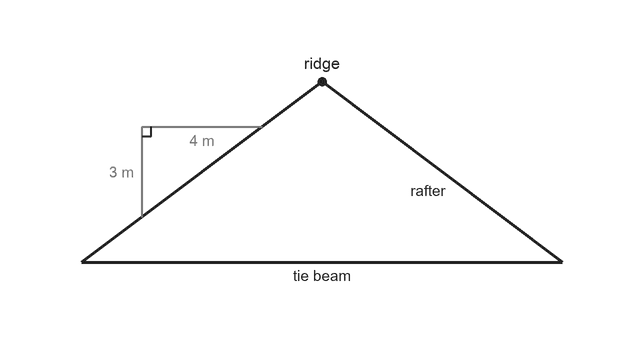
What is the angle between the two rafters at the ridge, measured inside the roof (to the nearest )?
- 44 marks
Question 4
Competency: Application
(Hypothetical data.) A school garden is a four-sided plot with corners , , and on a plan where unit is m, as shown in the figure.
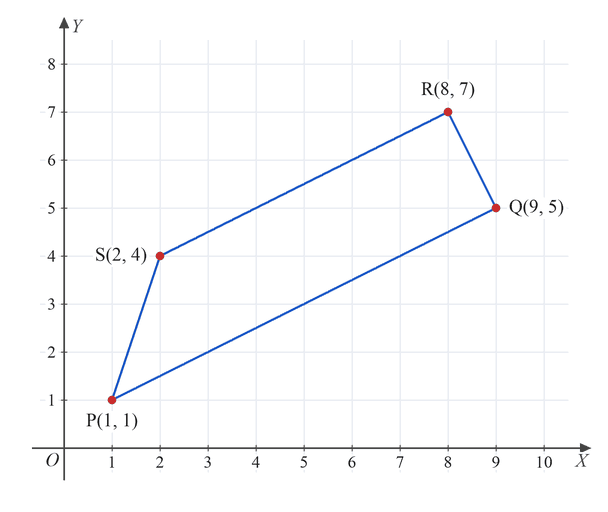
(a) Using slopes, show that and that is perpendicular to both of them.
(b) Hence find the area of the garden.
(c) A straight drip pipe is laid from parallel to until it meets at . Find the equation of the line of the pipe and the co-ordinates of .
- 51 mark
Question 5
Competency: Analysis & Evaluation
A drawing app has a “perpendicular” tool. Asha draws the line and then uses the tool to draw several lines perpendicular to it through different points.
Assertion (A): Every line that Asha draws with the tool has an equation of the form for some constant .
Reason (R): Two lines are perpendicular when their slopes are reciprocals of each other.
- 61 mark
Question 6
Competency: Application
(Hypothetical data.) A warehouse robot moves on a floor grid marked in metres. It starts at the origin and moves in a straight line to . There it turns through to its left (anticlockwise) and then moves m in a straight line.
Where does the robot stop?
- 74 marks
Question 7
Competency: Application
(Hypothetical data.) Water is drawn from a school's overhead tank at a steady rate, so the water level falls by cm every minute. At 8:20 a.m. the level gauge reads cm. Let be the time in minutes after 8:00 a.m. and the level in cm, so that changes linearly with and its graph is a straight line.
(a) Using the point-slope form, find the equation of the line and write it in slope-intercept form. Say what the slope and the -intercept mean for the tank.
(b) Write the equation in intercept form and use it to find when the tank would run empty.
(c) An alarm switches on the pump when the level falls to cm. At what time does the alarm sound?
- 81 mark
Question 8
Competency: Application
(Hypothetical data.) Two straight garden walls meet at right angles at a corner . Taking the walls as the co-ordinate axes (units in metres), a gardener lays a straight edging from a point on one wall to a point on the other, so that the walls and the edging enclose a triangular flower bed. A sprinkler is placed at the centroid of the bed, which is the point .
Along which line does the edging lie?
- 91 mark
Question 9
Competency: Analysis & Evaluation
Riya divides both sides of by and writes the result as . Reading this, she says that the line cuts the -axis units above the origin.
Assertion (A): The -intercept of the line is .
Reason (R): For the line , the intercepts are on the -axis and on the -axis.
- 104 marks
Question 10
Competency: Analysis & Evaluation
(Hypothetical data.) A delivery drone flies along a straight route on a map whose origin is the control tower (units in km). Four teams write the route's equation in different ways:
- Team A:
- Team B:
- Team C:
- Team D:
(a) Reduce the equations of Teams A, B and C to the general form with whole-number coefficients, and show that they describe the same line.
(b) Team A's equation is already in the normal form . State and (to the nearest ), and say what they tell the control tower.
(c) Does Team D's equation describe the same route? Give a reason.
- 111 mark
Question 11
Competency: Analysis & Evaluation
(Hypothetical data.) On the plan of a park, a fountain is at the origin and a straight boundary wall runs along the line (units in metres).
Assertion (A): The fountain is m from the wall.
Reason (R): The slope of the line of the wall is .
- 124 marks
Question 12
Competency: Application
(Hypothetical data.) On a harbour chart with units in kilometres, a ferry leaves and sails straight towards a buoy at at km/h. At the same moment a fishing boat leaves and sails straight towards a lighthouse at at km/h.
(a) Find the equations of the two courses.
(b) Find the point where the courses cross, and check that both boats really pass through , that is, that lies between each starting point and its target.
(c) How long after the start does each boat reach ? Which boat passes first, and by about how many minutes?
- 131 mark
Question 13
Competency: Analysis & Evaluation
(Hypothetical data.) A town planner draws four straight roads on a map, along the lines , , and . A traffic signal is needed at every point where two of these roads cross.
How many traffic signals are needed?
- 141 mark
Question 14
Competency: Analysis & Evaluation
A Celsius reading and a Fahrenheit reading of the same temperature are related by . On a graph with on the horizontal axis and on the vertical axis, this relation is a straight line.
Assertion (A): There is a temperature at which a Celsius thermometer and a Fahrenheit thermometer show the same number, and that number is .
Reason (R): The line meets the line at the point where .
- 154 marks
Question 15
Competency: Application
(Hypothetical data.) On a district map (units in km), a mobile tower stands at and gives good signal everywhere within km of it. A straight highway runs along , and a straight village road runs along .
(a) Find the perpendicular distance of from the highway. Does the highway pass through the zone of good signal?
(b) Find the length of the stretch of the highway that has good signal.
(c) Show that lies between the highway and the village road, find the distance between the two roads, and decide whether the village road gets good signal anywhere.
- 161 mark
Question 16
Competency: Application
(Hypothetical data.) On a town plan where unit is m, a straight high-voltage power line runs along , and a school stands at . The town's rule says that a school must be at least m from such a line.
Which statement is correct?
- 171 mark
Question 17
Competency: Analysis & Evaluation
(Hypothetical data.) On a garden plan (units in metres), a sprinkler stands at and a straight hedge runs along .
Assertion (A): The sprinkler is exactly m from the hedge.
Reason (R): The distance of the point from the line is .
- 184 marks
Question 18
Competency: Analysis & Evaluation
(Hypothetical data.) In a physics laboratory, a laser on an optics table (units in cm) sends a ray from to a small plane mirror at . The reflected ray travels from to , as shown in the figure. The position of the mirror itself is not marked.

(a) Find the equations of the lines and , and the equations of the two lines that bisect the angles between them.
(b) By the law of reflection, the normal to the mirror at bisects the angle , and the mirror is perpendicular to this normal. Decide which bisector is the mirror, using the fact that and must lie on the same side of the mirror.
(c) Find the angle of incidence (between and the normal) and show that it equals the angle of reflection (between and the normal).
- 191 mark
Question 19
Competency: Analysis & Evaluation
Two straight roads cross at a junction . The town builds two straight footpaths through : one bisects an angle between the roads, and the other bisects the angle next to it.
Assertion (A): The two footpaths are perpendicular to each other.
Reason (R): The two angles that the footpaths bisect are adjacent angles at , so they add up to .
- 204 marks
Question 20
Competency: Analysis & Evaluation
(Hypothetical data.) In a yard (units in metres), two straight fences run along and . A security camera is fixed at the point where the fences meet. Its narrow beam can be turned, and every position of the beam lies along a line of the family
where is a real number. A straight wall runs from to .
(a) Find , and show that every line of the family passes through .
(b) Find the values of for the beams that pass through and through .
(c) For which values of does the beam hit the wall? Check your answer with the beam for .
- 211 mark
Question 21
Competency: Application
(Hypothetical data.) A triangular field is bounded by a straight hedge along the -axis and two straight fences along and (units of m). The fences meet at the corner . The owner wants a straight path from to the hedge that splits the field into two parts of equal area. Every line through except the second fence has an equation of the form
Along which line should the path run?
- 224 marks
Question 22
Competency: Analysis & Evaluation
(Hypothetical data.) In a wall display, the floor is the -axis and the wall is the -axis (units in metres). A small ring is fixed at . A straight telescopic rod is pushed through the ring so that one end rests on the floor at and the other end rests against the wall at , where and . The rod can be tilted to different positions, always passing through the ring, and a small lamp hangs at the mid-point of the rod.
(a) Show that .
(b) Find the equation of the locus of .
(c) In which position of the rod does the lamp hang exactly at the ring? Find the length of the rod in that position.
- 231 mark
Question 23
Competency: Analysis & Evaluation
(Hypothetical data.) On a factory floor (units in metres), a straight safety line is painted along . An engineer marks every point of the floor that is exactly m from this line.
Assertion (A): The set of all the marked points is the single line .
Reason (R): The points at a fixed distance from a given line form two lines parallel to it, one on each side of it.
- 241 mark
Question 24
Competency: Application
(Hypothetical data.) A straight river has its south bank along and its north bank along (units of m). A coach tells a rower to keep the boat, at every moment, twice as far from the north bank as from the south bank, while staying on the river.
Along which line does the boat move?
- 253 marks
Question 25
Competency: Application
(Hypothetical data.) A vertical pole m tall stands with its foot at on level ground, which is the -axis (units in metres). In the afternoon the sun's rays make an angle with the ground, where , and they travel downwards towards larger values of .
(a) Find the slope of the sun's ray that just passes the top of the pole, and the equation of the line of this ray.
(b) Find where the tip of the pole's shadow falls on the ground, and the length of the shadow.
(c) A tall vertical wall is now built along , between the pole and the shadow's tip found in (b). How high up the wall does the shadow of the pole reach?
- 261 mark
Question 26
Competency: Analysis
(Hypothetical data.) In a physics practical, a student hangs loads on a spring and measures its length. In the range used, the length (in cm) of the spring changes linearly with the load (in N), so the points should all lie on one straight line. Exactly one length in the student's table was recorded wrongly.
Load (N) Length (cm) For which load was the length recorded wrongly?
- 271 mark
Question 27
Competency: Application
(Hypothetical data.) A carpenter cuts one corner off a rectangular sheet of plywood with a computer-controlled saw. In the machine's frame (units in cm), the corner of the sheet is the origin , the bottom edge lies along the positive -axis and the left edge lies along the positive -axis. The straight cut is programmed as
where is a positive number that is still to be set. The cut must meet the bottom edge three times as far from as it meets the left edge.
What value of must be set?
- 281 mark
Question 28
Competency: Analysis & Evaluation
(Hypothetical data.) On a city map drawn on a square grid, Main Street runs along the line and Ring Road runs along the line .
Assertion (A): Main Street and Ring Road are perpendicular to each other.
Reason (R): Any two perpendicular lines always have slopes whose product is .
- 291 mark
Question 29
Competency: Analysis & Evaluation
(Hypothetical data.) On a stage plan (units in metres), a laser on a turntable sends out a straight beam. For the setting of the control knob, where can be any real number, the beam lies along the line
Assertion (A): Every straight line through the point is the beam for some setting .
Reason (R): The equation can be written as , so every beam passes through the point where the lines and meet.
- 301 mark
Question 30
Competency: Application
(Hypothetical data.) A map of a wide, flat beach is drawn with units in metres. As the tide comes in, the edge of the water stays a straight line and moves inland without turning. At hours after 2 p.m., the water's edge lies along the line
At what speed does the water's edge move inland, measured at right angles to the edge?
- 311 mark
Question 31
Competency: Analysis
(Hypothetical data.) A lawn lies in the corner between two straight edges that meet at the origin (units in metres). One edge runs along the -axis for , and the other runs along the line for . The lawn is the region between these two edges. A garden lamp is to be placed on the lawn so that it is m from each of the two edges.
At which point should the lamp be placed?
- 322 marks
Question 32
Competency: Application
(Hypothetical data.) A weather balloon rises through a layer of air in which the temperature falls steadily with height, so the temperature (in C) is a linear function of the height (in km). Its sensor reads C at a height of km and C at a height of km.
(a) Using the two-point form, find in terms of .
(b) If the temperature keeps falling at the same rate, at what height will the sensor read C?
- 332 marks
Question 33
Competency: Evaluation
(Hypothetical data.) On a town map (units of m), three straight roads run along the lines , and . A planner notices that and argues: "Any point that lies on the first two roads makes both brackets zero, so it also lies on the third road. Hence the three roads meet at one point."
(a) Is the planner's argument correct for these roads? If the roads do meet at one point, find it.
(b) Using the same argument, another planner says that three straight canals along , and meet at one point, because . Judge this claim.
- 342 marks
Question 34
Competency: Application
(Hypothetical data.) On a farm plan (units in metres), a vegetable plot has the shape of a parallelogram . The corner , where the gate is, is at the origin. The side lies along the line , and the side lies along the line . The corner , opposite to , is marked by a post at .
Find the co-ordinates of the corners and .
- 352 marks
Question 35
Competency: Evaluation
(Hypothetical data.) On a farm map (units of m), a new borewell stands at . Two straight water mains run along the lines and . The borewell is to be joined to the nearer main by the shortest possible straight pipe. The engineer puts the co-ordinates of into the left side of each equation, gets and , and says: "The first main is nearer, because is less than ."
(a) Find the length, in metres, of the shortest pipe from to each main.
(b) Is the engineer right? Explain.
- 363 marks
Question 36
Competency: Analysis & Evaluation
(Hypothetical data.) A futsal goal is m wide. On a plan of the court (units in metres), the goal line is the -axis and the goal posts are at and , as shown in the figure. Two players are ready to shoot: Pooja at and Rahul at . In this question we take the rule that the larger the angle the goal makes at a player (the angle between the lines joining the player to the two posts), the better the player's chance of scoring.
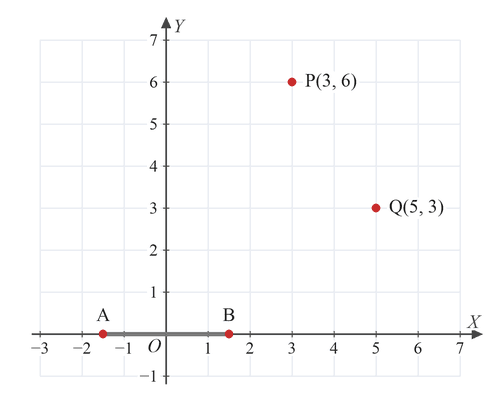
(a) Find the slopes of and , and hence the tangent of the angle .
(b) Find the tangent of the angle in the same way.
(c) Rahul says that he has the better chance because he is nearer to the centre of the goal. Is he right? Give a reason.
- 373 marks
Question 37
Competency: Analysis
(Hypothetical data.) A delivery drone flies at a constant height over a field. On a map of the field (units in metres), its position seconds after it starts is , where and , for .
(a) By removing , find the equation of the path of the drone, and describe the path.
(b) A straight boundary fence runs along . After how many seconds does the drone reach the fence, and at which point?
(c) Find the speed of the drone.
- 383 marks
Question 38
Competency: Creativity
(Hypothetical data.) In a garden (units in metres), a mango tree stands at and a neem tree at . The gardener wants to plant a straight hedge parallel to the footpath , so the hedge will lie along a line . Her two conditions are:
- the two trees must be on opposite sides of the hedge;
- the hedge must be at least m from each tree.
(a) Find every value of that meets both conditions.
(b) Design one hedge of your own that meets both conditions, and check that it does.
- 394 marks
Question 39
Competency: Analysis & Evaluation
(Hypothetical data.) A triangular park has three straight boundary walls, along the lines : , : and : (units in metres). The council wants the largest possible circular fountain pool inside the park. The centre of such a pool is equally far from all three walls, so it lies on the bisector of every angle of the park.
(a) Find the co-ordinates of the corners , and .
(b) Find the equation of the bisector of the angle of the park.
(c) Find the equation of the bisector of the angle of the park. Hence find the centre of the pool and its greatest possible radius. Can a pool of radius m be built?
- 405 marks
Question 40
Competency: Analysis & Evaluation
(Hypothetical data.) A straight irrigation canal runs along the line on a district map (units in km). Two villages stand at and , as shown in the figure. One pumping station is to be built on the canal, with a straight pipe from to each village, and the total length of the pipes should be as small as possible.

(a) Show that both villages are on the same side of the canal. Find the foot of the perpendicular from to the canal, and the image of in the canal.
(b) For every point on the canal, . Use this to find the best position of and the least total length of the pipes.
(c) An engineer suggests building the station at , the point of the canal nearest to . How much more pipe would that need than the best plan? Give your answer to the nearest km.