
Opening your dashboard
Class 11 Chemistry Chapter 5: States of Matter: Gases and Liquids Solutions
202 textbook questions with step-by-step answers, free to read, for ISC 2026-27.
Get talked through Ch 5, not just shown the answer
Reading a finished solution is not the same as being able to do it. The AI tutor takes one question at a time and works it with you, in your own words, until you can.
- Ask it out loud, in your own words
- It gives you the next step, not the answer
- Stuck on part (ii)? Start there
202 questions with solutions
1–3 marks · Mixed difficulty
The first 20 solutions are on this page. This chapter is a long one, so the rest open on their own page to keep this one quick to load.
- 11 mark
Question 1
The compressibility of a gas is less than unity at S.T.P. Therefore
Solve with AIAnswer
(A) litres
- Correct
(B) litres
(C) litres
(D) litres.
Answer: (B) litres
Key idea: The compressibility factor of a gas is , where is the volume of one mole (the molar volume). For an ideal gas , and at S.T.P. its molar volume is 22.4 L. So compares the real molar volume with the ideal one: at the same pressure and temperature.
Step 1 — Write as a ratio of volumes. At S.T.P. the ideal molar volume is 22.4 L, so we can write the compressibility factor like this.
Step 2 — Use the given fact . A fraction is less than 1 only when its top is smaller than its bottom.
Step 3 — Understand why. When , the attractions between the molecules pull them a little closer together, so the gas takes up less room than an ideal gas would.
Why the other options are wrong:
- (A) L would mean , which happens when repulsions (the size of the molecules) dominate, not when .
- (C) A molar volume of exactly 22.4 L would mean , which is ideal behaviour.
- (D) 44.8 L is the volume of two moles of an ideal gas at S.T.P.; it is not the molar volume of any gas there.
Therefore, the molar volume is less than 22.4 litres.
- 21 mark
Question 2
Equal masses of methane and hydrogen are mixed in an empty container at 25°C. The fraction of the total pressure exerted by hydrogen is
Solve with AIAnswer
(A) 1/2
- Correct
(B) 8/9
(C) 1/9
(D) 16/17.
Answer: (B) 8/9
Key idea: By Dalton's law of partial pressures, each gas in a mixture exerts a pressure in proportion to its number of moles: , where is the mole fraction of gas A and is the total pressure. So the fraction of the total pressure due to a gas equals its mole fraction.
Step 1 — Take a mass of each gas and find the moles. Moles are mass divided by molar mass; methane, , has g mol⁻¹ and hydrogen, , has g mol⁻¹.
Step 2 — Write the mole fraction of hydrogen. The mole fraction is the moles of hydrogen divided by the total moles.
Step 3 — Simplify. Multiply the top and the bottom by so the mass cancels.
Step 4 — Turn this into the fraction of pressure. By Dalton's law, equals this mole fraction; the temperature (25°C) does not affect the fraction.
Why the other options are wrong:
- (A) 1/2 would be right only for equal numbers of moles, but equal masses of a light and a heavy gas contain very different numbers of moles.
- (C) 1/9 is the fraction of the pressure exerted by methane, not by hydrogen.
- (D) 16/17 comes from treating hydrogen as atoms with ; hydrogen gas is made of molecules with .
Therefore, hydrogen exerts 8/9 of the total pressure.
- 31 mark
Question 3
A 0.5 dm³ flask contains gas and 1 dm³ flask contains gas at the same temperature. If density of = 3.0 g dm⁻³ and that of = 1.5 g dm⁻³ and the molar mass of of , then the ratio of pressure exerted by gases is
Solve with AIAnswer
(A)
(B)
- Correct
(C)
(D) .
Answer: (C)
Key idea: The ideal gas equation can be written in terms of density, because the number of moles is mass ÷ molar mass and density is mass ÷ volume. This gives the form below, where is the density, the molar mass, the gas constant and the temperature.
So at the same temperature, pressure depends only on ; the size of the flask does not matter once the density is known.
Step 1 — Write the pressure ratio. We divide the equation for by the one for ; and are the same for both, so they cancel.
Step 2 — Put in the data. The densities are 3.0 and 1.5 g dm⁻³, and , so .
Why the other options are wrong:
- (A) 2 is only the ratio of the densities; it leaves out the molar masses.
- (B) 1 comes from turning the molar-mass ratio upside down (); the lighter gas has more moles per litre, so it exerts more pressure, not the same.
- (D) 3 does not follow from with these data.
Therefore, .
- 41 mark
Question 4
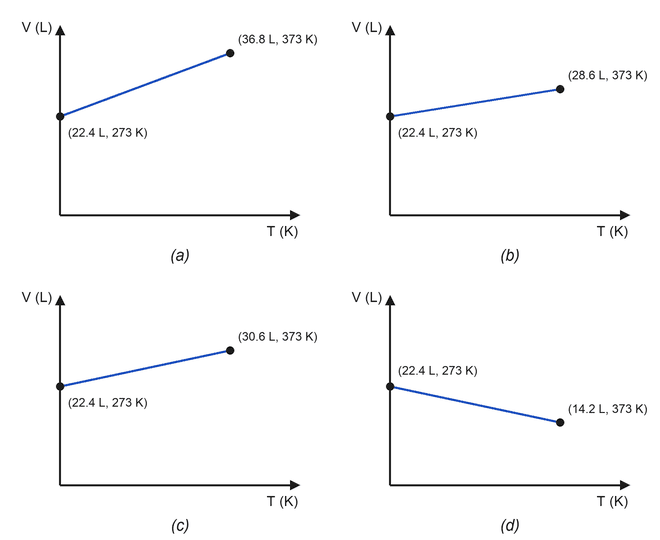
Which of the following volume ()–temperature () plots represents the behaviour of one mole of an ideal gas at one atmospheric pressure?
 Solve with AI
Answer
(A) Plot (a)
(B) Plot (b)
- Correct
(C) Plot (c)
(D) Plot (d)
Answer: (C) Plot (c)
Key idea: Charles' law says that at constant pressure the volume of a fixed amount of gas is directly proportional to its absolute temperature: . One mole of an ideal gas at 1 atm and 273 K occupies 22.4 L.
Step 1 — Write the starting point. Every plot starts at the state that one mole of an ideal gas really has at 1 atm and 273 K.
Step 2 — Find the volume at 373 K. Pressure stays at 1 atm, so we use Charles' law and solve for .
Step 3 — Match with the plots. Plot (c) is a straight rising line from (22.4 L, 273 K) to (30.6 L, 373 K), exactly as Charles' law predicts.
Why the other options are wrong:
- (A) Plot (a) ends at 36.8 L, which is larger than the 30.6 L that Charles' law allows at 373 K.
- (B) Plot (b) ends at 28.6 L, which is smaller than 30.6 L.
- (D) Plot (d) shows the volume falling as the gas is heated; at constant pressure a gas expands on heating, so the line must rise.
Therefore, plot (c) represents the ideal gas.
- 51 mark
Question 5
We have two gases and . The density of is 1.5 times that of . If the molecular masses of and are and , then is equal to :
Solve with AIAnswer
(A)
- Correct
(B)
(C)
(D) .
Answer: (B)
Key idea: From the ideal gas equation, the density of a gas is , so under the same pressure and temperature the density is directly proportional to the molar mass: .
Step 1 — Write the ratio. The question compares the two gases under the same conditions, so we can use the proportion directly.
Step 2 — Put in the density ratio. Gas is 1.5 times as dense as gas .
Step 3 — Solve for . We rearrange the equation to make the subject.
Why the other options are wrong:
- (A) turns the ratio upside down; it would make the lighter gas heavier than .
- (C) is upside down and also doubles the factor; nothing in the data gives 3.
- (D) uses a factor of 3, but the density ratio is 1.5.
Therefore, .
- 61 mark
Question 6
The molar volume of is maximum at
Solve with AIAnswer
(A) NTP
(B) 0°C and 2.0 atm.
- Correct
(C) 127°C and 1 atm.
(D) 273°C and 2 atm.
Answer: (C) 127°C and 1 atm
Key idea: For one mole of gas the ideal gas equation gives , where must be in kelvin. The molar volume is largest when is largest: high temperature and low pressure.
Step 1 — Convert each temperature to kelvin. We add 273 to each Celsius value: 0°C is 273 K, 127°C is 400 K and 273°C is 546 K.
Step 2 — Find for each option. We divide the kelvin temperature by the pressure in atm.
Step 3 — Pick the largest. is greatest for (C), so the molar volume is greatest there. Scaling from 22.4 L at NTP, it is about , which is about 32.8 L.
Why the other options are wrong:
- (A) At NTP the molar volume is 22.4 L, smaller than at 400 K and 1 atm.
- (B) At 0°C and 2 atm the gas is squeezed to half its NTP volume, about 11.2 L.
- (D) Doubling both the absolute temperature and the pressure cancels out, so the molar volume is about 22.4 L, the same as at NTP.
Therefore, the molar volume of is maximum at 127°C and 1 atm.
- 71 mark
Question 7
The ratio between the root mean square velocity of at 50 K and that of at 800 K is
Solve with AIAnswer
(A) 4
(B) 2
- Correct
(C) 1
(D) 1/4.
Answer: (C) 1
Key idea: The root mean square (r.m.s.) velocity of gas molecules is , where is the absolute temperature and the molar mass. So depends on the ratio .
Step 1 — Write the ratio of the two speeds. The factor is the same for both gases and cancels.
Step 2 — Work out for each gas. Hydrogen has and oxygen has .
Step 3 — Take the ratio. Both values are 25, so the ratio under the root is 1.
Why the other options are wrong:
- (A) 4 is ; it uses only the molar masses and forgets that oxygen is 16 times hotter.
- (B) 2 would need for hydrogen to be 4 times that for oxygen, but the two values are equal.
- (D) 1/4 is ; it uses only the temperatures and forgets the molar masses.
Therefore, the ratio of the r.m.s. velocities is 1.
- 81 mark
Question 8
The r.m.s. velocity of is times the r.m.s. velocity of . If and are temperatures of and respectively, then:
Solve with AIAnswer
(A)
(B)
- Correct
(C)
(D)
Answer: (C)
Key idea: , so the square of a speed ratio equals the ratio of values. Hydrogen has and nitrogen has .
Step 1 — Square the given speed ratio. Squaring removes the square roots.
Step 2 — Write the same ratio from the formula. Dividing for the two gases, cancels.
Step 3 — Equate and solve. Both expressions equal the same squared ratio.
So hydrogen is at half the absolute temperature of nitrogen, which means .
Why the other options are wrong:
- (A) At equal temperatures hydrogen would be (about 3.74) times faster, not times.
- (B) A hotter hydrogen sample would be even more than 3.74 times faster; the smaller ratio needs a cooler hydrogen sample.
- (D) makes hydrogen hotter, which again gives a ratio larger than .
Therefore, .
- 91 mark
Question 9
The root mean square velocity of an ideal gas at constant pressure varies with density () as
Solve with AIAnswer
(A)
(B)
(C)
- Correct
(D)
Answer: (D)
Key idea: The r.m.s. speed is ; using the density form of the gas equation, , it can be rewritten in terms of the pressure and the density .
Step 1 — Write the formula in terms of density. Rearranging shows that is the same as , so we replace one by the other.
Step 2 — Keep the pressure constant. With fixed, is a constant, so the speed depends only on the density.
So a denser gas, at the same pressure, has slower molecules.
Why the other options are wrong:
- (A) would make the speed rise steeply with density; in fact the speed falls as density rises.
- (B) also makes the speed rise with density, which is the wrong direction.
- (C) has the right power but the wrong direction; the density is in the denominator under the root.
Therefore, varies as .
- 101 mark
Question 10
mL of has effused through a hole in a container in 5 seconds. The time taken for the effusion of the same volume of the gas specified below under identical condition is
Solve with AIAnswer
(A) 10 seconds : He
- Correct
(B) 20 seconds :
(C) 25 seconds : CO
(D) 55 seconds :
Answer: (B) 20 seconds :
Key idea: Graham's law: under identical conditions the rate of effusion is inversely proportional to the square root of the molar mass, . For the same volume, rate = volume ÷ time, so the time taken is directly proportional to : .
Step 1 — Write the time for each gas. Hydrogen () takes 5 s, so for another gas we multiply 5 s by .
Step 2 — Check oxygen. Oxygen has a molar mass of 32, so we put into the formula.
This matches option (B).
Step 3 — Check the others. He has , CO has and has ; their times are about 7.07 s, 18.7 s and 23.5 s.
Why the other options are wrong:
- (A) Helium would take , about 7.07 s, not 10 s.
- (C) CO would take , about 18.7 s, not 25 s.
- (D) would take , about 23.5 s, not 55 s.
Therefore, the matching pair is 20 seconds : .
- 111 mark
Question 11
At constant volume and temperature conditions, the rates of diffusion and of gases and having densities and are related by the expression
Solve with AIAnswer
(A)
(B)
(C)
- Correct
(D)
Answer: (D)
Key idea: Graham's law of diffusion: under the same conditions, the rate of diffusion of a gas is inversely proportional to the square root of its density, .
Step 1 — Write the ratio of the two rates. Dividing the law for gas by that for gas , the constant of proportionality cancels.
Step 2 — Make the subject. We multiply both sides by ; note that stays outside the square root.
Note: the book prints options (b) and (d) identically, as , which puts inside the square root, so no printed option was exactly right. Option (b) is kept as printed and the keyed option (D) is set to the correct relation. Graham's law compares gases at the same temperature and pressure; the stem's "constant volume and temperature" is read as identical conditions.
Why the other options are wrong:
- (A) It puts under the root and also turns the density ratio upside down, so a denser gas would diffuse faster.
- (B) It puts inside the square root, so would vary as ; the two rates must be in direct proportion.
- (C) It turns the density ratio upside down, so the denser gas would diffuse faster, which is the opposite of Graham's law.
Therefore, .
- 121 mark
Question 12
For an ideal gas, number of moles per litre in terms of its pressure , gas constant and temperature is
Solve with AIAnswer
(A)
(B)
- Correct
(C)
(D) .
Answer: (C)
Key idea: The ideal gas equation is , where is the number of moles in volume . The number of moles per litre is , the molar concentration.
Step 1 — Start from the ideal gas equation. This links pressure, volume, moles and temperature.
Step 2 — Divide both sides by and by . This puts on its own.
Note: the book's printed key (d) is a slip; is the volume per mole (), so the correct option is (C), .
Why the other options are wrong:
- (A) puts in the numerator; heating a gas at fixed pressure lowers the moles per litre, so must be in the denominator.
- (B) multiplies all three and does not come from rearranging .
- (D) is , the volume occupied by one mole, which is the reciprocal of what is asked.
Therefore, the number of moles per litre is .
- 131 mark
Question 13
The kinetic energy of two moles of at 27°C is (R = 8.324 J K⁻¹ mol⁻¹)
Solve with AIAnswer
(A) 5491.6 J
(B) 6491.6 J
- Correct
(C) 7491.6 J
(D) 8882.4 J
Answer: (C) 7491.6 J
Key idea: By the kinetic theory of gases, the average translational kinetic energy of moles of gas is , where is the absolute temperature. It depends only on the amount of gas and the temperature, not on what the gas is.
Step 1 — Write the data. We convert 27°C to kelvin by adding 273, and use the gas constant printed in the question.
Step 2 — Put the values into the formula. We multiply , , and .
Note: the usual value of is 8.314 J K⁻¹ mol⁻¹, which gives about 7482.6 J; the key uses the printed 8.324.
Why the other options are wrong:
- (A) 5491.6 J is 2000 J too small; it would correspond to a temperature of about 220 K, not 300 K.
- (B) 6491.6 J is 1000 J too small; it would correspond to about 260 K.
- (D) 8882.4 J is too large; it would correspond to about 356 K.
Therefore, the kinetic energy is 7491.6 J.
- 141 mark
Question 14
The average kinetic energy of an ideal gas per molecule in SI units at 25°C will be
Solve with AIAnswer
(A) kJ
- Correct
(B) J
(C) J
(D) J.
Answer: (B) J
Key idea: The average kinetic energy of one molecule is , where is in kelvin and is the Boltzmann constant (the gas constant per molecule, ), whose value is J K⁻¹.
Step 1 — Convert the temperature. We add 273 to the Celsius value.
Step 2 — Put the values into the formula. We multiply by and by .
The SI unit of energy is the joule, so the answer is in J.
Why the other options are wrong:
- (A) The number is right but the unit is kJ, which would make the energy 1000 times too large.
- (C) J is ten times too large; the power of ten is off by one.
- (D) J has the digits swapped and is also about ten times too large.
Therefore, the average kinetic energy per molecule is J.
- 151 mark
Question 15
Which of the following relations correctly represents the relationship between the average molar kinetic energy of CO, and that of , , at the same temperature?
Solve with AIAnswer
- Correct
(A)
(B)
(C)
(D) Cannot be predicted unless the volumes of the gases are given
Answer: (A)
Key idea: By the kinetic theory, the average translational kinetic energy of one mole of any gas is . It depends only on the absolute temperature, not on the nature, mass, pressure or volume of the gas.
Step 1 — Write the energy for each gas. For one mole of each gas at the same temperature , the formula is the same.
Step 2 — Compare. The right-hand sides are identical, so the two molar kinetic energies are equal. (CO and even have the same molar mass, 28 g mol⁻¹, but that is not needed: the energy would be equal for any two gases.)
Why the other options are wrong:
- (B) CO cannot have more kinetic energy per mole than at the same temperature; the energy depends only on .
- (C) For the same reason, CO cannot have less kinetic energy per mole than .
- (D) The volume is not needed, because per mole contains no volume term.
Therefore, .
- 161 mark
Question 16
The r.m.s. velocity of at a temperature T (in kelvins) is cm s⁻¹. At what temperature (in kelvin) the r.m.s. velocity of nitrous oxide () would be cm s⁻¹?
Solve with AIAnswer
- Correct
(A) 16 T
(B) 2 T
(C) 4 T
(D) 32 T
Answer: (A) 16 T
Key idea: . and have the same molar mass, and g mol⁻¹, so for them the speed depends only on , as .
Step 1 — Write the speed ratio. Since the molar masses are equal, they cancel and only the temperatures remain.
Step 2 — Put in the speeds. The new speed is and the old one is .
Step 3 — Square both sides. This removes the root.
Watch out: speed goes as the square root of temperature, so four times the speed needs sixteen times the temperature.
Why the other options are wrong:
- (B) 2T would raise the speed only to , about .
- (C) 4T would raise the speed only to ; it forgets to square the factor 4.
- (D) 32T would raise the speed to , about .
Therefore, the required temperature is 16 T.
- 171 mark
Question 17
Value of universal gas constant, R depends upon
Solve with AIAnswer
(A) temperature of the gas
(B) volume of gas
(C) number of moles of gas
- Correct
(D) none of these.
Answer: (D) none of these
Key idea: The universal gas constant in is a true constant: it has the same value for every gas under every condition. Its numerical value changes only with the units used (8.314 J K⁻¹ mol⁻¹, 0.0821 L atm K⁻¹ mol⁻¹, 1.987 cal K⁻¹ mol⁻¹).
Step 1 — Recall where comes from. Combining Boyle's, Charles' and Avogadro's laws gives equal to a constant, called .
Step 2 — See what happens when conditions change. If , or changes, the other quantities adjust so that keeps the same value. So does not depend on any of them.
Why the other options are wrong:
- (A) Changing the temperature changes or , but stays the same, so is not affected.
- (B) Changing the volume changes the pressure in step, so is not affected.
- (C) Taking more moles changes in proportion, so is not affected.
Therefore, R depends on none of these.
- 181 mark
Question 18
At STP, a container has 1 mole of Ar, 2 moles of , 3 moles of and 4 moles of . Without changing the total pressure if one mole of is removed, the partial pressure of
Solve with AIAnswer
- Correct
(A) is changed by about 26%
(B) is halved
(C) is unchanged
(D) changes by 33%
(E) is decreased by about 8%.
Answer: (A) is changed by about 26%
Key idea: By Dalton's law, the partial pressure of a gas is its mole fraction times the total pressure: . Here the total pressure is kept the same, so the partial pressure changes only through the mole fraction.
Step 1 — Find the mole fraction of oxygen before. The total amount is mol, of which 3 mol is oxygen.
Step 2 — Find the mole fraction after removing 1 mol of oxygen. Now there are 2 mol of oxygen in a total of 9 mol.
Step 3 — Find the percentage change in the partial pressure. Since is unchanged, the partial pressure changes in the same ratio as the mole fraction.
This is about 26%.
The partial pressure of oxygen falls by about 26%.
Why the other options are wrong:
- (B) Halving would need the mole fraction to fall to 0.15, but it falls only to 0.222.
- (C) The mole fraction of oxygen changes from 0.300 to 0.222, so the partial pressure cannot stay the same.
- (D) 33% is the fall in the moles of oxygen (3 to 2), but the total moles also fall (10 to 9), so the partial pressure falls by less.
- (E) About 8% is the drop measured as a fraction of the total pressure ( to , a drop of ); as a change in the oxygen partial pressure itself, the drop is about 26%.
Therefore, the partial pressure of changes by about 26%.
- 191 mark
Question 19
A gas behaves most like an ideal gas under conditions of
Solve with AIAnswer
(A) High pressure and low temperature
(B) High temperature and high pressure
- Correct
(C) Low pressure and high temperature
(D) Low pressure and low temperature.
Answer: (C) Low pressure and high temperature
Key idea: Real gases differ from ideal gases for two reasons: the molecules have a volume of their own, and they attract one another. An ideal gas is one where both effects are negligible.
Step 1 — Effect of low pressure. At low pressure the molecules are far apart, so the volume of the molecules is tiny compared with the volume of the container, and they are too far apart to attract one another much.
Step 2 — Effect of high temperature. At high temperature the molecules move fast, so their kinetic energy is much larger than the weak attractions between them, and the attractions hardly affect their motion.
Step 3 — Combine the two. Low pressure and high temperature together make both causes of deviation negligible, so the gas comes closest to ideal behaviour.
Why the other options are wrong:
- (A) High pressure crowds the molecules (their own volume matters) and low temperature lets attractions act; these are the conditions of greatest deviation, used for liquefaction.
- (B) High temperature helps, but high pressure makes the volume of the molecules important.
- (D) Low pressure helps, but at low temperature the slow molecules feel the attractions strongly.
Therefore, a gas behaves most ideally at low pressure and high temperature.
- 201 mark
Question 20
The density of neon will be highest at
Solve with AIAnswer
(A) STP
- Correct
(B) 0°C, 2 atm
(C) 273°C, 1 atm
(D) 273°C, 2 atm.
Answer: (B) 0°C, 2 atm
Key idea: From the ideal gas equation, density is . For one gas, and are fixed, so the density is proportional to (with in kelvin): high pressure and low temperature give the highest density.
Step 1 — Convert temperatures to kelvin. 0°C is 273 K and 273°C is 546 K.
Step 2 — Find for each option. We divide the pressure in atm by the kelvin temperature.
Step 3 — Pick the largest. is the largest value, so neon is densest at 0°C and 2 atm. Taking g mol⁻¹ for neon, this is about , nearly 1.79 g L⁻¹.
Why the other options are wrong:
- (A) At STP the density is about , nearly 0.89 g L⁻¹, half the value at 2 atm.
- (C) Doubling the absolute temperature at 1 atm halves the density, to about 0.45 g L⁻¹.
- (D) Doubling both and cancels out, giving the same density as at STP.
Therefore, the density of neon is highest at 0°C and 2 atm.
- 211 mark
Question 21
At constant temperature, the product of pressure and volume of a given amount of gas is constant. This is :
- 221 mark
Question 22
Charles' law is represented mathematically as :
- 231 mark
Question 23
In general gas equation, , is the volume of:
- 241 mark
Question 24
In the equation of state of an ideal gas , the value of universal gas constant would depend only on:
- 251 mark
Question 25
The value of gas constant per degree per mol is approximately:
- 261 mark
Question 26
Which one of the following is not the value of ?
- 271 mark
Question 27
One litre of a gas collected at NTP will occupy at 2 atmospheric pressure and 27°C:
- 281 mark
Question 28
10 g of a gas at atmospheric pressure is cooled from 273°C to 0°C keeping the volume constant; its pressure would become :
- 291 mark
Question 29
300 mL of a gas at 27°C is cooled to −3°C at constant pressure, the final volume is :
- 301 mark
Question 30
273 ml of a gas at STP was taken to 27°C and 600 mm pressure. The final volume of the gas would be
- 311 mark
Question 31
The density of the gas is equal to:
[ = Pressure; = Volume; = Temperature; = Gas constant; = number of moles; = molecular mass]
- 321 mark
Question 32
The volume of a gas at 0°C is 273 mL. Its volume at 1°C and same pressure will be :
- 331 mark
Question 33
If the pressure and absolute temperature of 2 litre of carbon dioxide are doubled, the volume of carbon dioxide would become :
- 341 mark
Question 34
The V.D. of a gas is 11.2. The volume occupied by 11.2 g of this gas at NTP is:
- 351 mark
Question 35
Five gram each of the following gases at 87°C and 750 mm pressure are taken. Which of them will have the least volume?
- 361 mark
Question 36
The molecular masses of and are 32 and 64 respectively. If one litre of at 15°C and 750 mm pressure contains N molecules, the number of molecules in two litre of under the same condition of temperature and pressure will be:
- 371 mark
Question 37
Rate of diffusion of a gas is:
- 381 mark
Question 38
The rate of diffusion of hydrogen is about
- 391 mark
Question 39
The rate of diffusion of methane at a given temperature is twice that of a gas X. The molecular mass of X is:
- 401 mark
Question 40
Some moles of diffuse through a small opening in 18 seconds. Same number of moles of an unknown gas diffuse through the same opening in 45 seconds. Molecular mass of the unknown gas is :
- 411 mark
Question 41
A bottle of dry ammonia and a bottle of dry hydrogen chloride connected through a long tube are opened simultaneously at both the ends. The white ring first formed will be:
- 421 mark
Question 42
Which of the following gases will have the highest rate of diffusion ?
- 431 mark
Question 43
The mass of molecules of CO is:
- 441 mark
Question 44
10 g of hydrofluoric acid occupy 5.6 litre of volume at NTP. The empirical formula of the gas is HF. The molecular formula of the gas will be (at. mass of fluorine = 19):
- 451 mark
Question 45
The number of moles of in 0.224 litre of hydrogen gas at STP is:
- 461 mark
Question 46
Mass of 112 mL of oxygen at NTP on liquefaction will be:
- 471 mark
Question 47
Equal masses of methane and oxygen are mixed in an empty container at 25°C. The fraction of the total pressure exerted by oxygen is:
- 481 mark
Question 48
Equal masses of methane and hydrogen are mixed in an empty container at 25°C. The fraction of the total pressure exerted by hydrogen is:
- 491 mark
Question 49
A gaseous mixture of 2 moles of , 3 moles of , 5 moles of and 10 moles of is contained in a vessel. Assuming that gases are ideal and the partial pressure of is 1.5 atm, the total pressure is:
[Hint : 5 moles of produce pressure 1.5 atm; therefore partial pressures of = 3 atm. atm and atm]
- 501 mark
Question 50
50 mL of a gas diffuse through a membrane in the same time as for the diffusion of 40 mL of gas under identical conditions of pressure and temperature. If the molecular mass of is 64, that of B would be:
- 511 mark
Question 51
3.2 g of oxygen (at. mass = 16) and 0.2 g of hydrogen (at. mass = 1) are placed in a 1.12 litre flask at 0°C. The total pressure of the gas mixture will be:
- 521 mark
Question 52
The density of a gas at 27°C and 1 atm is . Pressure remaining constant, at which of the following temperatures will its density become ?
- 531 mark
Question 53
If 4 g of oxygen diffuse through a very narrow hole, how much hydrogen would have diffused under identical conditions?
[Hint: ]
- 541 mark
Question 54
A closed vessel contains equal number of hydrogen and nitrogen molecules. The total pressure is 740 mmHg. If molecules are removed, the pressure would become/remain:
- 551 mark
Question 55
Two sealed containers of same capacity at the same temperature are filled with 44 g of hydrogen gas in one and 44 g of in the other. If the pressure of is 1 atm, what is the pressure in the hydrogen container?
- 561 mark
Question 56
Density of neon will be highest at :
- 571 mark
Question 57
Equal masses of ethane and hydrogen are mixed in an empty container at 25°C. The fraction of the total pressure exerted by hydrogen is :
- 581 mark
Question 58
According to kinetic theory of gases:
- 591 mark
Question 59
Postulate of kinetic theory is:
- 601 mark
Question 60
A helium atom is two times heavier than a hydrogen molecule. At 298 K, the average kinetic energy of a helium atom is:
- 611 mark
Question 61
The kinetic theory of gases predicts that total kinetic energy of a gas depends on:
- 621 mark
Question 62
If a gas is allowed to expand at constant temperature then:
- 631 mark
Question 63
The gaseous mixture contains 56 g of nitrogen, 44 g of and 16 g of methane. The total pressure of the mixture is 720 mm Hg. The partial pressure of methane is:
- 641 mark
Question 64
The root mean square speed of an ideal gas at 27°C is 0.3 m/sec. Its RMS velocity at 927°C is:
- 651 mark
Question 65
The RMS speed at NTP of the species can be calculated from the expression :
- 661 mark
Question 66
At constant volume, for a fixed number of moles of a gas, the pressure of the gas increases with rise of temperature due to :
- 671 mark
Question 67
Non-ideal gases approach ideal behaviour:
- 681 mark
Question 68
The ratio of root mean square speed and average speed of a gas molecule, at a particular temperature is:
- 691 mark
Question 69
Most probable speed, average speed and RMS speed are related as:
- 701 mark
Question 70
In a closed flask of 5 litre, 1.0 g of is heated from 300–600 K. Which statement is not correct.
- 711 mark
Question 71
The RMS speed of hydrogen molecules at room temperature is 2400 m s⁻¹. At room temperature the RMS speed of oxygen molecules would be :
[Hint : ]
- 721 mark
Question 72
The molecules of which of the following gas have highest speed ?
- 731 mark
Question 73
Which one of the following is an ideal gas?
- 741 mark
Question 74
van der Waals' equation explains the behaviour of :
- 751 mark
Question 75
The critical temperature of a gas is that temperature :
- 761 mark
Question 76
The van der Waals' equation for a real gas is:
- 771 mark
Question 77
In van der Waals' equation of state for a non-ideal gas the term that accounts for intermolecular force is:
- 781 mark
Question 78
The units of in van der Waals' equation are :
- 791 mark
Question 79
If 1000 mL of gas at 600 torr and 500 mL of gas at 800 torr are placed in a 2 litre flask, the final pressure will be:
- 801 mark
Question 80
Two samples of gases and are at the same temperature. The molecules of are travelling four times faster than the molecules of . The ratio of of their masses will be:
[Hint : ]
- 811 mark
Question 81
The root mean square speed of a certain gas at 27°C is 3 × 10⁴ cm s⁻¹. The temperature at which the velocity will be 6 × 10⁴ cm s⁻¹ is :
- 821 mark
Question 82
The temperature at which real gases obey the ideal gas laws over a wide range of pressure is called :
- 831 mark
Question 83
The value of van der Waals' constant for gases , , and are 1.360, 1.390, 4.170 and 2.253 litre² atm mol⁻² respectively. The gas which can be most easily liquefied is :
- 841 mark
Question 84
According to kinetic theory of gases for a di-atomic molecule:
- 851 mark
Question 85
When the universal gas constant (R) is divided by Avogadro's number (N), their ratio is called :
- 861 mark
Question 86
The compressibility factor of a gas is defined as . The compressibility factor of an ideal gas is:
- 871 mark
Question 87
A mixture of three gases (density 1.0), (density 0.2) and (density 0.4) is enclosed in a vessel at constant temperature. When the equilibrium is established, the gas/gases:
- 881 mark
Question 88
16 g of oxygen and 3 g of hydrogen are mixed and kept at 760 mm pressure at 0°C. The total volume occupied by the mixture will be nearly :
- 891 mark
Question 89
When an ideal gas undergoes unrestricted expansion, no cooling occurs because the molecules:
- 901 mark
Question 90
Which of the following mixture of gases at room temperature does not follow Dalton's law of partial pressures?
- 911 mark
Question 91
The speed possessed by most of the gaseous molecules is:
- 921 mark
Question 92
In which of the following pairs the gaseous species diffuse through a porous plug along with the same rate of diffusion?
- 931 mark
Question 93
Which of the following statements is correct?
- 941 mark
Question 94
When helium is allowed to expand into vacuum, heating effect is observed. This is due to the fact that :
- 951 mark
Question 95
At STP, the order of mean square velocity of molecules of , , and HBr is:
- 961 mark
Question 96
At constant temperature in a given mass of an ideal gas:
- 971 mark
Question 97
One mole of an ideal mono-atomic gas is mixed with 1 mole of an ideal diatomic gas. The molar specific heat of the mixture at constant volume is:
- 981 mark
Question 98
In an experiment during the analysis of a carbon compound, 145 mL of was collected at 27°C. The mass of is nearly:
- 991 mark
Question 99
Eight grams each of oxygen and hydrogen at 27°C will have the total kinetic energy in the ratio of ______.
- 1001 mark
Question 100
Volume of a gas under constant pressure varies ______ as its absolute temperature.
- 1011 mark
Question 101
The volume of a gas becomes zero at ______.
- 1021 mark
Question 102
The pressure of a gas mixture is equal to the ______ of the partial pressures of its constituents at a particular temperature.
- 1031 mark
Question 103
Two non-reacting gases mix with each other and ultimately form a homogeneous mixture due to the property of ______.
- 1041 mark
Question 104
The rate of diffusion of helium is ______ times the rate of diffusion of methane.
- 1051 mark
Question 105
The value of gas constant in units of atm-litre K⁻¹ mol⁻¹ is ______.
- 1061 mark
Question 106
The value of gas constant in joule per mol per kelvin is ______.
- 1071 mark
Question 107
Equal masses of and are kept in a vessel at 27°C. The total pressure is 2 atm. The partial pressure of is ______.
[Hint : , i.e., mole fraction of ]
- 1081 mark
Question 108
At constant temperature, the pressure of the gas is ______ proportional to the volume.
- 1091 mark
Question 109
The value of for 5.6 litre of an ideal gas is ______ at NTP.
- 1101 mark
Question 110
When the pressure of the gas is tripled (at constant temperature) the volume is reduced to ______ its original volume.
- 1111 mark
Question 111
The root mean square speed is always ______ than the average speed of molecules.
- 1121 mark
Question 112
Molecules of different gases have the ______ average kinetic energy at a given temperature.
- 1131 mark
Question 113
The instrument used for measurement of pressure of a gas is called ______.
- 1141 mark
Question 114
Wet air will diffuse through a tiny hole ______ than dry air.
- 1151 mark
Question 115
5.6 litre of a monoatomic gas at STP contain ______ atoms.
- 1161 mark
Question 116
The rate of diffusion of a gas is ______ proportional to both ______ and square root of molecular mass.
- 1171 mark
Question 117
The total energy of one mole of gas (ideal monoatomic) at 27°C is ______ cal.
- 1181 mark
Question 118
If a gas is expanded at constant temperature, the kinetic energy of the molecules remains the ______.
- 1191 mark
Question 119
The vapour density of a gas is 11.2. The volume occupied by 11.2 g of this gas NTP is ______ litre.
- 1201 mark
Question 120
The relation between and kinetic energy of an ideal gas is = ______ .
- 1211 mark
Question 121
For ideal gas the compressibility factor is ______.
- 1222 marks
Question 122
Discuss some important properties of gases. How do gases differ from liquids and solids?
- 1232 marks
Question 123
Explain the terms:
(a) Compressibility
(b) Expansibility
(c) Diffusibility
(d) Homogeneity.
- 1242 marks
Question 124
State Boyle's law, Charles' law and Avogadro's law. From these laws derive the ideal gas equation, . Discuss the nature of in this equation. What is the value of in the equation?
- 1252 marks
Question 125
State and illustrate Dalton's law of partial pressures. How is this law applied in calculating the pressure of a gas collected over water?
- 1262 marks
Question 126
How will you derive Dalton's law of partial pressures from ideal gas equation?
- 1272 marks
Question 127
What do you understand by the term “diffusion of gases”? How does it differ from effusion?
- 1282 marks
Question 128
Discuss some applications of gaseous diffusion.
- 1292 marks
Question 129
State Graham's law of diffusion. How can this law be used to determine the molecular weights of gases?
- 1302 marks
Question 130
State the main postulates of Kinetic Theory of Gases. How does this theory explain the following properties of gases?
(i) Great compressibility.
(ii) Boyle's law.
(iii) Charles' law.
(iv) Graham's law of diffusion.
- 1313 marks
Question 131
Calculate the total pressure in a 10 L cylinder which contains 0.4 g of helium, 1.6 g of oxygen and 1.4 g of nitrogen at 27°C. Also calculate the partial pressure of helium gas in the cylinder. Assume ideal behaviour for gases ( = 0.082 L atm K⁻¹ mol⁻¹).
- 1323 marks
Question 132
What is density of gas at 27°C and 2 atmospheric pressure? (At. wts. S = 32, O = 16, = 0.0821 L atm K⁻¹ mol⁻¹)
- 1333 marks
Question 133
At 300 K and 2.0 atm. pressure, gaseous HF has density 4.87 g L⁻¹. What is the molecular weight of HF? Account for any discrepancy observed in the value.
- 1343 marks
Question 134
One mole of nitrogen gas at 0.8 atm takes 38 s to diffuse through a pin hole whereas one mole of an unknown compound of xenon with fluorine at 1.6 atm takes 57 s to diffuse through the same hole. Calculate the molecular formula of the compound.
- 1353 marks
Question 135
The compression factor (compressibility factor) for one mole of a van der Waals' gas at 0°C and 100 atm pressure is found to be 0.5. Assuming that the volume of the gas molecule is negligible, calculate the van der Waals' constant .
- 1363 marks
Question 136
56 g of gas are mixed with 44 g of and the pressure of resulting mixture is found to be 303 kPa. Calculate the partial pressure of and in the mixture.
- 1373 marks
Question 137
At temperature , and pressure , two ideal gases and are mixed. Show that the density of the mixture is given by where and are the mole fractions and and are the molecular weights of the gases and respectively.
- 1383 marks
Question 138
The average velocity of a gas is 400 m/s. Find the root mean square velocity at the same temperature.
- 1393 marks
Question 139
A balloon whose volume is 5 litres contains 6.1 g of . What mass of nitrogen must be added to the balloon to expand its volume to 11 litre at the same temperature and pressure?
- 1403 marks
Question 140
A 10 litre flask contains 0.2 mole of methane, 0.3 mole of hydrogen and 0.4 mole of nitrogen at 25°C. What is the partial pressure of each component and what is the pressure inside the flask?
- 1413 marks
Question 141
If 200 mL of at 25°C and a pressure of 250 mm are mixed with 350 mL of at 25°C and a pressure of 300 mm so that the volume of resulting mixture is 300 mL, what would be the final pressure of the mixture at 25°C?
- 1423 marks
Question 142
When 2 g of a gaseous substance is introduced into an initially evacuated flask at 25°C, the pressure is found to be 1-atmosphere. 3 g of another gaseous substance is then added to it at the same temperature and pressure. The final pressure is found to be 1.5 atmosphere. Calculate the ratio of molecular masses of and assuming ideal gas behaviour.
- 1433 marks
Question 143
1500 mL flask contains 400 mg and 60 mg at 100°C.
(a) What is the total pressure in the flask?
(b) If the mixture is permitted to react to form water vapour at 100°C, what will be left and what will be their partial pressures?
- 1443 marks
Question 144
The reaction between gaseous and HBr produces a white solid . Suppose a small quantity of gaseous and gaseous HBr are introduced simultaneously into opposite ends of an open tube which is one metre long. Calculate the distance of white solid formed from the end which was used to introduce .
- 1453 marks
Question 145
A spherical balloon of 21 cm diameter is to be filled up with hydrogen at NTP from a cylinder containing the gas at 20 atm and 27°C. The cylinder can hold 2.82 litre of water at NTP. Calculate the number of balloons that can be filled up.
- 1463 marks
Question 146
Calculate the volume occupied by 7 g of nitrogen gas at 27°C and 750 mm of pressure.
- 1473 marks
Question 147
The average speed at K and most probable speed at K of gas is 9 × 10⁴ cm sec⁻¹. Calculate the values of and .
- 1483 marks
Question 148
A glass bulb of 1 litre capacity contains 2 × 10²¹ molecules of nitrogen exerting a pressure of 7.57 × 10³ Nm⁻². Calculate the root mean square speed and the temperature of gas molecules. If the ratio of to is 0.82, calculate for these molecules at this temperature.
- 1493 marks
Question 149
An iron cylinder contains helium at a pressure of 250 kPa at 300 K. The cylinder can withstand a pressure of 1 × 10⁶ Pa. The room in which the cylinder is placed catches fire. Predict whether cylinder will blow up before it melts or not, melting point of the cylinder = 1800 K.
- 1503 marks
Question 150
An LPG (liquefied petroleum gas) cylinder weighs 14.8 kg when empty; when full, it weighs 29.0 kg and shows a pressure of 2.5 atm. In the course of use at 27°C, the weight of the cylinder is reduced to 23.2 kg. Find out the volume of the gas in cubic metre used up at the normal usage conditions, and the final pressure inside the cylinder. Assume LPG to be -butane with normal boiling point 0°C.
- 1513 marks
Question 151
A balloon of diameter 20 metre weighs 100 kg. Calculate its pay load if it is filled with He at 1.0 atm and 27°C. Density of air is 1.2 kg m⁻³. [ = 0.082 dm³ atm K⁻¹ mol⁻¹]
- 1523 marks
Question 152
20 dm³ of diffuse through a porous partition in 60 s. What volume of will diffuse under similar conditions in 30 s?
- 1533 marks
Question 153
At room temperature, the following reaction goes to completion,
Dimer at 262 K is solid. A 250 mL flask and 100 mL flask are separated by a stop cock. At 300 K, the nitric oxide in larger flask exerts a pressure of 1.053 atm and the smaller one contains oxygen at 0.789 atm. The gases are mixed by opening the stop cock and after the end of the reaction, the flasks are cooled to 220 K. Neglecting the vapour pressure of the dimer, find out the pressure and composition of gas remaining at 220 K. (Assume gases behave ideally.)
- 1543 marks
Question 154
A 4:1 molar mixture of He and is contained in a vessel at 20 bar pressure. Due to hole in the vessel, the gas mixture leaks out. What is the composition of the mixture effusing out initially?
- 1553 marks
Question 155
Calculate the total pressure in a 10 litre cylinder which contains 0.4 g of helium, 1.6 g of oxygen and 1.4 g of nitrogen at 27°C. Also calculate the partial pressure of helium gas in the cylinder. Assume ideal gas behaviour of gases. Given = 0.082 litre atm K⁻¹ mol⁻¹.
- 1563 marks
Question 156
An evacuated glass vessel weighs 50.0 g when empty, 148.0 g when filled with a liquid of density 0.98 g mL⁻¹ and 50.5 g when filled with an ideal gas at 760 mmHg at 300 K. Determine the molecular mass of the gas.
- 1573 marks
Question 157
Using van der Waals' equation, calculate the constant '' when two moles of gas confined in a four litre flask exerts a pressure of 11.0 atmospheres at a temperature of 300 K. The value of '' is 0.05 lit. mol⁻¹.
- 1583 marks
Question 158
A glass bulb contains 2.24 L of and 1.12 L of at STP. It is connected to a fully evacuated bulb by a stopcock with a small opening. The stopcock is opened for some time and then closed. The first bulb now contains 0.10 g of . Calculate the percentage composition by weight of the gases in the second bulb.
- 1593 marks
Question 159
Calculate the average kinetic energy in joule of the molecules in 8 g of methane at 27°C.
- 1603 marks
Question 160
The pressure exerted by 12 g of an ideal gas at temperature °C in a vessel of volume litre is one atm. When the temperature is increased by 10 degree at the same volume, the pressure increases by 10 per cent. Calculate the temperature and volume . (Mol. mass of the gas = 120).
- 1613 marks
Question 161
The composition of air is approximately 80% and 20% by mass. Calculate the density of air at 293 K and 76 cm Hg pressure.
[Hint: Determine first the average molecular mass of air and then apply ]
- 1623 marks
Question 162
Calculate the internal energy of one gram mole of nitrogen at 150°C assuming it to be an ideal gas.
- 1633 marks
Question 163
Calculate the kinetic energy of 5 moles of a gas at 27°C in erg and calorie.
- 1643 marks
Question 164
Calculate the root mean square speed of molecules of carbon dioxide at 1000°C.
- 1653 marks
Question 165
The density of a gas at 1.5 atm is 1.52 g L⁻¹. Calculate RMS speed of the molecules of the gas.
- 1663 marks
Question 166
At what temperature will the RMS speed of hydrogen be the same as that of oxygen at 25°C?
- 1673 marks
Question 167
The average speed at temperature and most probable speed at of gas is 9 × 10⁴ cm/sec. Calculate the values of and .
- 1683 marks
Question 168
How many times would the average molecular speed of nitrogen increases as its temperature is raised from −73°C to 127°C?
- 1693 marks
Question 169
56 g of nitrogen are confined to a 6 litre flask at 37°C. Calculate its pressure using van der Waals' equation for nitrogen, = 4.17 atm litre² mol⁻² and = 0.037.
- 1703 marks
Question 170
One mole of carbon dioxide was found to occupy a volume of 1.32 litre at 48°C under a pressure of 16.4 atm. Calculate the pressure that would have been expected from :
(i) the ideal gas equation,
(ii) van der Waals equation
( = 3.59 atm litre² mol⁻¹ ; = 4.27 × 10⁻³ litre mol⁻¹ and = 0.0821 litre-atm K⁻¹ mol⁻¹)
- 1713 marks
Question 171
Calculate the pressure exerted by one mole of gas at 273 K if the van der Waals' constant = 3.592 dm⁶ atm mol⁻². Assume that the volume occupied by molecules is negligible.
- 1723 marks
Question 172
The van der Waals constant '' for helium is 2.433 × 10⁻⁵ m³ mol⁻¹. Calculate the diameter of a helium atom.
- 1733 marks
Question 173
The critical temperature, pressure and volume of a gas are given as = 31°C, = 73 atm, = 0.2066 of its volume at 0°C and 1 atm pressure. Calculate the van der Waals' constant '', ''.
- 1743 marks
Question 174
The density of oxygen is 16 and that of nitrogen is 14 at 0°C and 760 mm pressure. At what temperature will oxygen have the same density as nitrogen at 0°C assuming that pressure remains constant?
- 1753 marks
Question 175
Calculate the volume occupied at 27°C and 2 atmospheric pressure of the gas evolved from 2 mL of solid carbon dioxide. Given that the density of solid carbon dioxide is 1.53 g mL⁻¹.
- 1763 marks
Question 176
Oxygen is present in a litre flask at a pressure of 7.6 × 10⁻¹⁰ mmHg. Calculate the number of oxygen molecules in the flask at 0°C.
- 1773 marks
Question 177
Calculate the density of gas at 25.0°C and 1.05 atmospheric pressure.
- 1783 marks
Question 178
125 mL of a gas of pressure 500 mm is mixed with 200 mL of another gas at a pressure of 300 mm in vessel of 150 mL capacity. What will be the total pressure of the resulting mixture if the temperature is kept constant?
- 1793 marks
Question 179
Two vessels whose volumes are in the ratio 2 : 1 contain nitrogen and oxygen at 800 mm and 680 mm pressure respectively when they are connected together. What will be the pressure of the resulting mixture?
- 1803 marks
Question 180
Calculate the total pressure in a mixture of 4 g of oxygen and 3 g of hydrogen confined to a total volume of one litre at 0°C.
[Hint: Determine total number of moles and then apply ]
- 1813 marks
Question 181
A gas cylinder contains 55% nitrogen, 20% oxygen and 25% carbon dioxide by mass at 760 mm pressure. Calculate the partial pressure of each gas.
- 1823 marks
Question 182
A container holds 22.4 litre of a gas at 1 atmospheric pressure and at 0°C. The gas consists of a mixture of argon, oxygen and sulphur dioxide in which :
(a) Partial pressure of = (partial pressure of ) + (partial pressure of Ar)
(b) Partial pressure of = 2 × partial pressure of Ar
Calculate the density of the gas mixture under these conditions.
[Hint: Let the partial pressure of argon be . So, Partial pressure of oxygen = and Partial pressure of =
Total =
Moles will be in the ratio 1 : 2 : 3.
- 1833 marks
Question 183
Two gases and have their molecular masses 2 and 32 respectively. If 100 mL of diffuses in a certain time, find out the volume of which will diffuse in the same time.
- 1843 marks
Question 184
25 mL hydrogen diffuses in 50 second. How much time will 20 mL of oxygen take to diffuse under similar conditions?
- 1853 marks
Question 185
The rate of effusion of an unknown gas () through a pinhole is found to be 0.279 times the rate of effusion of hydrogen gas through the same pinhole, if both gases are at STP. Calculate the molecular mass of the unknown gas.
- 1863 marks
Question 186
Pure diffuse through an aperture in 224 second, whereas mixture of and another gas containing 80% diffuses from the same in 234 second. What is the molecular mass of gas?
[Hint:
Solving eqs. (i) and (ii), = 46.6]
- 1873 marks
Question 187
At room temperature, ammonia gas at one atmospheric pressure and hydrogen chloride at atmospheric pressure are allowed to effuse through identical pinholes from opposite ends of a glass tube of one metre length and uniform cross-section. is first formed at a distance of 60 cm from the end through which HCl gas is sent in. What is the value of ?
[Hint: ]
- 1883 marks
Question 188
The pressure in a vessel that contained pure oxygen dropped from 2000 torr to 1500 torr in 47 minute as the oxygen leaked through a small hole into vacuum. When the same vessel is filled with another gas, the pressure dropped from 2000 torr to 1500 torr in 74 minute. What is the molar mass of the second gas?
[Hint: Apply ]
- 1893 marks
Question 189
What is the final volume of one mole of nitrogen initially at STP, if it is subjected to a pressure of 2 atm and heated to a temperature of 546 K?
- 1903 marks
Question 190
7.0 g of a gas at 300 K and 1 atmospheric pressure occupies a volume of 4.1 litres. What is the molecular mass of gas?
- 1913 marks
Question 191
A container of volume 2.461 L at 27°C has a mixture of 0.3 moles of nitrogen (at. mass 14), 0.5 moles of helium (at. mass 4) and 0.2 moles of oxygen (at. mass 16). What will be the partial pressures of the gases?
- 1923 marks
Question 192
At standard temperature and pressure what will be the ratio of masses of helium and that will occupy the same volume? What will be the ratio of the times required for these masses of gases to diffuse through the same orifice?
- 1933 marks
Question 193
The density of phosphorus vapour at 310°C and 775 torr is 2.64 g dm⁻³. What is the molecular formula of phosphorus?
- 1943 marks
Question 194
The density of oxygen is 1.43 g L⁻¹ at STP. Determine the density of oxygen at 17°C and 800 torr.
- 1953 marks
Question 195
A car tyre has a volume of 10 litre when inflated. The tyre is inflated to a pressure of 3 atm at 17°C with air. Due to driving the temperature of the tyre increases to 47°C.
(a) What would be the pressure at this temperature?
(b) How many litre of air measured at 47°C and pressure of 1 atm should be let out to restore the tyre to 3 atm at 47°C?
- 1963 marks
Question 196
A gaseous mixture of He and is found to have a density of 0.518 g L⁻¹ at 25°C and 720 torr. What is percent by mass of helium in this mixture?
- 1973 marks
Question 197
When 3.2 g sulphur is vapourised at 450°C and 723 mm pressure, the vapour occupies a volume of 780 mL. What is the molecular formula of sulphur?
- 1983 marks
Question 198
At the top of a mountain, the thermometer reads 0°C and the barometer reads 700 mmHg. At the bottom of the mountain the thermometer reads 30°C and the pressure 760 mm Hg. Compare the density of air at the top with that at the bottom.
- 1993 marks
Question 199
Calculate the volume occupied by 8.09 × 10²³ molecules of oxygen at 27°C and a pressure of 700 torr.
- 2003 marks
Question 200
An open flask contains air at 27°C. Calculate the temperature at which it should be heated so that 1/3rd of air measured at 27°C escapes out.
- 2013 marks
Question 201
The density of liquid at room temperature is 0.8 g cm⁻³. How large a cartridge of liquid must be provided to inflate a life jacket of 4 litre capacity at S.T.P.?
- 2023 marks
Question 202
Calculate the amount of which must be heated to produce 2.40 litre of oxygen at 740 mmHg and 25°C.
What Class 11 Chemistry Ch 5 covers
The sections of the chapter, in the order the book takes them. Every question above comes from one of these.
- 01Intermolecular Forces and Thermal Energy
- 02The Gas Laws
- 03Ideal Gas Equation
- 04Dalton's Law of Partial Pressures
- 05Graham's Law of Diffusion
- 06Kinetic Molecular Theory of Gases
More ways to study this chapter
The same chapter asked three other ways. Practise it, revise it, and see what the board has set on Ch 5 before.
Class 11 Chemistry Ch 5 questions students ask
How many questions are there in Class 11 Chemistry Ch 5?
202 questions. Every one is solved step by step on this page.
Are these Class 11 Chemistry solutions free?
Yes. Every question and its full working is free to read, with no account needed.
Can I download the Class 11 Chemistry Ch 5 solutions as a PDF?
There is no PDF to download. Every solution is on this page instead, which means it is searchable, always the current syllabus, and readable on a phone. Use your browser's print option if you want it on paper.