Opening your dashboard
Class 11 Chemistry Chapter 5 States of Matter: Gases and Liquids: Practice Questions
114 questions on Chapter 5, each worked through on its own page with the AI tutor. Class 11 Chemistry, ICSE 2026-27.
114 questions
1–4 marks · Mixed difficulty
- 11 mark
Question 1
The boiling points of the noble gases rise steadily down the group: He (−269 °C), Ne (−246 °C), Ar (−186 °C), Kr (−153 °C), Xe (−108 °C). Which statement best explains this trend?
- 23 marks
Question 2
At 25 °C and 1 atm, chlorine is a gas, bromine is a liquid and iodine is a solid, although all three are non-polar diatomic molecules.
(a) Name the only type of intermolecular force present in all three.
(b) Explain the difference in their physical states in terms of the balance between intermolecular forces and thermal energy.
- 31 mark
Question 3
Ethanol, , and dimethyl ether, , both have molar mass 46 g mol⁻¹. Ethanol boils at 78 °C, but dimethyl ether boils at −24 °C. The main reason for this difference is that
- 42 marks
Question 4
Ammonia (, molar mass 17 g mol⁻¹) boils at −33 °C, but methane (, molar mass 16 g mol⁻¹) boils at −161 °C. Name the main intermolecular forces in each substance and use them to explain this large difference.
- 53 marks
Question 5
The state of a substance depends on the balance between intermolecular forces and thermal energy.
(a) What is meant by thermal energy, and how does it change with temperature?
(b) Explain, using this balance, why cooling a gas helps to turn it into a liquid.
(c) Explain why compressing the gas also helps.
- 61 mark
Question 6
A sealed syringe holds 40 mL of air at 1.0 atm. The plunger is pushed in slowly until the volume is 25 mL, with the temperature kept constant. By what percentage does the pressure of the air increase?
- 73 marks
Question 7
A gas sample occupies 250 mL at 20 °C. A student says, "If I heat it to 40 °C at constant pressure, the temperature doubles, so the volume will become 500 mL."
(a) State Charles's law correctly.
(b) Calculate the actual volume at 40 °C.
(c) Explain the student's mistake.
- 81 mark
Question 8
1.5 L of nitrogen and 6.0 L of hydrogen are mixed and react completely to form ammonia, all volumes being measured at the same temperature and pressure:
What is the total volume of gas left after the reaction?
- 93 marks
Question 9
A weather balloon holds 5.0 m³ of helium at ground level, where the pressure is 1.00 atm and the temperature is 27 °C. It rises to a height where the pressure is 0.50 atm and the temperature is −21 °C. Calculate the new volume of the balloon, assuming it expands freely and no gas escapes.
- 102 marks
Question 10
The bulb of a filament lamp is filled with argon at 0.80 atm when the gas is at 25 °C. When the lamp is switched on, the gas warms up at constant volume. At what temperature (in °C) will the argon reach 1.00 atm?
- 111 mark
Question 11
A classroom measures 8 m × 6 m × 3 m. The air in it is at 27 °C and 1.00 atm. About how many moles of air does the room contain? (R = 0.0821 L atm K⁻¹ mol⁻¹)
- 123 marks
Question 12
Many older car airbags were inflated by the rapid decomposition of sodium azide:
Calculate the volume of nitrogen produced from 130 g of sodium azide at 27 °C and 1.25 atm. (Na = 23, N = 14; R = 0.0821 L atm K⁻¹ mol⁻¹)
- 131 mark
Question 13
A 2.00 L steel vessel contains 0.500 mol of nitrogen gas. At what temperature will the gas exert a pressure of 500 kPa? (R = 8.314 J K⁻¹ mol⁻¹)
- 143 marks
Question 14
A 10.0 L laboratory cylinder of oxygen at 27 °C shows a pressure of 20.0 atm. After some oxygen has been used, the gauge reads 12.0 atm at the same temperature. Assume oxygen behaves as an ideal gas. (O = 16; R = 0.0821 L atm K⁻¹ mol⁻¹)
(a) How many moles of oxygen did the cylinder hold at the start?
(b) What mass of oxygen has been used?
(c) What volume would the used oxygen occupy at 1.00 atm and 27 °C?
- 154 marks
Question 15
A gaseous hydrocarbon contains 85.7 % carbon and 14.3 % hydrogen by mass. A 0.568 g sample of the gas occupies 250 mL at 27 °C and 1.00 atm. (C = 12, H = 1; R = 0.0821 L atm K⁻¹ mol⁻¹)
(a) Find its empirical formula.
(b) Calculate its molar mass.
(c) Find its molecular formula.
(d) Calculate its density at 0 °C and 1.00 atm.
- 161 mark
Question 16
Which statement is correct for a mixture of non-reacting ideal gases kept in a rigid container at a fixed temperature?
- 173 marks
Question 17
Dry air contains 20.9 % oxygen by volume, and this percentage is the same at all heights in the lower atmosphere. The air pressure is 760 mmHg at sea level and about 253 mmHg at the summit of Mount Everest.
(a) Calculate the partial pressure of oxygen at sea level and at the summit.
(b) What percentage of oxygen by volume would a climber's breathing mixture need at the summit to give the same partial pressure of oxygen as sea-level air?
- 181 mark
Question 18
A diver at a depth of 50 m breathes a mixture of 10 % oxygen and 90 % helium by moles, supplied at the surrounding pressure of 6.0 atm. What is the partial pressure of oxygen in the mixture?
- 193 marks
Question 19
A rigid 10.0 L flask at 27 °C contains nitrogen at a pressure of 0.80 atm. Then 0.20 mol of argon is added, the volume and temperature staying the same. (R = 0.0821 L atm K⁻¹ mol⁻¹)
(a) Find the partial pressure of argon and the new total pressure.
(b) Explain why the partial pressure of nitrogen does not change.
(c) If the same 0.20 mol of argon had instead been added to the original nitrogen in a cylinder fitted with a piston that kept the total pressure at 0.80 atm, what would the partial pressure of nitrogen become?
- 204 marks
Question 20
0.650 g of zinc reacts completely with excess dilute hydrochloric acid. The hydrogen is collected over water at 25 °C, when the total pressure of the gas in the collecting tube is 750 mmHg. The aqueous tension (vapour pressure of water) at 25 °C is 23.8 mmHg. (Zn = 65; R = 0.0821 L atm K⁻¹ mol⁻¹)
(a) Write the balanced equation and find the moles of hydrogen formed.
(b) Find the partial pressure of dry hydrogen.
(c) Calculate the volume of gas collected.
- 211 mark
Question 21
A cylinder holds a mixture of helium (M = 4.0 g mol⁻¹) and argon (M = 40 g mol⁻¹). The cylinder develops a tiny leak and some gas effuses out. What happens to the composition of the gas left inside?
- 222 marks
Question 22
A helium-filled party balloon goes soft overnight much sooner than an identical balloon filled with air. Explain this using Graham's law, and calculate how many times faster helium escapes through the rubber than air does. (He = 4.0 g mol⁻¹; average molar mass of air = 28.8 g mol⁻¹)
- 231 mark
Question 23
Gas molecules in a room move at several hundred metres per second, yet the smell of perfume sprayed at one end takes many seconds or even minutes to reach the other end. The main reason is that
- 243 marks
Question 24
(a) Using the fact that molecules of different gases at the same temperature have the same average kinetic energy, show that the average speed of gas molecules is inversely proportional to the square root of the molar mass.
(b) Use the ideal gas equation to explain why Graham's law can also be written as (where d is the density), and state the condition under which this form holds.
(c) Find the ratio of the rates of diffusion of carbon monoxide and carbon dioxide under the same conditions. (CO = 28.0 g mol⁻¹, CO₂ = 44.0 g mol⁻¹)
- 251 mark
Question 25
A sample of neon is at 27 °C. To what temperature must it be heated so that the average kinetic energy of its atoms becomes exactly twice as large? (R = 8.314 J K⁻¹ mol⁻¹)
- 262 marks
Question 26
One postulate of the kinetic theory is that collisions between gas molecules, and with the walls, are perfectly elastic.
(a) What does “perfectly elastic” mean here?
(b) Suppose collisions were NOT elastic. Predict what would happen to the temperature and pressure of a gas kept in a sealed, perfectly insulated container, and explain why this is never observed.
- 273 marks
Question 27
The kinetic gas equation is , where m is the mass of one molecule, N the number of molecules and the root mean square speed. Use this equation, together with the kinetic-theory result that the average kinetic energy per molecule depends only on temperature, to deduce Avogadro's law.
- 283 marks
Question 28
A diver's scuba tank has an internal volume of 12.0 L and is filled with air to 200 bar ( Pa) at 27 °C. Treat the air as an ideal gas. (R = 8.314 J K⁻¹ mol⁻¹)
(a) Calculate the amount (in moles) of air in the tank.
(b) Calculate the total translational kinetic energy of the air molecules.
(c) If the tank were filled instead with pure oxygen at the same pressure and temperature, would this energy be larger, smaller or the same? Give a reason.
- 291 mark
Question 29
Two sealed flasks each have a volume of 5.00 L. Flask X contains helium at 2.00 atm and 300 K. Flask Y contains argon at 1.00 atm and 600 K. What is the ratio of the total translational kinetic energy of the gas in X to that in Y? (R = 0.0821 L atm K⁻¹ mol⁻¹)
- 303 marks
Question 30
Imagine a tiny sample of just five gas molecules moving with speeds of 200, 300, 400, 500 and 600 m s⁻¹.
(a) Calculate the average speed of the sample.
(b) Calculate the root mean square speed of the sample.
(c) Explain why the root mean square speed of a gas is always larger than its average speed (unless all the molecules have the same speed).
- 311 mark
Question 31
In the kinetic gas equation , the pressure depends on the mean of the squares of the molecular speeds, not on the square of their average speed. Why does the square of the speed appear?
- 323 marks
Question 32
A gas sample at 27 °C is found to have a root mean square speed of 517 m s⁻¹. (R = 8.314 J K⁻¹ mol⁻¹)
(a) Calculate the molar mass of the gas.
(b) Which of these could the gas be: He, CH₄, N₂ or CO₂? Give a reason.
- 331 mark
Question 33
A gas is kept in a sealed container at a constant temperature for a long time. Which statement about the speeds of its molecules is correct?
- 341 mark
Question 34
The van der Waals constant b of a gas is related to the volume of its molecules. Which of the following gases has the largest value of b?
- 353 marks
Question 35
Real gases do not obey exactly.
(a) Name the two assumptions of the kinetic theory that are responsible for this.
(b) For each assumption, state the correction that van der Waals made, and write the van der Waals equation for n moles.
(c) Explain why the measured pressure of a real gas is less than the pressure the molecules would exert if there were no attractions.
- 363 marks
Question 36
At 0 °C the compressibility factor of hydrogen rises above 1 steadily as the pressure is increased. For nitrogen at the same temperature, Z first dips slightly below 1 and then rises above 1 at high pressure. Explain these two behaviours.
- 371 mark
Question 37
For 1.00 mol of carbon dioxide (a = 3.59 L² atm mol⁻²) held in a 1.00 L vessel, the pressure-correction term of the van der Waals equation is 3.59 atm. If the same 1.00 mol of gas is allowed to expand into a 10.0 L vessel at the same temperature, the pressure-correction term becomes
- 381 mark
Question 38
The critical temperatures of four gases are: carbon dioxide 31.0 °C, ammonia 132.4 °C, methane −82.6 °C and oxygen −118.6 °C. On a hot day at 35 °C, which of these gases can be liquefied by compression alone, without cooling?
- 392 marks
Question 39
Cooking gas in India is supplied in two forms. LPG (mainly propane and butane) is sold as a liquid in cylinders at a pressure of only a few bar. CNG (mainly methane) is stored at about 200 bar but is still a gas. The critical temperatures are: propane 96.7 °C, butane 152.0 °C, methane −82.6 °C.
(a) Explain why LPG can be stored as a liquid at room temperature.
(b) Explain why methane stays a gas in a CNG cylinder however high the pressure is made.
- 403 marks
Question 40
Andrews studied how the volume of carbon dioxide changes as it is compressed at a fixed temperature. Describe what happens, stage by stage, when carbon dioxide at 21.5 °C is compressed slowly from a low pressure until it is completely liquid. How would the behaviour differ at 40 °C? (The critical temperature of CO₂ is 31.1 °C.)
- 411 mark
Question 41
A sealed thick-walled glass tube contains liquid carbon dioxide with its vapour above it. The tube is warmed slowly until it reaches the critical point of carbon dioxide. Which observation is made at the critical point?
- 424 marks
Question 42
For ammonia the van der Waals constants are a = 4.17 L² atm mol⁻² and b = 0.0371 L mol⁻¹. The critical constants of a van der Waals gas are , and . (R = 0.0821 L atm K⁻¹ mol⁻¹)
(a) Calculate the critical temperature of ammonia in kelvin and in °C.
(b) Calculate its critical pressure and critical molar volume.
(c) In a cold-storage plant, ammonia gas at 30 °C is compressed to make it a liquid. Use your answer to (a) to explain why this works without first cooling the gas.
- 431 mark
Question 43
Sweat evaporating from the skin cools the body, even though the sweat never reaches its boiling point. According to the kinetic theory, the cooling happens because
- 442 marks
Question 44
(a) Explain, in terms of surface tension, why small drops of water and of mercury are nearly spherical.
(b) A dry steel needle placed gently on still water floats, but it sinks when a few drops of liquid detergent are added to the water. Explain.
- 453 marks
Question 45
At 20 °C the viscosity of glycerol, , is about 1.4 Pa s, while that of ethanol, , is only about 0.0012 Pa s.
(a) What is meant by viscosity?
(b) Explain why glycerol is so much more viscous than ethanol.
(c) Explain why warming glycerol makes it flow much more easily.
- 461 mark
Question 46
A cylinder fitted with a piston contains water and water vapour only, at equilibrium at 20 °C. The vapour pressure is 2.34 kPa. The piston is pulled out slowly so that the space above the liquid doubles in volume, keeping the temperature at 20 °C. Some liquid water still remains. Which statement is correct once equilibrium is restored?
- 474 marks
Question 47
The table gives the vapour pressure of water at different temperatures.
Temperature (°C) 100 110 120 130 Vapour pressure (kPa) 101.3 143.3 198.7 270.3 The weight on the safety valve of a pressure cooker keeps the total pressure inside at about 199 kPa while the water boils.
(a) At what temperature does the water boil inside the cooker?
(b) Explain why food cooks faster in a pressure cooker than in an open pan.
(c) Explain why it is dangerous to force the lid off while the cooker is still hot and under pressure.
- 481 mark
Question 48
The density of gas is twice that of . Molecular mass of A is half of molecular mass of . The ratio of partial pressure of and is
- 491 mark
Question 49
At identical temperature and pressure, the rate of diffusion of hydrogen gas is times that of a hydrocarbon having molecular formula . What is the value of ?
- 501 mark
Question 50
For one mole of an ideal gas, increasing the temperature from 10° C to 20° C
- 511 mark
Question 51
If dm³ of water is introduced into a 1.0 dm³ flask at 300 K, how many moles of water are in the vapour phase when equilibrium is established?
(Given: Vapour pressure of at 300 K is 3170 Pa; J K⁻¹ mol⁻¹)
- 521 mark
Question 52
The rms velocity of hydrogen is times the rms velocity of nitrogen. If is the temperature of the gas, which of the following is true?
- 531 mark
Question 53
'' and '' are van der Waals' constants for gases. Chlorine is more easily liquefied than ethane because
- 541 mark
Question 54
For gaseous state, if most probable speed is denoted by C*, average speed by and mean square speed by C, then for a larger number of molecules the ratios of these speed are
- 551 mark
Question 55
At a certain temperature, the time required for the complete diffusion of 200 mL of gas is 30 minutes. The time required for the complete diffusion of 50 mL of gas at the same temperature will be
- 561 mark
Question 56
Density of carbon monoxide is maximum at
- 571 mark
Question 57
If is a compressibility factor, van der Waals' equation at low pressure can be written as
- 581 mark
Question 58
One mole of (g) at 300 K is kept in a closed vessel at 1 atm pressure. It is heated to 600 K when 20% by mass of (g) decomposes to (g). The resultant pressure is
- 591 mark
Question 59
The units of surface tension and viscosity of liquids are respectively
- 601 mark
Question 60
A gas can be liquefied at temperature and pressure provided
- 611 mark
Question 61
Plot of Maxwell's distribution of velocities is given below:
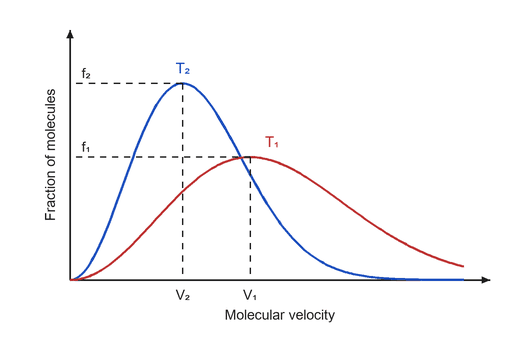
Which of the following is correct about this plot?
- 621 mark
Question 62
The intermolecular interaction that is dependent on the inverse cube of distance between the molecules is
- 631 mark
Question 63
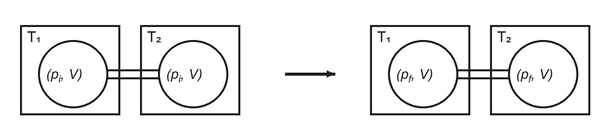
Two closed bulbs of equal volume () containing an ideal gas initially at pressure and temperature are connected through a narrow tube of negligible volume as shown in the figure below. The temperature of one of the bulbs is then raised to . The final pressure is
- 641 mark
Question 64
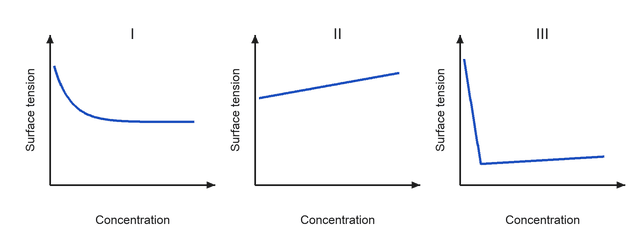
The qualitative sketches I, II, and III given below show the variation of surface tension with molar concentration of three different aqueous solutions KCl, and at room temperature. The correct assignment of the sketches is
- 651 mark
Question 65
An open vessel at 27°C is heated until two fifth of the air (assumed as an ideal gas) in it has escaped from the vessel. Assuming that the volume of the vessel remains constant, the temperature at which the vessel has been heated is
- 661 mark
Question 66
The volume of gas is twice than that of gas . The compressibility factor of gas is thrice than that of gas at same temperature. The pressure of the gases for equal number of moles are
- 671 mark
Question 67
0.5 moles of gas and moles of gas exert a pressure of 200 Pa in a container of volume 10 m³ at 1000 K. Given is the gas constant in J K⁻¹ mol⁻¹, is:
- 681 mark
Question 68
Consider the van der Waals' constants, and for the following gases.
Gas Ar Ne Kr Xe (atm dm⁶ mol⁻²) 1.3 0.2 5.1 4.1 ( dm³ mol⁻¹) 3.2 1.7 1.0 5.0 Which gas is expected to have the highest critical temperature?
- 691 mark
Question 69
Which equation will explain the nature of versus curve for gas at moderately low pressure?
- 701 mark
Question 70
An open vessel at 27°C is heated until two fifth of the air (assumed as an ideal gas) in it has escaped from the vessel. Assuming that the volume of the vessel remains constant, the temperature at which the vessel has been heated is
- 711 mark
Question 71
Points I, II and III in the following plot respectively correspond to (: most probable velocity)
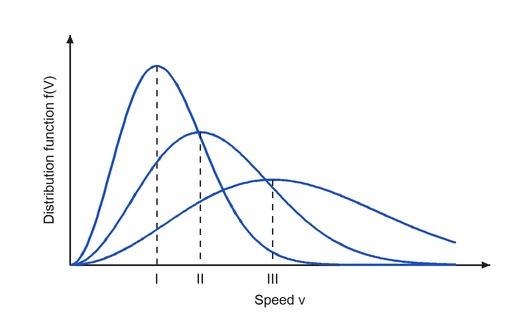
- 721 mark
Question 72
Which of the following statements(s) is (are) correct regarding the root mean square speed () and average translational kinetic energy () of a molecule in a gas at equilibrium?
(a) is inversely proportional to the square root of its molecular mass.
(b) is doubled when its temperature is increased four times.
(c) is doubled when its temperature is increased four times.
(d) at a given temperature does not depend on its molecular mass.
- 731 mark
Question 73
The relative strength of interionic/intermolecular forces in decreasing order is:
- 741 mark
Question 74
Identify the correct labels of , and in the following graph from the options given below:
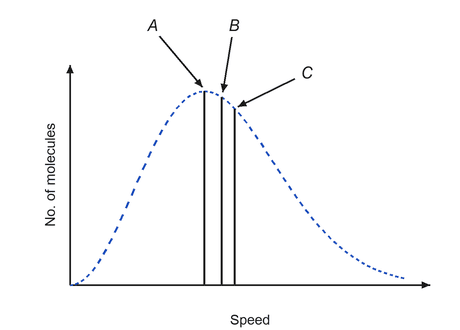
Root mean square speed (); most probable speed (); Average speed ().
- 751 mark
Question 75
A graph of vapour pressure and temperature for three different liquids , and is shown below:
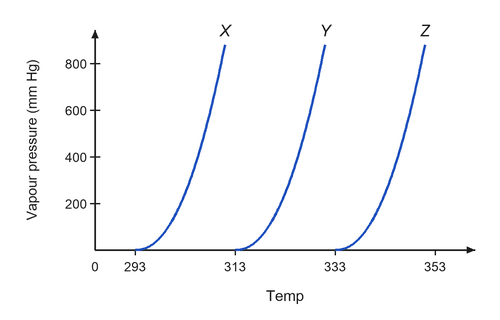
The following inferences are made:
(A) has higher intermolecular interactions compared to .
(B) has lower intermolecular interactions compared to .
(C) has lower intermolecular interactions compared to .
The correct inference(s) is /are:
- 761 mark
Question 76
Match the type of interaction in column A with the distance dependence of their interaction energy in column B:
A B (i) ion-ion (a) (ii) Dipole-dipole (b) (iii) London dispersion (c) (d) - 771 mark
Question 77
A mixture of one mole each of , He and each are enclosed in a cylinder of volume at temperature T. If the partial pressure of is 2 atm, the total pressure of the gases in the cylinder is,
- 781 mark
Question 78
If the distribution of molecular speeds of a gas is as per the figure shown below, then the ratio of the most probable, the average and the root mean square speeds, respectively is
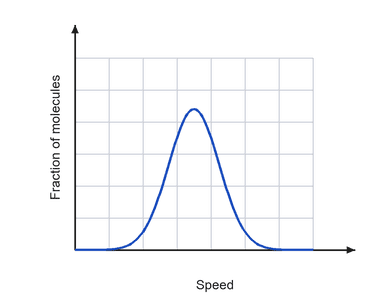
- 791 mark
Question 79
Which one of the following is the correct vs plot at constant temperature for an ideal gas? ( and stand for pressure and volume of the gas respectively)
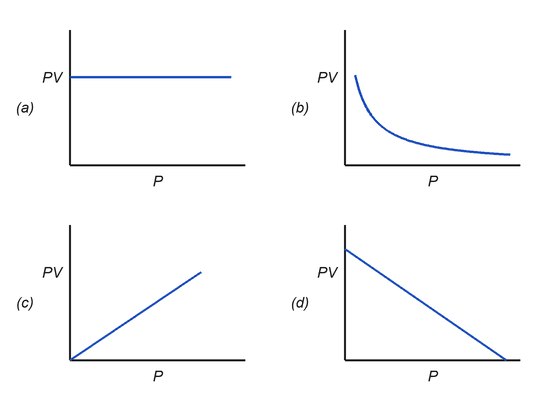
- 801 mark
Question 80
A spherical balloon of radius 3 cm containing helium gas has a pressure of bar. At the same temperature, the pressure of a spherical balloon of radius 12 cm containing the same amount of gas will be ________ bar.
- 811 mark
Question 81
is used, even in spacecrafts to produce . The daily consumption of pure by a person is 492 L at 1 atm, 300 K. How much amount of , in grams is required to produce for the daily consumption of a person at 1 atm, 300 K?
L atm mol⁻¹ K⁻¹
- 821 mark
Question 82
A home owner uses m³ of methane () gas, (assume is an ideal gas) in a year to heat his home. Under the pressure of 1.0 atm and 300 K, mass of gas used is g. The value of is ________ (Nearest integer)
(Given L atm K⁻¹ mol⁻¹)
- 831 mark
Question 83
The volume occupied by 4.75 g of acetylene gas at 50°C and 740 mmHg pressure is ________ L. (Rounded off to the nearest integer)
[Given L atm K⁻¹ mol⁻¹]
- 841 mark
Question 84
A car tyre is filled with nitrogen gas at 35 psi at 27°C. It will burst if pressure exceeds 40 psi. The temperature in °C at which the car tyre will burst is ________ (Rounded off to the nearest integer).
- 851 mark
Question 85
The number of chlorine atoms in 20 mL of chlorine gas at STP is ________ . (Rounded off to the nearest integer).
[Assume chlorine is an ideal gas at STP, L bar mol⁻¹ K⁻¹, ]
- 861 mark
Question 86
A certain gas obeys . The value of is . The value of is ________ (Integer answer)
(: compressibility factor)
- 871 mark
Question 87
The pressure exerted by a non-reactive gaseous mixture of 6.4 g of methane and 8.8 g of carbon dioxide in a 10 L vessel at 27°C is ________ kPa. (Rounded off to the nearest integer).
[Assume gases are ideal, R = 8.314 J mol⁻¹ K⁻¹
Atomic masses: C: 12.0 u, H: 1.0 u, O: 16.0 u]
- 881 mark
Question 88
An evacuated glass vessel weighs 50 g when empty, 144.0 g when filled with a liquid of density 0.47 g mL⁻¹ and 50.5 g when filled with an ideal gas at 760 mm Hg at 300 K. The molar mass of the ideal gas is (Given R = 0.0821 L atm K⁻¹ mol⁻¹)
- 891 mark
Question 89
The mass of m³ of a gas is 4.4 g at 273.15 K and 101.325 kPa pressure. The gas may be
- 901 mark
Question 90
A bubble of gas released at the bottom of a lake increases to eight times its original volume when it reaches the surface. Assuming that atmospheric pressure is equivalent to the pressure exerted by a column of water 10 m height, the depth of the lake is
- 911 mark
Question 91
A gaseous mixture was prepared by taking equal mole of CO and . If the total pressure of the mixture was found 1 atmosphere, the partial pressure of the nitrogen () in the mixture is
- 921 mark
Question 92
Two gases and having the same volume diffuses through a porous partition in 20 and 10 second respectively. The molecular mass of is 49 u. Molecular mass of will be
- 931 mark
Question 93
By what factor does the average velocity of a gaseous molecule increases when the temperature (in Kelvin) is doubled.
- 941 mark
Question 94
A mixture contains 64 g of dioxygen and 60 g of neon at a total pressure of 10 bar. The partial pressures bar of dioxygen and neon are respectively
(atomic masses: O = 16, Ne = 20)
- 951 mark
Question 95
The gas with the highest critical temperature is
- 961 mark
Question 96
50 mL of each gas A and of gas B takes 150 and 200 seconds respectively for effusing through a pin hole under the similar conditions. If molecular mass of gas A is 36, the molecular mass of gas B will be
- 971 mark
Question 97
The compressibility factor for a real gas at high pressure is
- 981 mark
Question 98
Choose the incorrect statement in the following:
- 991 mark
Question 99
When 4 g of an ideal gas is introduced into an evacuated flask kept at 25° C, the pressure is found to be one atmosphere. If 6 g of another ideal gas is then added to the same flask, the pressure becomes 2 atm at same temperature. The ratio of molecular weights () of the two gases would be
- 1001 mark
Question 100
The volume of neon gas in cm³ at STP having the same number of atoms as that present in 800 mg of Ca is (At. mass: Ca = 40 g mol⁻¹, Ne = 20 g mol⁻¹)
- 1011 mark
Question 101
Which of the following is not the postulate of the kinetic theory of gases?
- 1021 mark
Question 102
Maximum deviation from ideal gas is expected from
- 1031 mark
Question 103
Dipole-induced dipole interactions are present in which of the following pairs?
- 1041 mark
Question 104
Two vessels of volumes 16.4 L and 5 L contain two ideal gases of molecular existence at the respective temperature of 27°C and 227°C and exert 1.5 and 4.1 atmospheres respectively. The ratio of the number of molecules of the former to that of the latter is
- 1051 mark
Question 105
At 273 K, the density of a certain gaseous oxide at 2 atmosphere is same as that of dioxygen at 5 atmosphere. The molecular mass of the oxide (in g mol⁻¹) is
- 1061 mark
Question 106
Equal masses of , and methane have been taken in a container of volume at temperature 27° C in identical conditions. The ratio of the volumes of gases : methane would be
- 1071 mark
Question 107
Equal masses of He, and are taken in a closed container. The ratio of the partial pressures of gases He, and would be
- 1081 mark
Question 108
A gas such as carbon monoxide would be most likely to obey the ideal gas law at:
- 1091 mark
Question 109
Equal moles of hydrogen and oxygen gases are placed in a container with a pin-hole through which both can escape. What fraction of the oxygen escapes in the time required for one-half of the hydrogen to escape?
- 1101 mark
Question 110
Given van der Waals' constant for , , and are respectively 4.17, 0.244, 1.36, and 3.59, which one of the following gases is most easily liquefied?
- 1111 mark
Question 111
The correction factor '' to the ideal gas equation corresponds to
- 1121 mark
Question 112
A gas at 350 K and 15 bar has molar volume 20 percent smaller than that for an ideal gas under the same conditions. The correct option about the gas and its compressibility factor () is
- 1131 mark
Question 113
A mixture of and Ar gases in a cylinder contains 7 g of and 8 g of Ar. If the total pressure of the mixture of the gases in the cylinder is 27 bar, the partial pressure of is:
[Use atomic masses (in g mol⁻¹): N = 14, Ar = 40]
- 1141 mark
Question 114
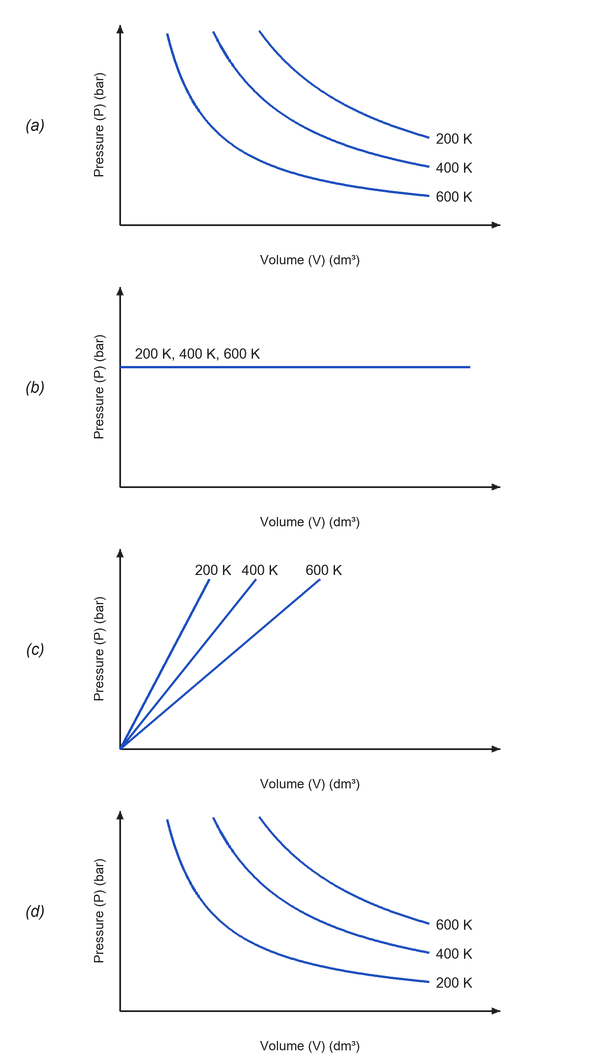
Choose the correct option for graphical representation of Boyle's law, which shows a graph of pressure vs. volume of a gas at different temperatures: