
Question 945 marksMedium
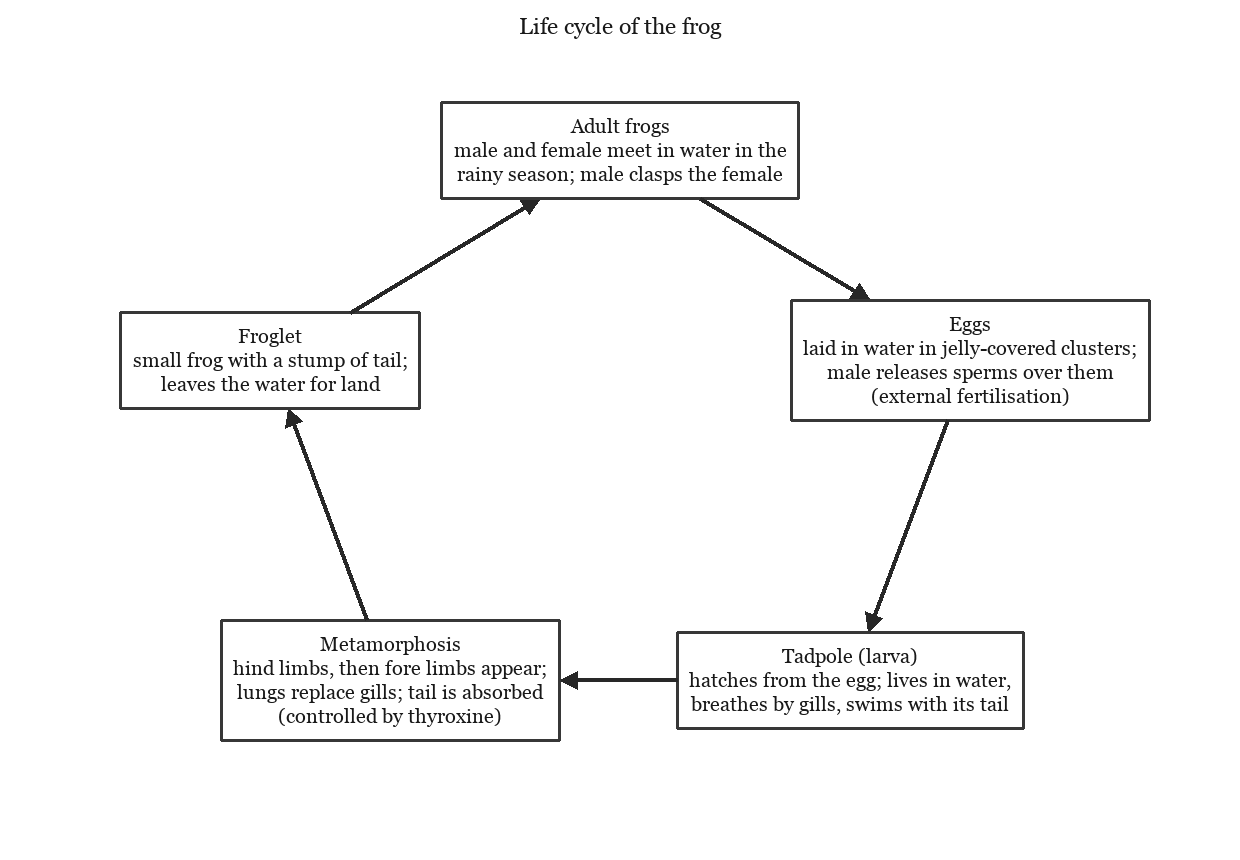
Explain the life cycle of frog from eggs till formation of adult frogs? How is frog adapted to stay on land and in water?
Confirming your payment
Sign up now and get 250 free tokens.
Appendix: Frog · Question 94 of 94
Explain the life cycle of frog from eggs till formation of adult frogs? How is frog adapted to stay on land and in water?
Solution:
Concept: The frog shows indirect development: a larva (tadpole) hatches from the egg and changes into the adult by metamorphosis.
Step 1 — Eggs and fertilisation: In the rainy season the female lays eggs in water, and the male releases sperms over them, so fertilisation is external.
Step 2 — Tadpole: Each fertilised egg develops and hatches into a tadpole, a larva that lives in water, breathes by gills and swims with its tail.
Step 3 — Metamorphosis to the adult: Under the control of thyroxine, the tadpole undergoes metamorphosis: hind limbs and then fore limbs appear, lungs replace the gills and the tail is absorbed. It passes through a froglet stage and becomes a lung-breathing adult frog.
Step 4 — Adaptations for water: The moist skin rich in blood vessels lets the frog breathe dissolved oxygen in water; the webbed toes of the hind limbs help in swimming; the nictitating membrane protects the eyes in water.
Step 5 — Adaptations for land: The lungs and the buccal cavity let it breathe air; the long, muscular hind limbs help it leap; the sticky tongue catches insects; the tympanum picks up sound. In very hot or cold weather it shelters in burrows (aestivation and hibernation), breathing through its skin.
Therefore, the frog's life cycle is egg → tadpole → froglet → adult frog, and its moist skin, lungs, webbed muscular hind limbs and protected eyes let it live both on land and in water.