
Opening your dashboard
Class 11 Biology Chapter 30: Appendix: Frog Solutions
94 textbook questions with step-by-step answers, free to read, for ISC 2026-27.
Get talked through Ch 30, not just shown the answer
Reading a finished solution is not the same as being able to do it. The AI tutor takes one question at a time and works it with you, in your own words, until you can.
- Ask it out loud, in your own words
- It gives you the next step, not the answer
- Stuck on part (ii)? Start there
94 questions with solutions
1–5 marks · Mixed difficulty
- 11 mark
Question 1
Which structure in the frog helps in sound detection?
Solve with AIAnswer
(A) nictitating membrane
- Correct
(B) tympanum
(C) vocal sac
(D) external nares
Answer: (B) tympanum
Concept: The frog has no external ear. On each side of the head, just behind the eye, there is a round grey patch, the tympanum (eardrum), which picks up sound vibrations and passes them to the internal ear.
Step 1 — What is asked: We need the structure that helps the frog to detect (receive) sound.
Step 2 — Recall the ear of the frog: The tympanum is a thin, circular membrane stretched behind each eye. Sound vibrations make it vibrate, and these vibrations are passed on to the internal ear, which sends impulses to the brain.
Step 3 — Answer: So the structure that helps in sound detection is the tympanum.
Step 4 — Check the other options: Each of the other options is wrong for the reason given below.
- (A) The nictitating membrane is a thin, transparent, movable eyelid that protects and moistens the eye; it has nothing to do with hearing.
- (C) Vocal sacs are present only in male frogs; they help to produce the loud croaking sound during the mating season, not to detect sound.
- (D) External nares (nostrils) let air into the buccal cavity for breathing and help in smell; they do not detect sound.
Therefore, the answer is (B) tympanum.
- 21 mark
Question 2
The skin of frog is adapted for
Solve with AIAnswer
(A) heat production
(B) water storage
- Correct
(C) respiration
(D) excretion
Answer: (C) respiration
Concept: Frog skin is thin, moist (kept wet by mucus) and richly supplied with blood vessels. These three features make it a good surface for the exchange of gases by diffusion, which is called cutaneous respiration.
Step 1 — What is asked: We need the main function for which the skin of the frog is specially adapted.
Step 2 — Link the features to a function: Oxygen dissolves in the film of moisture on the skin, diffuses through the thin skin into the blood capillaries just below it, and carbon dioxide diffuses out the same way.
Step 3 — Answer: So the skin of the frog is adapted for respiration. In water it is the main respiratory organ.
Step 4 — Check the other options: Each of the other options is wrong for the reason given below.
- (A) The frog is cold-blooded (a poikilotherm); its body temperature changes with the surroundings, and the skin does not produce heat.
- (B) The thin, moist skin lets water pass in and out easily, so a frog loses water quickly in dry air; the skin is not a store of water.
- (D) The main excretory organs of the frog are the kidneys, which remove urea in the urine; the skin is not specially adapted for excretion.
Therefore, the answer is (C) respiration.
- 31 mark
Question 3
Bile is produced by which of the following organs in frog?
Solve with AIAnswer
(A) Gallbladder
- Correct
(B) Liver
(C) Pancreas
(D) Intestine
Answer: (B) Liver
Concept: The liver is the largest digestive gland of the frog. It produces bile juice; the gall bladder only stores it.
Step 1 — What is asked: We need the organ that makes (produces) bile in the frog.
Step 2 — Follow the path of bile: Bile is secreted by the liver, stored in the gall bladder, and then poured into the duodenum through the common bile duct, where it emulsifies fats.
Step 3 — Answer: So bile is produced by the liver.
Step 4 — Check the other options: Each of the other options is wrong for the reason given below.
- (A) The gall bladder only stores and concentrates the bile made by the liver; it does not produce bile.
- (C) The pancreas produces pancreatic juice, which has enzymes for digesting carbohydrates and proteins; it does not make bile.
- (D) The intestine receives bile in its first part, the duodenum, but it does not produce bile.
Therefore, the answer is (B) Liver.
- 41 mark
Question 4
The common opening in frog for the digestive, excretory, and reproductive systems is:
Solve with AIAnswer
(A) Rectum
(B) Anus
(C) Colon
- Correct
(D) Cloaca
Answer: (D) Cloaca
Concept: In the frog the rectum, the ureters (and urinary bladder) and the reproductive ducts all open into one common chamber, the cloaca, which opens to the outside by the cloacal aperture.
Step 1 — What is asked: We need the single chamber through which faeces, urine and gametes all leave the frog's body.
Step 2 — Recall the cloaca: Faecal matter comes into the cloaca from the rectum, urine from the urinary bladder, and sperms or eggs from the reproductive ducts. All of them pass out through the cloacal aperture.
Step 3 — Answer: So the common opening is the cloaca.
Step 4 — Check the other options: Each of the other options is wrong for the reason given below.
- (A) The rectum is the last part of the alimentary canal (the large intestine of the frog); it carries only faecal matter and itself opens into the cloaca.
- (B) The frog has no separate anus; its digestive tract ends in the cloaca, which opens by the cloacal aperture.
- (C) In the frog the large intestine is only a short, wide rectum; there is no separate colon, and a colon would carry only food waste anyway.
Therefore, the answer is (D) Cloaca.
- 51 mark
Question 5
In which of the following conditions do frogs use cutaneous respiration the most?
Solve with AIAnswer
(A) during digestion
(B) on land
- Correct
(C) in water
(D) during tadpole stage
Answer: (C) in water
Concept: An adult frog has three modes of respiration: cutaneous (skin), buccopharyngeal (lining of the mouth cavity) and pulmonary (lungs). Which one it uses depends on where it is.
Step 1 — What is asked: We need the situation in which the frog depends most on breathing through its skin.
Step 2 — Compare land and water: When the frog is under water it cannot breathe air with its lungs or mouth lining. Oxygen dissolved in the water diffuses through its moist, well-supplied skin, so the skin is then its main respiratory organ. Frogs also breathe through the skin during hibernation and aestivation.
Step 3 — Answer: So frogs use cutaneous respiration the most in water.
Step 4 — Check the other options: Each of the other options is wrong for the reason given below.
- (A) Digestion does not change the mode of breathing; the frog breathes by the same organs before and after a meal.
- (B) On land the frog uses all three modes (skin, buccal cavity and lungs), so it does not depend mainly on the skin there.
- (D) The tadpole is the larva of the frog; it respires mainly by its gills, not mainly through the skin as the adult does in water.
Therefore, the answer is (C) in water.
- 61 mark
Question 6
Heart of a frog has following chambers.
Solve with AIAnswer
- Correct
(A) Two auricles and one ventricle
(B) One auricle and two ventricles
(C) Two auricles and two ventricles
(D) Two auricles and incomplete ventricle
Answer: (A) Two auricles and one ventricle
Concept: The heart of the frog is three-chambered: two auricles (atria) and one undivided ventricle. Two extra chambers are attached to it: the sinus venosus (on the dorsal side) and the truncus arteriosus (on the ventral side).
Step 1 — What is asked: We need the chambers of the frog's heart.
Step 2 — Recall the heart: The right auricle receives the blood returning from the body through the sinus venosus, and the left auricle receives oxygenated blood from the lungs through the pulmonary vein. Both auricles open into a single ventricle, where the two kinds of blood mix to some extent.
Step 3 — Answer: So the heart of a frog has two auricles and one ventricle.
Step 4 — Check the other options: Each of the other options is wrong for the reason given below.
- (B) No vertebrate heart has one auricle with two ventricles; the frog has two auricles and only one ventricle.
- (C) A four-chambered heart (two auricles and two ventricles) is found in birds, mammals and crocodiles, not in frogs.
- (D) The frog's ventricle is a single, undivided chamber with no partition at all; an incompletely divided ventricle is found in most reptiles.
Therefore, the answer is (A) Two auricles and one ventricle.
- 71 mark
Question 7
Frogs excrete nitrogenous waste mainly in the form of
Solve with AIAnswer
(A) Uric acid
(B) Ammonia
(C) Creatinine
- Correct
(D) Urea
Answer: (D) Urea
Concept: Animals are named after their main nitrogenous waste: ammonotelic (ammonia), ureotelic (urea) and uricotelic (uric acid). The adult frog is ureotelic.
Step 1 — What is asked: We need the main form in which an adult frog gets rid of its nitrogenous waste.
Step 2 — Recall the waste of the frog: The adult frog spends much time on land and cannot afford to lose the large volume of water needed to wash out toxic ammonia. Its liver converts ammonia into the less toxic urea, which the kidneys remove in the urine.
Step 3 — Answer: So frogs excrete nitrogenous waste mainly as urea.
Step 4 — Check the other options: Each of the other options is wrong for the reason given below.
- (A) Uric acid is the main nitrogenous waste of birds, most reptiles and insects (uricotelic animals), not of frogs.
- (B) Ammonia is the main waste of the tadpole, which lives in water; the adult frog is ureotelic.
- (C) Creatinine, formed from creatine in muscles, is present in the urine only in small amounts; it is not the main nitrogenous waste.
Watch out: The change from ammonia (tadpole) to urea (adult) happens during metamorphosis, so the answer for an adult frog is urea.
Therefore, the answer is (D) Urea.
- 81 mark
Question 8
Fertilisation in frogs occurs
Solve with AIAnswer
(A) Internally in the female body
(B) Internally in the male body
- Correct
(C) Externally in water
(D) Externally on land
Answer: (C) Externally in water
Concept: In external fertilisation the sperm and the egg fuse outside the body of the female, usually in water.
Step 1 — What is asked: We need where and how the sperm fuses with the egg in frogs.
Step 2 — Recall breeding in frogs: During the rainy season the male clasps the female. As the female lays her eggs in water, the male releases sperms over them, and the sperms swim through the water to the eggs.
Step 3 — Answer: So fertilisation in frogs occurs externally, in water.
Step 4 — Check the other options: Each of the other options is wrong for the reason given below.
- (A) The eggs are not fertilised inside the female; they are fertilised only after she has laid them in water.
- (B) Fertilisation never takes place in the male body, because the eggs are produced by the female.
- (D) Frog eggs are laid in water, and the sperms need water to swim to the eggs, so fertilisation does not occur on land.
Therefore, the answer is (C) Externally in water.
- 91 mark
Question 9
Which part of the frog's brain controls automatic actions like respiration and digestion?
Solve with AIAnswer
(A) Cerebellum
- Correct
(B) Medulla oblongata
(C) Cerebrum
(D) Optic lobe
Answer: (B) Medulla oblongata
Concept: The brain of the frog has three parts: the forebrain (olfactory lobes, cerebral hemispheres, diencephalon), the midbrain (optic lobes) and the hindbrain (cerebellum and medulla oblongata).
Step 1 — What is asked: We need the part of the brain that controls involuntary (automatic) actions such as breathing and digestion.
Step 2 — Recall the medulla oblongata: The medulla oblongata is the last part of the hindbrain and continues into the spinal cord. It controls involuntary actions such as respiration, heartbeat and digestion, which go on without the frog's conscious effort.
Step 3 — Answer: So the medulla oblongata controls automatic actions like respiration and digestion.
Step 4 — Check the other options: Each of the other options is wrong for the reason given below.
- (A) The cerebellum, also in the hindbrain, controls balance and posture of the body, not breathing or digestion.
- (C) The cerebrum (cerebral hemispheres of the forebrain) controls voluntary actions; with the olfactory lobes the forebrain also deals with smell.
- (D) The optic lobes of the midbrain control vision.
Therefore, the answer is (B) Medulla oblongata.
- 101 mark
Question 10
If the skin of a frog dries up completely, which immediate function will be most affected?
Solve with AIAnswer
(A) Excretion
(B) Temperature regulation
(C) Blood circulation
- Correct
(D) Respiration
Answer: (D) Respiration
Concept: Gases can pass through the skin only when they first dissolve in a film of moisture on it. The mucus glands keep the frog's skin moist for this reason.
Step 1 — What is asked: We need the function that would suffer first if the frog's skin became completely dry.
Step 2 — Think about what dry skin does: Without moisture, oxygen cannot dissolve on the skin surface and diffuse into the blood capillaries below it, and carbon dioxide cannot leave. So cutaneous respiration stops at once.
Step 3 — Answer: So the immediate function most affected is respiration.
Step 4 — Check the other options: Each of the other options is wrong for the reason given below.
- (A) Nitrogenous waste (urea) is removed mainly by the kidneys, so drying of the skin would not stop excretion at once.
- (B) The frog is cold-blooded, so its body temperature mainly follows the surroundings; dry skin would cool it less by evaporation, but that is far less urgent than the loss of gas exchange.
- (C) Blood is pumped round the body by the heart; drying of the skin does not immediately stop circulation.
Therefore, the answer is (D) Respiration.
- 111 mark
Question 11
Why do frogs lay eggs in water and not on land?
Solve with AIAnswer
(A) Because eggs have a hard shell
(B) To avoid predators
- Correct
(C) External fertilisation requires a moist environment
(D) To help eggs hatch faster
Answer: (C) External fertilisation requires a moist environment
Concept: In frogs fertilisation is external: the sperms are released over the eggs and must swim to them, which is possible only in water.
Step 1 — What is asked: We need the reason why frogs lay their eggs in water.
Step 2 — Link egg-laying to fertilisation: The male releases sperms over the eggs as the female lays them. The sperms can reach and fuse with the eggs only through water. Frog eggs also have only a soft jelly covering, so they would dry up on land, and the tadpoles that hatch need water.
Step 3 — Answer: So frogs lay eggs in water because external fertilisation requires a moist (watery) environment.
Step 4 — Check the other options: Each of the other options is wrong for the reason given below.
- (A) Frog eggs have no hard shell, only a soft jelly coat; a hard, waterproof shell is what lets reptile and bird eggs be laid on land.
- (B) Eggs in water are still eaten by fish, insects and other animals, so avoiding predators is not why they are laid there.
- (D) Eggs are not laid in water to make them hatch faster; water is needed for fertilisation and to keep the eggs from drying.
Therefore, the answer is (C) External fertilisation requires a moist environment.
- 121 mark
Question 12
What would happen if the cloaca of a frog gets blocked?
Solve with AIAnswer
(A) Only reproduction will be affected
(B) Only digestion will be affected
- Correct
(C) All excretory, digestive, and reproductive outputs will be affected
(D) No effect, as all systems have separate openings
Answer: (C) All excretory, digestive, and reproductive outputs will be affected
Concept: The cloaca is the common chamber into which the rectum, the urinary bladder (and ureters) and the reproductive ducts all open; it alone leads to the outside.
Step 1 — What is asked: We need the effect of a blocked cloaca on the frog.
Step 2 — Think about what passes through the cloaca: Faecal matter, urine and gametes (sperms or eggs) all leave the body through the cloaca. If it is blocked, none of these can be passed out.
Step 3 — Answer: So all excretory, digestive and reproductive outputs will be affected.
Step 4 — Check the other options: Each of the other options is wrong for the reason given below.
- (A) Reproduction would be affected, but not only reproduction, because urine and faeces also pass out through the cloaca.
- (B) Removal of faeces would be affected, but not only that, because urine and gametes also leave through the cloaca.
- (D) The three systems do not have separate openings to the outside in the frog; they share the cloaca, so a blockage would certainly have an effect.
Therefore, the answer is (C) All excretory, digestive, and reproductive outputs will be affected.
- 131 mark
Question 13
If the optic lobes of a frog's brain are damaged, the most likely effect will be on
Solve with AIAnswer
(A) Hearing
(B) Breathing
(C) Smell
- Correct
(D) Vision
Answer: (D) Vision
Concept: The midbrain of the frog has a pair of large optic lobes, which receive impulses from the eyes and control vision.
Step 1 — What is asked: We need the function that would suffer if the optic lobes were damaged.
Step 2 — Recall the job of the optic lobes: The optic nerves from the eyes carry impulses to the optic lobes, where the visual information is processed.
Step 3 — Answer: So damage to the optic lobes would mainly affect vision.
Step 4 — Check the other options: Each of the other options is wrong for the reason given below.
- (A) Hearing depends on the tympanum and internal ear, whose nerve (the auditory nerve) goes to the hindbrain, not to the optic lobes.
- (B) Breathing is an involuntary action controlled by the medulla oblongata of the hindbrain.
- (C) Smell is handled by the olfactory lobes of the forebrain.
Therefore, the answer is (D) Vision.
- 141 mark
Question 14
If a frog's gallbladder is removed, which digestive function may get slightly impaired?
Solve with AIAnswer
(A) Starch digestion
- Correct
(B) Fat digestion
(C) Protein digestion
(D) Water absorption
Answer: (B) Fat digestion
Concept: The liver makes bile; the gall bladder stores it and releases it into the duodenum when food arrives. Bile emulsifies fats (breaks large fat drops into tiny droplets) so that fat-digesting enzymes can act on them.
Step 1 — What is asked: We need the digestive function that would be slightly weakened without a gall bladder.
Step 2 — Think about what is lost: Without the gall bladder, bile is still made by the liver, but it is not stored and cannot be released in a large amount when a meal reaches the duodenum. So emulsification of fats becomes less efficient, though it does not stop.
Step 3 — Answer: So fat digestion may get slightly impaired. The word 'slightly' fits because the liver still makes bile.
Step 4 — Check the other options: Each of the other options is wrong for the reason given below.
- (A) Starch is digested by carbohydrate-digesting enzymes such as those in the pancreatic juice; bile is not needed for it.
- (C) Proteins are digested by the proteolytic enzymes of the gastric and pancreatic juices, which do not depend on the gall bladder.
- (D) Water is absorbed mainly in the intestine (much of it in the large intestine); this does not depend on bile stored in the gall bladder.
Therefore, the answer is (B) Fat digestion.
- 151 mark
Question 15
If a frog is kept in a very dry environment which of the following systems will be most immediately threatened?
Solve with AIAnswer
(A) Digestion
- Correct
(B) Skin respiration
(C) Vocalization
(D) Circulation
Answer: (B) Skin respiration
Concept: Cutaneous (skin) respiration works only while the skin stays moist, because oxygen must dissolve in the moisture before it can diffuse into the blood.
Step 1 — What is asked: We need the function that a very dry environment would threaten first.
Step 2 — Think about a dry place: In dry air the thin, moist skin quickly loses water. Once it dries, gases can no longer dissolve on it and diffuse across it, so breathing through the skin fails first.
Step 3 — Answer: So skin respiration will be the most immediately threatened.
Step 4 — Check the other options: Each of the other options is wrong for the reason given below.
- (A) Digestion of food in the alimentary canal is not directly stopped by dry surroundings.
- (C) Croaking (vocalisation), made by the larynx and made louder by the vocal sacs, is used for calling mates; it is not a vital function threatened at once by dry air.
- (D) Circulation is driven by the pumping of the heart, which does not depend directly on moist skin.
Therefore, the answer is (B) Skin respiration.
- 161 mark
Question 16
What is the scientific name of Indian frog?
Solve with AIAnswer
(A) Rana Indiana
- Correct
(B) Rana tigrina
(C) Rana amphibiana
(D) Anura tigrina
Answer: (B) Rana tigrina
Concept: The common Indian frog belongs to phylum Chordata, class Amphibia, order Anura, family Ranidae, genus Rana and species tigrina.
Step 1 — What is asked: We need the binomial (scientific) name of the common Indian frog.
Step 2 — Recall the systematic position: The genus is Rana and the species is tigrina. In a binomial the genus is written first with a capital letter and the species second with a small letter.
Step 3 — Answer: So the scientific name of the Indian frog is Rana tigrina.
Step 4 — Check the other options: Each of the other options is wrong for the reason given below.
- (A) This is not the name of the Indian frog; its species name is tigrina, and a species name is never written with a capital letter.
- (C) The word amphibian comes from the class name Amphibia; it is not the species name of the Indian frog.
- (D) Anura is the name of the order (tailless amphibians), not a genus, so it cannot be the first word of the binomial.
Note: Today this frog, the Indian bullfrog, is placed in another genus (and family, Dicroglossidae) and is named Hoplobatrachus tigerinus; Rana tigrina is its older name, used in this chapter.
Therefore, the answer is (B) Rana tigrina.
- 171 mark
Question 17
Which of the following statements is correct for frog?
Solve with AIAnswer
(A) Frog has a symmetrical body divided into head, neck and trunk.
(B) Hepatic portal system of frog is a portal system between kidneys and liver.
- Correct
(C) Eyes have a movable eyelid called nictitating membrane.
(D) Frog has external ear called tympanum to receive sound vibrations.
Answer: (C) Eyes have a movable eyelid called nictitating membrane.
Concept: Each eye of the frog is protected by a thin, transparent, movable eyelid called the nictitating membrane, which can be drawn over the eye, for example under water.
Step 1 — What is asked: We need the one statement that is correct for the frog.
Step 2 — Test each statement: The body has a head and a trunk only; there is no neck. The hepatic portal system carries blood from the intestine to the liver. The frog has no external ear; the tympanum is only an eardrum. The eyes do have a movable nictitating membrane.
Step 3 — Answer: So the correct statement is that the eyes have a movable eyelid called the nictitating membrane.
Step 4 — Check the other options: Each of the other options is wrong for the reason given below.
- (A) The body is bilaterally symmetrical, but it is divided into a head and a trunk only; the frog has no neck (and no tail).
- (B) The hepatic portal system carries blood from the intestine to the liver; the portal system of the kidneys is the renal portal system, which brings blood from the hind part of the body.
- (D) The frog has no external ear (no pinna). The tympanum is a round eardrum on the surface of the head that passes vibrations to the internal ear.
Therefore, the answer is (C) Eyes have a movable eyelid called nictitating membrane.
- 181 mark
Question 18
Which of the following is a common opening for sperms, urine and faeces?
Solve with AIAnswer
- Correct
(A) Cloaca
(B) Ureters
(C) Bidder's canals
(D) Rectum
Answer: (A) Cloaca
Concept: In the male frog the ureters carry both urine and sperms (so they are called urinogenital ducts) into the cloaca, and the rectum brings faeces into the same cloaca.
Step 1 — What is asked: We need the single opening through which sperms, urine and faeces all leave the male frog.
Step 2 — Follow each product: Sperms go from the testes through the vasa efferentia and the kidney to the ureters, and the ureters (with urine) open into the cloaca. Faeces pass from the rectum into the cloaca.
Step 3 — Answer: So the common opening for sperms, urine and faeces is the cloaca.
Step 4 — Check the other options: Each of the other options is wrong for the reason given below.
- (B) The ureters carry urine and, in males, sperms, but they never carry faeces, and they open into the cloaca rather than to the outside.
- (C) Bidder's canal is a canal inside the kidney of the male frog that receives sperms from the vasa efferentia; it does not carry faeces and does not open outside.
- (D) The rectum carries only faecal matter and itself opens into the cloaca.
Therefore, the answer is (A) Cloaca.
- 191 mark
Question 19
Which of the following carry sperms from testes to kidneys?
Solve with AIAnswer
- Correct
(A) Vasa efferentia
(B) Ureters
(C) Urinogenital ducts
(D) Cloaca
Answer: (A) Vasa efferentia
Concept: In the male frog the sperms travel: testis → vasa efferentia → Bidder's canal in the kidney → ureter (urinogenital duct) → cloaca.
Step 1 — What is asked: We need the tubes that take sperms from the testes to the kidneys.
Step 2 — Recall the male ducts: About 10–11 fine tubes, the vasa efferentia, run from each testis to the kidney on that side and open into Bidder's canal inside it.
Step 3 — Answer: So sperms are carried from the testes to the kidneys by the vasa efferentia.
Step 4 — Check the other options: Each of the other options is wrong for the reason given below.
- (B) The ureters run from the kidneys to the cloaca; they carry urine and sperms away from the kidneys, not from the testes to the kidneys.
- (C) Urinogenital ducts is another name for the male ureters, which carry urine and sperms from the kidneys to the cloaca.
- (D) The cloaca is the common chamber at the end through which sperms leave the body; it is not a tube from the testes.
Therefore, the answer is (A) Vasa efferentia.
- 201 mark
Question 20
Which of the following is a correct statement for metamorphosis?
Solve with AIAnswer
(A) Changing of eggs into larvae
- Correct
(B) Changes from tadpole to adult frog stage
(C) Changes from young adult frog to mature adult frog
(D) Development of eggs till hatching into tadpoles
Answer: (B) Changes from tadpole to adult frog stage
Concept: Metamorphosis is the change of a larva into an adult that looks and lives very differently. In the frog the larva is the gilled, tailed tadpole.
Step 1 — What is asked: We need the correct description of metamorphosis in the frog.
Step 2 — Recall the life cycle: The frog's life cycle is egg → tadpole (larva) → froglet → adult frog. During metamorphosis the tadpole loses its gills and tail, develops lungs and limbs, and becomes an adult frog.
Step 3 — Answer: So metamorphosis is the change from the tadpole to the adult frog stage.
Step 4 — Check the other options: Each of the other options is wrong for the reason given below.
- (A) The change of an egg into a larva is embryonic development followed by hatching; metamorphosis begins only after the tadpole has hatched.
- (C) A young frog growing into a mature frog is ordinary growth; its form does not change, so it is not metamorphosis.
- (D) Development of the egg till it hatches into a tadpole is embryonic development, which comes before metamorphosis.
Therefore, the answer is (B) Changes from tadpole to adult frog stage.
- 211 mark
Question 21
______ is a thin-walled triangular chamber attached to the right auricle of heart.
Solve with AIWritten solution
Solution:
Concept: Two extra chambers are attached to the three-chambered heart of the frog: the sinus venosus and the truncus arteriosus.
Step 1 — What is asked: We must find the word or words that correctly complete the sentence.
Step 2 — Recall the fact: The sinus venosus is a thin-walled, triangular chamber on the dorsal side of the heart, attached to the right auricle. It receives mainly deoxygenated blood from the venae cavae and passes it into the right auricle.
Step 3 — Fill the blank: The answer is sinus venosus.
Therefore, the completed sentence is: Sinus venosus is a thin-walled triangular chamber attached to the right auricle of heart.
- 221 mark
Question 22
The major excretory product of frog is ______.
Solve with AIWritten solution
Solution:
Concept: Animals are grouped by their main nitrogenous waste: ammonia, urea or uric acid.
Step 1 — What is asked: We must find the word or words that correctly complete the sentence.
Step 2 — Recall the fact: The adult frog converts ammonia into the less toxic urea and removes it in urine, so it is ureotelic. The tadpole, which lives in water, excretes ammonia.
Step 3 — Fill the blank: The answer is urea.
Therefore, the completed sentence is: The major excretory product of frog is urea.
- 231 mark
Question 23
The cold-blooded animals whose temperature keeps changing along with the environment are called ______.
Solve with AIWritten solution
Solution:
Concept: Animals are warm-blooded (constant body temperature) or cold-blooded (changing body temperature).
Step 1 — What is asked: We must find the word or words that correctly complete the sentence.
Step 2 — Recall the fact: Animals such as the frog, whose body temperature rises and falls with the temperature of the surroundings, are called poikilotherms. Birds and mammals, which keep a constant body temperature, are homeotherms.
Step 3 — Fill the blank: The answer is poikilotherms.
Therefore, the completed sentence is: The cold-blooded animals whose temperature keeps changing along with the environment are called poikilotherms.
- 241 mark
Question 24
The inner surface of ileum is modified into a number of infolding called ______.
Solve with AIWritten solution
Solution:
Concept: The ileum is the part of the small intestine where digestion is completed and food is absorbed.
Step 1 — What is asked: We must find the word or words that correctly complete the sentence.
Step 2 — Recall the fact: The inner surface of the ileum has many finger-like folds called villi, which carry microvilli. They greatly increase the surface for absorbing digested food into the blood.
Step 3 — Fill the blank: The answer is villi.
Therefore, the completed sentence is: The inner surface of ileum is modified into a number of infolding called villi.
- 251 mark
Question 25
Frogs respire through ______ in water.
Solve with AIWritten solution
Solution:
Concept: An adult frog can respire through its skin, the lining of its mouth cavity and its lungs.
Step 1 — What is asked: We must find the word or words that correctly complete the sentence.
Step 2 — Recall the fact: Under water the frog cannot use its lungs or mouth lining, so it takes in dissolved oxygen by diffusion through its moist skin, which is richly supplied with blood vessels (cutaneous respiration).
Step 3 — Fill the blank: The answer is moist skin.
Therefore, the completed sentence is: Frogs respire through moist skin in water.
- 261 mark
Question 26
Frogs undergo hibernation called summer sleep, during peak summer time.
Solve with AIWritten solution
Solution:
Concept: Frogs avoid extreme heat and cold by resting in deep burrows.
Step 1 — What is asked: We must decide whether the statement is true or false.
Step 2 — Recall the fact: Hibernation is the winter sleep of frogs. The summer sleep, during peak summer, is called aestivation.
Step 3 — Judge: So the statement is False.
Therefore, the statement is False — frogs undergo aestivation (summer sleep) in peak summer; hibernation is their winter sleep.
- 271 mark
Question 27
Frog is called an amphibian because its larval stage can live in water and adult stage on land.
Solve with AIWritten solution
Solution:
Concept: An amphibian is an animal that can live both on land and in water.
Step 1 — What is asked: We must decide whether the statement is true or false.
Step 2 — Recall the fact: The adult frog itself lives both on land and in water: it swims with webbed hind feet and breathes through its skin under water, and it hops and breathes with its lungs on land. So it is not true that only the adult lives on land and only the larva in water.
Step 3 — Judge: So the statement is False.
Note: The word amphibian means 'double life', and some books explain it by the water-living tadpole and the land-living adult, so the statement is partly right. It is marked false here because the adult frog lives both on land and in water.
Therefore, the statement is False — the frog is called an amphibian because it can live both on land and in water.
- 281 mark
Question 28
Duodenum receives the secretions from both liver and pancreas.
Solve with AIWritten solution
Solution:
Concept: The liver and the pancreas are the two digestive glands associated with the alimentary canal of the frog.
Step 1 — What is asked: We must decide whether the statement is true or false.
Step 2 — Recall the fact: Bile from the liver (stored in the gall bladder) and pancreatic juice from the pancreas both reach the duodenum through the common bile duct.
Step 3 — Judge: So the statement is True.
Therefore, the statement is True — the duodenum receives bile from the liver and pancreatic juice from the pancreas.
- 291 mark
Question 29
Right atrium receives oxygenated blood from the lungs while left atrium receives deoxygenated blood from the body.
Solve with AIWritten solution
Solution:
Concept: In the frog the two atria are completely separated by a septum, so the two kinds of blood stay apart in them.
Step 1 — What is asked: We must decide whether the statement is true or false.
Step 2 — Recall the fact: The right atrium receives deoxygenated blood from the body through the sinus venosus, and the left atrium receives oxygenated blood from the lungs through the pulmonary vein. The statement has them the wrong way round.
Step 3 — Judge: So the statement is False.
Note: Oxygen-rich blood from the skin returns through the cutaneous veins to the sinus venosus and the right atrium, not to the left atrium; only the pulmonary vein opens into the left atrium.
Therefore, the statement is False — the right atrium receives deoxygenated blood from the body and the left atrium receives oxygenated blood from the lungs.
- 301 mark
Question 30
On land the frogs respire through lungs only.
Solve with AIWritten solution
Solution:
Concept: An adult frog has three modes of respiration: cutaneous, buccopharyngeal and pulmonary.
Step 1 — What is asked: We must decide whether the statement is true or false.
Step 2 — Recall the fact: On land the frog respires through its lungs, the moist lining of its buccal cavity and its moist skin, so all three act as respiratory organs.
Step 3 — Judge: So the statement is False.
Therefore, the statement is False — on land frogs respire through the lungs, the buccal cavity lining and the skin.
- 315 marks
Question 31
Match the following:
Column A Column B 1. Vasa efferentia (a) Optic lobes 2. Hindbrain (b) Medulla oblongata 3. Midbrain (c) Respiration by skin 4. Bile juice (d) Bidder's canal 5. Cutaneous (e) Emulsification of fats Solve with AIWritten solution
Solution:
Concept: Each item in Column A is linked to one entry in Column B: a duct to the canal it opens into, a part of the brain to a structure it contains, a juice to its action, and a kind of respiration to the organ used. Use each Column B entry once.
Step 1 — Match Vasa efferentia: It matches (d) Bidder's canal, because the vasa efferentia carry sperms from the testis into the kidney, where they open into Bidder's canal.
Step 2 — Match Hindbrain: It matches (b) Medulla oblongata, because the hindbrain is made of the cerebellum and the medulla oblongata.
Step 3 — Match Midbrain: It matches (a) Optic lobes, because the midbrain of the frog consists of a pair of optic lobes, which control vision.
Step 4 — Match Bile juice: It matches (e) Emulsification of fats, because bile breaks large fat drops into tiny droplets (emulsification), so that enzymes can digest them.
Step 5 — Match Cutaneous: It matches (c) Respiration by skin, because cutaneous means 'of the skin', and cutaneous respiration is respiration through the moist skin.
Therefore, the matches are: 1 matches (d); 2 matches (b); 3 matches (a); 4 matches (e); 5 matches (c).
- 321 mark
Question 32
The summer sleep of frog.
Solve with AIWritten solution
Solution:
Concept: Frogs are cold-blooded, so they escape extreme heat and cold by resting in burrows.
Step 1 — What is asked: We need one or two words for the description.
Step 2 — Recall the fact: During peak summer the frog stays inactive in a deep, cool burrow and breathes only through its skin. This summer sleep is called aestivation (the winter sleep is hibernation).
Step 3 — Answer: The answer is Aestivation.
Therefore, the answer is Aestivation.
- 331 mark
Question 33
Respiration through the lining of mouth cavity.
Solve with AIWritten solution
Solution:
Concept: The adult frog respires through its skin, its mouth cavity lining and its lungs.
Step 1 — What is asked: We need one or two words for the description.
Step 2 — Recall the fact: The moist mucous lining of the mouth (buccal) cavity and pharynx is richly supplied with capillaries. Gas exchange through it, while the floor of the mouth moves up and down with the mouth closed, is called buccopharyngeal respiration.
Step 3 — Answer: The answer is Buccopharyngeal respiration.
Therefore, the answer is Buccopharyngeal respiration.
- 341 mark
Question 34
Organ in which the bile juice is stored.
Solve with AIWritten solution
Solution:
Concept: Bile is made by the liver and used in the duodenum.
Step 1 — What is asked: We need one or two words for the description.
Step 2 — Recall the fact: Bile made by the liver is stored in a small sac, the gall bladder, and released into the duodenum through the common bile duct.
Step 3 — Answer: The answer is Gall bladder.
Therefore, the answer is Gall bladder.
- 351 mark
Question 35
A tubular chamber attached to the ventricle on the ventral side of heart.
Solve with AIWritten solution
Solution:
Concept: Two extra chambers are attached to the frog's heart: the sinus venosus (dorsal, on the right auricle) and the truncus arteriosus (ventral, on the ventricle).
Step 1 — What is asked: We need one or two words for the description.
Step 2 — Recall the fact: The ventricle opens on the ventral side into a tubular chamber, the truncus arteriosus (also called the conus arteriosus). It has a spiral valve that sends oxygen-rich blood mostly to the body and oxygen-poor blood mostly to the lungs.
Step 3 — Answer: The answer is Conus arteriosus (truncus arteriosus).
Note: Both names are used for this chamber. Many textbooks call it the conus arteriosus, and this chapter calls it the truncus arteriosus; strictly, the conus arteriosus is the first (proximal) part of the truncus, which holds the spiral valve.
Therefore, the answer is Conus arteriosus (truncus arteriosus).
- 361 mark
Question 36
Structural and functional units in kidneys.
Solve with AIWritten solution
Solution:
Concept: The kidneys are the main excretory organs of the frog.
Step 1 — What is asked: We need one or two words for the description.
Step 2 — Recall the fact: Each kidney is made of thousands of tiny tubules called uriniferous tubules or nephrons. They filter wastes from the blood and form urine.
Step 3 — Answer: The answer is Nephrons (uriniferous tubules).
Therefore, the answer is Nephrons (uriniferous tubules).
- 371 mark
Question 37
Assertion (A): Cutaneous respiration in frogs are efficient in water.
Reason (R): Frog's skin is moist and richly supplied with blood vessels.
Solve with AIAnswer
(A) A is true, R is false.
(B) A is false, R is true.
- Correct
(C) Both A and R are true and R is the correct reason for A.
(D) Both A and R are true and R is the incorrect reason for A.
(E) Both A and R are false.
Answer: (C) Both A and R are true and R is the correct reason for A.
Concept: For gases to pass through a surface by diffusion, the surface must be thin, moist and close to blood capillaries.
Step 1 — Judge A: Under water the frog takes in dissolved oxygen through its skin so well that it can stay submerged for long periods; the skin is its main respiratory organ there. A is true.
Step 2 — Judge R: The skin of the frog is kept moist by mucus and has a rich network of blood capillaries just below its surface. R is true.
Step 3 — Decide whether R explains A: Oxygen dissolves in the moisture on the skin and diffuses straight into the blood vessels below, while carbon dioxide diffuses out. These two features are exactly why cutaneous respiration works so well in water, so R correctly explains A.
Step 4 — Check the other options: Each of the other options is wrong for the reason given below.
- (A) is wrong: R is true, not false.
- (B) is wrong: A is true, not false.
- (D) is wrong: R does correctly explain A, so it is not an incorrect reason.
- (E) is wrong: A is true, so the two statements are not both false.
Therefore, the answer is (C).
- 381 mark
Question 38
Assertion (A): Adult frogs are ureotelic animals.
Reason (R): Ammonia is the main nitrogenous waste in adult frogs.
Solve with AIAnswer
- Correct
(A) A is true, R is false.
(B) A is false, R is true.
(C) Both A and R are true and R is the correct reason for A.
(D) Both A and R are true and R is the incorrect reason for A.
(E) Both A and R are false.
Answer: (A) A is true, R is false.
Concept: An animal is ureotelic if urea is its main nitrogenous waste and ammonotelic if ammonia is.
Step 1 — Judge A: The adult frog converts ammonia into urea in the liver and excretes mainly urea, so it is ureotelic. A is true.
Step 2 — Judge R: Ammonia is the main nitrogenous waste of the tadpole, which lives in water, not of the adult frog. R is false.
Step 3 — Decide whether R explains A: Since R is false, it cannot explain A.
Step 4 — Check the other options: Each of the other options is wrong for the reason given below.
- (B) is wrong: A is true, not false.
- (C) is wrong: it needs both statements true, but R is false.
- (D) is wrong: it needs both statements true, but R is false.
- (E) is wrong: A is true, so the two statements are not both false.
Therefore, the answer is (A).
- 391 mark
Question 39
Assertion (A): Fertilisation in frogs are external and occurs in water.
Reason (R): Water is essential for tadpoles to swim.
Solve with AIAnswer
(A) A is true, R is false.
(B) A is false, R is true.
(C) Both A and R are true and R is the correct reason for A.
- Correct
(D) Both A and R are true and R is the incorrect reason for A.
(E) Both A and R are false.
Answer: (D) Both A and R are true and R is the incorrect reason for A.
Concept: In frogs the female lays eggs in water and the male releases sperms over them; the eggs hatch into tadpoles.
Step 1 — Judge A: Fertilisation in frogs takes place outside the female's body, in water, as the eggs are laid. A is true.
Step 2 — Judge R: Tadpoles are aquatic larvae with a tail and gills; they live and swim only in water. R is true.
Step 3 — Decide whether R explains A: R is about the needs of the tadpole, which appears only after fertilisation. Fertilisation happens in water because the sperms must swim through water to reach the eggs. So R is true but is not the correct explanation of A.
Step 4 — Check the other options: Each of the other options is wrong for the reason given below.
- (A) is wrong: R is true, not false.
- (B) is wrong: A is true, not false.
- (C) is wrong: R is true but it does not explain A.
- (E) is wrong: A is true, so the two statements are not both false.
Therefore, the answer is (D).
- 401 mark
Question 40
Assertion (A): Frogs can detect vibrations in the environment.
Reason (R): The tympanum and inner ear help frogs to sense sound and vibrations.
Solve with AIAnswer
(A) A is true, R is false.
(B) A is false, R is true.
- Correct
(C) Both A and R are true and R is the correct reason for A.
(D) Both A and R are true and R is the incorrect reason for A.
(E) Both A and R are false.
Answer: (C) Both A and R are true and R is the correct reason for A.
Concept: The frog has no external ear; its hearing organ is the tympanum (eardrum) together with the internal ear.
Step 1 — Judge A: Frogs respond to sounds, such as the calls of other frogs, and to vibrations around them. A is true.
Step 2 — Judge R: Vibrations make the tympanum vibrate, and these are passed on to the internal ear, which sends impulses to the brain. R is true.
Step 3 — Decide whether R explains A: The frog can detect vibrations because it has a tympanum and an internal ear that pick them up, so R correctly explains A.
Step 4 — Check the other options: Each of the other options is wrong for the reason given below.
- (A) is wrong: R is true, not false.
- (B) is wrong: A is true, not false.
- (D) is wrong: R does correctly explain A, so it is not an incorrect reason.
- (E) is wrong: A is true, so the two statements are not both false.
Therefore, the answer is (C).
- 411 mark
Question 41
Assertion (A): Peripheral nervous system is made up of nerves coming from the brain and spinal cord.
Reason (R): Peripheral nervous system connects central nervous system to limbs and body organs.
Solve with AIAnswer
(A) A is true, R is false.
(B) A is false, R is true.
(C) Both A and R are true and R is the correct reason for A.
- Correct
(D) Both A and R are true and R is the incorrect reason for A.
(E) Both A and R are false.
Answer: (D) Both A and R are true and R is the incorrect reason for A.
Concept: The nervous system of the frog has a central part (brain and spinal cord) and a peripheral part (the nerves arising from them).
Step 1 — Judge A: The peripheral nervous system is made of the cranial nerves, which come from the brain, and the spinal nerves, which come from the spinal cord. A is true.
Step 2 — Judge R: These nerves link the brain and spinal cord with the limbs and body organs, carrying messages both ways. R is true.
Step 3 — Decide whether R explains A: A tells us what the peripheral nervous system is made of; R tells us what it does. The job of the nerves does not explain where they arise from, so R is not the correct explanation of A.
Step 4 — Check the other options: Each of the other options is wrong for the reason given below.
- (A) is wrong: R is true, not false.
- (B) is wrong: A is true, not false.
- (C) is wrong: R is true but it does not explain A.
- (E) is wrong: A is true, so the two statements are not both false.
Therefore, the answer is (D).
- 425 marks
Question 42
Read the sources given and answer any four from the questions given below.
During the monsoon season, common Indian frogs, can be seen near the ponds and rivers as they emerge from their burrows after their sleep through the dry summer. Frogs have a moist skin that helps them in protection as well as respiration in water. On land, the frogs use their lungs, as well as buccal cavity along with their skin for respiration. Being carnivores, they have a short alimentary canal.
Frog has three-chambered heart with two atria and one ventricle. Blood is pumped efficiently, although some mixing of oxygenated and deoxygenated blood occurs in the single ventricle. Water is very important for fertilisation. As eggs are laid in water and external fertilisation also occurs in water. Tiny, tailed tadpoles hatch from eggs which undergo metamorphosis to become adult frogs.
(1) Why must the frog's skin remain moist?
(a) To stay camouflaged
(b) To regulate temperature
(c) For gases to diffuse through the skin
(d) To throw excess water
(2) Frogs respire on land through:
(a) their moist skin
(b) lungs
(c) buccal cavity
(d) All (a), (b) and (c)
(3) What is the scientific term for summer sleep?
(a) Hibernation
(b) Aestivation
(c) Dormancy
(d) none of these
(4) Mixing of blood in frog occurs in
(a) right auricle
(b) left auricle
(c) both auricles
(d) ventricle
(5) Which of the following statements is not correct for frogs?
(a) Eggs of frogs are always laid in water.
(b) Frogs have a long alimentary canal.
(c) Tadpoles undergo metamorphosis to become adults.
(d) Adult frogs respire through their moist skin when in water.
Solve with AIWritten solution
Solution:
Concept: The passage covers the frog's skin and respiration, aestivation, its short gut, its three-chambered heart, and external fertilisation followed by metamorphosis. Each part is answered from the matching sentence of the passage.
Part (1)
Step 1 — Find it in the passage: The passage says the moist skin helps the frog in respiration in water. Oxygen must first dissolve in the moisture on the skin before it can diffuse through the skin into the blood, and carbon dioxide leaves the same way.
Step 2 — Rule out the others: Camouflage comes from the olive-green, spotted colour of the skin, not from its moistness, so (a) is wrong; the frog is cold-blooded and its body temperature follows the surroundings, and the passage links the moist skin with protection and respiration, so (b) is wrong; excess water is removed by the kidneys as urine, so (d) is wrong.
Answer: (c) For gases to diffuse through the skin
Part (2)
Step 1 — Find it in the passage: The passage says that on land frogs use their lungs, as well as the buccal cavity along with their skin, for respiration.
Step 2 — Rule out the others: Each of (a), (b) and (c) names only one of the three respiratory surfaces used on land, so each alone is incomplete; the full answer is all three together.
Answer: (d) All (a), (b) and (c)
Part (3)
Step 1 — Find it in the passage: The passage mentions the frogs' sleep through the dry summer. The scientific term for this summer sleep is aestivation.
Step 2 — Rule out the others: Hibernation is the winter sleep, so (a) is wrong; dormancy is a general word for any inactive resting state, not the special term for summer sleep, so (c) is wrong; since aestivation is the correct term, (d) is wrong.
Answer: (b) Aestivation
Part (4)
Step 1 — Find it in the passage: The passage says some mixing of oxygenated and deoxygenated blood occurs in the single ventricle.
Step 2 — Rule out the others: The right auricle receives only the blood returning from the body, so (a) is wrong; the left auricle receives only the oxygenated blood from the lungs, so (b) is wrong; the two auricles are completely separated by a septum, so these two streams first meet in the ventricle, not in the auricles, and (c) is wrong.
Answer: (d) ventricle
Part (5)
Step 1 — Find it in the passage: The passage says that, being carnivores, frogs have a short alimentary canal. So the statement 'Frogs have a long alimentary canal' is the one that is not correct.
Step 2 — Rule out the others: Statement (a) is correct for the common Indian frog, whose eggs are laid in water, as the passage says; (c) is correct, because tadpoles undergo metamorphosis to become adults; (d) is correct, because in water the adult frog respires through its moist skin. So none of these can be the answer.
Answer: (b) Frogs have a long alimentary canal.
Note: A few frog species in other parts of the world lay their eggs on land in moist places, but for the common Indian frog of the passage statement (a) holds, so (b) is the statement that is not correct.
Therefore, the answers are: (1) (c), (2) (d), (3) (b), (4) (d), (5) (b).
- 431 mark
Question 43
Mark the odd one out: Skin, lungs, buccal cavity, oesophagus.
Solve with AIWritten solution
Solution:
Concept: The adult frog respires through three surfaces: the skin, the lining of the buccal cavity and the lungs.
Step 1 — What is asked: We must find the one item that does not belong with the other three, and say why.
Step 2 — Find the common feature: Skin, lungs and buccal cavity are all respiratory surfaces of the frog. The oesophagus is the food pipe that carries swallowed food from the buccal cavity to the stomach; it takes no part in respiration.
Step 3 — Answer: The odd one out is Oesophagus.
Therefore, the odd one out is Oesophagus.
- 441 mark
Question 44
Mark the odd one out: Rectum, ureters, urinary bladder, cloaca.
Solve with AIWritten solution
Solution:
Concept: The excretory system of the frog is a pair of kidneys, a pair of ureters, the urinary bladder and the cloaca.
Step 1 — What is asked: We must find the one item that does not belong with the other three, and say why.
Step 2 — Find the common feature: Ureters, urinary bladder and cloaca are all parts of the excretory system that carry or hold urine. The rectum is the last part of the alimentary canal, so it belongs to the digestive system (it opens into the cloaca, which is shared).
Step 3 — Answer: The odd one out is Rectum.
Therefore, the odd one out is Rectum.
- 451 mark
Question 45
Mark the odd one out: Optic lobes, spinal cord, medulla oblongata, cerebral hemispheres.
Solve with AIWritten solution
Solution:
Concept: The central nervous system of the frog has two parts: the brain inside the cranium and the spinal cord inside the vertebral column.
Step 1 — What is asked: We must find the one item that does not belong with the other three, and say why.
Step 2 — Find the common feature: Optic lobes (midbrain), medulla oblongata (hindbrain) and cerebral hemispheres (forebrain) are all parts of the brain. The spinal cord continues from the medulla oblongata down the vertebral column; it is not a part of the brain.
Step 3 — Answer: The odd one out is Spinal cord.
Therefore, the odd one out is Spinal cord.
- 461 mark
Question 46
Mark the odd one out: Thyroid, adrenal, pancreas, insulin.
Solve with AIWritten solution
Solution:
Concept: An endocrine gland is a ductless gland that releases chemical messengers called hormones into the blood.
Step 1 — What is asked: We must find the one item that does not belong with the other three, and say why.
Step 2 — Find the common feature: Thyroid, adrenal and pancreas (through its islets) are all endocrine glands. Insulin is not a gland at all; it is a hormone made by the pancreatic islets that lowers the blood sugar level.
Step 3 — Answer: The odd one out is Insulin.
Therefore, the odd one out is Insulin.
- 471 mark
Question 47
Mark the odd one out: Oviducts, ovisacs, cloaca, Bidder's canal.
Solve with AIWritten solution
Solution:
Concept: The female reproductive system of the frog is a pair of ovaries, a pair of oviducts with ovisacs at their ends, and the cloaca.
Step 1 — What is asked: We must find the one item that does not belong with the other three, and say why.
Step 2 — Find the common feature: Oviducts, ovisacs and cloaca are all on the path of the eggs in the female frog. Bidder's canal is a canal inside the kidney of the male frog that receives sperms from the vasa efferentia, so it is not part of the female reproductive system.
Step 3 — Answer: The odd one out is Bidder's canal.
Therefore, the odd one out is Bidder's canal.
- 481 mark
Question 48
What is the scientific name of a common Indian frog?
Solve with AIWritten solution
Solution:
Concept: A scientific name has two parts: the genus name (with a capital letter) and the species name (with a small letter), written in italics.
Step 1 — What is asked: We need the two-part scientific name of the common Indian frog.
Step 2 — The name: The common Indian frog belongs to the genus Rana and the species tigrina, so its name is Rana tigrina.
Note: Newer classifications place this frog in another genus and call it Hoplobatrachus tigerinus (the Indian bullfrog); Rana tigrina is its older, widely used name.
Therefore, the common Indian frog is Rana tigrina.
- 491 mark
Question 49
Which class of vertebrates does frog belong to?
Solve with AIWritten solution
Solution:
Concept: Vertebrates are grouped into classes such as Pisces, Amphibia, Reptilia, Aves and Mammalia.
Step 1 — What is asked: We need the class of vertebrates that includes the frog.
Step 2 — The class: The frog lives both in water and on land, has a moist skin without scales and lays its eggs in water, so it belongs to the class Amphibia.
Therefore, the frog belongs to the class Amphibia, so it is an amphibian.
- 501 mark
Question 50
How do frogs breathe in water?
Solve with AIWritten solution
Solution:
Concept: Gases move by diffusion across any thin, moist surface that has a good blood supply.
Step 1 — What is asked: We need the way a frog takes in oxygen when it is under water.
Step 2 — The method: Under water the lungs are not used. Oxygen dissolved in the water diffuses through the thin, moist skin into the many blood vessels below it, and carbon dioxide diffuses out. This is cutaneous respiration.
Therefore, frogs breathe in water through their moist skin (cutaneous respiration).
- 511 mark
Question 51
Where do frogs lay their eggs? Where does the fertilisation of eggs take place?
Solve with AIWritten solution
Solution:
Concept: In external fertilisation the sperms meet the eggs outside the body of the female.
Step 1 — What is asked: We need the place where eggs are laid and the place where they are fertilised.
Step 2 — Egg laying: The female frog lays her eggs in water, for example in ponds, during the rainy season.
Step 3 — Fertilisation: The male releases sperms over the eggs as they are laid, so fertilisation is external and takes place in water.
Therefore, frogs lay their eggs in water, and fertilisation is external, in the water.
- 521 mark
Question 52
What is the body covering of a frog like?
Solve with AIWritten solution
Solution:
Concept: The skin of an amphibian has no scales; mucous glands keep it moist.
Step 1 — What is asked: We need a description of the frog's body covering.
Step 2 — The covering: The body is covered by a smooth, moist and slimy skin coated with mucus. There are no scales and no exoskeleton.
Therefore, the frog's body is covered by a smooth, moist, slimy skin without scales.
- 531 mark
Question 53
Which part of the frog's body helps in hearing? Do they have external ears?
Solve with AIWritten solution
Solution:
Concept: The ear of the frog has no outer ear flap; sound is picked up by a membrane on the side of the head.
Step 1 — What is asked: We need the part used for hearing and whether frogs have external ears.
Step 2 — The hearing part: A round eardrum, the tympanum, behind each eye picks up sound vibrations and passes them to the internal ear, which also helps in balance.
Step 3 — External ear: Frogs have no external ear; the tympanum lies flush with the skin.
Therefore, the tympanum with the internal ear helps in hearing, and frogs have no external ears.
- 541 mark
Question 54
What is the larval stage of a frog called?
Solve with AIWritten solution
Solution:
Concept: A larva is the young stage that hatches from the egg and looks very different from the adult.
Step 1 — What is asked: We need the name of the frog's larva.
Step 2 — The name: The egg hatches into a fish-like, tailed larva with gills that lives in water. It is called a tadpole.
Therefore, the larval stage of a frog is called the tadpole.
- 551 mark
Question 55
Which organs help frogs in respiration on land?
Solve with AIWritten solution
Solution:
Concept: On land the frog uses every moist surface with a rich blood supply for gas exchange.
Step 1 — What is asked: We need the respiratory organs used by a frog on land.
Step 2 — The organs: On land the frog breathes by the lungs (pulmonary respiration), the moist lining of the buccal cavity (buccopharyngeal respiration) and the moist skin (cutaneous respiration).
Therefore, on land frogs respire through the lungs, the buccal cavity lining and the moist skin.
- 561 mark
Question 56
Name the main excretory waste in adult frogs. Which are the main organs of excretion?
Solve with AIWritten solution
Solution:
Concept: Animals that excrete mainly urea are called ureotelic.
Step 1 — What is asked: We need the main nitrogenous waste of the adult frog and its excretory organs.
Step 2 — The waste: The adult frog excretes mainly urea, so it is ureotelic (the tadpole excretes ammonia).
Step 3 — The organs: The pair of kidneys are the main excretory organs; their nephrons filter the waste out of the blood.
Therefore, urea is the main excretory waste of adult frogs, and the kidneys are the main excretory organs.
- 571 mark
Question 57
What type of circulatory system is found in frogs?
Solve with AIWritten solution
Solution:
Concept: In a closed circulatory system blood always flows inside the heart and blood vessels.
Step 1 — What is asked: We need the type of circulatory system of the frog.
Step 2 — The type: The frog's blood flows only inside the heart, arteries, capillaries and veins, so it has a closed circulatory system. The blood also passes through the heart twice in one round; as some mixing occurs in the single ventricle, this is an incomplete double circulation.
Therefore, frogs have a closed circulatory system.
- 581 mark
Question 58
How many chambers are there in a frog's heart? Name them.
Solve with AIWritten solution
Solution:
Concept: The chambers of the heart are the atria (which receive blood) and the ventricles (which pump it out).
Step 1 — What is asked: We need the number of chambers in the frog's heart and their names.
Step 2 — The chambers: The heart has three chambers: two atria (right and left auricles) and one ventricle.
Watch out: The sinus venosus and the truncus arteriosus are attached to the heart, but they are not counted among its three chambers.
Therefore, the frog's heart has three chambers: two atria and one ventricle.
- 591 mark
Question 59
What is the function of the cloaca in frogs?
Solve with AIWritten solution
Solution:
Concept: In the frog the rectum, the ureters and the genital ducts all open into one common chamber.
Step 1 — What is asked: We need the job of the cloaca.
Step 2 — The function: The cloaca is a common chamber that receives faeces from the rectum, urine from the ureters and gametes (sperms or eggs) from the genital ducts, and passes them out through the cloacal aperture.
Note: Some short answers name only excretion and reproduction; the cloaca also passes out the undigested food (faeces), so it serves all three systems.
Therefore, the cloaca is the common opening for the digestive, excretory and reproductive systems.
- 601 mark
Question 60
Name the organs that secrete and store bile in frogs.
Solve with AIWritten solution
Solution:
Concept: Bile is a digestive juice that helps in the digestion of fats.
Step 1 — What is asked: We need the organ that makes bile and the organ that stores it.
Step 2 — Secretion: The liver secretes bile juice.
Step 3 — Storage: The bile is stored in the gall bladder and is sent into the duodenum through the common bile duct.
Therefore, the liver secretes bile and the gall bladder stores it.
- 611 mark
Question 61
Name the gland that plays an important role in metamorphosis of frog.
Solve with AIWritten solution
Solution:
Concept: Metamorphosis is the change of the tadpole into the adult frog; it is controlled by a hormone.
Step 1 — What is asked: We need the endocrine gland that controls metamorphosis.
Step 2 — The gland: The thyroid gland secretes thyroxine, which brings about metamorphosis of the tadpole into the frog.
Therefore, the thyroid gland plays an important role in the metamorphosis of the frog.
- 621 mark
Question 62
How do frogs breathe during hibernation?
Solve with AIWritten solution
Solution:
Concept: During hibernation (winter sleep) the frog is inactive and needs very little oxygen.
Step 1 — What is asked: We need the mode of breathing of a frog during its winter sleep.
Step 2 — The method: The frog stays still in a burrow and its lungs are not used. Oxygen diffuses in and carbon dioxide diffuses out through its moist skin, which must stay moist for this gas exchange.
Therefore, during hibernation frogs breathe through their moist skin (cutaneous respiration).
- 632 marks
Question 63
Name the organs of digestive system in a sequence that food undergoes during digestion. Where is digestion completed?
Solve with AIWritten solution
Solution:
Concept: The alimentary canal of the frog is short, because the frog is a carnivore.
Step 1 — The sequence: Food passes through mouth → buccal cavity → pharynx → oesophagus → stomach → small intestine (duodenum, then ileum) → large intestine (rectum) → cloaca, and the undigested waste leaves through the cloacal aperture.
Step 2 — Where digestion is completed: Digestion begins in the stomach, continues in the duodenum with bile and pancreatic juice, and is completed in the ileum (the later part of the small intestine), whose villi then absorb the digested food.
Therefore, food passes from mouth to cloaca in the order above, and digestion is completed in the ileum of the small intestine.
- 642 marks
Question 64
How does the circulatory system of a frog work?
Solve with AIWritten solution
Solution:
Concept: The frog has a closed circulatory system with a three-chambered heart, and the blood passes through the heart twice in one complete round (incomplete double circulation, because some mixing occurs in the single ventricle).
Step 1 — Blood returning to the heart: Veins bring blood from the body to the sinus venosus, which passes it into the right atrium. Oxygenated blood from the lungs enters the left atrium through the pulmonary veins.
Step 2 — Pumping: Both atria push their blood into the single ventricle, where some mixing occurs. The ventricle pumps it into the truncus arteriosus, whose spiral valve sends mostly deoxygenated blood to the lungs and skin (pulmonary circulation) and mostly oxygenated blood to the body (systemic circulation).
Therefore, the frog's heart pumps blood in two circuits, to the lungs and skin and to the body, through a closed system of vessels.
- 652 marks
Question 65
What is the role of kidneys and the cloaca in the excretory system of frogs?
Solve with AIWritten solution
Solution:
Concept: Excretion is the removal of nitrogenous wastes, mainly urea in the adult frog.
Step 1 — Kidneys: The two kidneys are the main excretory organs. Their many nephrons (uriniferous tubules) filter urea and other wastes from the blood and remove extra water, forming urine.
Step 2 — Cloaca: Urine reaches the cloaca through the ureters; it is stored for a time in the urinary bladder, which opens into the cloaca, and is then passed out through the cloacal aperture.
Therefore, the kidneys form urine by filtering wastes from the blood, and the cloaca collects the urine and passes it out of the body.
- 662 marks
Question 66
How is the nervous system of a frog structured?
Solve with AIWritten solution
Solution:
Concept: The nervous system of the frog has three parts: the central, the peripheral and the autonomic nervous system.
Step 1 — Central nervous system: It is made of the brain, protected by the cranium, and the spinal cord, protected by the vertebral column. The brain has a forebrain, a midbrain and a hindbrain.
Step 2 — Peripheral and autonomic systems: The peripheral nervous system is made of cranial nerves (10 pairs, from the brain) and spinal nerves (from the spinal cord). The autonomic nervous system (sympathetic and parasympathetic) controls involuntary activities of internal organs.
Therefore, the frog's nervous system is made of the CNS (brain and spinal cord), the PNS (cranial and spinal nerves) and the autonomic nervous system.
- 672 marks
Question 67
How do frogs survive both in water and on land?
Solve with AIWritten solution
Solution:
Concept: An amphibian is an animal adapted to a double life, in water and on land.
Step 1 — Breathing in both places: In water the frog breathes through its moist skin; on land it also uses its lungs and the lining of its buccal cavity.
Step 2 — Moving and surviving: Its long, muscular hind limbs with webbed toes help it swim in water and leap on land. In very hot or very cold weather it shelters in deep burrows (aestivation and hibernation), breathing through its skin.
Therefore, frogs survive in water and on land because they can breathe by skin, lungs and buccal cavity and can both swim and leap.
- 682 marks
Question 68
Describe the structure and function of a frog's tongue.
Solve with AIWritten solution
Solution:
Concept: The frog catches flying insects with a tongue that can be shot out of the mouth.
Step 1 — Structure: The tongue is muscular and bilobed at its tip. It is attached at the front of the mouth and free behind, so it lies folded inside the mouth; it is coated with sticky mucus.
Step 2 — Function: When an insect comes near, the tongue is flicked out, the prey sticks to it, and it is pulled back into the mouth; the tongue also helps in swallowing and carries taste buds.
Therefore, the frog's tongue is a sticky, muscular, bilobed tongue, attached in front and free behind, used to catch prey.
- 692 marks
Question 69
What is the role of (i) liver and (ii) pancreas in digestion?
Solve with AIWritten solution
Solution:
Concept: The liver and the pancreas are the two digestive glands joined to the small intestine of the frog.
Step 1 — Liver: (i) The liver secretes bile juice, which is stored in the gall bladder and reaches the duodenum through the common bile duct. Bile emulsifies fats, breaking them into tiny droplets that enzymes can digest easily.
Step 2 — Pancreas: (ii) The pancreas, lying between the stomach and the duodenum, secretes pancreatic juice. Its enzymes digest carbohydrates and proteins (and fats); the juice reaches the duodenum through the common bile duct.
Therefore, the liver gives bile to emulsify fats, and the pancreas gives pancreatic juice that digests carbohydrates and proteins.
- 702 marks
Question 70
Name three important sense organs of frog and their main function.
Solve with AIWritten solution
Solution:
Concept: Sense organs pick up changes in the surroundings and send messages to the brain.
Step 1 — Eyes and ears: (i) Eyes: vision, to spot prey and danger; a movable nictitating membrane protects them. (ii) Tympanum with internal ears: hearing and balance.
Step 2 — Nose: (iii) Nostrils (nasal epithelium): smell, to detect food and danger; they are also used in breathing. (The tongue with taste buds is for taste, and the skin for touch.)
Therefore, the eyes (vision), the tympanum with internal ears (hearing and balance) and the nose (smell) are three important sense organs of the frog.
- 712 marks
Question 71
Give functions of pituitary and thyroid glands in frog.
Solve with AIWritten solution
Solution:
Concept: Endocrine glands are ductless glands that pour hormones directly into the blood.
Step 1 — Pituitary: The pituitary is the master gland: its hormones control several other endocrine glands (such as the thyroid, the adrenals and the gonads) and regulate growth, reproduction and metabolism.
Step 2 — Thyroid: The thyroid secretes thyroxine, which controls growth, development and metabolism and brings about metamorphosis of the tadpole into the adult frog.
Therefore, the pituitary controls several other endocrine glands, growth and reproduction, and the thyroid controls metabolism and metamorphosis.
- 722 marks
Question 72
Explain cutaneous and pulmonary respiration in frog briefly.
Solve with AIWritten solution
Solution:
Concept: Respiration in the frog takes place across moist surfaces with a rich blood supply, by diffusion of gases.
Step 1 — Cutaneous respiration: This is gas exchange through the moist skin, which is thin and richly supplied with blood vessels. Oxygen diffuses in and carbon dioxide out. It is the only method in water and during hibernation and aestivation, and it continues on land.
Step 2 — Pulmonary respiration: This is gas exchange in the lungs, used on land. Air enters through the nostrils into the buccal cavity; as the frog has no diaphragm, the floor of the buccal cavity rises and pushes the air into the lungs, where gases are exchanged by diffusion.
Therefore, cutaneous respiration takes place through the skin (mainly in water) and pulmonary respiration through the lungs (on land).
- 732 marks
Question 73
Give location and function of (i) medulla oblongata (ii) nephrons
Solve with AIWritten solution
Solution:
Concept: Each structure is described by where it lies and what it does.
Step 1 — Medulla oblongata: (i) It is the last part of the hindbrain; it passes through the foramen magnum at the base of the skull and continues as the spinal cord. It controls involuntary actions such as respiration, heartbeat and digestion.
Step 2 — Nephrons: (ii) They are the thousands of tiny uriniferous tubules inside each kidney. They filter waste products (mainly urea) from the blood, remove extra water and so form urine.
Therefore, the medulla oblongata lies at the hind end of the brain and controls involuntary actions, and the nephrons lie in the kidneys and filter wastes from the blood.
- 742 marks
Question 74
How does a frog reproduce?
Solve with AIWritten solution
Solution:
Concept: The frog reproduces sexually; the sexes are separate and fertilisation is external.
Step 1 — Mating and fertilisation: In the rainy season the male and female meet in water; the male clasps the female with the help of the copulatory pads on its forelimbs. The female lays thousands of eggs in water and the male releases sperms over them, so fertilisation is external, in water.
Step 2 — Development: The fertilised eggs hatch into tadpoles, which live in water and breathe by gills. The tadpoles undergo metamorphosis and become adult frogs.
Therefore, the frog reproduces sexually by external fertilisation in water, followed by a tadpole stage and metamorphosis.
- 752 marks
Question 75
What is metamorphosis in frogs?
Solve with AIWritten solution
Solution:
Concept: Metamorphosis is a big change of body form from the larva to the adult.
Step 1 — Meaning: Metamorphosis is the change of the aquatic tadpole (with gills and a tail) into the adult frog (with lungs and limbs), which can live on land and in water.
Step 2 — Main changes: The limbs appear (hind limbs first), lungs replace the gills, and the tail is absorbed, passing through a froglet stage. The change is controlled by thyroxine from the thyroid gland.
Therefore, metamorphosis is the change of a gilled, tailed tadpole into a lung-breathing adult frog, controlled by thyroxine.
- 762 marks
Question 76
What are vasa efferentia? Where are they present in frog?
Solve with AIWritten solution
Solution:
Concept: In the male frog the sperms reach the cloaca through the kidneys and the ureters.
Step 1 — What they are: Vasa efferentia are a number of fine tubules, about 10-12, that carry sperms from the testis to the kidney.
Step 2 — Where they are present: They are present only in male frogs. They arise from each testis, run to the kidney of the same side, enter it on its side and open into Bidder's canal, from where the sperms reach the urinogenital duct (ureter).
Note: The number of vasa efferentia varies from frog to frog; it is usually given as about 10-12.
Therefore, vasa efferentia are fine tubules in the male frog that carry sperms from the testes into the kidneys.
- 772 marks
Question 77
Why is frog called an amphibian? What is the importance of water in reproduction in frog?
Solve with AIWritten solution
Solution:
Concept: The word amphibian means 'double life': living both in water and on land.
Step 1 — Why an amphibian: The adult frog can live both on land and in water: it breathes by its skin in water and by its lungs on land, swims with webbed feet and leaps on land.
Step 2 — Importance of water: The eggs are laid in water and fertilisation is external, in water; the eggs need water to stay moist. The tadpoles that hatch live only in water, breathing by gills and swimming with their tail.
Therefore, the frog is an amphibian because it lives on land and in water, and water is essential for its egg laying, fertilisation and tadpole stage.
- 783 marks
Question 78
What is the role of duodenum, small intestine and cloaca in the digestive system?
Solve with AIWritten solution
Solution:
Concept: The small intestine (duodenum and ileum) is where digestion is completed and food is absorbed; the cloaca is the common exit at the end of the canal.
Step 1 — Duodenum: It is the first, U-shaped part of the small intestine, running parallel to the stomach. It receives the partly digested food (chyme) from the stomach and also bile and pancreatic juice through the common bile duct. Bile emulsifies fats and pancreatic enzymes digest carbohydrates and proteins.
Step 2 — Small intestine (ileum): In the long, coiled ileum digestion is completed. Its inner surface has many folds called villi, which carry microvilli; these give a large surface for the absorption of digested food into the blood.
Step 3 — Cloaca: The undigested waste passes through the rectum into the cloaca, a common chamber for the digestive, excretory and reproductive systems, and is expelled through the cloacal aperture.
Therefore, the duodenum receives bile and pancreatic juice for digestion, the ileum completes digestion and absorbs food, and the cloaca passes out the undigested waste.
- 793 marks
Question 79
How do frogs breathe in water and on land? How do they breathe during hibernation?
Solve with AIWritten solution
Solution:
Concept: The frog has three respiratory surfaces: the moist skin, the moist lining of the buccal cavity and the lungs.
Step 1 — In water: The frog breathes only through its moist skin (cutaneous respiration). Oxygen dissolved in the water diffuses through the thin, moist skin into its many blood vessels, and carbon dioxide diffuses out.
Step 2 — On land: All three surfaces are used. Air enters the buccal cavity through the nostrils; gases are exchanged across its moist lining (buccopharyngeal respiration). Raising the floor of the buccal cavity pushes air into the lungs (pulmonary respiration), as the frog has no diaphragm. The skin keeps exchanging gases too.
Step 3 — During hibernation: The frog lies inactive in a burrow and needs very little oxygen. It does not use its lungs; it breathes only through its moist skin.
Therefore, frogs breathe by the skin in water, by the skin, buccal cavity and lungs on land, and only by the skin during hibernation.
- 803 marks
Question 80
Explain the role of sinus venosus, ventricles and lungs in the circulatory system of frog.
Solve with AIWritten solution
Solution:
Concept: The frog has a three-chambered heart (two atria, one ventricle) with two extra chambers joined to it, the sinus venosus (dorsal) and the truncus arteriosus (ventral), and an incomplete double circulation.
Step 1 — Sinus venosus: It is a thin-walled, triangular chamber on the dorsal side of the heart, joined to the right atrium. It receives mostly deoxygenated blood from the body through the venae cavae and, on contracting, pushes it into the right atrium. The heartbeat starts in its wall.
Step 2 — Ventricle: The frog has a single, thick-walled ventricle. It receives blood from both atria through one atrio-ventricular aperture, so some mixing occurs, reduced by the ridges and folds of its wall. It pumps the blood into the truncus arteriosus, whose spiral valve sends mostly deoxygenated blood to the lungs and skin and mostly oxygenated blood to the body.
Step 3 — Lungs: In the pulmonary circulation the lungs receive deoxygenated blood, which takes in oxygen and gives out carbon dioxide in them. The oxygenated blood returns through the pulmonary veins to the left atrium.
Watch out: The frog has only one ventricle. Blood oxygenated in the skin returns through the veins to the sinus venosus and right atrium; only the pulmonary veins from the lungs enter the left atrium.
Therefore, the sinus venosus collects body blood for the right atrium, the single ventricle pumps blood out of the heart, and the lungs oxygenate the blood and return it to the left atrium.
- 813 marks
Question 81
Explain the pathway of nitrogenous wastes in the excretory system from the main organs till these are excreted out.
Solve with AIWritten solution
Solution:
Concept: The adult frog is ureotelic: its main nitrogenous waste is urea, which is removed by the kidneys.
Step 1 — Formation of urine in the kidneys: Blood carrying urea reaches the two kidneys. Thousands of nephrons (uriniferous tubules) filter the urea, other wastes and extra water out of the blood, forming urine.
Step 2 — Ureters to cloaca: From each kidney a thin tube, the ureter, carries the urine to the cloaca. (In males the ureters also carry sperms and are called urinogenital ducts.)
Step 3 — Storage and exit: From the cloaca the urine passes into the thin-walled urinary bladder, which lies ventral to the rectum and opens into the cloaca. Some water is reabsorbed here. Finally the urine is expelled through the cloaca and cloacal aperture.
Watch out: In the frog the ureters open into the cloaca, not directly into the urinary bladder; the bladder fills from the cloaca.
Therefore, the path is: blood → kidneys (nephrons) → ureters → cloaca → urinary bladder (storage) → cloaca → cloacal aperture.
- 823 marks
Question 82
Explain the organs involved in the reproductive system of male frog.
Solve with AIWritten solution
Solution:
Concept: In the male frog the sperms leave the body through the kidneys, the ureters and the cloaca.
Step 1 — Testes: A pair of yellowish, ovoid testes lie attached to the upper part of the kidneys by a double fold of peritoneum called the mesorchium. They produce sperms.
Step 2 — Vasa efferentia and Bidder's canal: About 10-12 fine tubules, the vasa efferentia, carry sperms from each testis into the kidney of the same side, where they open into Bidder's canal.
Step 3 — Urinogenital ducts and cloaca: The ureters carry both sperms and urine, so they are called urinogenital ducts; they open into the cloaca, the common chamber through which sperms, urine and faeces are passed out.
Therefore, the male reproductive system consists of the testes, vasa efferentia (with Bidder's canal in the kidney), urinogenital ducts and the cloaca.
- 833 marks
Question 83
What is the role of various sense organs of frog?
Solve with AIWritten solution
Solution:
Concept: The frog has five kinds of sense organs; only the eyes and the internal ears are well developed, the rest are groups of cells round nerve endings.
Step 1 — Eyes and ears: The eyes give vision (front, side and partly behind) to spot prey and danger; the tympanum with internal ears picks up sound vibrations and also helps in balance.
Step 2 — Nose and tongue: The nasal epithelium in the nostrils gives the sense of smell, to detect food and danger; the taste buds on the tongue give the sense of taste.
Step 3 — Skin: The sensory papillae in the skin sense touch, temperature and moisture.
Therefore, the eyes, ears, nose, tongue and skin of the frog give vision, hearing and balance, smell, taste and touch.
- 843 marks
Question 84
List any three adaptations of frogs that help them live on land and in water.
Solve with AIWritten solution
Solution:
Concept: An adaptation is a feature that helps an animal survive where it lives.
Step 1 — Three ways of breathing: (i) The thin, moist skin with many blood vessels lets the frog breathe in water, while the lungs and buccal cavity let it breathe air on land.
Step 2 — Limbs: (ii) The long, muscular hind limbs with webbed toes help it swim in water and leap on land.
Step 3 — Eyes: (iii) The bulging eyes have a movable nictitating membrane that protects them in water and keeps them moist on land.
Therefore, moist skin with lungs, webbed muscular hind limbs and the nictitating membrane help the frog live both on land and in water.
- 852 marks
Question 85
Differentiate between the following: Hibernation and aestivation.
Solve with AIWritten solution
Solution:
Concept: Frogs are cold-blooded (poikilotherms), so they avoid extreme weather by going into a resting state in deep burrows.
Step 1 — What is asked: We need the differences between hibernation and aestivation.
Step 2 — Compare them: The main points of difference are set out below.
Feature Hibernation Aestivation Meaning Winter sleep Summer sleep Season Peak winter (extreme cold) Peak summer (extreme heat and dryness) Protects from Freezing cold Heat and drying up Common features Inactive in a burrow; breathes by the moist skin Inactive in a burrow; breathes by the moist skin Therefore, hibernation is the frog's winter sleep against cold, while aestivation is its summer sleep against heat and dryness.
- 862 marks
Question 86
Differentiate between the following: Cutaneous and pulmonary respiration.
Solve with AIWritten solution
Solution:
Concept: The frog exchanges gases by diffusion across more than one moist, blood-rich surface.
Step 1 — What is asked: We need the differences between cutaneous and pulmonary respiration.
Step 2 — Compare them: The main points of difference are set out below.
Feature Cutaneous respiration Pulmonary respiration Organ Moist skin Lungs When used In water, on land, and during hibernation and aestivation On land only How air or water reaches it Skin is in direct contact with water or air Air is pushed from the buccal cavity into the lungs by raising its floor Therefore, cutaneous respiration takes place through the skin (the only method in water), while pulmonary respiration takes place through the lungs on land.
- 872 marks
Question 87
Differentiate between the following: Central nervous system and peripheral nervous system.
Solve with AIWritten solution
Solution:
Concept: The nervous system is divided by where its parts lie: in the middle (central) or spreading out to the body (peripheral).
Step 1 — What is asked: We need the differences between central nervous system and peripheral nervous system.
Step 2 — Compare them: The main points of difference are set out below.
Feature Central nervous system (CNS) Peripheral nervous system (PNS) Parts Brain and spinal cord Cranial nerves and spinal nerves Protection Brain in the cranium, spinal cord in the vertebral column Nerves run through the body Role Receives messages, processes them and gives orders Connects the CNS to the limbs, sense organs and body organs Therefore, the CNS is the brain and spinal cord, while the PNS is the nerves that link the CNS to all parts of the body.
- 882 marks
Question 88
Differentiate between the following: Forebrain and midbrain.
Solve with AIWritten solution
Solution:
Concept: The frog's brain has three parts: forebrain, midbrain and hindbrain.
Step 1 — What is asked: We need the differences between forebrain and midbrain.
Step 2 — Compare them: The main points of difference are set out below.
Feature Forebrain Midbrain Parts Olfactory lobes, paired cerebral hemispheres and unpaired diencephalon A pair of optic lobes Position Front part of the brain Middle part of the brain Function Smell and voluntary actions Vision Therefore, the forebrain (olfactory lobes, cerebral hemispheres, diencephalon) controls smell and voluntary actions, while the midbrain (optic lobes) controls vision.
- 892 marks
Question 89
Differentiate between the following: Thyroid and parathyroid glands.
Solve with AIWritten solution
Solution:
Concept: Both are endocrine (ductless) glands in the throat region (the frog has no neck), but they make different hormones.
Step 1 — What is asked: We need the differences between thyroid and parathyroid glands.
Step 2 — Compare them: The main points of difference are set out below.
Feature Thyroid gland Parathyroid glands Hormone Thyroxine Parathyroid hormone Main function Controls growth, development and metabolism Keeps the calcium and phosphate level of the body normal Role in metamorphosis Brings about metamorphosis of the tadpole No such role Therefore, the thyroid controls growth, metabolism and metamorphosis, while the parathyroids control the calcium and phosphate level.
- 905 marks
Question 90
Give the location and function of stomach, duodenum and pancreas. Explain their role in the digestion of food. Draw a well labelled schematic diagram of digestive system of frog.
Solve with AIWritten solution
Solution:
Concept: The digestive system of the frog has a short alimentary canal (mouth to cloaca) and two digestive glands, the liver and the pancreas; food is caught with the tongue and swallowed whole.
Step 1 — Stomach: location and function: The stomach is a large, muscular, curved organ that follows the oesophagus in the front part of the body cavity. Its walls secrete gastric juice containing HCl and proteolytic (protein-digesting) enzymes.
Step 2 — Role of the stomach: Its muscular walls churn the swallowed food and mix it with gastric juice, so protein digestion begins and the food becomes a partly digested paste called chyme, which moves into the duodenum.
Step 3 — Duodenum: location and function: The duodenum is the first, U-shaped part of the small intestine, running parallel to the stomach. It receives the chyme and, through the common bile duct, both bile (from the gall bladder) and pancreatic juice.
Step 4 — Role of the duodenum: Here bile emulsifies fats into tiny droplets, and pancreatic enzymes digest carbohydrates, proteins and fats further. The food then passes to the ileum, where digestion is completed and the villi absorb the products.
Step 5 — Pancreas: location, function and role: The pancreas is a gland lying in the space between the stomach and the duodenum. It secretes pancreatic juice, whose enzymes digest carbohydrates and proteins (and fats); the juice is poured into the duodenum through the common bile duct.
Step 6 — The diagram: The labelled schematic diagram below shows the alimentary canal from the buccal cavity to the cloaca, with the liver, gall bladder, bile duct and pancreas.

Therefore, the stomach begins protein digestion with HCl and enzymes, the duodenum receives bile and pancreatic juice, and the pancreas supplies enzymes for carbohydrates and proteins.
- 915 marks
Question 91
Explain various ways of respiration in frog along with a schematic diagram.
Solve with AIWritten solution
Solution:
Concept: Respiration in the frog is the exchange of oxygen and carbon dioxide by diffusion across moist surfaces richly supplied with blood. The frog uses three such surfaces, so it can respire both in water and on land.
Step 1 — Cutaneous respiration (through the skin): The skin is thin, moist (kept so by mucus) and richly supplied with blood vessels. Oxygen diffuses in and carbon dioxide diffuses out across it. It is the only method in water and during hibernation and aestivation, and it continues on land.
Step 2 — Buccopharyngeal respiration (through the buccal cavity): On land, with the mouth closed, the frog lowers and raises the floor of its buccal cavity, so air moves in and out through the external and internal nares. Gases are exchanged across the moist mucous lining of the mouth and pharynx, which is rich in blood capillaries.
Step 3 — Pulmonary respiration (through the lungs): The lungs are a pair of elongated, thin-walled sacs in the upper part of the trunk. The frog has no diaphragm, so it uses the buccal cavity as a pump: the floor is lowered to draw air in through the nostrils, the nostrils close, and the floor is raised to push the air through the glottis into the lungs.
Step 4 — Gas exchange and expiration: In the lungs oxygen diffuses into the blood and carbon dioxide out. The elastic lungs and the body wall then push the air back into the buccal cavity, and it leaves through the nostrils. Pulmonary respiration is used on land.
Step 5 — The diagram: The schematic diagram below shows the three respiratory surfaces and the movement of gases.

Therefore, the frog respires in three ways: through the skin (cutaneous), through the buccal cavity lining (buccopharyngeal) and through the lungs (pulmonary).
- 925 marks
Question 92
What is the main nitrogenous waste in adult frog? How is it excreted out of the body? Draw a well labelled diagram of excretory system of frog.
Solve with AIWritten solution
Solution:
Concept: Nitrogenous wastes come from the breakdown of proteins; the excretory system removes them from the blood.
Step 1 — The main waste: The main nitrogenous waste of the adult frog is urea, so the adult is ureotelic. (The tadpole, living in water, excretes ammonia and is ammoniotelic.)
Step 2 — Organs of the excretory system: It consists of a pair of kidneys, a pair of ureters, a urinary bladder and the cloaca. The kidneys are compact, dark red, bean-shaped organs, one on either side of the backbone, in the hind part of the body cavity.
Step 3 — Filtration in the kidneys: Each kidney has thousands of nephrons (uriniferous tubules). They filter urea, other wastes and extra water from the blood, forming urine.
Step 4 — Ureters and cloaca: A thin ureter from each kidney carries the urine to the cloaca. In males the ureters also carry sperms (urinogenital ducts); in females the ureters and oviducts open separately into the cloaca.
Step 5 — Storage and expulsion: Urine passes from the cloaca into the thin-walled urinary bladder, ventral to the rectum, where it is stored and some water is reabsorbed. It is finally expelled through the cloaca and cloacal aperture, the same opening through which the faeces leave.
Step 6 — The diagram: The labelled diagram below shows the excretory organs of the frog.

Watch out: The ureters of the frog open into the cloaca, not directly into the urinary bladder.
Therefore, urea is the main waste of the adult frog; it is filtered by the kidneys, carried by the ureters to the cloaca, stored in the urinary bladder and passed out through the cloacal aperture.
- 935 marks
Question 93
Explain the female reproductive system of a frog. Draw a labelled diagram of the same.
Solve with AIWritten solution
Solution:
Concept: In the female frog the eggs are made in the ovaries, collected by the oviducts and stored in the ovisacs before being laid through the cloaca; the ovaries have no link with the kidneys.
Step 1 — Ovaries: A pair of large, lobed ovaries lie near the kidneys, but they have no functional connection with the kidneys. They produce eggs (ova); a female can lay about 2500-3000 eggs at a time. Finger-like fat bodies lie near them and store food.
Step 2 — Ostium and oviducts: On each side a long, coiled oviduct runs near the ovary, but it is not joined to it. Its front end opens into the body cavity by a funnel-shaped ostium, which collects the eggs shed from the ovary into the body cavity.
Step 3 — Ovisacs: At its hind end, near the cloaca, each oviduct widens into a thin-walled ovisac, a temporary store for eggs before they are laid.
Step 4 — Cloaca: Both ovisacs open separately into the cloaca, and the ureters also open separately into it. The eggs are released through the cloaca into the water, where the male fertilises them.
Step 5 — The diagram: The labelled diagram below shows one ovary and one oviduct (the other side is similar).

Therefore, the female reproductive system of the frog consists of the ovaries, the oviducts with their ostia, the ovisacs and the cloaca.
- 945 marks
Question 94
Explain the life cycle of frog from eggs till formation of adult frogs? How is frog adapted to stay on land and in water?
Solve with AIWritten solution
Solution:
Concept: The frog shows indirect development: a larva (tadpole) hatches from the egg and changes into the adult by metamorphosis.
Step 1 — Eggs and fertilisation: In the rainy season the female lays eggs in water, and the male releases sperms over them, so fertilisation is external.
Step 2 — Tadpole: Each fertilised egg develops and hatches into a tadpole, a larva that lives in water, breathes by gills and swims with its tail.
Step 3 — Metamorphosis to the adult: Under the control of thyroxine, the tadpole undergoes metamorphosis: hind limbs and then fore limbs appear, lungs replace the gills and the tail is absorbed. It passes through a froglet stage and becomes a lung-breathing adult frog.
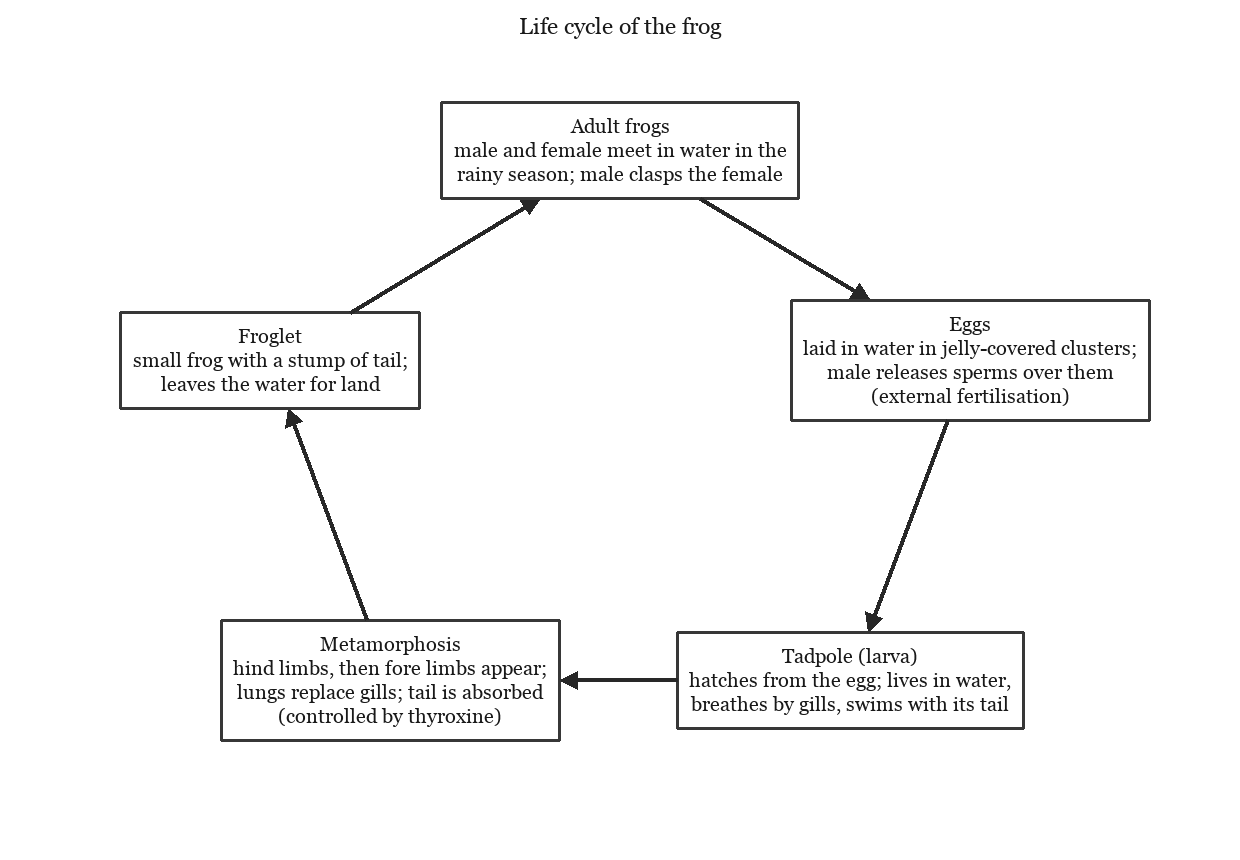
Step 4 — Adaptations for water: The moist skin rich in blood vessels lets the frog breathe dissolved oxygen in water; the webbed toes of the hind limbs help in swimming; the nictitating membrane protects the eyes in water.
Step 5 — Adaptations for land: The lungs and the buccal cavity let it breathe air; the long, muscular hind limbs help it leap; the sticky tongue catches insects; the tympanum picks up sound. In very hot or cold weather it shelters in burrows (aestivation and hibernation), breathing through its skin.
Therefore, the frog's life cycle is egg → tadpole → froglet → adult frog, and its moist skin, lungs, webbed muscular hind limbs and protected eyes let it live both on land and in water.
What Class 11 Biology Ch 30 covers
The sections of the chapter, in the order the book takes them. Every question above comes from one of these.
- 01Systematic Position, Habit and Habitat
- 02External Morphology
- 03Digestive System
- 04Circulatory System
- 05Respiratory System
- 06Excretory System
Class 11 Biology Ch 30 questions students ask
How many questions are there in Class 11 Biology Ch 30?
94 questions. Every one is solved step by step on this page.
Are these Class 11 Biology solutions free?
Yes. Every question and its full working is free to read, with no account needed.
Can I download the Class 11 Biology Ch 30 solutions as a PDF?
There is no PDF to download. Every solution is on this page instead, which means it is searchable, always the current syllabus, and readable on a phone. Use your browser's print option if you want it on paper.