
Question 1105 marksMedium
What is the mechanism of hearing? Make a labelled diagram of the inner ear of humans. How is ear involved in the maintenance of balance and posture?
Confirming your payment
Sign up now and get 250 free tokens.
Neural Control and Coordination · Question 110 of 111
What is the mechanism of hearing? Make a labelled diagram of the inner ear of humans. How is ear involved in the maintenance of balance and posture?
Solution:
Concept: The ear changes sound vibrations into nerve impulses in the cochlea, and its vestibular apparatus senses head position and movement.
Step 1 — Mechanism of hearing: The pinna collects sound waves, which pass down the auditory canal and make the tympanic membrane vibrate. The ear ossicles (malleus, incus, stapes) carry the vibrations to the oval window and raise their pressure about 22 times, because the force collected by the large ear drum is delivered onto the much smaller oval window. The vibrations pass into the perilymph of the vestibular canal and through Reissner's membrane into the endolymph of the middle canal, making the basilar membrane vibrate.
Step 2 — Producing impulses: The movement of the basilar membrane bends the hairs of the hair cells of the organ of Corti against the tectorial membrane. The hair cells produce a receptor potential and release a transmitter, which starts nerve impulses in the fibres of the auditory nerve; the nerve carries them to the auditory area of the cerebrum. Different regions of the basilar membrane respond to different pitches, and the vibrations finally die out at the round window.
Step 3 — Diagram: The labelled membranous labyrinth of the inner ear is drawn below.
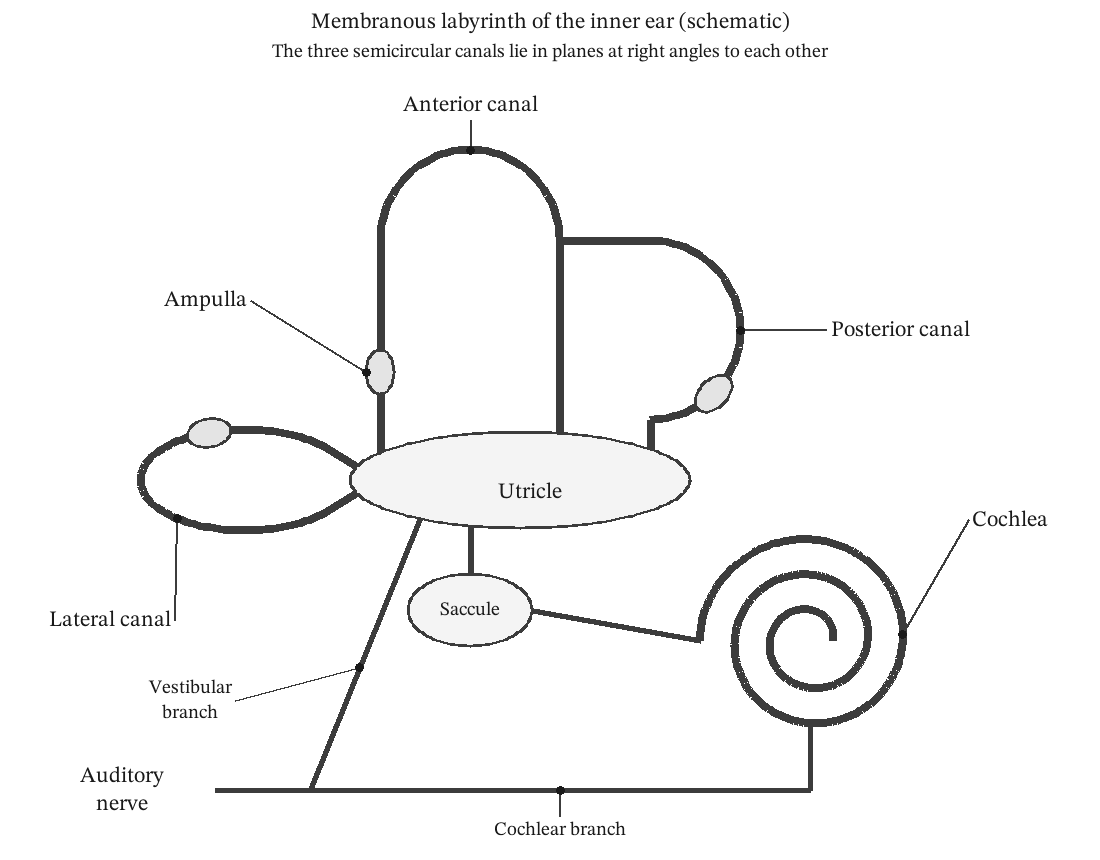
Step 4 — Static balance: The utricle and saccule contain maculae — hair cells covered by a jelly with otoliths; gravity pulls on the otoliths and bends the hairs, so the brain knows the position of the head (static equilibrium).
Step 5 — Dynamic balance: The three semicircular canals lie at right angles to each other; when the head rotates, endolymph moves and pushes the cupula on the crista in each ampulla, bending the hairs, so that impulses about rotation start in the vestibular nerve fibres (dynamic equilibrium). The cerebellum combines these signals with those from the eyes, muscles and joints and adjusts the muscles to keep balance and posture.
Therefore, hearing results from the cochlea's hair cells turning vibrations into signals that start impulses in the auditory nerve, and balance is kept by the utricle and saccule (static) and the semicircular canals (dynamic), coordinated by the cerebellum.