
Question 1095 marksMedium
What is a reflex action? Explain a reflex arc along with a diagram. What is the difference between a conditioned and unconditioned reflex? Give examples of both reflexes.
Confirming your payment
Sign up now and get 250 free tokens.
Neural Control and Coordination · Question 109 of 111
What is a reflex action? Explain a reflex arc along with a diagram. What is the difference between a conditioned and unconditioned reflex? Give examples of both reflexes.
Solution:
Concept: A reflex is a quick, automatic, involuntary response to a stimulus, controlled by the spinal cord or lower parts of the brain.
Step 1 — Reflex action: It is a rapid, automatic and involuntary response to a stimulus that happens without conscious thought, e.g. pulling the hand away from a pin prick or the knee jerk.
Step 2 — Reflex arc: The pathway of a reflex is the reflex arc: receptor (picks up the stimulus) → sensory neuron (carries the impulse through the dorsal root to the spinal cord) → interneuron in the grey matter (in some reflexes, such as the knee jerk, the sensory neuron joins the motor neuron directly) → motor neuron (leaves through the ventral root) → effector muscle or gland, which responds.
Step 3 — Diagram: The reflex arc for a pin prick is shown below.
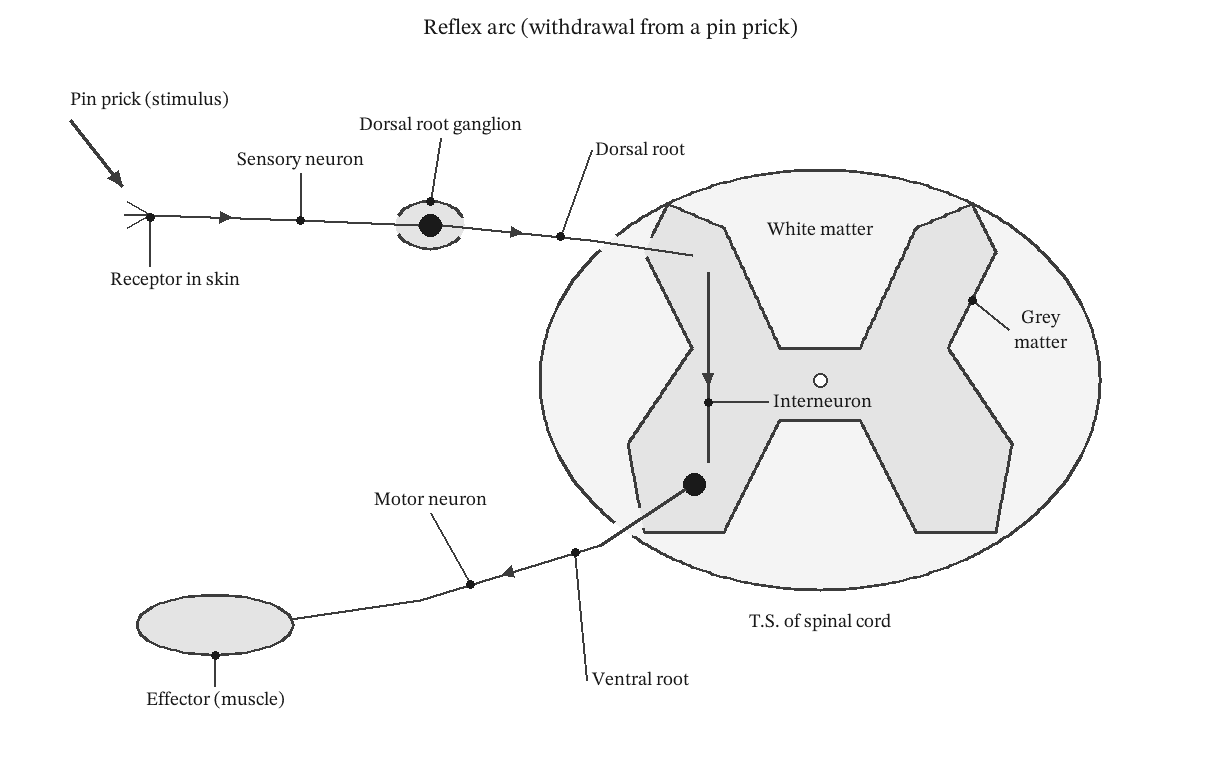
Step 4 — Difference: The table compares the two kinds of reflex.
| Feature | Unconditioned reflex | Conditioned reflex |
|---|---|---|
| Origin | Inborn, present from birth | Acquired by learning and experience |
| Stimulus | Natural stimulus | New stimulus linked with a natural one |
| Permanence | Permanent | Can fade if not reinforced |
Step 5 — Examples: Examples of unconditioned reflexes are salivation when food is tasted, blinking when something comes near the eye, narrowing of the pupil in bright light and the knee jerk. Examples of conditioned reflexes are a dog salivating at the sound of a bell (Pavlov's experiment) and our mouth watering at the sight or smell of tasty food.
Therefore, a reflex is an automatic response through a reflex arc (receptor, sensory neuron, interneuron, motor neuron, effector), unconditioned reflexes being inborn and conditioned reflexes learned.