
Question 715 marksMedium
How is a cardiac impulse conducted in heart? Give the origin and sequence of changes that occur in a cardiac impulse.
Confirming your payment
Sign up now and get 250 free tokens.
Body Fluids and Circulation · Question 71 of 76
How is a cardiac impulse conducted in heart? Give the origin and sequence of changes that occur in a cardiac impulse.
Solution:
Concept: The human heart is myogenic: the impulse arises in special cardiac muscle (nodal tissue) and travels along a conducting system.
Step 1 — Origin: The impulse arises in the SA node, a patch of nodal tissue in the wall of the right atrium near the opening of the superior vena cava. Its cells excite themselves about 70-75 times a minute, so it is the pacemaker.
Step 2 — Spread over the atria: The impulse spreads as a wave over both atria, which contract almost together (atrial systole). It cannot pass directly to the ventricles because a fibrous ring separates atrial and ventricular muscle.
Step 3 — AV node: The AV node, in the lower interatrial septum near the right AV opening, picks up the impulse and delays it for about 0.1 s, so the atria finish emptying before the ventricles contract.
Step 4 — Bundle of His and branches: From the AV node the impulse passes into the bundle of His (AV bundle), which runs down the interventricular septum and divides into right and left bundle branches.
Step 5 — Purkinje fibres: The branches end in the Purkinje fibres, which spread the impulse quickly through the walls of both ventricles, so the ventricles contract together from the apex upwards (ventricular systole).
Step 6 — Flow chart and control: The sequence is shown below. The rate can be changed from outside: the vagus nerve (parasympathetic) slows it, and sympathetic nerves and adrenaline speed it up.
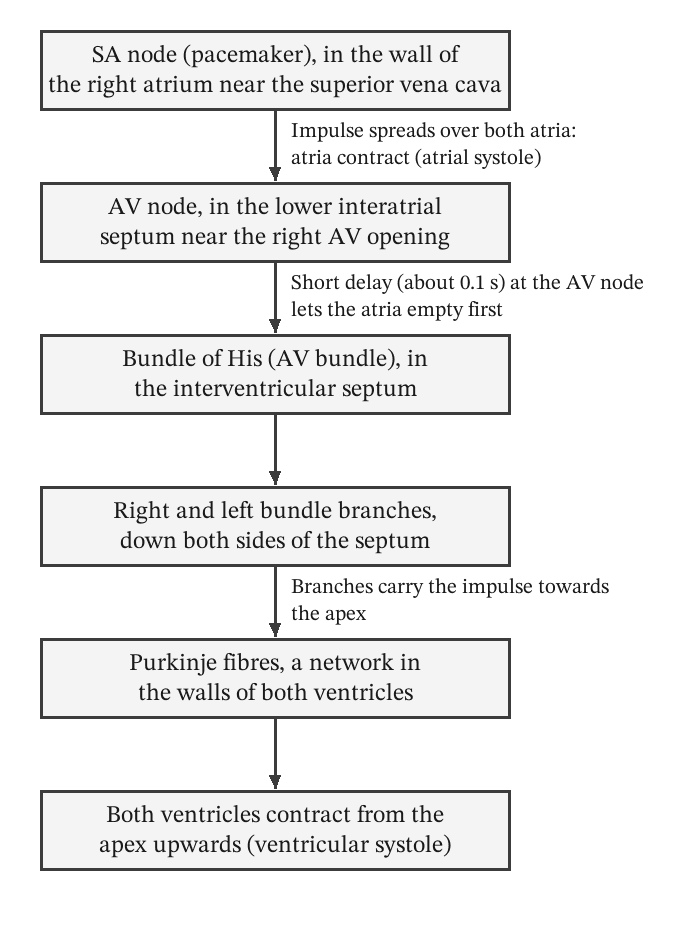
Therefore, the cardiac impulse originates in the SA node and is conducted SA node → atria → AV node → bundle of His → bundle branches → Purkinje fibres → ventricles.