
Question 705 marksMedium
Explain the changes in heart during one cardiac cycle.
Confirming your payment
Sign up now and get 250 free tokens.
Body Fluids and Circulation · Question 70 of 76
Explain the changes in heart during one cardiac cycle.
Solution:
Concept: One cardiac cycle (one heartbeat) lasts about 0.8 s at 72-75 beats per minute and has three phases: atrial systole (0.1 s), ventricular systole (0.3 s) and joint diastole (0.4 s).
Step 1 — Joint diastole (filling): All four chambers are relaxed. Blood flows from the venae cavae and pulmonary veins into the atria and, through the open AV valves, into the ventricles. The semilunar valves are closed. Most ventricular filling happens now.
Step 2 — Atrial systole (about 0.1 s): The SA node fires and the atria contract, pushing the remaining blood (about a fifth to a quarter of the filling) into the ventricles. The ventricles are still relaxed.
Step 3 — Ventricular systole (about 0.3 s): The impulse reaches the ventricles through the AV node, bundle of His and Purkinje fibres, and the ventricles contract. Ventricular pressure rises, the AV valves close (lub), then the semilunar valves open and about 70 mL of blood (stroke volume) is pumped from each ventricle into the aorta and pulmonary trunk. The atria relax and start filling again.
Step 4 — Ventricular diastole: The ventricles relax and their pressure falls below that in the arteries, so the semilunar valves close (dub). When ventricular pressure falls below atrial pressure, the AV valves open and filling begins again: this is the joint diastole (about 0.4 s).
Step 5 — Time bar: The time bar sums up the phases of one cycle.
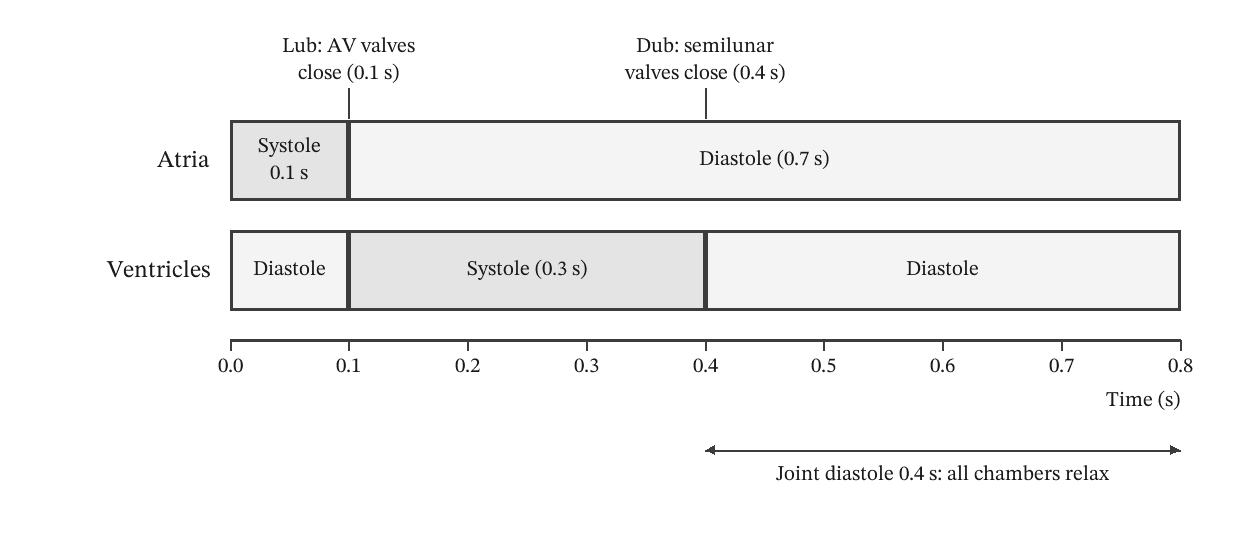
Step 6 — Cardiac output: Each ventricle pumps about 70 mL per beat, so at 72 beats per minute:
Note: Some books give atrial systole 0.15 s and ventricular systole 0.25 s; the cycle is still about 0.8 s.
Therefore, in one cardiac cycle of about 0.8 s the atria contract (0.1 s), the ventricles contract (0.3 s) and all chambers relax together (0.4 s), with lub and dub marking the closure of the AV and semilunar valves.