
Question 373 marksMedium
How is haemoglobin associated with respiration? How does affinity of haemoglobin for oxygen change with fall in pO₂ and high pCO₂?
Confirming your payment
Sign up now and get 250 free tokens.
Breathing and Exchange of Gases · Question 37 of 57
How is haemoglobin associated with respiration? How does affinity of haemoglobin for oxygen change with fall in pO₂ and high pCO₂?
Solution:
Concept: Haemoglobin carries oxygen reversibly, loading it where pO₂ is high and unloading it where pO₂ is low.
Step 1 — Role of haemoglobin: In the lungs each haemoglobin molecule binds up to four O₂ molecules to form oxyhaemoglobin, and carries about 97 % of the O₂ in blood; it also carries about 20–25 % of the CO₂ as carbaminohaemoglobin and buffers the H⁺ formed from CO₂.
Step 2 — Fall in pO₂: Saturation follows an S-shaped (sigmoid) curve: at pO₂ 100 mm Hg haemoglobin is about 97 % saturated, at 40 mm Hg about 75 %, and it is half-saturated at about 27 mm Hg, so as pO₂ falls its hold on oxygen weakens and O₂ is released.
Step 3 — High pCO₂: A high pCO₂ (with more H⁺ and higher temperature) lowers the affinity further and shifts the curve to the right (Bohr effect), so active tissues receive more O₂.
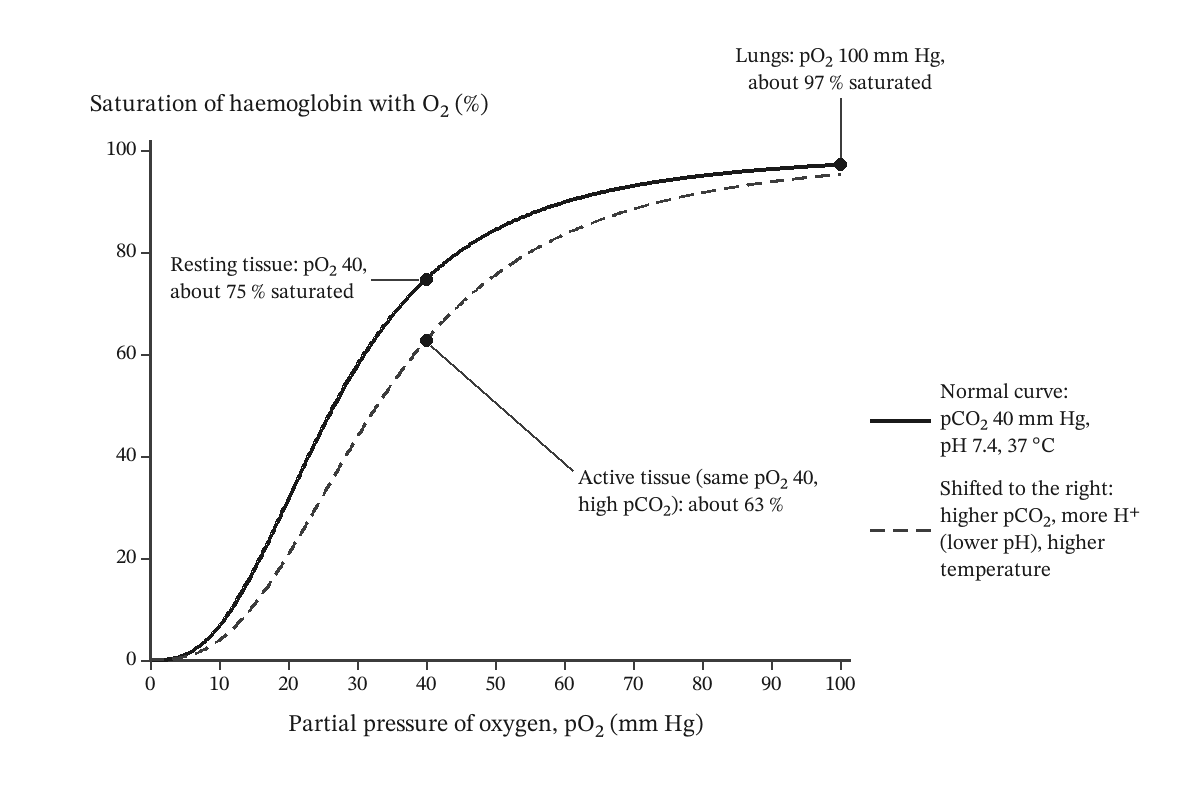
Therefore, haemoglobin carries O₂ (and some CO₂) in respiration, and its affinity for oxygen decreases when pO₂ falls and when pCO₂ is high.