
Question 363 marksMedium
How does exchange of gases take place between the alveolus and blood capillary? Define the term vital capacity.
Confirming your payment
Sign up now and get 250 free tokens.
Breathing and Exchange of Gases · Question 36 of 57
How does exchange of gases take place between the alveolus and blood capillary? Define the term vital capacity.
Solution:
Concept: Gases cross the respiratory membrane only by simple diffusion, down their partial-pressure gradients.
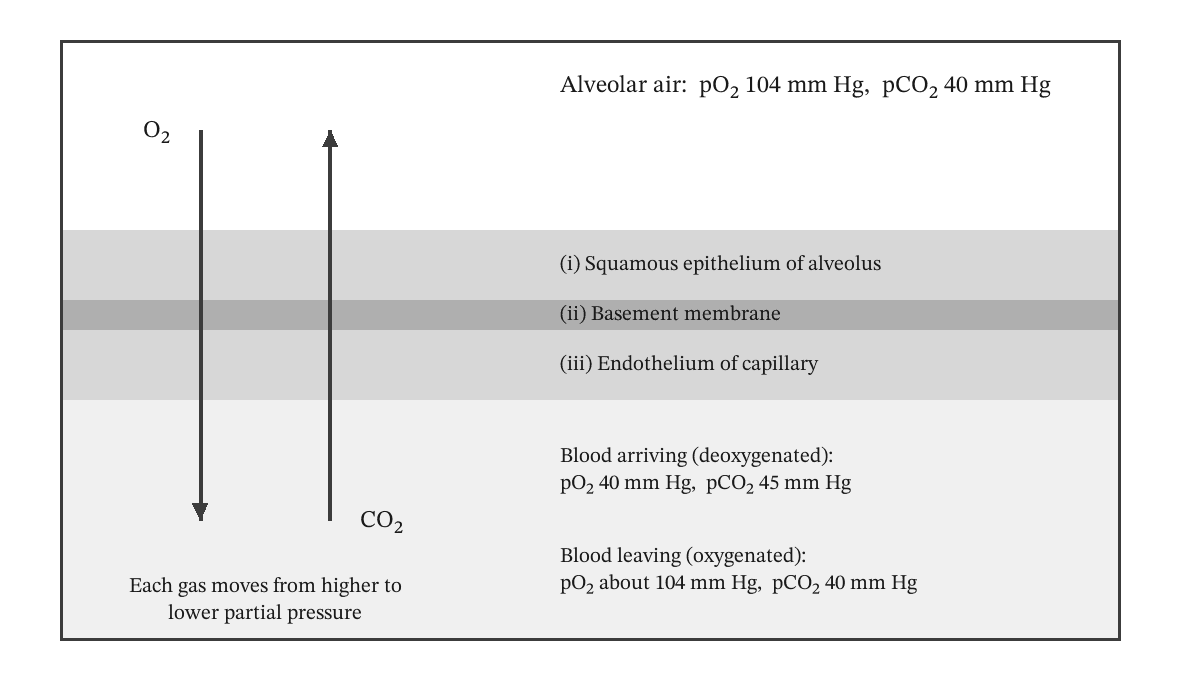
Step 1 — Oxygen: Alveolar air has pO₂ 104 mm Hg, while blood arriving from the body has pO₂ 40 mm Hg, so O₂ diffuses from the alveolus into the capillary blood.
Step 2 — Carbon dioxide: Arriving blood has pCO₂ 45 mm Hg, while alveolar air has pCO₂ 40 mm Hg, so CO₂ diffuses from the blood into the alveolus; it diffuses about 20 times faster than O₂, so even this small gradient is enough. Blood leaving the alveolus has almost the same pO₂ and pCO₂ as alveolar air.
Step 3 — Vital capacity: Vital capacity is the maximum volume of air a person can breathe out after a maximum inspiration (VC = TV + IRV + ERV), about 4000–4600 mL in an adult man.
Therefore, O₂ diffuses from alveolus to blood and CO₂ from blood to alveolus down their partial-pressure gradients, and vital capacity is the maximum air breathed out after a maximum inspiration.