
Question 545 marksMedium
Give causes and symptoms of (i) bronchitis and (ii) emphysema. What is the role of alveoli in respiration? What is vital capacity? How is it different from total lung capacity?
Confirming your payment
Sign up now and get 250 free tokens.
Breathing and Exchange of Gases · Question 54 of 57
Give causes and symptoms of (i) bronchitis and (ii) emphysema. What is the role of alveoli in respiration? What is vital capacity? How is it different from total lung capacity?
Solution:
Concept: Smoking and polluted air damage the bronchi and alveoli, and lung volumes measure how much air can be moved.
Step 1 — (i) Bronchitis: Bronchitis is caused by viral or bacterial infection (acute bronchitis) or by long exposure to cigarette smoke, dust and irritant gases (chronic bronchitis). The bronchi become inflamed and make excess mucus, so the person has a persistent cough with thick greenish-yellow sputum.
Step 2 — (ii) Emphysema: Emphysema is caused mainly by long-term cigarette smoking and air pollutants. The alveolar walls break and lose elasticity, air is trapped in enlarged sacs and the area for exchange falls, so the person has breathlessness, cough and difficulty in breathing out; the damage is permanent.
Step 3 — Role of alveoli: The alveoli (about 300–500 million, area 50–70 m²) are the sites of gas exchange: O₂ diffuses from them into blood and CO₂ from blood into them across a very thin membrane.
Step 4 — Vital capacity: Vital capacity is the maximum volume of air breathed out after a maximum inspiration: VC = TV + IRV + ERV, about 4000–4600 mL.
Step 5 — Difference from TLC: Total lung capacity is the total air in the lungs after a maximum inspiration: TLC = VC + RV, about 5000–6000 mL. So TLC includes the residual volume, which can never be breathed out, while VC does not.
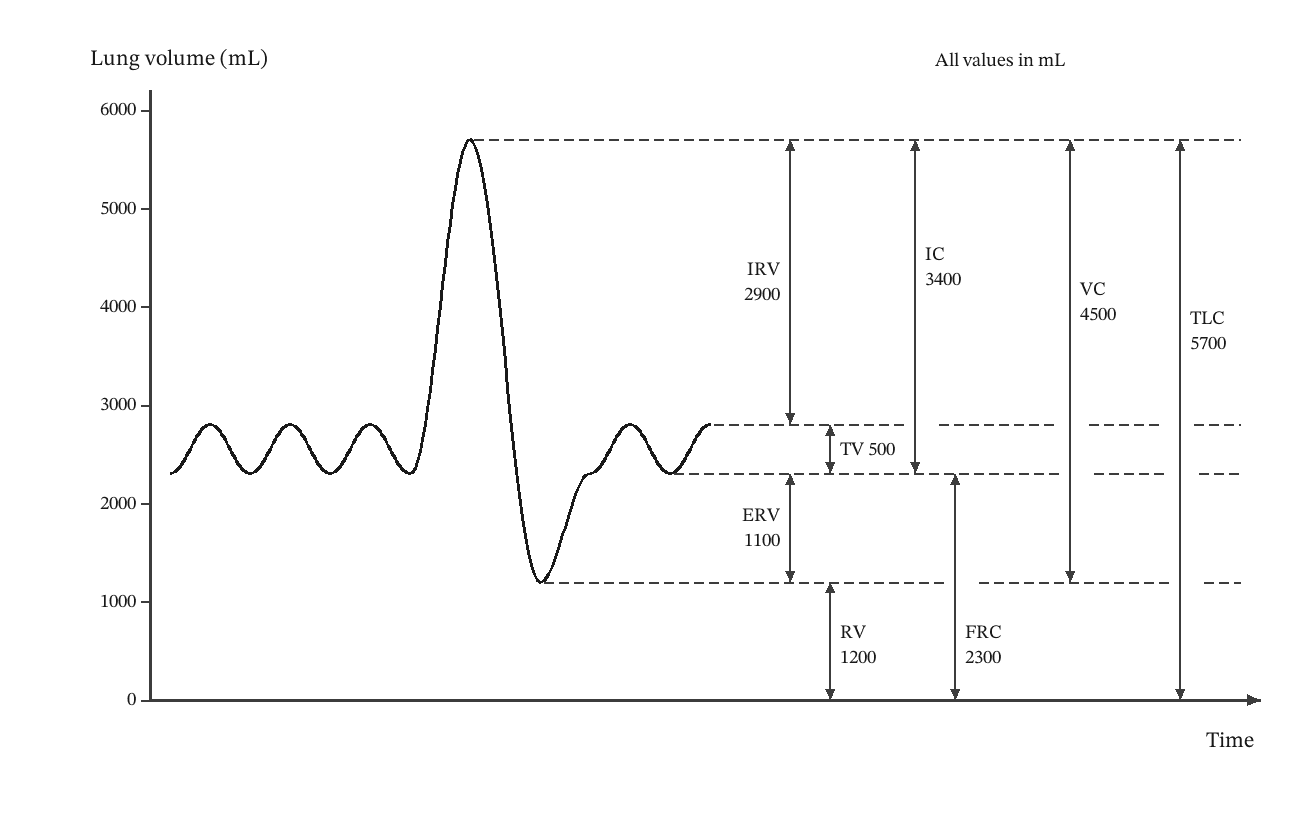
Therefore, bronchitis (infection or smoke) causes mucus and cough, emphysema (smoking) destroys alveolar walls, alveoli are the sites of gas exchange, and vital capacity equals total lung capacity minus residual volume.