Solution:
Concept: Gas exchange in the lungs depends on open airways, a very thin barrier and differences in partial pressure.
Step 1 — Cartilaginous rings: The C-shaped rings of cartilage keep the trachea open, so it does not collapse when the pressure inside falls during inspiration; the open part of each C faces the oesophagus so swallowed food can pass.
Step 2 — Squamous epithelium of alveoli: Flat, very thin squamous cells make the air–blood barrier extremely thin (less than 1 µm), so O₂ and CO₂ can diffuse across quickly.
Step 3 — Exchange along the alveolar surface: Gases cross the three-layered respiratory membrane by simple diffusion: O₂ moves from alveolar air (pO₂ 104 mm Hg) into blood (pO₂ 40 mm Hg), and CO₂ from blood (pCO₂ 45 mm Hg) into alveolar air (pCO₂ 40 mm Hg). CO₂ diffuses about 20 times faster than O₂, so its small gradient is enough.
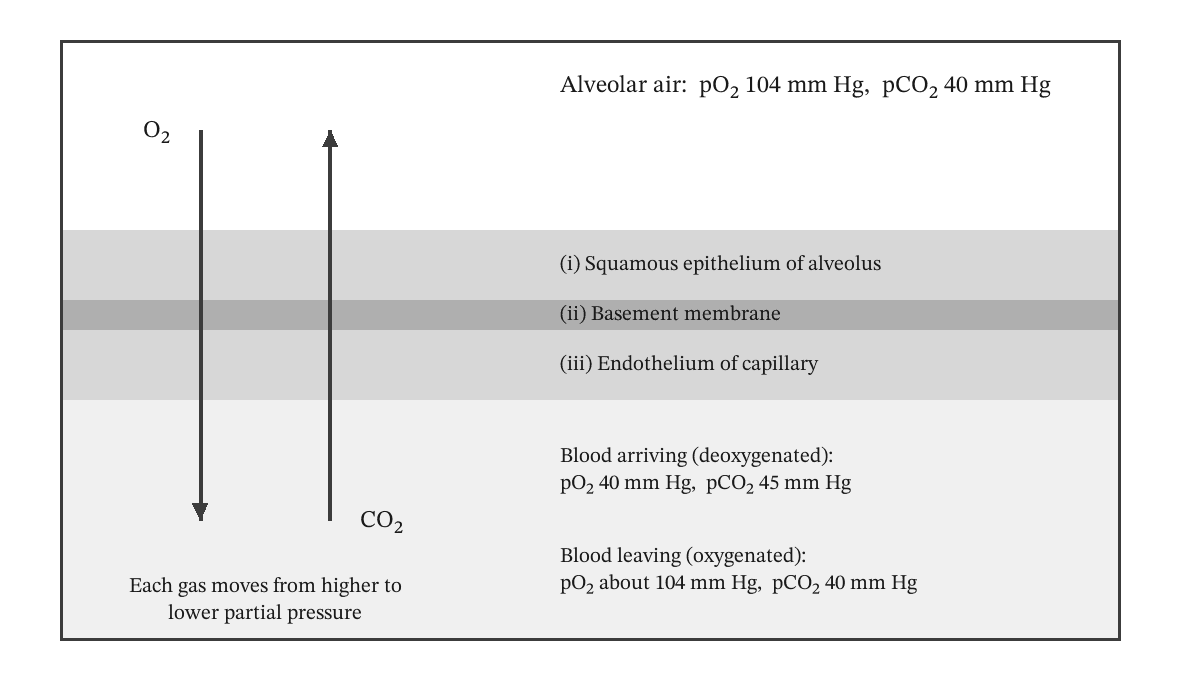
Step 4 — Partial pressures: The table gives the partial pressures (mm Hg) at each place.
| Gas | Atmospheric air | Alveoli | Deoxygenated blood | Oxygenated blood | Tissues |
|---|
| pO₂ | 159 | 104 | 40 | 95 | 40 |
| pCO₂ | 0.3 | 40 | 45 | 40 | 45 |
Step 5 — Result: Blood leaving the alveoli has almost the same pO₂ and pCO₂ as alveolar air, and the gradients are kept up because fresh air keeps entering and blood keeps flowing.
Therefore, cartilage rings keep the trachea open, squamous alveolar cells make diffusion fast, and gases diffuse across the alveolar surface from higher to lower partial pressure.
