
Opening your dashboard
Class 11 Biology Chapter 20: Plant Growth and Development Solutions
58 textbook questions with step-by-step answers, free to read, for ISC 2026-27.
Get talked through Ch 20, not just shown the answer
Reading a finished solution is not the same as being able to do it. The AI tutor takes one question at a time and works it with you, in your own words, until you can.
- Ask it out loud, in your own words
- It gives you the next step, not the answer
- Stuck on part (ii)? Start there
58 questions with solutions
1–5 marks · Mixed difficulty
- 11 mark
Question 1
In a root tip where is the region of cell differentiation?
Solve with AIWritten solution
Solution:
Concept: A growing root tip has three zones one behind the other: cell division, cell elongation and cell differentiation.
Step 1 — What is asked: We need the position of the zone where root cells mature.
Step 2 — The fact: Just behind the root cap is the region of cell division, behind it the region of elongation, and farther back, away from the tip towards the root base, the region of differentiation (maturation), where root hairs and permanent tissues form.
Therefore, the region of cell differentiation lies farthest from the root tip, behind the zone of elongation, towards the root base.
- 21 mark
Question 2
Which are the meristematic regions in the plants?
Solve with AIWritten solution
Solution:
Concept: Growth in plants is confined to meristems, groups of cells that keep dividing.
Step 1 — What is asked: We need the kinds of meristem, named by where they lie.
Step 2 — The fact: Apical meristems lie at root and shoot tips, lateral meristems (vascular cambium and cork cambium) lie along the sides of stems and roots, and intercalary meristems lie at the bases of internodes or leaves.
Therefore, the meristematic regions are apical, lateral and intercalary.
- 31 mark
Question 3
Where does primary growth occur in plants?
Solve with AIWritten solution
Solution:
Concept: Primary growth is growth in length along the plant axis.
Step 1 — What is asked: We need the regions that give growth in length.
Step 2 — The fact: The root and shoot apical meristems lengthen the axis, and intercalary meristems lengthen internodes between the tips and the older parts.
Therefore, primary growth occurs at the apical regions (root and shoot tips) and the intercalary regions.
- 41 mark
Question 4
What is the importance of lateral meristematic region?
Solve with AIWritten solution
Solution:
Concept: Lateral meristems run parallel to the sides of stems and roots.
Step 1 — What is asked: We need the role of the lateral meristems.
Step 2 — The fact: The vascular cambium adds secondary xylem and phloem, and the cork cambium adds cork, so the stem and root become thicker; this is secondary growth, seen in dicots and gymnosperms.
Therefore, the lateral meristematic region brings about secondary growth, that is, increase in girth.
- 51 mark
Question 5
List various phases of growth.
Solve with AIWritten solution
Solution:
Concept: In a growing root or shoot tip, cells pass through three phases one after another.
Step 1 — What is asked: We need the phases a meristematic cell passes through as it grows.
Step 2 — The phases: First the meristematic phase (constant cell division), then the elongation phase (cells enlarge and vacuolate), and last the maturation phase (cells differentiate and reach their permanent size).
Therefore, the phases of growth are the meristematic, elongation and maturation phases.
- 61 mark
Question 6
A sigmoid growth curve has distinct four phases. Name them.
Solve with AIWritten solution
Solution:
Concept: Growth plotted against time gives an S-shaped (sigmoid) curve.
Step 1 — What is asked: We need the four phases of the sigmoid curve in order.
Step 2 — The phases: Growth is slow at first (lag phase), then fast and exponential (log phase), then it slows (decelerating phase) and finally stops (stationary phase).
Therefore, the four phases are the lag, log (exponential), decelerating and stationary phases.
- 71 mark
Question 7
In which stage is the rate of growth maximum?
Solve with AIWritten solution
Solution:
Concept: The rate of growth is the increase in growth per unit time, that is, the slope of the growth curve.
Step 1 — What is asked: We need the phase of the sigmoid curve with the steepest rise.
Step 2 — The fact: In the log (exponential) phase every new cell keeps dividing, so the number of growing cells and hence the rate of growth is the highest.
Therefore, the rate of growth is maximum in the log (exponential) phase.
- 81 mark
Question 8
Name the equipment used to measure rate of growth in a plant.
Solve with AIWritten solution
Solution:
Concept: Growth in length of a shoot is very slow, so it must be magnified to be measured.
Step 1 — What is asked: We need the instrument that measures growth in length of a shoot.
Step 2 — The fact: The auxanometer (for example, the arc auxanometer) magnifies the small increase in length of a shoot through a pulley and pointer on a graduated arc.
Therefore, the auxanometer is used to measure the rate of growth of a plant.
- 91 mark
Question 9
What is dedifferentiation?
Solve with AIWritten solution
Solution:
Concept: Mature (differentiated) plant cells normally stop dividing.
Step 1 — What is asked: We need the meaning of dedifferentiation.
Step 2 — The fact: In plants some living differentiated cells, such as parenchyma, can regain the capacity to divide under certain conditions and become meristematic again.
Therefore, dedifferentiation is the regaining of the capacity to divide by living differentiated cells.
- 101 mark
Question 10
Give one example of dedifferentiation in plants.
Solve with AIWritten solution
Solution:
Concept: Dedifferentiated cells form new meristems from permanent tissue.
Step 1 — What is asked: We need a meristem that arises by dedifferentiation.
Step 2 — The example: The cork cambium arises from mature cortical parenchyma cells, and the interfascicular cambium arises from parenchyma between the vascular bundles; both are meristems for secondary growth.
Therefore, the formation of cork cambium (or interfascicular cambium) from parenchyma is an example of dedifferentiation.
- 111 mark
Question 11
Name a hormone associated with cell division.
Solve with AIWritten solution
Solution:
Concept: The name of this plant hormone itself comes from cytokinesis (cell division).
Step 1 — What is asked: We need the plant growth regulator whose main role is cell division.
Step 2 — The fact: Cytokinins, together with auxins, stimulate cell division in meristems and in tissue culture.
Therefore, cytokinin is the hormone associated with cell division.
- 121 mark
Question 12
Which hormone is associated with senescence or ageing?
Solve with AIWritten solution
Solution:
Concept: Senescence is the last stage of development, when organs age and die.
Step 1 — What is asked: We need the hormone that promotes ageing.
Step 2 — The fact: Ethylene is produced in large amounts by senescing tissues and ripening fruits, and it speeds up ageing of leaves, flowers and fruits.
Therefore, ethylene is the hormone associated with senescence or ageing.
- 131 mark
Question 13
Name the hormones associated with growth inhibiting activities like dormancy and abscission.
Solve with AIWritten solution
Solution:
Concept: Plant growth regulators are grouped as growth promoters and growth inhibitors.
Step 1 — What is asked: We need the growth-inhibiting hormones.
Step 2 — The fact: Abscisic acid (ABA) causes seed and bud dormancy, and ethylene, along with ABA, causes abscission of leaves and fruits.
Therefore, abscisic acid and ethylene are the hormones associated with dormancy and abscission.
- 141 mark
Question 14
Name the growth hormone associated with cell elongation especially shoot tip.
Solve with AIWritten solution
Solution:
Concept: The word auxin comes from the Greek 'auxein', to grow.
Step 1 — What is asked: We need the hormone that elongates cells behind the shoot tip.
Step 2 — The fact: Auxins loosen the walls of young cells behind the apical meristem, so turgor pressure stretches them and the shoot grows taller.
Therefore, auxin is the hormone associated with cell elongation at the shoot tip.
- 151 mark
Question 15
Name a principal naturally occurring auxin present in plants.
Solve with AIWritten solution
Solution:
Concept: The term auxin covers IAA and all natural and synthetic compounds with similar action.
Step 1 — What is asked: We need the main natural auxin.
Step 2 — The fact: Indole-3-acetic acid (IAA) is the principal natural auxin; indole-3-butyric acid (IBA) also occurs naturally.
Therefore, indole-3-acetic acid (IAA) is the principal naturally occurring auxin.
- 161 mark
Question 16
On which plants did Darwin and Francis conduct their experiments?
Solve with AIWritten solution
Solution:
Concept: Charles Darwin and his son Francis (1880) studied the bending of shoots towards light.
Step 1 — What is asked: We need the plants whose seedlings they used.
Step 2 — The fact: They worked on the coleoptiles of germinating canary grass (Phalaris canariensis) and oat (Avena sativa) seedlings lit from one side.
Therefore, Darwin and Francis used the coleoptiles of canary grass (Phalaris) and oat (Avena).
- 171 mark
Question 17
Who conducted the famous Avena curvature test?
Solve with AIWritten solution
Solution:
Concept: A bioassay measures a hormone by the growth response it causes in a living plant part.
Step 1 — What is asked: We need the scientist who devised the Avena curvature test.
Step 2 — The fact: F. W. Went (1928) placed agar blocks that had held oat coleoptile tips on one side of decapitated coleoptiles in the dark; the coleoptiles bent, and the angle of bending was proportional to the amount of auxin in the block. This bioassay is the Avena curvature test.
Note: Winslow Briggs is sometimes named for this test, but he worked in the 1950s on how auxin moves to the shaded side of a lit tip; the curvature test itself is Went's.
Therefore, the Avena curvature test was devised by F. W. Went (1928).
- 181 mark
Question 18
Where are auxins present in the plants?
Solve with AIWritten solution
Solution:
Concept: Auxins are made mainly in actively growing apices.
Step 1 — What is asked: We need the main sites of auxin in a plant.
Step 2 — The fact: Auxins are present in the shoot tip and young leaves, from where they move down to the regions of elongation; they are also found in root tips.
Therefore, auxins are present mainly in the shoot tips and young leaves.
- 191 mark
Question 19
What is naphthalene acetic acid (NAA)?
Solve with AIWritten solution
Solution:
Concept: Auxins may be natural (IAA, IBA) or made in the laboratory.
Step 1 — What is asked: We need the nature of NAA.
Step 2 — The fact: NAA is a synthetic auxin, used to start roots on stem cuttings and to prevent premature fruit drop.
Therefore, NAA (naphthalene acetic acid) is a synthetic auxin.
- 201 mark
Question 20
Name the fungus that causes foolish seedling disease.
Solve with AIWritten solution
Solution:
Key idea: The bakanae ('foolish seedling') disease of rice makes infected seedlings grow abnormally tall, thin and pale, so they fall over and give little or no grain. Japanese workers showed in the 1920s that a substance made by the fungus alone causes these symptoms, and this substance was later named gibberellin after the fungus.
Step 1 — Read what is asked.
We need the name of the fungus that causes the foolish seedling disease of rice.
Step 2 — Recall why the seedlings grow 'foolishly'.
The fungus growing on the rice seedlings secretes gibberellins. These make the internodes of the seedlings elongate far more than normal, so the infected seedlings become much taller and weaker than healthy ones.
Step 3 — Name the fungus.
The fungus is Gibberella fujikuroi, the name of its sexual stage, and the gibberellins were named after this genus. Under the current rule of one name for one fungus, the whole fungus is called Fusarium fujikuroi.
Note: Older books call this fungus Fusarium moniliforme; that name was used loosely for several different fungi and is no longer used, and the bakanae fungus is now named Fusarium fujikuroi.
Therefore, foolish seedling disease of rice is caused by the fungus Gibberella fujikuroi (now named Fusarium fujikuroi).
- 211 mark
Question 21
Where are gibberellins present in the greatest concentration?
Solve with AIWritten solution
Solution:
Key idea: Gibberellins are growth-promoting hormones made in actively growing parts of the plant, such as shoot and root apices, young leaves, buds and embryos. They are needed in large amounts where an embryo and seed are developing.
Step 1 — Read what is asked.
We need the plant part in which gibberellins are present in the greatest concentration.
Step 2 — Recall where gibberellins occur.
Gibberellins are found in root and shoot apices, buds, young leaves and embryos, that is, in parts that are growing actively.
Step 3 — Pick out the richest source.
Their concentration is highest in immature (developing) seeds. For this reason the first gibberellin obtained from a flowering plant was isolated in 1958 from immature seeds of the runner bean.
Therefore, gibberellins are present in the greatest concentration in immature (developing) seeds.
- 221 mark
Question 22
Name the plant hormone that causes bolting in cabbage plants.
Solve with AIWritten solution
Solution:
Key idea: Bolting is the sudden, rapid elongation of the internodes of a rosette plant just before it flowers, so that a tall flowering stalk shoots up from the rosette.
Step 1 — Read what is asked.
We need the plant hormone that makes cabbage plants bolt.
Step 2 — Recall how a cabbage normally grows.
A cabbage grows as a rosette: its internodes stay very short, so the leaves are crowded together into a head. Normally it bolts and flowers only after a cold period (winter).
Step 3 — Name the hormone.
Gibberellins (such as GA₃) make the cells of the internodes divide and elongate. When cabbage is treated with gibberellins, the internodes lengthen suddenly and the plant bolts and flowers even without the cold period.
Therefore, gibberellins (such as GA₃) cause bolting in cabbage plants.
- 231 mark
Question 23
What is the effect of gibberellins on buds?
Solve with AIWritten solution
Solution:
Key idea: A dormant bud stays inactive even when conditions are suitable. Dormancy is controlled by a balance between abscisic acid, which keeps buds dormant, and gibberellins, which act against it.
Step 1 — Read what is asked.
We need the effect of gibberellins on buds.
Step 2 — Recall what keeps buds dormant.
Abscisic acid (ABA) builds up in buds before an unfavourable season and keeps them dormant.
Step 3 — State the effect of gibberellins.
Gibberellins act against ABA and break bud dormancy, so the buds sprout and grow. For example, the dormant buds ('eyes') of potato tubers sprout earlier when the tubers are treated with gibberellins.
Therefore, gibberellins break the dormancy of buds, so the buds sprout and grow.
- 241 mark
Question 24
What happens if sugarcane crop is sprayed with gibberellins?
Solve with AIWritten solution
Solution:
Key idea: Sugarcane stores its sugar (sucrose) in the stem. Gibberellins make internodes elongate, so they increase the length of the stem.
Step 1 — Read what is asked.
We need the effect of spraying a sugarcane crop with gibberellins.
Step 2 — Recall the action of gibberellins on stems.
Gibberellins make the cells of the internodes elongate, so the internodes and therefore the whole stem become longer.
Step 3 — Link the longer stem to the yield.
Because sugar is stored in the stem, a longer stem stores more sugar. Spraying sugarcane with gibberellins therefore raises the yield, by as much as about 20 tonnes per acre.
Therefore, a gibberellin spray increases the length of the sugarcane stem, so more sugar is stored and the yield increases.
- 251 mark
Question 25
Name the active ingredient taken out of coconut milk.
Solve with AIWritten solution
Solution:
Key idea: The 'milk' of the coconut here means coconut water, the liquid endosperm of the coconut. In the 1940s it was found that adding it to culture media makes plant tissues and embryos divide and grow.
Step 1 — Read what is asked.
We need the active growth substance obtained from coconut milk.
Step 2 — Recall what coconut milk does.
Coconut milk added to a tissue-culture medium makes the cells divide, so the tissue forms a growing mass (callus). A substance that promotes cell division in this way is a cytokinin.
Step 3 — Name the active ingredient.
The active substance of coconut milk is a natural cytokinin, mainly of the zeatin type (zeatin and its riboside).
Therefore, the active ingredient taken out of coconut milk is a cytokinin (of the zeatin type).
- 261 mark
Question 26
What is the basic function that cytokinin performs?
Solve with AIWritten solution
Solution:
Key idea: Cytokinins are plant hormones whose natural forms are derivatives of the base adenine. Their name comes from cytokinesis, the division of the cytoplasm during cell division.
Step 1 — Read what is asked.
We need the basic (main) function of cytokinins.
Step 2 — Recall how cytokinins were discovered.
Cytokinins were discovered as substances that make cultured plant tissue divide, and they were named after cytokinesis because of this effect.
Step 3 — State the function.
The basic function of cytokinins is to promote cell division. They do this together with auxins; in tissue culture, tissue such as tobacco pith divides actively only when both hormones are supplied.
Therefore, the basic function of cytokinin is to promote cell division (cytokinesis).
- 271 mark
Question 27
In which parts of plants, the cytokinins are produced?
Solve with AIWritten solution
Solution:
Key idea: Natural cytokinins are made in regions where cells divide rapidly, because their main job is to promote cell division.
Step 1 — Read what is asked.
We need the parts of the plant in which cytokinins are produced.
Step 2 — List the sites of production.
Cytokinins are produced in root apices, developing shoot buds, young fruits, seeds and embryos, all of which are regions of rapid cell division.
Step 3 — Add how they reach other parts.
In a mature plant most cytokinin is made in the root tips. From there it moves upwards in the xylem sap to the shoot and the leaves.
Therefore, cytokinins are produced in root apices, developing shoot buds, young fruits, seeds and embryos, mainly in the root tips of a mature plant.
- 281 mark
Question 28
If cytokinin is sprayed on cabbage and lettuce leaves, what will happen?
Solve with AIWritten solution
Solution:
Key idea: After harvest a leaf ages quickly: its chlorophyll and proteins are broken down and it turns yellow. Cytokinins delay this ageing (senescence).
Step 1 — Read what is asked.
We need the effect of spraying cytokinin on cabbage and lettuce leaves.
Step 2 — Recall what happens to a harvested leaf.
A harvested leaf no longer receives cytokinin from the roots, so it breaks down its chlorophyll and proteins, turns yellow and wilts within a few days.
Step 3 — State the effect of the spray.
Cytokinin keeps protein synthesis going and stops chlorophyll from breaking down, so the sprayed leaves stay green and fresh for longer. This delay of leaf senescence extends their shelf life.
Therefore, the cabbage and lettuce leaves remain green and fresh longer, so their shelf life is extended.
- 291 mark
Question 29
Name a plant hormone that exists in gaseous state.
Solve with AIWritten solution
Solution:
Key idea: Most plant hormones are substances dissolved in the cell sap, but one plant hormone is a simple gas that spreads through the air spaces of the plant and around it.
Step 1 — Read what is asked.
We need a plant hormone that exists as a gas.
Step 2 — Name the hormone.
Ethylene (C₂H₄) is the gaseous plant hormone. It is a simple hydrocarbon made by almost all plant tissues.
Step 3 — Note where it is given off most.
Ripening fruits and ageing (senescent) tissues give off large amounts of ethylene. Being a gas, it can also act on fruits and plants nearby.
Therefore, ethylene (C₂H₄) is a plant hormone that exists in the gaseous state.
- 301 mark
Question 30
What is the effect of ethylene on fruits?
Solve with AIWritten solution
Solution:
Key idea: Ripening makes a fruit soft, sweet, coloured and aromatic. In fruits such as banana, tomato, apple and mango it begins with a burst of respiration (the climacteric).
Step 1 — Read what is asked.
We need the effect of ethylene on fruits.
Step 2 — State the main effect.
Ethylene induces fruit ripening. It raises the rate of respiration and starts the changes of ripening: starch turns to sugar, the fruit softens, and its colour and aroma develop.
Step 3 — Add the other effect on fruits.
Ethylene also promotes the abscission (fall) of fruits, and fruits are ripened commercially by exposing them to ethylene or to ethephon, which releases it.
Therefore, ethylene induces the ripening of fruits (and also promotes fruit fall).
- 311 mark
Question 31
Which plant hormone is released from an injured or over–ripe fruit and brings ripening of other fruits?
Solve with AIWritten solution
Solution:
Key idea: Ripening and wounded tissues make much more ethylene than healthy unripe tissues, and ethylene is a gas, so it can pass from one fruit to the fruits around it.
Step 1 — Read what is asked.
We need the hormone released from an injured or over-ripe fruit that brings about ripening of other fruits.
Step 2 — Recall why such a fruit releases it.
Injury and over-ripening both raise ethylene production sharply, so an injured or over-ripe fruit gives off a lot of ethylene gas.
Step 3 — Explain how it ripens other fruits.
The gas spreads to the fruits kept with it, especially in a closed bag or box, and makes them start ripening and producing ethylene themselves. This is why one over-ripe fruit can quickly ripen a whole basket.
Therefore, ethylene is the hormone released from an injured or over-ripe fruit, and it brings about ripening of other fruits.
- 321 mark
Question 32
Give two important roles of abscisic acid.
Solve with AIWritten solution
Solution:
Key idea: Abscisic acid (ABA) is a growth-inhibiting hormone that helps the plant survive unfavourable conditions such as drought and winter.
Step 1 — Read what is asked.
We need two important roles of abscisic acid.
Step 2 — Give the first role: closing stomata.
During drought ABA builds up in the leaves and causes closure of stomata. With the stomata closed, the plant loses much less water by transpiration.
Step 3 — Give the second role: inducing dormancy.
ABA induces dormancy of seeds and buds. Dormant seeds and buds can survive a cold or dry season and grow again when conditions improve.
Note: ABA was named for its supposed role in leaf and fruit abscission, but ethylene is now known to be the main promoter of abscission; ABA works along with it.
Therefore, abscisic acid closes the stomata under water stress and induces dormancy of seeds and buds.
- 331 mark
Question 33
Where is ABA found in plants?
Solve with AIWritten solution
Solution:
Key idea: Abscisic acid (ABA) is a growth-inhibiting hormone. It builds up in mature and ageing parts of the plant and in parts under stress.
Step 1 — Read what is asked.
We need the parts of the plant in which ABA is found.
Step 2 — State where ABA is found.
ABA occurs in almost all parts of the plant, but it is found in the largest amounts in mature leaves, ripening fruits and maturing seeds, where it helps to make the seeds dormant.
Step 3 — Add the effect of stress.
Under water stress the level of ABA rises sharply in the leaves and roots, which is how it signals the stomata to close.
Therefore, ABA is found mainly in mature leaves, fruits and seeds, and its level rises in leaves and roots under water stress.
- 341 mark
Question 34
Name two hormones that are antagonistic in action.
Solve with AIWritten solution
Solution:
Key idea: Two hormones are antagonistic when one promotes a process and the other inhibits the same process, so the result depends on the balance between them.
Step 1 — Read what is asked.
We need two hormones that act against each other.
Step 2 — Recall a process both hormones control.
Seed and bud dormancy is controlled by two hormones: abscisic acid induces dormancy and keeps seeds and buds inactive, while gibberellins break dormancy and make them grow.
Step 3 — Give a second process with the same pair.
In germinating cereal grains, gibberellins make the aleurone layer form α-amylase to digest the stored starch, while ABA blocks this. The same two hormones again act in opposite directions.
Therefore, abscisic acid and gibberellins are antagonistic in action.
- 351 mark
Question 35
Which hormones promote activity of each other?
Solve with AIWritten solution
Solution:
Key idea: Hormones act synergistically when each promotes the activity of the other, so together they give a greater effect than either alone.
Step 1 — Read what is asked.
We need hormones that promote each other's activity.
Step 2 — Give the main synergistic pair.
Auxins and gibberellins together promote stem elongation much more than either of them alone. They also act together in the differentiation of xylem.
Step 3 — Give another synergistic pair.
Auxins and cytokinins act together in cell division: cultured tissue such as tobacco pith divides actively only when both are supplied.
Therefore, auxins and gibberellins promote each other's activity (and auxins with cytokinins in cell division).
- 361 mark
Question 36
To promote flowering in pineapples, which hormones are the plants sprayed with?
Solve with AIWritten solution
Solution:
Key idea: Growers want all the pineapple plants of a field to flower at the same time, so that the fruits ripen together and can be harvested in one go. Some growth regulators can start flowering in this way.
Step 1 — Read what is asked.
We need the hormones sprayed on pineapple plants to promote flowering.
Step 2 — Name the hormones.
Auxins such as NAA (naphthalene acetic acid) sprayed on pineapple plants induce flowering, so the whole crop flowers together.
Step 3 — Explain how the spray works.
Auxin sprays act largely by making the pineapple plant release ethylene, and ethylene is the direct trigger of flowering in pineapple.
Note: Ethylene, applied as ethephon, also initiates flowering and synchronises fruit set in pineapple, and it is the treatment mostly used by growers today.
Therefore, pineapple plants are sprayed with auxins (such as NAA) to promote flowering.
- 371 mark
Question 37
Name a hormone that brings about seedless fruits by parthenocarpy.
Solve with AIWritten solution
Solution:
Key idea: Parthenocarpy is the development of a fruit without fertilisation, so the fruit has no seeds. Normally hormones made by the developing seeds make the ovary grow into a fruit, and a sprayed hormone can take their place.
Step 1 — Read what is asked.
We need a hormone that gives seedless fruits by parthenocarpy.
Step 2 — Name the hormone.
Gibberellins induce parthenocarpy, for example in apple, pear and grapes, so these fruits develop without seeds.
Step 3 — Add the other hormone that does this.
Auxins sprayed on flowers also induce parthenocarpy, for example in tomato.
Therefore, gibberellins (and also auxins) bring about seedless fruits by parthenocarpy.
- 381 mark
Question 38
Which hormone brings the stomatal closure during severe drought condition?
Solve with AIWritten solution
Solution:
Key idea: Under severe drought the plant must cut down its loss of water, and most water is lost through open stomata.
Step 1 — Read what is asked.
We need the hormone that closes the stomata during severe drought.
Step 2 — Name the hormone.
The hormone is abscisic acid (ABA). Its level rises sharply in the roots and leaves when the soil dries out.
Step 3 — Explain how it closes the stomata.
ABA makes the guard cells lose potassium ions and then water, so the guard cells lose turgor and the stomata close. Transpiration falls and the plant saves water.
Therefore, abscisic acid (ABA) brings about stomatal closure during severe drought.
- 391 mark
Question 39
From which plant was the first naturally occurring cytokinin identified? What was it named?
Solve with AIWritten solution
Solution:
Key idea: The first cytokinin discovered, kinetin (1955), was obtained from autoclaved herring-sperm DNA, not from a plant. Scientists therefore went on to look for the cytokinin that plants make themselves.
Step 1 — Read what is asked.
We need the plant from which the first naturally occurring cytokinin was identified, and its name.
Step 2 — Name the plant.
In 1963 the first natural cytokinin was identified from the immature grains (kernels) of maize (corn), Zea mays.
Step 3 — Name the cytokinin.
It was named zeatin, after the genus Zea from which it was obtained.
Note: Kinetin is not a normal plant cytokinin; only traces of it have since been reported in some plant tissues.
Therefore, the first naturally occurring cytokinin was identified from maize, Zea mays, and was named zeatin.
- 401 mark
Question 40
Name a selective weed killer.
Solve with AIWritten solution
Solution:
Key idea: A selective weed killer (herbicide) kills some kinds of plants and spares others, so it can be sprayed on a crop to remove the weeds growing in it.
Step 1 — Read what is asked.
We need the name of a selective weed killer.
Step 2 — Name the weed killer.
2,4-D (2,4-dichlorophenoxyacetic acid) is a synthetic auxin used as a selective weed killer.
Step 3 — Explain why it is selective.
At weed-killing doses 2,4-D causes uncontrolled, abnormal growth in broad-leaved (dicot) plants, which then die. Cereals and other monocots such as wheat, maize and rice are hardly affected, so 2,4-D removes dicot weeds from cereal fields.
Therefore, 2,4-D (2,4-dichlorophenoxyacetic acid) is a selective weed killer.
- 411 mark
Question 41
Why is abscisic acid also known as stress hormone?
Solve with AIWritten solution
Solution:
Key idea: Stress means unfavourable conditions such as drought, waterlogging, salinity or cold. A stress hormone is one whose level rises under such conditions and helps the plant cope with them.
Step 1 — Read what is asked.
We need the reason why abscisic acid is called the stress hormone.
Step 2 — Recall how ABA responds to stress.
The production of ABA rises sharply when the plant faces stress such as drought, waterlogging or cold.
Step 3 — State what ABA does under stress.
ABA closes the stomata, so less water is lost, and it switches on changes that increase the plant's tolerance of the stress. It also induces dormancy of seeds and buds, which helps them survive an unfavourable season.
Therefore, abscisic acid is called the stress hormone because its level rises under stress and it closes the stomata and increases the plant's tolerance of the stress.
- 422 marks
Question 42
Where are auxins, cytokinins and abscisic acid present in plants? Why does oat coleoptile turn towards light?
Solve with AIWritten solution
Solution:
Key idea: Each plant hormone is made in particular regions of the plant. Phototropic bending happens because auxin from the tip is shifted to the shaded side, so the two sides grow at different rates.
Step 1 — Read what is asked.
The question has two parts: where auxins, cytokinins and abscisic acid are present, and why an oat coleoptile turns towards light.
Step 2 — State where auxins are present.
Auxins are present in the growing apices: mainly the shoot tips and young leaves, and also the root tips.
Step 3 — State where cytokinins are present.
Cytokinins are present in regions of rapid cell division: root apices, developing shoot buds, young fruits, seeds and embryos.
Step 4 — State where abscisic acid is present.
Abscisic acid (ABA) occurs in most parts of the plant, but mainly in mature leaves, fruits and seeds.
Step 5 — Explain why the coleoptile bends towards light.
The tip of the oat coleoptile senses light coming from one side. Auxin made in the tip moves sideways towards the shaded side and is then carried down the coleoptile. The cells on the shaded side therefore receive more auxin and elongate more than the cells on the lit side, so the coleoptile curves towards the light. This bending is called positive phototropism.
Therefore, auxins are present in shoot tips and young leaves, cytokinins in root apices, buds, young fruits and seeds, and ABA mainly in mature leaves, fruits and seeds; the oat coleoptile turns towards light because more auxin on its shaded side makes that side grow faster.
- 432 marks
Question 43
Why does growth rate decrease after the exponential increase? Define the terms differentiation and dedifferentiation.
Solve with AIWritten solution
Solution:
Key idea: In the exponential (log) phase every new cell keeps dividing, so growth is fastest. This cannot go on for ever, because the supply of nutrients and space is limited.
Step 1 — Read what is asked.
We must explain why the growth rate falls after the exponential phase, and define differentiation and dedifferentiation.
Step 2 — Explain why the growth rate decreases.
As the plant, organ or culture grows, nutrients, water and space become limiting. At the same time many cells mature and lose the ability to divide, and other internal and external factors begin to limit growth. The growth rate therefore falls (decelerating phase), and finally growth stops (stationary phase).
Step 3 — Define differentiation.
Differentiation is the process by which cells formed by meristems mature and change in structure to perform specific functions. For example, a cell that becomes a tracheid loses its protoplasm and develops a thick, lignified wall to carry water.
Step 4 — Define dedifferentiation.
Dedifferentiation is the process by which living differentiated cells, which had lost the capacity to divide, regain it. For example, parenchyma cells of the cortex regain the power to divide and form the cork cambium.
Therefore, the growth rate falls after the exponential phase because nutrients and space become limiting and many cells stop dividing; differentiation is the maturing of cells for specific functions, and dedifferentiation is the regaining of the power to divide by differentiated cells.
- 442 marks
Question 44
What was the reason of the shoot tip showing growth when coleoptile tips were removed and agar block was kept? Name the scientist who performed this experiment.
Solve with AIWritten solution
Solution:
Key idea: A coleoptile whose tip has been cut off grows very little, because the substance that makes its cells elongate comes from the tip.
Step 1 — Read what is asked.
We must give the reason why the cut coleoptile grew when an agar block was kept on it, and name the scientist who did this experiment.
Step 2 — Describe the experiment.
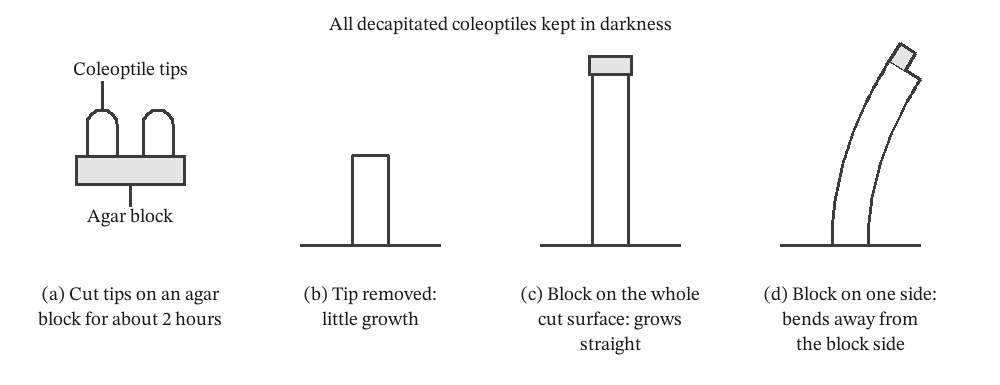
Coleoptile tips of oat seedlings were cut off and kept on an agar block for some time. The tips were then thrown away, and the block alone was placed on a decapitated coleoptile (stump) kept in the dark. The figure shows the set-up and the results.
Step 3 — Give the reason for the growth.
While the tips stood on the agar, a growth-promoting chemical (auxin) diffused from the tips into the agar. When the block was placed on the stump, the chemical passed down into the stump and made its cells elongate, so the stump grew even in the dark. A block placed on one side of the cut surface made that side grow more, so the stump bent away from that side.
Step 4 — Name the scientist.
The experiment was performed by the Dutch botanist F. W. Went (1928). He called the substance a 'growth substance'; the name auxin (from the Greek word for 'to grow') was given to it soon afterwards, in 1931.
Therefore, the stump grew because auxin had diffused from the tips into the agar block and then into the stump, and the experiment was performed by F. W. Went.
- 452 marks
Question 45
Why was the chemical 2,4-D used during war? What happens when cabbage is treated with gibberellins?
Solve with AIWritten solution
Solution:
Key idea: The chemical 2,4-D is a synthetic auxin. At high doses it kills broad-leaved (dicot) plants by causing uncontrolled growth. Gibberellins make internodes elongate.
Step 1 — Read what is asked.
The question has two parts: why 2,4-D was used during a war, and what happens when cabbage is treated with gibberellins.
Step 2 — Explain the use of 2,4-D in war.
During the Vietnam War, in the 1960s, 2,4-D mixed with 2,4,5-T, a mixture called Agent Orange, was sprayed from the air as a defoliant. It made broad-leaved trees and shrubs drop their leaves and die, which stripped away the forest cover that hid opposing forces and destroyed their food crops.
Step 3 — Note the harm it caused.
The 2,4,5-T in Agent Orange was contaminated with the highly toxic dioxin TCDD, which caused lasting harm to people and the environment. For this reason 2,4,5-T has since been banned in most countries, while 2,4-D is still used as a weed killer.
Step 4 — Explain the effect of gibberellins on cabbage.
Cabbage grows as a rosette with very short internodes. Gibberellins make the internodes elongate suddenly, so the plant bolts (forms a tall flowering stalk) and flowers, even without the cold period it normally needs.
Therefore, 2,4-D (in Agent Orange) was used in war as a defoliant to strip forests of their leaves, and cabbage treated with gibberellins bolts and flowers.
- 462 marks
Question 46
How is the shelf life of harvested crops increased? What will happen if terminal bud of a plant is broken?
Solve with AIWritten solution
Solution:
Key idea: Harvested crops lose quality because their leaves age (senesce) and their stored organs sprout. The terminal bud controls the lateral buds through the auxin it makes.
Step 1 — Read what is asked.
The question has two parts: how the shelf life of harvested crops is increased, and what happens when the terminal bud of a plant is broken.
Step 2 — Explain how cytokinins increase shelf life.
Harvested leafy vegetables such as cabbage, lettuce and celery are treated with cytokinins. Cytokinins delay senescence: chlorophyll and proteins are not broken down, so the leaves stay green and fresh for longer.
Step 3 — Add how stored tubers are kept.
Stored potato tubers would sprout and shrivel. Treating them with the methyl ester of NAA (a synthetic auxin) keeps their buds dormant, so the tubers keep well in store.
Note: MENA (the methyl ester of NAA) is the classic textbook example of a potato sprout inhibitor; large potato stores today mostly control sprouting with other approved sprout suppressants, together with a controlled storage temperature.
Step 4 — Explain what happens when the terminal bud is broken.
The terminal bud makes auxin that suppresses the growth of the lateral buds; this is called apical dominance. When the terminal bud is broken, this suppression ends, so the axillary (lateral) buds grow into branches and the plant becomes bushy.
Therefore, the shelf life of harvested crops is increased by treating them with cytokinins (and stored potatoes with the methyl ester of NAA), and breaking the terminal bud makes the lateral buds grow into branches.
- 473 marks
Question 47
Explain various phases of a sigmoid plant growth curve.
Solve with AIWritten solution
Solution:
Key idea: When growth (size, weight or cell number) of a plant, organ or cell population is plotted against time, an S-shaped (sigmoid) curve is obtained. The curve has four phases, as described below.
Step 1 — Read what is asked.
We must explain the phases of the sigmoid growth curve.
Step 2 — Look at the shape of the curve.
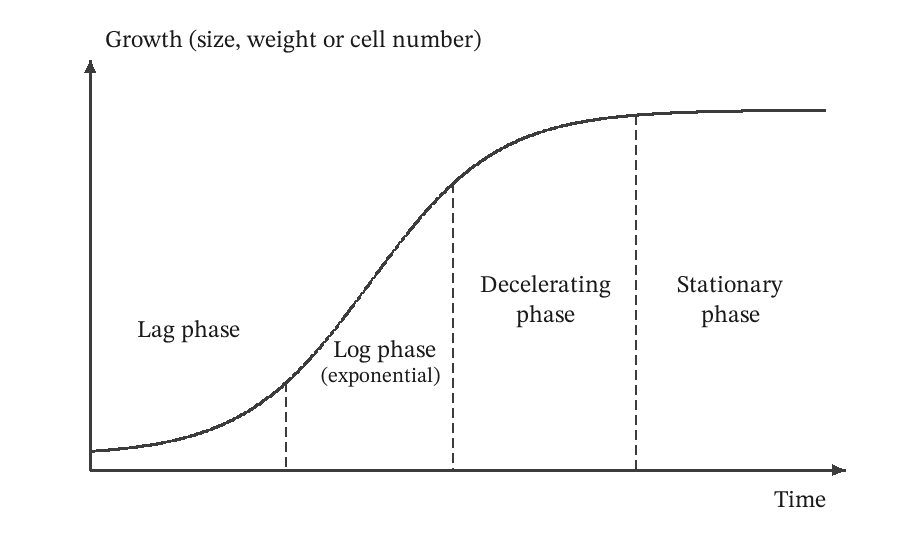
Plotted against time, growth first rises slowly, then steeply, and finally levels off, which gives the curve its S shape. The figure marks the four phases on the curve.
Step 3 — Explain the lag phase.
In the lag phase growth is slow, because only a few cells are dividing and the system is still getting ready to grow.
Step 4 — Explain the log (exponential) phase.
In the log phase growth is rapid and exponential, and the growth rate reaches its highest value, because every new cell keeps dividing. Growth in this phase follows the law
Here W₀ is the initial size, W₁ the size after time t, r the relative growth rate and e the base of natural logarithms.
Step 5 — Explain the decelerating phase.
In the decelerating phase the growth rate falls, because nutrients and space become limiting and many cells mature and stop dividing.
Step 6 — Explain the stationary phase.
In the stationary phase growth stops and the size stays constant, because a limiting factor such as the supply of nutrients or space has been fully reached.
Therefore, a sigmoid growth curve has a slow lag phase, a fast exponential log phase, a decelerating phase in which the rate falls, and a stationary phase in which growth stops.
- 483 marks
Question 48
What is an auxanometer? How is it used?
Solve with AIWritten solution
Solution:
Key idea: Growth in length of a shoot is too slow to see directly, so an instrument magnifies it and shows it on a scale.
Step 1 — Read what is asked.
We must say what an auxanometer is and how it is used.
Step 2 — Define the auxanometer.
An auxanometer is an instrument used to measure the rate of growth in length of a shoot. A common type is the arc auxanometer; a self-recording type, which draws the growth on a rotating drum, is called an auxograph.
Step 3 — Describe the set-up.
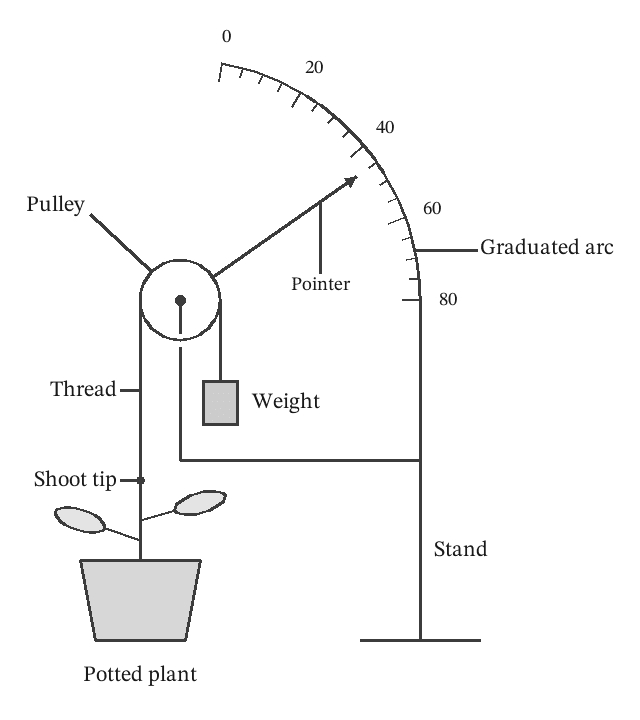
A thread is tied to the shoot tip of a potted plant and passed over a small pulley. A weight hangs from the other end of the thread to keep it tight. A long pointer fixed to the pulley moves over a graduated arc, as the figure shows.
Step 4 — Explain how it is used.
As the shoot grows taller, the thread slackens at the tip, so the weight descends and turns the pulley. The pointer turns with the pulley and moves along the arc. Because the pointer is much longer than the radius of the pulley, its tip moves many times farther than the shoot grows, so the growth is magnified.
Step 5 — Find the rate of growth.
The arc is read at the start and at the end of a known time. The distance moved by the pointer tip, divided by the magnification (pointer length ÷ pulley radius), gives the actual growth, and dividing this by the time gives the rate of growth.
Therefore, an auxanometer is an instrument that measures the rate of growth in length of a shoot, using a thread, pulley and long pointer that magnify the growth on a graduated arc.
- 493 marks
Question 49
Name the phytohormones involved in growth promoting activities. Give one important use of each one of these.
Solve with AIWritten solution
Solution:
Key idea: The growth-promoting phytohormones are auxins, gibberellins and cytokinins. They take part in cell division, cell enlargement, tropic growth, flowering, fruiting and seed formation.
Step 1 — Read what is asked.
We must name the growth-promoting phytohormones and give one important use of each.
Step 2 — Name auxins and give a use.
Auxins include the natural IAA and IBA and the synthetic NAA and 2,4-D. Auxins such as IBA and NAA are applied to stem cuttings to start root formation, which is used for vegetative propagation.
Step 3 — Name gibberellins and give a use.
Gibberellins include GA₃ (gibberellic acid). Sprayed on sugarcane, they lengthen the stem, so more sugar is stored and the yield rises by as much as about 20 tonnes per acre.
Step 4 — Name cytokinins and give a use.
Cytokinins include kinetin and zeatin. They delay senescence, so they are used to extend the shelf life of harvested leafy vegetables such as lettuce and cabbage.
Therefore, the growth-promoting phytohormones are auxins (rooting of stem cuttings), gibberellins (longer sugarcane stems and higher yield) and cytokinins (longer shelf life of leafy vegetables).
- 503 marks
Question 50
Name a gaseous phytohormone. Give its two important functions.
Solve with AIWritten solution
Solution:
Key idea: Ethylene (C₂H₄) is a simple gas. It is made by almost all plant tissues, and in large amounts by ripening fruits and ageing tissues.
Step 1 — Read what is asked.
We must name the gaseous phytohormone and give two of its important functions.
Step 2 — Name the hormone.
The gaseous phytohormone is ethylene.
Step 3 — Give the first function: fruit ripening.
Ethylene induces fruit ripening, for example in banana, apple and tomato. It raises the rate of respiration at the start of ripening, and fruits are ripened commercially by exposing them to ethylene or spraying them with ethephon, which releases ethylene.
Step 4 — Give the second function: abscission and senescence.
Ethylene is the main hormone that promotes abscission of leaves, flowers and fruits, with abscisic acid working along with it, and it speeds up senescence.
Step 5 — Add its other effects.
Ethylene also breaks seed and bud dormancy. In dark-grown dicot seedlings it inhibits stem elongation, makes the stem swell and causes the seedlings to grow horizontally with a tight apical hook.
Therefore, the gaseous phytohormone is ethylene; it induces fruit ripening and promotes abscission and senescence of leaves, flowers and fruits.
- 513 marks
Question 51
Explain the terms (i) senescence (ii) abscission (iii) apical dominance.
Solve with AIWritten solution
Solution:
Key idea: Senescence, abscission and apical dominance are three processes in plants, each controlled by plant growth regulators.
Step 1 — Read what is asked.
We must explain the three terms (i) senescence, (ii) abscission and (iii) apical dominance.
Step 2 — Explain (i) senescence.
Senescence is the ageing phase at the end of the development of a cell, organ or whole plant. Chlorophyll, proteins and RNA are broken down, and the part finally dies. Ethylene promotes senescence and cytokinins delay it.
Step 3 — Explain (ii) abscission.
Abscission is the shedding of leaves, flowers or fruits. An abscission zone forms at the base of the organ, enzymes such as cellulase and pectinase dissolve the walls of a layer of cells in this zone, and the organ falls off; a protective layer then seals the scar. Ethylene, with ABA, promotes abscission, while auxin from a young organ prevents it.
Step 4 — Explain (iii) apical dominance.
Apical dominance is the suppression of the growth of the lateral (axillary) buds by the terminal bud, caused mainly by the auxin it produces. When the terminal bud is removed, the lateral buds grow into branches; cytokinins act against apical dominance.
Therefore, senescence is the ageing of a cell, organ or plant that ends in death, abscission is the shedding of leaves, flowers or fruits through an abscission zone, and apical dominance is the suppression of lateral buds by the terminal bud.
- 522 marks
Question 52
Differentiate between: Arithmetic and Geometric growth
Solve with AIWritten solution
Solution:
Key idea: In arithmetic growth, after each division only one daughter cell keeps dividing while the other differentiates. In geometric growth, all the daughter cells keep dividing.
Step 1 — Read what is asked.
We must differentiate between arithmetic growth and geometric growth.
Step 2 — Compare the two kinds of growth.
The table compares them point by point.
Feature Arithmetic growth Geometric growth Cell division Only one daughter cell divides again; the other differentiates Both daughter cells continue to divide Rate of increase The same amount added in every unit of time Increase in proportion to the size already present Graph against time Straight line Exponential curve; sigmoid when growth becomes limited Example Root elongating at a constant rate Early embryo; cells in a culture Step 3 — Write the law of arithmetic growth.
Arithmetic growth follows the law
Here Lₜ is the length at time t, L₀ the length at time zero and r the growth rate per unit time.
Step 4 — Write the law of geometric growth.
Geometric growth follows the law
Here W₀ and W₁ are the initial and final sizes, r the relative growth rate, t the time and e the base of natural logarithms. The two graphs are shown below.

Therefore, arithmetic growth adds a constant amount in each unit of time (a straight-line graph), while geometric growth increases the size in proportion to the size already present (an exponential curve).
- 532 marks
Question 53
Differentiate between: Cell expansion and Cell differentiation
Solve with AIWritten solution
Solution:
Key idea: A new cell formed by a meristem first enlarges (cell expansion) and then becomes specialised for a particular job (cell differentiation).
Step 1 — Read what is asked.
We must differentiate between cell expansion and cell differentiation.
Step 2 — Compare the two processes.
The table compares them point by point.
Feature Cell expansion Cell differentiation Nature of change Quantitative: increase in size or volume Qualitative: change in structure and function How it happens Water uptake, vacuolation and loosening of the wall under turgor Changes in wall (thickening, lignification) and in protoplasm (some cells lose the nucleus) Region of root or shoot Zone of elongation Zone of maturation Example Elongating cells behind the root tip A cell becoming a tracheid Step 3 — Sum up the main difference.
Cell expansion changes only how big the cell is, while cell differentiation changes what the cell is like and what it does.
Therefore, cell expansion is an increase in cell size, while cell differentiation is a change in cell structure for a specific function.
- 542 marks
Question 54
Differentiate between: Primary and Secondary growth
Solve with AIWritten solution
Solution:
Key idea: Primary growth lengthens the plant axis (root and stem), while secondary growth thickens it.
Step 1 — Read what is asked.
We must differentiate between primary growth and secondary growth.
Step 2 — Compare the two kinds of growth.
The table compares them point by point.
Feature Primary growth Secondary growth Meristem Apical and intercalary meristems Lateral meristems: vascular cambium and cork cambium Direction Increase in length Increase in girth (thickness) Occurs in All plants Mainly dicots and gymnosperms Tissues formed Primary tissues Secondary xylem, secondary phloem and cork Step 3 — Sum up the main difference.
Primary growth is made by meristems at the tips and nodes and adds length, while secondary growth is made by meristems along the sides and adds girth.
Therefore, primary growth is growth in length by apical and intercalary meristems, while secondary growth is growth in girth by lateral meristems.
- 552 marks
Question 55
Differentiate between: Differentiation and Dedifferentiation
Solve with AIWritten solution
Solution:
Key idea: Plant cells can lose the ability to divide when they become specialised, and some of them can later regain it.
Step 1 — Read what is asked.
We must differentiate between differentiation and dedifferentiation.
Step 2 — Compare the two processes.
The table compares them point by point.
Feature Differentiation Dedifferentiation Meaning Meristematic cells mature to perform specific functions Differentiated cells regain the power of division Capacity to divide Lost Regained Result Permanent tissues New meristems Example Tracheids formed from cambial cells Cork cambium and interfascicular cambium formed from parenchyma Step 3 — Sum up the main difference.
The two processes go in opposite directions: differentiation takes away the power to divide, while dedifferentiation gives it back.
Therefore, differentiation turns dividing cells into specialised permanent cells, while dedifferentiation makes permanent cells divide again.
- 562 marks
Question 56
Differentiate between: Cytokinins and Ethylene
Solve with AIWritten solution
Solution:
Key idea: Cytokinins mainly promote growth, while ethylene mainly inhibits growth and promotes ageing.
Step 1 — Read what is asked.
We must differentiate between cytokinins and ethylene.
Step 2 — Compare the two hormones.
The table compares them point by point.
Feature Cytokinins Ethylene Chemical nature Mostly adenine derivatives, e.g. kinetin, zeatin A simple gas, C₂H₄ Main role Promote cell division Promote fruit ripening and abscission Effect on leaf ageing Delay senescence; leaves stay green Speed up senescence Produced in Root apices, shoot buds, young fruits, seeds Almost all tissues, most in ripening fruits and ageing tissues Step 3 — Sum up the main difference.
Cytokinins keep tissues young and dividing, while ethylene brings on ripening and ageing.
Therefore, cytokinins promote cell division and delay ageing, while ethylene is a gas that ripens fruits and speeds up ageing and abscission.
- 575 marks
Question 57
Give functions of all those hormones associated with the increased growth of the plants.
Solve with AIWritten solution
Solution:
Key idea: The hormones that increase growth are the growth promoters: auxins, gibberellins and cytokinins.
Step 1 — Read what is asked.
We must give the functions of all the hormones that increase the growth of plants.
Step 2 — Give the main functions of auxins.
Auxins elongate cells behind the shoot tip by loosening their walls, and they start roots on stem cuttings.
Step 3 — Give the other effects of auxins.
Auxins maintain apical dominance, prevent premature abscission of young leaves and fruits, cause parthenocarpy (for example in tomato) and promote fruit growth.
Step 4 — Give the effects of gibberellins on stem growth.
Gibberellins cause internode elongation. They make genetic dwarfs of pea and maize that cannot make enough gibberellin grow to normal height, lengthen sugarcane stems and cause bolting in rosette plants such as cabbage.
Step 5 — Give the effects of gibberellins on seeds, buds and fruits.
Gibberellins break seed and bud dormancy; in germinating cereal grains the embryo's gibberellins make the aleurone layer form α-amylase, which digests the stored starch. They also induce parthenocarpy and increase the size of grape berries and the length of their bunches.
Step 6 — Give the functions of cytokinins.
Cytokinins promote cell division (together with auxins) and cell differentiation in tissue culture. They promote the growth of lateral buds against apical dominance, help break dormancy of some seeds and delay leaf senescence.
Step 7 — Explain how these hormones work together.
These hormones often act synergistically: auxins with gibberellins in stem elongation, and cytokinins with auxins in cell division. In a callus, a higher cytokinin-to-auxin ratio gives shoots and a higher auxin-to-cytokinin ratio gives roots.
Therefore, auxins elongate cells and start roots, gibberellins elongate internodes and break dormancy, and cytokinins promote cell division and delay ageing, often acting together to increase growth.
- 585 marks
Question 58
What is senescence? How does it occur in various plants?
Solve with AIWritten solution
Solution:
Key idea: The development of a plant runs from germination of the seed to senescence, the final ageing phase.
Step 1 — Read what is asked.
We must define senescence and describe how it occurs in different plants.
Step 2 — Define senescence.
Senescence is the ageing phase at the end of the life of a cell, organ or whole plant. Its deteriorative changes end in death.
Step 3 — Describe the changes in the cells.
During senescence chlorophyll breaks down, so leaves turn yellow, and proteins and RNA are broken down. The food and minerals released move to young parts, seeds and storage organs.
Step 4 — Describe whole-plant senescence in annuals.
In annual plants such as wheat, rice and mustard, the whole plant dies after flowering and fruiting. This is called whole-plant (overall) senescence.
Step 5 — Describe top senescence in some perennials.
In some perennials, such as banana and gladiolus, the shoot above the ground dies each year while the underground parts stay alive and send up new shoots. This is called top (shoot) senescence.
Step 6 — Describe leaf senescence in perennials.
In deciduous trees all the leaves senesce and fall together at the onset of winter or a dry season (simultaneous or deciduous senescence). In evergreen plants the older leaves age and fall one after another while new leaves keep forming (progressive or sequential senescence).
Step 7 — Describe senescence of flowers and fruits.
Petals wither soon after pollination, and fruit ripening is itself a senescence process with a burst of respiration.
Step 8 — Explain how hormones control senescence.
Ethylene promotes senescence and abscission, and ABA works along with it. Cytokinins delay leaf senescence, and gibberellins delay the senescence of some fruits.
Therefore, senescence is the ageing phase that ends in death; it affects the whole plant in annuals, the aerial shoot in some perennials, all the leaves together in deciduous trees and older leaves one by one in evergreens, as well as flowers and fruits, and it is controlled by ethylene, ABA and cytokinins.
What Class 11 Biology Ch 20 covers
The sections of the chapter, in the order the book takes them. Every question above comes from one of these.
- 01Growth
- 02Growth Rates
- 03Conditions and Measurement of Growth
- 04Differentiation, Dedifferentiation and Redifferentiation
- 05Development
- 06Plant Growth Regulators
More ways to study this chapter
The same chapter asked three other ways. Practise it, revise it, and see what the board has set on Ch 20 before.
Class 11 Biology Ch 20 questions students ask
How many questions are there in Class 11 Biology Ch 20?
58 questions. Every one is solved step by step on this page.
Are these Class 11 Biology solutions free?
Yes. Every question and its full working is free to read, with no account needed.
Can I download the Class 11 Biology Ch 20 solutions as a PDF?
There is no PDF to download. Every solution is on this page instead, which means it is searchable, always the current syllabus, and readable on a phone. Use your browser's print option if you want it on paper.