
Opening your dashboard
Class 11 Biology Chapter 20 Plant Growth and Development: Practice Questions
109 questions on Chapter 20, each worked through on its own page with the AI tutor. Class 11 Biology, ICSE 2026-27.
109 questions
1–4 marks · Mixed difficulty
- 12 marks
Question 1
Ten pea seeds were soaked and left to germinate in complete darkness for 6 days. (Hypothetical data.)
Measurement (10 seeds or seedlings) Day 0 Day 6 Fresh mass 3.0 g 9.5 g Dry mass 2.6 g 2.2 g (a) Why did the fresh mass rise so much?
(b) The seedlings were clearly growing, yet their dry mass fell. Explain why.
- 21 mark
Question 2
Which one of the following shows an unlimited (indeterminate) pattern of growth?
- 31 mark
Question 3
The leaves of lawn grass are cut short by a mower every week, yet each leaf blade keeps growing longer from its base. Which meristem is mainly responsible for this regrowth?
- 43 marks
Question 4
Cross-sections are cut from the trunks of two trees of the same age: a deodar from the hills of Himachal Pradesh, which has cold winters, and an evergreen tree from a tropical forest of Kerala, where the climate is warm all year.
(a) What is a growth ring, and which meristem forms it?
(b) Why are the rings of the deodar distinct and easy to count?
(c) Why may the rings of the tropical tree be faint or fused?
- 53 marks
Question 5
The figure shows the outline of a growing root tip with three regions marked X, Y and Z.
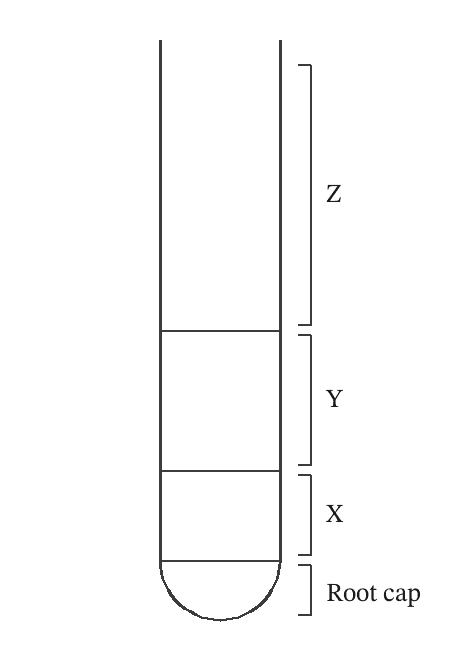
Name the regions X, Y and Z, and give one feature of the cells found in each.
- 61 mark
Question 6
A coconut palm and a mango tree of the same age grow side by side. Over the years both grow taller, but only the mango trunk becomes much thicker each year. Which statement best explains this?
- 73 marks
Question 7
Cells just behind a root tip can become several times longer within a few hours, although they form very little new cytoplasm.
(a) What force pushes the walls outward as such a cell enlarges?
(b) What part does the vacuole play?
(c) Why is this enlargement counted as growth even though the number of cells does not change?
- 81 mark
Question 8
In a section of a growing shoot, a student sees a band of cells that are much larger than those near the apex, with large vacuoles, and are laying down new cell wall material. Which phase of growth are these cells in?
- 93 marks
Question 9
The dry mass of two seedlings, P and Q, was measured at the start and end of the same 5 days. (Hypothetical data.)
Seedling Dry mass on day 0 Dry mass on day 5 P 2.0 g 3.0 g Q 20.0 g 21.5 g Take the relative growth rate as the absolute growth rate divided by the dry mass at the start.
(a) Find the absolute growth rate of each seedling.
(b) Find the relative growth rate of each seedling.
(c) Which seedling is growing more efficiently? Why does the absolute growth rate alone mislead here?
- 101 mark
Question 10
A root grows at a constant rate. Its length is 4 cm at the start and 13 cm after 6 days. (Hypothetical data.) If the rate stays the same, what will its length be after 10 days from the start?
- 113 marks
Question 11
A suspension culture of plant cells grows geometrically according to . It starts with cells per mL and has cells per mL after 6 days. (Hypothetical data.)
(a) Calculate the relative growth rate per day (take ).
(b) Assuming the culture stays in its exponential phase, how many cells per mL will it have 8 days from the start?
(c) Why can this rate not continue for many weeks in the same flask?
- 121 mark
Question 12
A population of cells is growing geometrically, with every new cell able to divide again. Which quantity stays constant while this exponential growth continues?
- 132 marks
Question 13
Two growing systems were measured every day. (Hypothetical data.)
Day 0 1 2 3 4 Length of root X (mm) 3 5 7 9 11 Cells in algal culture Y 1000 2000 4000 8000 16000 State whether each system shows arithmetic or geometric growth, giving the evidence from the table.
- 142 marks
Question 14
In the early embryo of a flowering plant every cell divides, but later only the cells of certain regions keep dividing while the others stop dividing and mature.
(a) Name the type of growth seen in each of these two stages.
(b) Explain why the growth rate behaves differently in the two stages.
- 154 marks
Question 15
The dry mass of a young plant was measured at the start of each week. (Hypothetical data.)
Week 0 1 2 3 4 5 Dry mass (g) 1.0 2.0 4.0 7.5 10.5 12.5 Take the relative growth rate for a week as the mass gained in that week divided by the mass at the start of that week.
(a) Find the absolute growth rate (g per week) for each of the five weeks.
(b) In which week was the absolute growth rate highest?
(c) Find the relative growth rate in the first week and in the fifth week.
(d) Why does the relative growth rate fall even while the plant is still gaining mass?
- 161 mark
Question 16
The area of a leaf increased from 20 cm² to 26 cm² in 3 days. (Hypothetical data.) Taking the relative growth rate as the daily increase in area divided by the area at the start, what was the leaf's relative growth rate?
- 171 mark
Question 17
Two sets of bean seedlings of the same age are grown for 10 days, set P in a dark cupboard and set Q on a sunny window-sill, with equal water. The P seedlings become taller than Q but are thin and pale yellow with tiny leaves. Which statement best explains the appearance of set P?
- 182 marks
Question 18
After heavy rain, a maize field stayed waterlogged for a week, and the young plants almost stopped growing, although they had plenty of water and the soil was rich in nutrients. Explain why growth slowed, linking your answer to one condition necessary for growth.
- 193 marks
Question 19
In an arc auxanometer, a thread tied to the tip of a potted shoot passes over a pulley and carries a small weight. A long pointer fixed to the centre of the pulley turns with it and moves over a graduated arc. In one such instrument the pulley has a radius of 1.5 cm and the pointer is 30 cm long. Over 48 hours the tip of the pointer moved 12 cm along the arc. (Hypothetical data.)
(a) How many times does the pointer magnify the movement of the thread?
(b) By how much did the shoot grow in the 48 hours?
(c) Find the growth rate of the shoot in cm per day.
- 203 marks
Question 20
Batches of the same seedlings were grown at different temperatures, with all other conditions kept the same, and their average shoot growth was recorded. (Hypothetical data.)
Temperature (°C) 10 20 30 40 48 Growth (cm per day) 0.2 0.8 1.4 0.7 0.0 (a) At which of these temperatures did the seedlings grow fastest?
(b) Why was growth so slow at 10 °C?
(c) Suggest why there was no growth at 48 °C.
- 212 marks
Question 21
Suggest the most suitable way to measure growth in each case, and give a reason:
(a) a culture of the alga Chlorella growing in a flask;
(b) a watermelon fruit enlarging on its plant.
- 221 mark
Question 22
Small pieces of pith parenchyma from a tobacco stem, whose cells had stopped dividing, were placed on a nutrient medium. After some weeks the cells had started dividing again and formed an undifferentiated mass called callus. What does the formation of callus show?
- 233 marks
Question 23
A tracheid begins as a living cell produced by a meristem and ends as a water-conducting element of the xylem.
(a) Describe two major changes the cell goes through as it differentiates.
(b) Explain how each change suits it to carry water over long distances.
- 243 marks
Question 24
In an old dicot stem, the following changes happen one after another:
(a) Living parenchyma cells of the cortex, which had long stopped dividing, start dividing again and form a cork cambium.
(b) The cork cambium divides repeatedly.
(c) The cells it produces on the outside mature into cork cells and stop dividing.
Name the process (differentiation, dedifferentiation or redifferentiation) seen in steps (a) and (c), and explain what step (b) shows about the cells of the cork cambium.
- 251 mark
Question 25
Cells produced by the same root apical meristem become root-cap cells if they come to lie at the very tip of the root, but become epidermal cells if they come to lie towards the outside of the root. What does this show?
- 261 mark
Question 26
The first leaves formed by a young cotton plant differ clearly in shape from the leaves it forms when it is mature, although the plant grows in the same field all along. What does this show?
- 272 marks
Question 27
Several cuttings were taken from one plant of an aquatic species. Half were grown fully under water and half with their shoots in the air. The new leaves formed under water were finely divided, while those formed in air were broad.
(a) Name the ability shown by the plant and the term for having such different leaf forms.
(b) Why can these differences not be due to the cuttings having different genes?
- 282 marks
Question 28
The stages in the life of a single plant cell are given below in a jumbled order:
mature cell; senescence; meristematic cell; expansion (elongation); death; differentiation and maturation
Arrange them in the correct sequence, and say what the term development includes.
- 291 mark
Question 29
A mango leaf reaches its full size, works for many months making food, then gradually turns yellow, loses its proteins and chlorophyll, and finally falls. In terms of development, what is the yellowing stage called?
- 301 mark
Question 30
Plant growth regulators are small molecules of very different chemical nature. Which pairing of a regulator with its chemical nature is correct?
- 311 mark
Question 31
The figure shows the set-up of an experiment of the kind first done by Charles Darwin and his son Francis on canary-grass coleoptiles lit from one side.
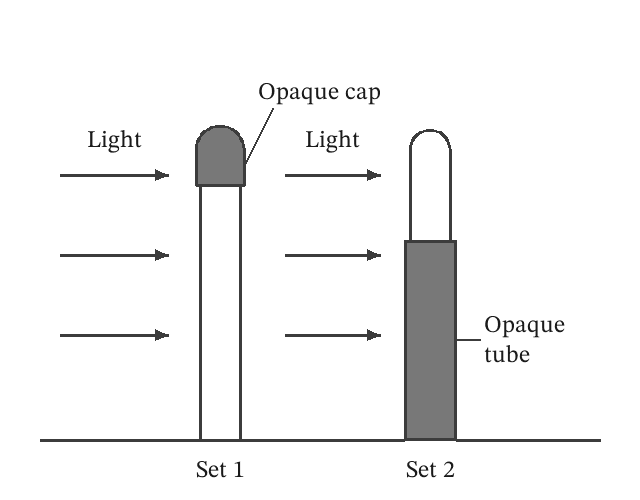
After some hours the coleoptiles of Set 1 were still straight, while those of Set 2 had bent towards the light. What do these results show?
- 323 marks
Question 32
Pieces of callus from tobacco pith were placed on four media for six weeks. (Hypothetical data.)
Medium Auxin (IAA), mg per L Cytokinin (kinetin), mg per L Result 1 0 0 Callus hardly grew 2 2.0 0.2 Roots formed 3 0.2 2.0 Shoots formed 4 2.0 2.0 Callus grew but stayed undifferentiated (a) Work out the auxin : cytokinin ratio in media 2 and 3, and state the rule the results suggest.
(b) What does medium 1 show about the need for these hormones?
(c) A callus on medium 3 has formed many shoots but no roots. To which medium should the shoots be moved next, and why?
- 331 mark
Question 33
A farmer sprays 2,4-D on a wheat field that is also infested with bathua (Chenopodium, a broad-leaved dicot weed) and wild oat (a grass weed). Which result is expected?
- 343 marks
Question 34
In malting, barley grains are soaked and allowed to germinate so that the starch in them is turned into sugars, which brewers then use. Brewers often add a little gibberellic acid to the soaked grains.
(a) Describe how gibberellins bring about the breakdown of starch in a germinating cereal grain.
(b) Explain why adding gibberellic acid speeds up malting.
- 353 marks
Question 35
A grower sprayed a dilute auxin solution on tomato flowers that had not been pollinated. Fruits developed normally but contained no seeds.
(a) What is this kind of fruit development called?
(b) Why do the fruits have no seeds?
(c) Suggest how the auxin made the fruit develop.
- 361 mark
Question 36
A forestry nursery wants its young conifer trees to reach maturity sooner so that they produce seeds early. Which regulator would be sprayed on the juvenile conifers?
- 373 marks
Question 37
A student repeats the kind of experiment E. Kurosawa did in 1926 on the foolish seedling (bakanae) disease of rice. The fungus that causes the disease was grown in a liquid culture medium, and the fungus was then filtered out. Three batches of healthy rice seedlings were sprayed:
Batch 1: with the fungus-free filtrate;
Batch 2: with fresh culture medium in which the fungus had never grown;
Batch 3: with plain water.
Only the Batch 1 seedlings grew abnormally tall and thin, like diseased plants.
(a) What conclusion can be drawn?
(b) Why was Batch 2 needed?
(c) Why was it important that the fungus itself was filtered out?
- 381 mark
Question 38
Discs cut from the same green leaf were floated in the dark for 5 days on three liquids. Discs on water turned yellow, discs on a kinetin solution stayed green, and discs on an abscisic acid solution turned yellow fastest. (Hypothetical data.) Which conclusion do the results support?
- 393 marks
Question 39
Pea seeds were germinated in the dark in two sealed boxes. Box 1 also contained a few ripening apples; Box 2 did not. After a week, the seedlings in Box 1 had short, thick, swollen stems that grew more sideways than upwards, with a tightly curved hook at the tip. The seedlings in Box 2 had long, thin, upright stems.
(a) Which gas caused the difference, and where did it come from?
(b) Describe how this gas changed the growth of the stems.
(c) How does the hook help a seedling in the soil?
- 402 marks
Question 40
In parts of Assam, deep-water rice grows in fields that flood each monsoon. As the water rises, the rice stems lengthen quickly and keep their upper leaves above the surface. Name the regulator mainly responsible and explain how this response helps the plant survive.
- 413 marks
Question 41
Leaves of a potted plant were tested before and after watering was stopped for 3 days. (Hypothetical data.)
Condition ABA in leaves (ng per g) Width of stomatal pores (µm) Well watered 30 7 After 3 days without water 240 1 (a) By how many times did the ABA level rise, and how did the stomata respond?
(b) How does this response help the plant?
(c) What disadvantage does the plant suffer while its stomata stay closed?
- 421 mark
Question 42
A cucumber grower wants each vine to bear more female flowers, so that more fruits are set. Which treatment of the young plants would help?
- 433 marks
Question 43
In a nursery trial, 40 rose cuttings were dipped in a solution of the synthetic auxin NAA (naphthalene acetic acid) and 40 were dipped in water before planting. After 3 weeks, 34 of the NAA-treated cuttings and 12 of the water-dipped cuttings had formed roots. (Hypothetical data.)
(a) Calculate the percentage of cuttings that rooted in each group.
(b) What do the results show?
(c) Give two reasons why nurseries use synthetic auxins such as NAA rather than the natural auxin IAA.
- 441 mark
Question 44
A mutant plant is unable to make one particular growth regulator. Its seeds fail to become dormant: they germinate while still inside the fruit on the parent plant. Which regulator does the mutant most likely lack?
- 452 marks
Question 45
A wholesaler receives raw green bananas and keeps them in a closed ripening room, treating them with ethephon. They ripen evenly in a few days.
(a) Why is the room kept closed?
(b) How does ethephon cause ripening?
- 464 marks
Question 46
Four batches of young pea plants were treated as follows and observed after 10 days. (Hypothetical data.)
Batch Treatment Lateral buds after 10 days A Left intact Dormant B Shoot apex cut off; plain lanolin paste on the cut end Grew into branches C Shoot apex cut off; lanolin paste containing IAA on the cut end Dormant D Left intact; cytokinin solution applied to one lateral bud That bud began to grow (a) What do batches A and B show?
(b) Why was plain lanolin used in batch B?
(c) What does batch C show about the cause of the effect seen in A?
(d) What does batch D show about how cytokinin and auxin interact?
- 471 mark
Question 47
Barley grains were cut in half and the halves without the embryo were soaked for 2 days. Halves in water made no α-amylase; halves in gibberellic acid made much α-amylase; halves in gibberellic acid plus abscisic acid made very little. (Hypothetical data.) Which conclusion fits these results?
- 483 marks
Question 48
The leaf blades of young Coleus plants were cut off, leaving the petioles attached to the stem. (Hypothetical data.)
Group 1: plain lanolin on the cut end of each petiole; the petioles fell off within 4 days.
Group 2: lanolin containing IAA on the cut end; the petioles stayed attached for over 3 weeks.
Group 3: plain lanolin on the cut end, and the plants kept in air containing ethylene; the petioles fell off within 2 days.
(a) Why did removing the blade make the petiole fall in Group 1?
(b) What do Groups 2 and 3 show about IAA and ethylene in abscission?
(c) Name the type of interaction between the two hormones in this process.
- 493 marks
Question 49
The levels of two hormones were measured in the buds of an apple tree in Kashmir through the year. (Hypothetical data, relative units.)
Month October December February April ABA 40 90 50 10 Gibberellins 20 10 30 80 State of buds Forming Dormant Dormant Sprouting (a) Calculate the ABA : gibberellin ratio in December and in April.
(b) Relate the change in this ratio to the state of the buds.
(c) Name the type of interaction shown by these two hormones in bud dormancy.
- 503 marks
Question 50
Equal segments cut from pea stems were floated for 24 hours on four solutions, and their increase in length was measured. (Hypothetical data.)
Solution Water IAA Gibberellic acid (GA) IAA + GA Increase in length (mm) 2 6 5 11 (a) How much extra growth, above the water control, did IAA alone and GA alone cause?
(b) What total increase would be expected with IAA + GA if their effects simply added up?
(c) Compare this with the result and name the type of interaction shown.
- 511 mark
Question 51
Hormone that causes elongation of internodal regions in genetically dwarf varieties is
- 521 mark
Question 52
The maximum growth rate is observed during
- 531 mark
Question 53
Indole acetic acid belongs to the group of hormones called
- 541 mark
Question 54
Auxins increase the height of a plant by
- 551 mark
Question 55
Which of the following is used as a weedkiller along with 2,4,5-T?
- 561 mark
Question 56
Bolting in rosette plants can be induced by
- 571 mark
Question 57
A mixture of more cytokinin and less auxin when sprayed on culture cells induces the formation of
- 581 mark
Question 58
Which of the following is used to inhibit sprouting of potatoes for storage?
- 591 mark
Question 59
Seedless fruits can be obtained by spraying
(i) gibberellins
(ii) auxins
(iii) cytokinins
(iv) ethylene
- 601 mark
Question 60
Ageing in plants can be delayed by spraying
(i) auxins
(ii) gibberellins
(iii) cytokinins
(iv) ethylene
- 611 mark
Question 61
Zeatin, a chemical with high cytokinin activity is obtained from
(i) corn
(ii) maize
(iii) wheat
(iv) rice
- 621 mark
Question 62
Which one of the following hastens the ripening of fruits?
- 631 mark
Question 63
Which one of the following hormones acts antagonistically to gibberellins during seed dormancy?
- 641 mark
Question 64
Senescence is inhibited by
(i) ethylene
(ii) gibberellic acid
(iii) abscisic acid
(iv) cytokinin
- 651 mark
Question 65
Instrument used for measurement of plant growth is called
- 661 mark
Question 66
In a callus culture, the roots can be induced by supply of
- 671 mark
Question 67
Which hormone is maximum in coconut milk?
- 681 mark
Question 68
Leaf fall occurs in a tree, when there is an increase in the concentration of
- 691 mark
Question 69
Cell elongation in the internodal regions of the green plants takes place due to
(i) indole acetic acid
(ii) cytokinins
(iii) gibberellins
(iv) ethylene
- 701 mark
Question 70
Gibberellins can promote seed germination because of their influence on
- 711 mark
Question 71
Which one of the following pairs is not correctly matched?
- 721 mark
Question 72
'Foolish seedling' disease of rice led to the discovery of
- 731 mark
Question 73
A hormone that delays senescence is
(i) auxin
(ii) cytokinin
(iii) ethylene
(iv) gibberellin
- 741 mark
Question 74
Gibberellin was first discovered from
- 751 mark
Question 75
Removal of apical bud of a flowering plant leads to
- 761 mark
Question 76
Coconut milk is widely used in tissue culture because it contains
- 771 mark
Question 77
The maximum growth rate occurs in
- 781 mark
Question 78
Cell elongation in the internodal regions of the green plants takes place due to
(i) indole acetic acid
(ii) cytokinins
(iii) gibberellins
(iv) ethylene
- 791 mark
Question 79
Following plant hormone that causes apical dominance
- 801 mark
Question 80
Gibberellin causes
(i) apical dominance
(ii) flowering
(iii) internodal growth
(iv) wilting
- 811 mark
Question 81
Senescence in leaves can be delayed by applying the following on them
(i) indole acetic acid
(ii) GA
(iii) kinetin
(iv) ethylene
- 821 mark
Question 82
Which of the following is a gaseous hormone?
- 831 mark
Question 83
________ is applied to cuttings to induce root initiation in horticulture.
- 841 mark
Question 84
Gibberellins stimulate the synthesis of ________ during seed germination.
- 851 mark
Question 85
________ promotes senescence and is found in high concentration in ripened fruits.
- 861 mark
Question 86
Along with auxins, ________ promote cell division.
- 871 mark
Question 87
Application of ________ brings bolting in rosette plants.
- 881 mark
Question 88
Gibberellins delay leaf ageing.
- 891 mark
Question 89
Auxins are produced at shoot tips.
- 901 mark
Question 90
Cytokinins promote lateral buds.
- 911 mark
Question 91
Abscisic acid brings ripening of fruits.
- 921 mark
Question 92
In horticulture, ethylene is used to induce flowering in pineapples.
- 931 mark
Question 93
In a sigmoid growth curve, the exponential growth occurs in the 'lag' phase.
- 941 mark
Question 94
Auxins were discovered in a fungus that caused foolish seedling disease in rice seedlings.
- 951 mark
Question 95
Abscisic acid causes closure of stomata during severe drought condition.
- 961 mark
Question 96
Plant hormone that promotes cell division.
- 971 mark
Question 97
Plant hormone that is also known as stress hormone.
- 981 mark
Question 98
A gaseous plant growth regulator.
- 991 mark
Question 99
Phytohormone that got its name from a fungus called Fusarium moniliforme that caused a disease called 'bakane' in rice seedlings.
- 1001 mark
Question 100
A hormone produced at the shoot tip which could move through the gel blocks but not through mica and caused bending of the coleoptile tip in experiments.
- 1011 mark
Question 101
Assertion (A): The difference in shapes of leaves produced in air and those produced in water in buttercup represent the heterophyllous development due to environment.
Reason (R): The phenomenon of heterophylly is an example of plasticity.
- 1021 mark
Question 102
Assertion (A): Auxins help to prevent fruit and leaf drop at early stages.
Reason (R): Auxins promote the growth of apical buds.
- 1031 mark
Question 103
Assertion (A): Cytokinins induce apical dominance and act antagonistically to auxins.
Reason (R): Cytokinins promote cell growth at shoot meristem.
- 1041 mark
Question 104
Assertion (A): During Vietnam war, Agent Orange, a mixture of 2,4-D and 2,4,5-T was used.
Reason (R): 2,4-D and 2,4,5-T mix are used as herbicides.
- 1051 mark
Question 105
Assertion (A): Abscisic acid (ABA) closes down stomata during severe drought conditions and so is also known as stress hormone.
Reason (R): ABA increases the tolerance of plants to various kinds of stresses.
- 1061 mark
Question 106
Assertion (A): Gibberellins are used to increase the fruit size and bunch length in grapes.
Reason (R): Gibberellins break seed dormancy by stimulating enzyme production.
- 1073 marks
Question 107
Why is not any one parameter good enough to demonstrate growth throughout the life of a flowering plant?
- 1082 marks
Question 108
Why is abscisic acid also known as stress hormone?
- 1093 marks
Question 109
‘Both growth and differentiation in higher plants are open’. Comment.