
Question 825 marksMedium
Discuss the structure of a neuron.
Confirming your payment
Sign up now and get 250 free tokens.
Structural Organisation in Animals: Animal Tissues · Question 82 of 89
Discuss the structure of a neuron.
Solution:
Concept: a neuron is the structural and functional unit of nervous tissue, specialised to carry impulses.
Step 1 — Cell body (cyton): contains a large central nucleus and granular cytoplasm with mitochondria, Golgi apparatus, neurofibrils and Nissl's granules (RNA-rich, for protein synthesis).
Step 2 — Dendrites: short, much-branched processes (dendrons ending in dendrites) that receive stimuli and carry impulses towards the cell body; they also contain Nissl's granules.
Step 3 — Axon: a single long process that carries impulses away from the cell body; its cytoplasm (axoplasm) has mitochondria and neurofibrils but no Nissl's granules; its membrane is the axolemma.
Step 4 — Coverings: in a myelinated axon, Schwann cells wrap a fatty myelin sheath around it, broken at nodes of Ranvier; the outer layer is the neurilemma. Myelin makes conduction fast.
Step 5 — Axon ending: the axon ends in branches with swollen synaptic knobs that release neurotransmitters (e.g. acetylcholine) to pass the impulse to the next cell. Neurons may be unipolar, bipolar or multipolar by the number of processes.
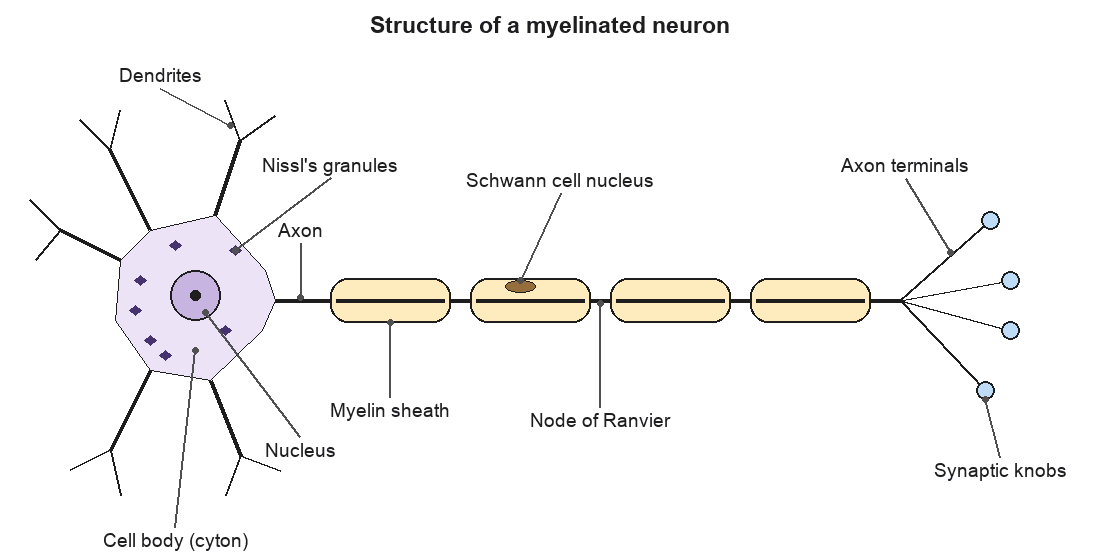
Therefore, a neuron consists of a cell body with Nissl's granules, branched dendrites and a long (often myelinated) axon ending in synaptic knobs.