
Question 815 marksMedium
Explain the fine structure of a striated muscle.
Confirming your payment
Sign up now and get 250 free tokens.
Structural Organisation in Animals: Animal Tissues · Question 81 of 89
Explain the fine structure of a striated muscle.
Solution:
Concept: a striated (skeletal) muscle is built in levels: muscle → bundles → muscle fibres → myofibrils → sarcomeres.
Step 1 — Muscle and bundles: a muscle is covered by connective tissue and made of bundles (fascicles) of muscle fibres lying parallel; it joins bones through tendons.
Step 2 — Muscle fibre: each fibre is a long, cylindrical, unbranched, multinucleate cell covered by the sarcolemma; its cytoplasm (sarcoplasm) has many mitochondria, glycogen and a network of sarcoplasmic reticulum, and its nuclei lie at the periphery.
Step 3 — Myofibrils: the fibre is packed with parallel myofibrils showing alternate dark A bands and light I bands; the bands of all myofibrils lie in line, giving the cross-striations.
Step 4 — Sarcomere: each I band is bisected by a Z line; the part between two Z lines is a sarcomere, the unit of contraction. The A band has a lighter H zone in its middle, crossed by the M line.
Step 5 — Filaments: thin actin filaments are attached to the Z lines and form the I band; thick myosin filaments with cross-bridges form the A band. In contraction actin slides over myosin, so the I bands and H zone shorten while the A band stays the same.
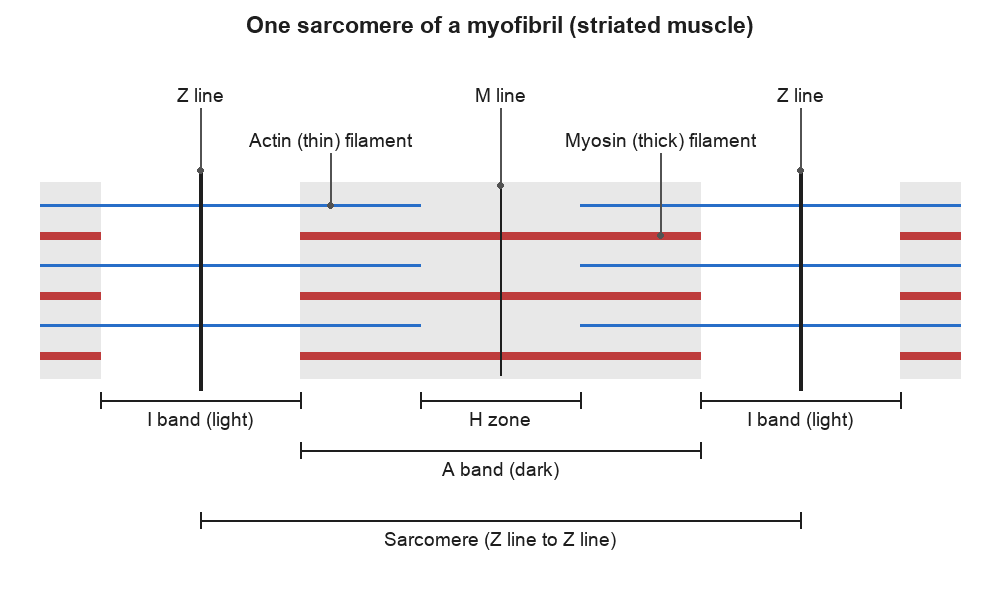
Therefore, a striated muscle is made of multinucleate fibres whose myofibrils are divided into sarcomeres of actin and myosin filaments.