Solution:
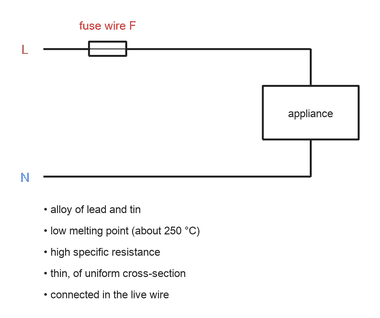
Concept: A fuse is a safety device that works on the heating effect of current. It is a short piece of thin wire of a tin–lead alloy, of high resistance and low melting point (about 250 °C), joined in series in the live wire. When the current goes above its current rating, it heats up, melts and breaks the circuit.
(a)
Step 1 — Fill the blanks.
A fuse is a short piece of wire of high resistance and of material of low melting point. The high resistance produces enough heat, and the low melting point lets it melt quickly.
(b)
Step 2 — Fill the blanks.
A fuse wire is made of an alloy of lead and tin. If the current in a circuit exceeds the current rating of the fuse wire, it melts. The alloy melts at about 250 °C, so the circuit breaks before the wiring overheats.
(c)
Step 3 — Fill the blanks.
A fuse is connected in series with the live wire. In series all the current passes through it, and in the live wire its melting cuts the appliance off from the high potential.
(d)
Step 4 — Fill the blank.
Higher the current rating, thicker is the fuse wire, because a thicker wire needs a larger current to reach its melting point.
(e)
Step 5 — Fill the blank.
Live wire is also called phase wire.
Therefore, the words are: (a) resistance, melting point; (b) lead, tin, melts; (c) series, live; (d) thicker; (e) phase.
