Answer: (D) assertion is true but reason is false
Concept: In an assertion–reason item, judge the assertion (A) and the reason (R) separately as true or false, and then decide whether R correctly explains A. By Joule's law the heat produced is H = I²Rt, so when the same current flows for the same time, the part with the higher resistance produces more heat.
Step 1 — Judge the assertion.
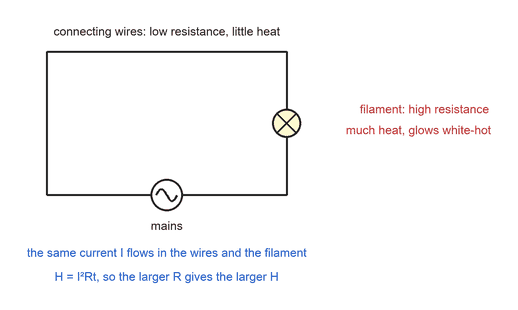
The connecting wires and the filament are in series, so the same current flows through both. Yet the filament becomes white-hot while the wires stay cool. So the assertion is true.
Step 2 — Judge the reason.
The filament (of tungsten) has a high resistance and a high melting point; it is not of low resistance. So the reason, as printed, is false.
Step 3 — Link the two.
In fact it is the filament's HIGH resistance that makes it produce much more heat than the low-resistance wires, so the true explanation is the opposite of the printed reason.
Why the other options are wrong:
- (A) both A and R are true and R is the correct explanation of A: this needs the reason to be true, but the filament has a high resistance, not a low one.
- (B) both A and R are True and R is not the correct explanation of A: this needs the reason to be true, but it is false.
- (C) assertion is false but reason is true: this says the assertion is false, but the same current does flow and the filament does get much hotter.
Therefore, the assertion is true but the reason is false, option (D).
