
Question 163 marksEasy
(a) At what voltage is the electric power from the generating station transmitted ? Give reason to your answer.
(b) What is the nature of current transmitted from the power station ?
Confirming your payment
Sign up now and get 250 free tokens.
Household Circuits · Question 16 of 73
(a) At what voltage is the electric power from the generating station transmitted ? Give reason to your answer.
(b) What is the nature of current transmitted from the power station ?
Solution:
Concept: For a given power P = VI, the current is I = P ÷ V, so a higher voltage means a smaller current. The heat wasted in line wires of resistance R in time t is H = I²Rt, so a smaller current wastes much less energy as heat.
(a)
Step 1 — State the transmission voltage.
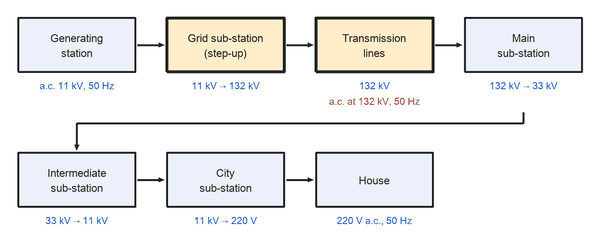
The power is stepped up at the grid sub-station and transmitted at 132 kV.
Step 2 — Give the reason.
For the same power, raising the voltage from 11 kV to 132 kV (12 times) makes the current 12 times smaller.
The heat lost in the line wires depends on the square of the current, so it becomes 144 times smaller. A high voltage therefore reduces the loss of energy as heat in the long transmission wires.
(b)
Step 3 — State the nature of the current.
The current transmitted is alternating current (a.c.) of frequency 50 Hz. Only an a.c. voltage can be stepped up and stepped down by transformers, so power is generated and transmitted as a.c.
Watch out: A high voltage does not mean a high current: for a given power, the higher the voltage, the SMALLER the current.
Therefore, (a) the power is transmitted at 132 kV, because a high voltage means a small current and so a small heat loss (I²Rt) in the line wires; (b) the current transmitted is a.c. (50 Hz).