
Question 311 markMCQEasy
An alloy of lead and tin is used as the material of the fuse wire because its melting point is .......... and specific resistance is ........... .
Confirming your payment
Sign up now and get 250 free tokens.
Household Circuits · Question 31 of 73
An alloy of lead and tin is used as the material of the fuse wire because its melting point is .......... and specific resistance is ........... .
(A) high, high
(B) low, high
(C) low, low
(D) high, low
Answer: (B) low, high
Concept: A fuse is a safety device that works on the heating effect of current. It is a short piece of thin wire of a tin–lead alloy, of high resistance and low melting point (about 250 °C), joined in series in the live wire. When the current goes above its current rating, it heats up, melts and breaks the circuit.
Step 1 — Choose the melting point.
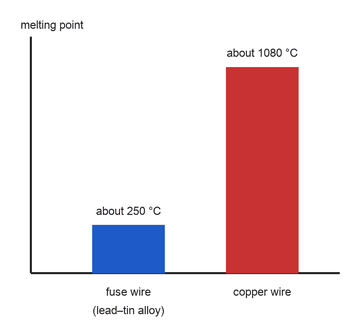
The wire must melt as soon as the current goes a little above its rating. So its melting point must be low: the tin–lead alloy melts at about 250 °C, while copper melts at about 1080 °C.
Step 2 — Choose the specific resistance.
A wire of high resistance produces more heat for the same current (H = I²Rt), so it reaches its melting point quickly. So its specific resistance must be high.
Why the other options are wrong:
Therefore, the alloy of lead and tin has a low melting point and a high specific resistance, option (B).