
Question 301 markMCQEasy
The rise in temperature of fuse wire depends upon :
Confirming your payment
Sign up now and get 250 free tokens.
Household Circuits · Question 30 of 73
The rise in temperature of fuse wire depends upon :
(A) current rating
(B) radius
(C) length of wire
(D) both (A) and (B)
Answer: (D) both (A) and (B)
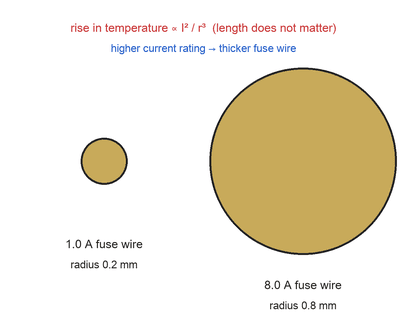
Concept: The rise in temperature of a fuse wire is directly proportional to the square of the current I and inversely proportional to the cube of its radius r, ΔT ∝ I² ÷ r³. It does not depend on the length of the wire.
Step 1 — Read the rule.
The rise in temperature depends on the current I that the wire is made to carry (its current rating) and on its radius r. The length does not appear in the rule.
Step 2 — Check it with the book's example.
A fuse wire of rating 1.0 A has radius 0.2 mm, and one of rating 8.0 A has radius 0.8 mm. Work out I² ÷ r³ for each wire.
The two values are equal, so both wires get equally hot at their own rated current.
Watch out: A longer fuse wire makes more heat but also has more surface to lose it, so its rise in temperature does not depend on the length.
Why the other options are wrong:
Therefore, the rise in temperature of a fuse wire depends on both the current rating and the radius r, option (D).