
Question 822 marksEasy
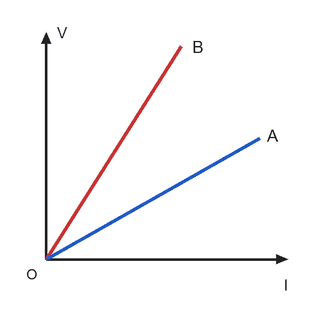
The - graph for a series combination and for a parallel combination of two resistors is shown in Fig. 8.41. Which of the two, A or B, represents the parallel combination ? Give a reason for your answer.
Confirming your payment
Sign up now and get 250 free tokens.
Current Electricity · Question 82 of 160
The - graph for a series combination and for a parallel combination of two resistors is shown in Fig. 8.41. Which of the two, A or B, represents the parallel combination ? Give a reason for your answer.
Solution:
Concept: On a V–I graph (p.d. V on the y-axis, current I on the x-axis), the slope V ÷ I of each line is its resistance R. For two resistors, the series combination has the larger resistance (R₁ + R₂, more than either) and the parallel combination the smaller (less than either).
Step 1 — Compare the slopes.
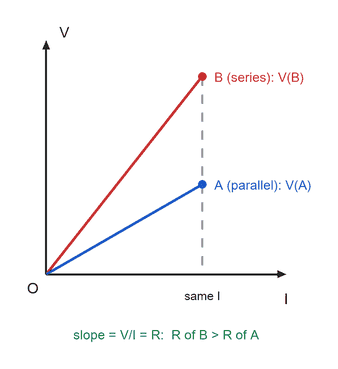
Line B is steeper than line A. So at the same current, B shows the larger p.d., which means B has the larger resistance and A the smaller.
Step 2 — Match the lines with the combinations.
The parallel combination has the smaller resistance, so it is the less steep line, A. The series combination, with the larger resistance, is line B.
Watch out: On a V–I graph the steeper line has MORE resistance; on an I–V graph it would be the other way round.
Therefore, line A represents the parallel combination, because it has the smaller slope (smaller resistance), and the equivalent resistance in parallel is less than in series.