
Question 835 marksEasy
Explain the meaning of the terms e.m.f., terminal voltage, and internal resistance of a cell.
Confirming your payment
Sign up now and get 250 free tokens.
Current Electricity · Question 83 of 160
Explain the meaning of the terms e.m.f., terminal voltage, and internal resistance of a cell.
Solution:
Concept: A cell does work on the charges that flow round a circuit. Part of this work is done outside the cell and part inside it, against the resistance of its electrolyte.
Step 1 — Meaning of e.m.f. (ε).
The e.m.f. (ε) of a cell is the work done per unit positive charge in taking it round the complete circuit, both outside the cell and through the electrolyte inside it. It equals the p.d. across the terminals of the cell when no current is drawn from it (open circuit). It depends only on the materials of the electrodes and the electrolyte, and it is measured in volt; for example, a Leclanché cell has an e.m.f. of 1.5 V.
Step 2 — Meaning of terminal voltage.
The terminal voltage (V) of a cell is the p.d. across its terminals when it is sending a current through an external circuit (closed circuit). It is the work done per unit positive charge in the circuit outside the cell only. It is measured in volt and is less than the e.m.f.
Step 3 — Meaning of internal resistance.
The internal resistance (r) of a cell is the resistance offered by the electrolyte inside the cell to the flow of current through it. It is measured in ohm. When a current I flows, a voltage Ir is used up inside the cell, which is why the terminal voltage is less than the e.m.f.
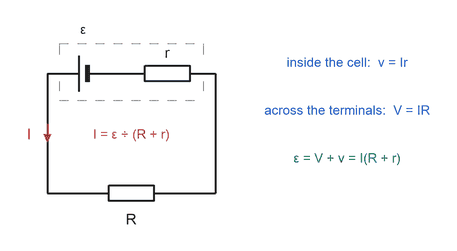
Watch out: The e.m.f. is not a force; it is the work done per unit charge, measured in volt.
Therefore, the e.m.f. is the terminal p.d. when no current is drawn, the terminal voltage is the terminal p.d. when current is drawn, and the internal resistance is the resistance of the electrolyte inside the cell, with ε = V + Ir.