
Question 943 marksEasy
You have three resistors of values 2 Ω, 3 Ω, and 5 Ω. How will you join them so that the total resistance is less than 1 Ω ? Draw a diagram and find the total resistance.
Confirming your payment
Sign up now and get 250 free tokens.
Current Electricity · Question 94 of 160
You have three resistors of values 2 Ω, 3 Ω, and 5 Ω. How will you join them so that the total resistance is less than 1 Ω ? Draw a diagram and find the total resistance.
Solution:
Concept: In parallel the p.d. is the same across each resistor, the currents add up (I = I₁ + I₂ + …), and the equivalent resistance is given by 1/R = 1/R₁ + 1/R₂ + …, less than the smallest one. For two resistors, R = R₁R₂ ÷ (R₁ + R₂).
Given: resistors of 2 Ω, 3 Ω and 5 Ω.
Step 1 — Choose the arrangement.
A parallel combination has a resistance less than the smallest resistor in it, so the lowest possible resistance comes from joining all three resistors in parallel.
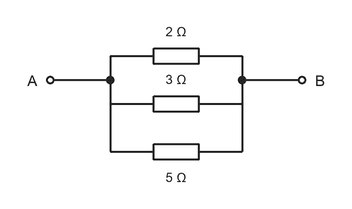
Step 2 — Add the reciprocals.
For the three resistors in parallel, the reciprocal of the total resistance is the sum of their reciprocals; the common denominator is 30.
Step 3 — Invert to get R.
Turn the fraction upside down to find R.
Step 4 — See that no other arrangement works.
Every other arrangement puts at least two of the resistors in series somewhere, which raises the total. Working them all out, the smallest is 1.6 Ω (3 Ω and 5 Ω in series, with the 2 Ω joined across them), which is already more than 1 Ω.
Watch out: Remember to invert 31/30; the answer is 30/31 Ω, which is less than 1 Ω.
Therefore, all three resistors are joined in parallel, and the total resistance is 30/31 Ω ≈ 0.97 Ω, which is less than 1 Ω.