
Question 933 marksEasy
Four resistors each of resistance 5 Ω are connected in parallel. What is the effective resistance ?
Confirming your payment
Sign up now and get 250 free tokens.
Current Electricity · Question 93 of 160
Four resistors each of resistance 5 Ω are connected in parallel. What is the effective resistance ?
Solution:
Concept: In parallel the p.d. is the same across each resistor, the currents add up (I = I₁ + I₂ + …), and the equivalent resistance is given by 1/R = 1/R₁ + 1/R₂ + …, less than the smallest one. For two resistors, R = R₁R₂ ÷ (R₁ + R₂).
Given: four resistors of 5 Ω each, in parallel.
Step 1 — Add the reciprocals.
All four 5 Ω resistors are in parallel, so the reciprocal of the effective resistance is the sum of the four reciprocals.
Step 2 — Invert to get R.
Turn the fraction upside down to find R itself.
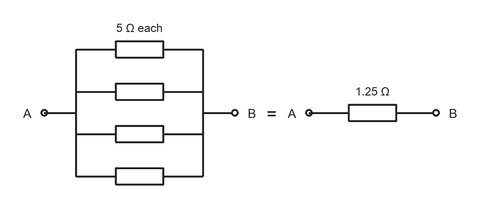
Step 3 — Notice the shortcut.
For n equal resistors, each of resistance R₀, in parallel, R = R₀ ÷ n; here 5 ÷ 4 gives the same 1.25 Ω.
Watch out: 1/R = 4/5 is not the answer; invert it to get R = 1.25 Ω.
Therefore, the effective resistance is 1.25 Ω.