Solution:
Concept: In parallel the p.d. is the same across each resistor, the currents add up (I = I₁ + I₂ + …), and the equivalent resistance is given by 1/R = 1/R₁ + 1/R₂ + …, less than the smallest one. For two resistors, R = R₁R₂ ÷ (R₁ + R₂). The power in each resistor is V² ÷ R, and the battery supplies the sum of the two.
Given: A = 4 Ω and B = 6 Ω in parallel; V = 6 V; battery resistance negligible.
(i)
Step 1 — Find the equivalent resistance.
For two resistors in parallel, R = R₁R₂ ÷ (R₁ + R₂).
R=4+64×6=1024=2.4 Ω
Step 2 — Find the power supplied by the battery.
The battery has negligible resistance, so the whole 6 V is across the combination, and P = V² ÷ R.
P=2.462=2.436=15 W
(ii)
Step 3 — Find the power in resistor A.
Each resistor has the full 6 V across it, so P = V² ÷ R for each.
PA=436=9 W
Step 4 — Find the power in resistor B.
We do the same for the 6 Ω resistor.
PB=636=6 W
Step 5 — Check the total.
The two powers should add up to the power supplied by the battery.
PA+PB=9+6=15 W
In parallel the smaller resistance takes the larger power.
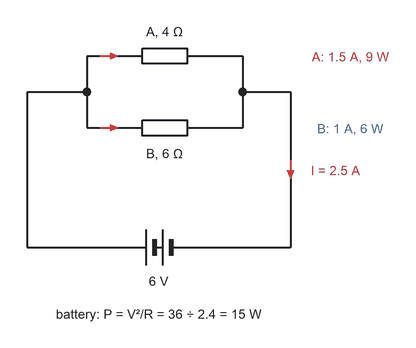
Watch out: In parallel the smaller resistance takes MORE power (P = V² ÷ R), the opposite of a series circuit.
Therefore, (i) the battery supplies 15 W, and (ii) the power dissipated is 9 W in A (4 Ω) and 6 W in B (6 Ω).

