Solution:
Concept: The e.m.f. ε of a cell is the p.d. across its terminals when it sends no current (open circuit). When it sends a current I through an external resistance R, a part Ir of the e.m.f. is used up inside the cell (internal resistance r), so the terminal voltage is V = ε − Ir, and ε = I(R + r). The battery supplies energy εIt; part of it is used in the bulb (I²Rt) and the rest is lost as heat inside the battery (I²rt).
Given: battery p.d. 4 V (taken as the e.m.f. ε), r = 2.5 Ω, I = 0.5 A, t = 10 min.
Step 1 — Decide what the 4 V is.
We take the 4 V as the e.m.f. ε of the battery, which is how the book's answers are worked (see the note below).
Step 2 — Change the time into seconds.
Ten minutes is 10 × 60 seconds.
t=10×60 s=600 s
(i)
Step 3 — Find the total energy supplied.
The battery supplies energy at the rate εI, so in time t it supplies εIt.
W=εIt=4×0.5×600=1200 J
(ii)
Step 4 — Find the total resistance.
Since ε = I(R + r), the total resistance of the circuit is ε ÷ I.
R+r=Iε=0.54=8 Ω
Step 5 — Find the resistance of the bulb.
We subtract the internal resistance from the total.
R=8−2.5=5.5 Ω
(iii)
Step 6 — Find the energy dissipated in the bulb.
We use Joule's law for the bulb alone.
Wbulb=I2Rt=0.52×5.5×600=825 J
Step 7 — Check the energy balance.
The energy lost inside the battery is I²rt, and the two parts must add up to the total supplied.
Winside=0.52×2.5×600=375 J
Wbulb+Winside=825+375=1200 J
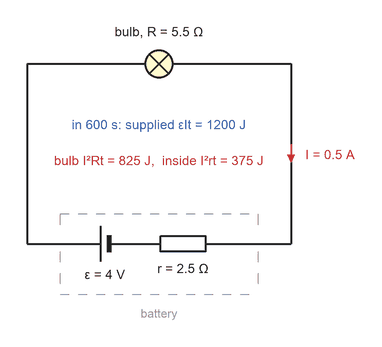
Watch out: The bulb does not get all the energy the battery supplies; part is lost in the internal resistance.
Note: if the 4 V were read as the terminal p.d. across the bulb, the bulb would be 4 ÷ 0.5 = 8 Ω, it would take 1200 J, and the battery would supply 1200 J + 375 J = 1575 J; the book's answers use the e.m.f. reading given here.
Therefore, (i) the battery supplies 1200 J in 10 minutes, (ii) the resistance of the bulb is 5.5 Ω, and (iii) the energy dissipated in the bulb is 825 J.
