
Question 973 marksEasy
A combination consists of three resistors in series. Four similar sets are connected in parallel.
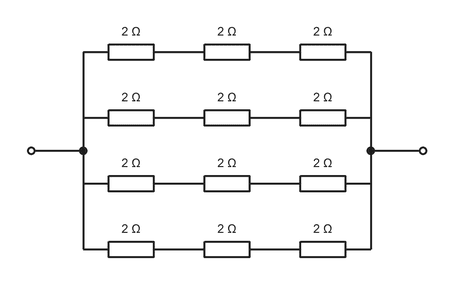
If the resistance of each resistor is 2 ohm, find the resistance of the combination.
Confirming your payment
Sign up now and get 250 free tokens.
Current Electricity · Question 97 of 160
A combination consists of three resistors in series. Four similar sets are connected in parallel.
If the resistance of each resistor is 2 ohm, find the resistance of the combination.
Solution:
Concept: In series the same current flows through each resistor, the p.d.s add up (V = V₁ + V₂ + …), and the equivalent resistance is R = R₁ + R₂ + …, more than the largest one. In parallel the p.d. is the same across each resistor, the currents add up (I = I₁ + I₂ + …), and the equivalent resistance is given by 1/R = 1/R₁ + 1/R₂ + …, less than the smallest one. For two resistors, R = R₁R₂ ÷ (R₁ + R₂).
Given: each resistor = 2 Ω; 3 in series in a set; 4 sets in parallel.
Step 1 — Find the resistance of one set.
Each set has three 2 Ω resistors in series, so their resistances add.
Step 2 — Combine the four sets.
The four sets, each of 6 Ω, are joined in parallel, so the reciprocals add.
Step 3 — Invert to get R.
Turn the fraction upside down to find R.

Watch out: Work out one set first (series), then combine the sets (parallel); the order matters.
Therefore, the resistance of the combination is 1.5 Ω.