
Question 963 marksEasy
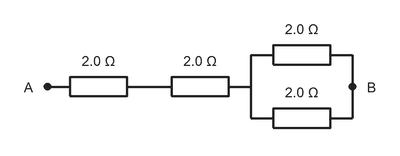
Calculate the equivalent resistance between the points A and B in Fig. 8.44 if each resistance is 2.0 Ω.
Confirming your payment
Sign up now and get 250 free tokens.
Current Electricity · Question 96 of 160
Calculate the equivalent resistance between the points A and B in Fig. 8.44 if each resistance is 2.0 Ω.
Solution:
Concept: In series the same current flows through each resistor, the p.d.s add up (V = V₁ + V₂ + …), and the equivalent resistance is R = R₁ + R₂ + …, more than the largest one. In parallel the p.d. is the same across each resistor, the currents add up (I = I₁ + I₂ + …), and the equivalent resistance is given by 1/R = 1/R₁ + 1/R₂ + …, less than the smallest one. For two resistors, R = R₁R₂ ÷ (R₁ + R₂).
Given: each resistance = 2.0 Ω.
Step 1 — Read the network.
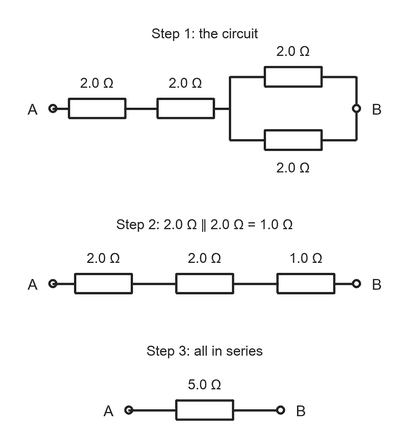
From A, two 2.0 Ω resistors are joined end to end, and then two 2.0 Ω resistors are joined side by side between the same two points before B. So the last two are in parallel, and that pair is in series with the first two.
Step 2 — Combine the parallel pair.
The two 2.0 Ω resistors in parallel give product ÷ sum.
Step 3 — Add everything in series.
The two 2.0 Ω resistors and the 1.0 Ω of the pair now carry the same current, so they are in series and add.
Watch out: Reduce the parallel pair first; do not add all four resistors (8.0 Ω).
Therefore, the equivalent resistance between A and B is 5.0 Ω.