
Question 51 markMCQEasy
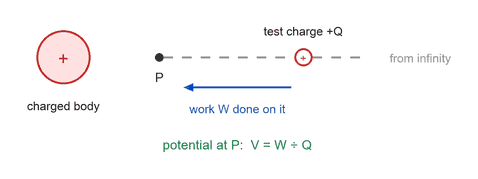
If W joule of work is done in bringing a test charge Q coulomb from infinity to the point P, then electric potential V at point P is :
Confirming your payment
Sign up now and get 250 free tokens.
Current Electricity · Question 5 of 160
If W joule of work is done in bringing a test charge Q coulomb from infinity to the point P, then electric potential V at point P is :
(A) V = W Q
(B) V = Q/W
(C) V = W/Q
(D) none of the above
Answer: (C) V = W/Q
Concept: The electric potential at a point is the work done per unit positive charge in bringing a test charge from infinity to that point, V = W ÷ Q. Its S.I. unit is the volt (1 volt is 1 joule per coulomb).
Step 1 — Find the work done on each coulomb.
W joule of work is done on Q coulomb of charge, so the work done on each unit of charge is W divided by Q.
Step 2 — Write the potential.
By definition, this work per unit charge is the potential at P.
Step 3 — Check the unit.
The unit of W ÷ Q is joule per coulomb (J C⁻¹), which is the volt, the unit of potential.
Watch out: Potential is work PER UNIT charge, so the charge goes in the denominator.
Why the other options are wrong:
Therefore, the potential at P is V = W/Q, option (C).