
Question 41 markMCQEasy
If electrons pass through a cross-section of a conductor in time , then current in conductor is :
Confirming your payment
Sign up now and get 250 free tokens.
Current Electricity · Question 4 of 160
If electrons pass through a cross-section of a conductor in time , then current in conductor is :
(A)
(B)
(C)
(D)
Answer: (A)
Concept: Current is the rate of flow of charge: I = Q ÷ t. Its S.I. unit is the ampere (1 ampere is 1 coulomb per second), and n is a pure number while e is a charge in coulomb.
Step 1 — Find the total charge.
Each electron carries a charge e, so n electrons together carry n times that charge.
Step 2 — Divide by the time.
This charge crosses the section in time t, and current is charge per unit time.
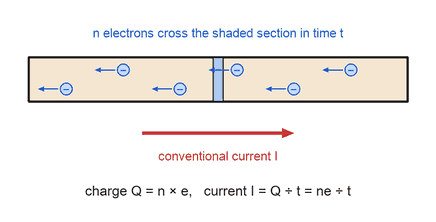
Step 3 — Check the unit.
Here n is a pure number, e is in coulomb and t is in second, so ne ÷ t comes out in C s⁻¹, which is the ampere, as a current must.
Watch out: Current is charge DIVIDED by time; multiplying by t or dividing by e gives the wrong unit.
Why the other options are wrong:
Therefore, the current in the conductor is I = ne/t, option (A).